Exploratory Data Analysis Ma Maneesh Agrawala CS 448B: - - PDF document

exploratory data analysis
SMART_READER_LITE
LIVE PREVIEW

Exploratory Data Analysis Ma Maneesh Agrawala CS 448B: - - PDF document

Exploratory Data Analysis Ma Maneesh Agrawala CS 448B: Visualization Fall 2020 1 A2: Exploratory Data Analysis Use Tableau to formulate & answer questions First steps Step 1: Pick domain & data Step 2: Pose questions Step 3:


slide-1
SLIDE 1

1

Exploratory Data Analysis

Ma Maneesh Agrawala

CS 448B: Visualization Fall 2020

1

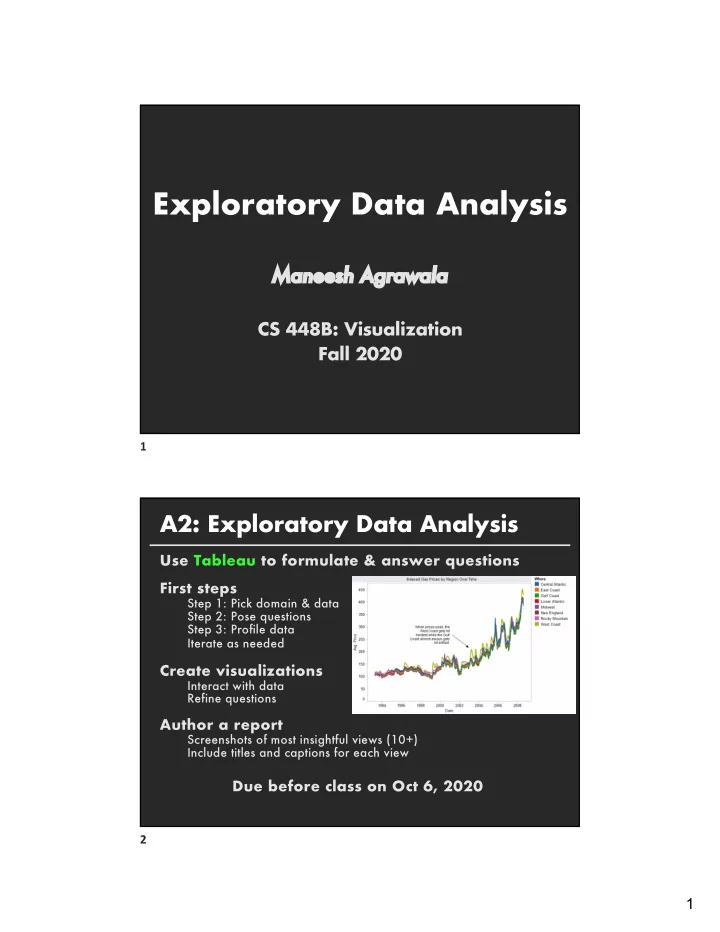
A2: Exploratory Data Analysis

Use Tableau to formulate & answer questions First steps

Step 1: Pick domain & data Step 2: Pose questions Step 3: Profile data Iterate as needed

Create visualizations

Interact with data Refine questions

Author a report

Screenshots of most insightful views (10+) Include titles and captions for each view

Due before class on Oct 6, 2020

2

slide-2
SLIDE 2

2

Exploratory Data Analysis

3

The Rise of Statistics (1900-1950s)

Rise of formal methods in statistics and social science — Fisher, Pearson, … Little innovation in graphical methods A period of application and popularization Graphical methods enter textbooks, curricula, and mainstream use

4

slide-3
SLIDE 3

3

5

Four major influences act on data analysis today:

  • 1. Formal theories of statistics
  • 2. Accelerating developments in

computers and display devices

  • 3. More and larger bodies of data
  • 4. Emphasis on quantification in

many disciplines

The Future of Data Analysis, John W. Tukey 1962

6

slide-4
SLIDE 4

4

The last few decades have seen the rise of formal theories of statistics, "legitimizing" variation by confining it by assumption to random sampling,

  • ften assumed to involve tightly

specified distributions, and restoring the appearance of security by emphasizing narrowly optimized techniques and claiming to make statements with "known" probabilities

  • f error.

The Future of Data Analysis, John W. Tukey 1962

7

While some of the influences of statistical theory on data analysis have been helpful, others have not.

The Future of Data Analysis, John W. Tukey 1962

8

slide-5
SLIDE 5

5

Exposure, the effective laying open

  • f the data to display the

unanticipated, is to us a major portion of data analysis. Formal statistics has given almost no guidance to exposure; indeed, it is not clear how the informality and flexibility appropriate to the exploratory character of exposure can be fitted into any of the structures of formal statistics so far proposed.

The Future of Data Analysis, John W. Tukey 1962

9

Nothing - not the careful logic of mathematics, not statistical models and theories, not the awesome arithmetic power of modern computers - nothing can substitute here for the flexibility of the informed human mind. Accordingly, both approaches and techniques need to be structured so as to facilitate human involvement and intervention.

The Future of Data Analysis, John W. Tukey 1962

10

slide-6
SLIDE 6

6

Topics

Data Wrangling Effectiveness of antibiotics Intro to Tableau

13

Data Wrangling

14

slide-7
SLIDE 7

7

15 16

slide-8
SLIDE 8

8

Data “Wrangling”

One often needs to manipulate data prior to

  • analysis. Tasks include reformatting,

cleaning, quality assessment, and integration Some approaches:

Writing custom scripts Manual manipulation in spreadsheets Trifacta Wrangler: http://trifacta.com/products/wrangler/ Open Refine: http://openrefine.org

17

How to gauge the quality of a visualization?

“The first sign that a visualization is good is that it shows you a problem in your data… …every successful visualization that I've been involved with has had this stage where you realize, "Oh my God, this data is not what I thought it would be!" So already, you've discovered something.”

  • Martin Wattenberg

18

slide-9
SLIDE 9

9

19

Node-link

21

slide-10
SLIDE 10

10

Matrix

22

Matrix

23

slide-11
SLIDE 11

11

Visualize Friends by School?

Berkeley ||||||||||||||||||||||||||||||| Cornell |||| Harvard ||||||||| Harvard University ||||||| Stanford |||||||||||||||||||| Stanford University |||||||||| UC Berkeley ||||||||||||||||||||| UC Davis ||||||||||

  • Univ. of California at Berkeley |||||||||||||||
  • Univ. of California, Berkeley

||||||||||||||||||

  • Univ. of California, Davis

|||

24

Data Quality Hurdles

Missing Data

no measurements, redacted, …?

Erroneous Values

misspelling, outliers, …?

Type Conversion

e.g., zip code to lat-lon

Entity Resolution

  • diff. values for the same thing?

Data Integration

effort/errors when combining data

LE LESSON: Anticipate problems with your data. Many research problems around these issues!

25

slide-12
SLIDE 12

12

Analysis Example: Effectiveness of Antibiotics

35

Antibiotic Effectiveness: The Data

Genus of Bacteria String Species of Bacteria String Antibiotic Applied String Gram-Staining Pos / Neg

  • Min. Inhibitory Concent. (g)

Number Collected prior to 1951

36

slide-13
SLIDE 13

13

What questions might we ask?

37

Will Burtin, 1951

How do the drugs compare?

38

slide-14
SLIDE 14

14

Will Burtin, 1951

Radius: 1/log(MIC) Bar Color: Antibiotic Background Color: Gram Staining 39

Do bacteria group by antibiotic resistance?

Not a streptococcus! (realized ~30 yrs later) Really a streptococcus! (realized ~20 yrs later)

Wainer & Lysen American Scientist, 2009

40

slide-15
SLIDE 15

15

How do the bacteria group w.r.t. resistance? Do different drugs correlate?

Wainer & Lysen American Scientist, 2009

41

Lessons

Exploratory Process 1 Construct graphics to address questions 2 Inspect “answer” and assess new questions 3 Repeat! Transform the data appropriately (e.g., invert, log) “Show data variation, not design variation”

  • Tufte

42

slide-16
SLIDE 16

16

Tableau / Polaris

77

Tableau

Research at Stanford: “Polaris” by Stolte, Tang & Hanrahan. 78

slide-17
SLIDE 17

17

Tableau

Data Display Data Model Encodings

79

Polaris/Tableau Approach

Insight: simultaneously specify both database queries and visualization Choose data, then visualization, not vice versa Use smart defaults for visual encodings Can also suggest more encodings upon request (ShowMe – Like APT)

80

slide-18
SLIDE 18

18

Dataset

I

Federal Elections Commission Receipts

I

Every Congressional Candidate from 1996 to 2002

I

4 Election Cycles

I

9216 Candidacies

81

Data Set Schema

I Year (Qi) I Candidate Code (N) I Candidate Name (N) I Incumbent / Challenger / Open-Seat (N) I Party Code (N) [1=Dem,2=Rep,3=Other] I Party Name (N) I Total Receipts (Qr) I State (N) I District (N)

I

This is a subset of the larger data set available from the FEC, but should be sufficient for the demo

82

slide-19
SLIDE 19

19

Hypotheses?

What might we learn from this data?

83

Hypotheses?

What might we learn from this data?

I

Have receipts increased over time?

I

Do democrats or republicans spend more?

I

Candidates from which state spend the most money?

Tableau Demo

84

slide-20
SLIDE 20

20

Specifying Table Configurations

Operands are names of database fields

Each operand interpreted as a set {…} Data is either O or Q and treated differently

Three operators:

concatenation (+) cross product (x) nest (/)

85 86

slide-21
SLIDE 21

21

87 88

slide-22
SLIDE 22

22

89 90

slide-23
SLIDE 23

23

91