Exercise sheet 4 Patrick Loiseau, Paul de Kerret Game Theory, Fall - - PDF document

exercise sheet 4
SMART_READER_LITE
LIVE PREVIEW

Exercise sheet 4 Patrick Loiseau, Paul de Kerret Game Theory, Fall - - PDF document

Exercise sheet 4 Patrick Loiseau, Paul de Kerret Game Theory, Fall 2016 Exercise 1 1. Find all pure strategies and mixed strategies Nash equilibria of the following two-players game: a b 2 , 1 0 , 0 A 1 , 0 0 , 2 B Answer: Two pure


slide-1
SLIDE 1

Exercise sheet 4

Patrick Loiseau, Paul de Kerret Game Theory, Fall 2016

Exercise 1

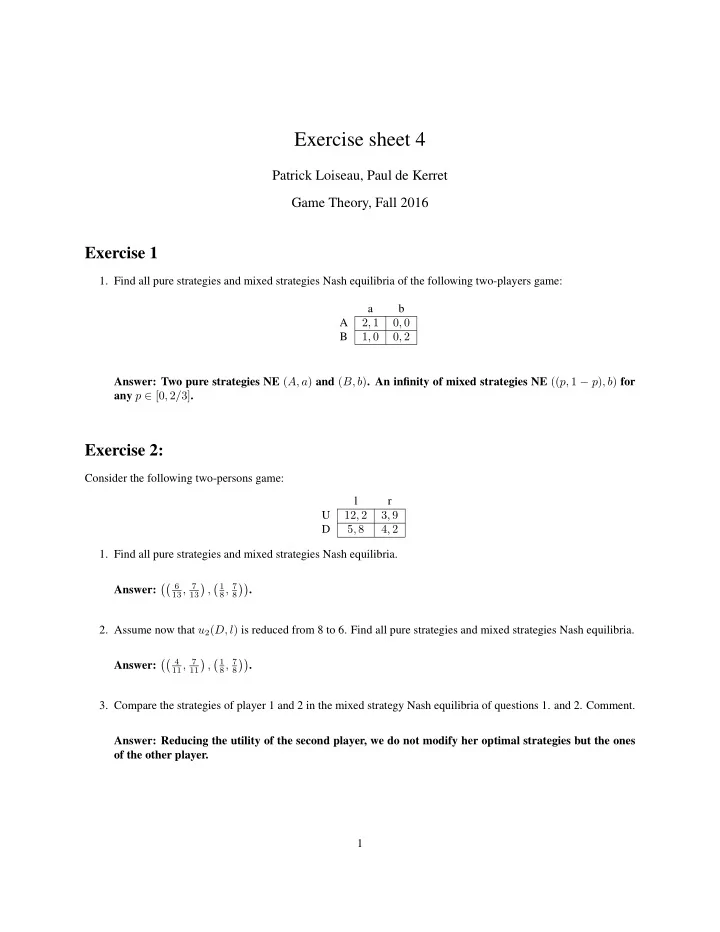
  • 1. Find all pure strategies and mixed strategies Nash equilibria of the following two-players game:

a b A 2, 1 0, 0 B 1, 0 0, 2 Answer: Two pure strategies NE (A, a) and (B, b). An infinity of mixed strategies NE ((p, 1 − p), b) for any p ∈ [0, 2/3].

Exercise 2:

Consider the following two-persons game: l r U 12, 2 3, 9 D 5, 8 4, 2

  • 1. Find all pure strategies and mixed strategies Nash equilibria.

Answer: 6

13, 7 13

  • ,

1

8, 7 8

  • .
  • 2. Assume now that u2(D, l) is reduced from 8 to 6. Find all pure strategies and mixed strategies Nash equilibria.

Answer: 4

11, 7 11

  • ,

1

8, 7 8

  • .
  • 3. Compare the strategies of player 1 and 2 in the mixed strategy Nash equilibria of questions 1. and 2. Comment.

Answer: Reducing the utility of the second player, we do not modify her optimal strategies but the ones

  • f the other player.

1

slide-2
SLIDE 2

Exercise 3:

Suppose that player 1’s car is not working properly: it lacks power. He does not know whether it needs a small engine cleaning or a major repair (say, a new engine). The probability that it needs a new laser is ρ. At his local garage, he finds that a new engine costs L, while a cleaning costs C (L > C). He knows that the expert at the garage, player 2, gets the same profit π, if she charges him for a new engine and indeed fixes the engine, or if she charges him for a cleaning and indeed just cleans it. But she can make more profit, Π > π if she charges him for a new engine but in fact (secretly) just cleans it. If it only needed a cleaning anyway, then she will get away with this, but she knows she will get sent to jail if she only cleans it when it needed a new engine. The expert is very good at her job, so she knows which is needed.

  • 1. Explain why player 1 should always believe player 2 when she says it just needs a cleaning but why he might

be skeptical if she says it needs a new laser. Answer: No game yet. If needs engine, player 2 will say so. Player 1 can reject the local expert’s advice and get a second opinion from a consultant who never lies. Assume however that, if he does so, he must accept the second expert’s advice and accept new repair costs L′ > L or C′ > C. The game is then: Honesty Dishonesty Always accept advice −ρL − (1 − ρ)C, π −L, ρπ + (1 − ρ)Π Reject if told ’new engine’ −ρL′ − (1 − ρ)C, (1 − ρ)π −ρL′ − (1 − ρ)C′, 0

  • 2. Explain the terms in the payoff matrix.
  • 3. Assume that L > ρL′ + (1 − ρ)C′. Is there a pure strategy Nash equilibrium?

Answer: No.

  • 4. Find the mixed strategy Nash equilibrium (as a function of the parameters).

Answer: p = π

Π and q = L−ρL′−(1−ρ)C′ L−ρL−(1−ρ)C′

  • 5. As we increase the cost of repair at the local garage L, what happens to the equilibrium probability that the

expert chooses ’honest’? What happens to the equilibrium probability that player 1 chooses ’Reject if told ’new engine”? Comment. Answer: When we increase L, q increases as well, while p is not affected by L.

  • 6. As we increase the profit from lying Π, what happens to the equilibrium probability that the expert chooses

’honest’? What happens to the equilibrium probability that player 1 chooses ’Reject if told ’new engine”? Comment. Answer: When we increase Π, q is not affected, while p decreases. 2

slide-3
SLIDE 3
  • 7. It has been said that, in America, when people go to the doctor, they never think they have a cold: they think

they have ‘mono’. Assuming this is true, why might we expect doctors in America often to act dishonestly? [Hint: think about how the parameter ρ affects the equilibrium in the above model]. Answer: ρ does not affect p, but q. When we assume ρ bigger, we think that 2 will act honestly, so we are more incentivated to accept. 3