Example title for notes and 14 March 2012 handouts Treatment of - - PDF document

example title for notes and 14 march 2012 handouts
SMART_READER_LITE
LIVE PREVIEW

Example title for notes and 14 March 2012 handouts Treatment of - - PDF document

Example title for notes and 14 March 2012 handouts Treatment of chronic stuttering: Benefits and Once a stutterer always a stutterer? challenges Susan Block La Trobe University, Melbourne, Australia Block ECSF 2012 Onslow & Langevin


slide-1
SLIDE 1

Example title for notes and handouts 14 March 2012 Example footer for notes and handouts 1

Susan Block La Trobe University, Melbourne, Australia

Treatment of chronic stuttering: Benefits and challenges

Block ECSF 2012

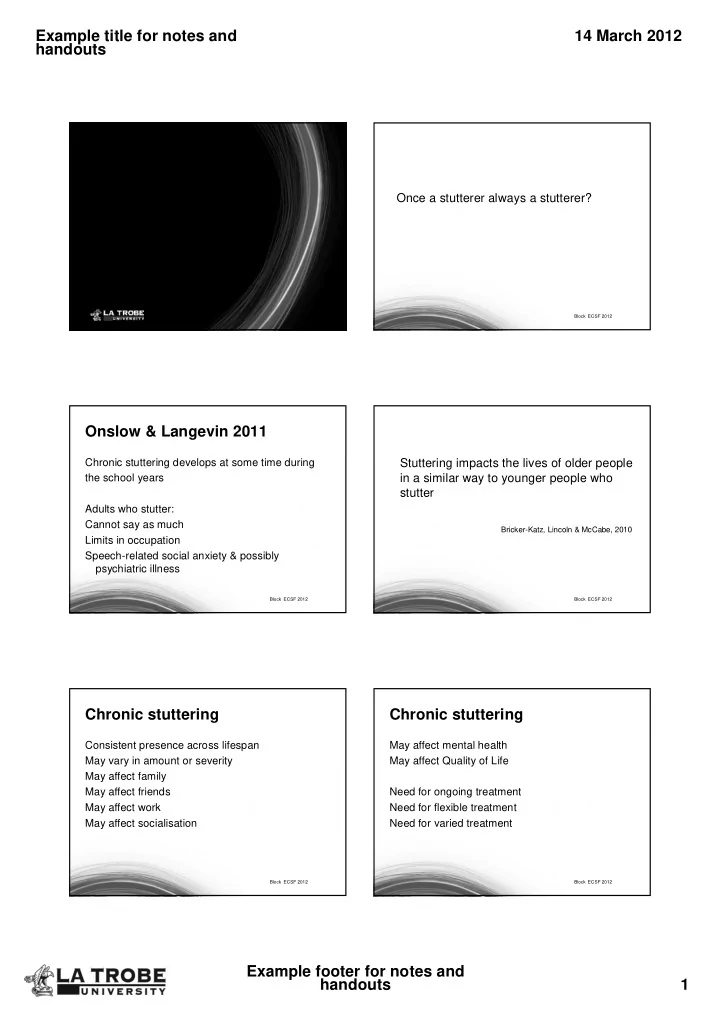
Once a stutterer always a stutterer?

Block ECSF 2012

Onslow & Langevin 2011

Chronic stuttering develops at some time during the school years Adults who stutter: Cannot say as much Limits in occupation Speech-related social anxiety & possibly psychiatric illness

Block ECSF 2012

Stuttering impacts the lives of older people in a similar way to younger people who stutter

Bricker-Katz, Lincoln & McCabe, 2010

Block ECSF 2012

Chronic stuttering

Consistent presence across lifespan May vary in amount or severity May affect family May affect friends May affect work May affect socialisation

Block ECSF 2012

Chronic stuttering

May affect mental health May affect Quality of Life Need for ongoing treatment Need for flexible treatment Need for varied treatment

slide-2
SLIDE 2

Example title for notes and handouts 14 March 2012 Example footer for notes and handouts 2

Block ECSF 2012

Considerations in treatment

Speech issues – motor control Psychological issues

Block ECSF 2012

Speech issues – motor control

Fluency strategies Evidence: Prolonged/Smooth speech Intensive Camperdown Program/telehealth Naturalness Ease of use Sufficient treatment

Block ECSF 2012

Psychological issues

Anticipation thinking stuttering vs process Anxiety Other mental health issues UTBAS Evidence: CBT

Block ECSF 2012

Other impact

Concerns re employment Concerns re socialisation Concerns re children General participation: ICF

Block ECSF 2012

Essentials

Appropriate treatment: Goals? Sufficient treatment Varied treatment Extending treatment - flexibility Enhancing maintenance Managing relapse

Block ECSF 2012

Essentials

Self management Self evaluation Attitude to communication Locus of control Communication/Social skills Dual tasking

slide-3
SLIDE 3

Example title for notes and handouts 14 March 2012 Example footer for notes and handouts 3

Block ECSF 2012

…”one of the things that bothered me most after 2/12 or so

  • f fluent speech after intensive therapy was that I was

fluent, but there was so much more to conversation than the social interaction skills I knew of.”

Cream et al, 2003

Block ECSF 2012

Challenges

  • Treatment experience
  • Continue to feel different
  • Need to dual task
  • Treatment does not eliminate stuttering: fluency

has a price

Block ECSF 2012

Challenges

  • Student delivered treatment
  • Poorly educated clinicians
  • Self help groups
  • Lack of access to treatment

Block ECSF 2012

Maximum benefits when:

Strategic approach to

  • Stuttered speech
  • Communication strategies

Cream et al, 2003

Block ECSF 2012

Clinicans: Important factors

Knowledge and experience Clinical experience Passion about stuttering On board for the entire journey Mentors Marriage research, treatment and student education

Block ECSF 2012

Benefits

Adults who stutter

Increased fluency Knowledge about speech Increased well-being Increased participation Positive about treatment

slide-4
SLIDE 4

Example title for notes and handouts 14 March 2012 Example footer for notes and handouts 4

Block ECSF 2012

Benefits

Speech Pathologists/clinicians

Working with motivated adults Empowering adults Using wide range of clinical repertoire Flexibility Evidence based effective treatment

Block ECSF 2012

Older adults would like effective, individual, and short-term treatment with speech–language pathologists who are knowledgeable about stuttering and sensitive to their emotional needs.

Bricker-Katz, Lincoln & McCabe, 2010

Block ECSF 2012