Exam Format and Notes: Electrodynamics PHYS30441 Time: 1 hours - - PowerPoint PPT Presentation

exam format and notes electrodynamics phys30441
SMART_READER_LITE
LIVE PREVIEW

Exam Format and Notes: Electrodynamics PHYS30441 Time: 1 hours - - PowerPoint PPT Presentation

Exam Format and Notes: Electrodynamics PHYS30441 Time: 1 hours Paper consists of 4 questions Answer question 1 and 2 others Question 1 is multi-part and covers the whole course Question 2 is on Statics . Question 3 is on


slide-1
SLIDE 1
slide-2
SLIDE 2

Exam Format and Notes: Electrodynamics PHYS30441

  • Time: 1 ½ hours
  • Paper consists of 4 questions
  • Answer question 1 and 2 others
  • Question 1 is multi-part and covers the whole course
  • Question 2 is on Statics.
  • Question 3 is on Radiation from moving charges or Hertzian Dipole
  • Question 4 is on Relativity
  • There will be a formula sheet in the exam paper.

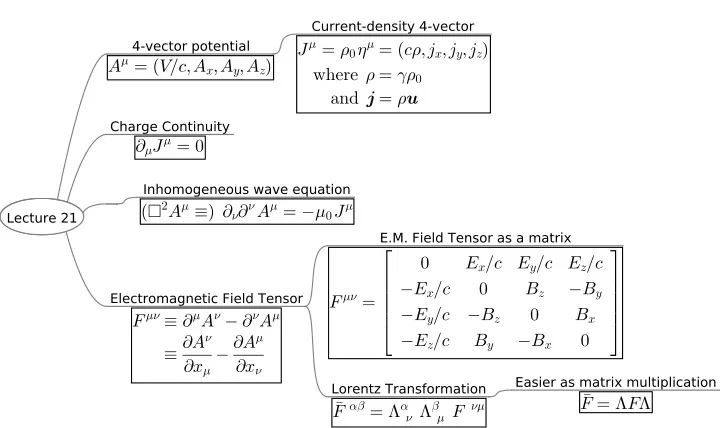
This will include: Legendre polynomials (if needed); Differential operators (i.e. grad, curl, divergence) for different coordinate systems (if needed); L.W. fields and potentials (if needed); EM field tensor and Lorentz transformation matrix (if needed). Difficult integrals (if needed).

slide-3
SLIDE 3

Summary of Essential E.M. Formulae

Gauss' law and Poisson's equation: R ~ D d2~ r = R d3r = q; r2V = ="; and solution: V =

1 4"

R

(r0) j~ r~ r0jd3r0

Also, r2 ~ A = 0 ~ J; with a solution: ~ A = 0

4

R

~ J(r0) j~ r~ r0jd3r0

Biot-Savart law: ~ B = 0

4

R dl0(~

r~ r0) j~ r~ r0j3

d ! l 0 = 0I

4

R dl0(~

r~ r0) j~ r~ r0j3

(dl' lies along the current source) Maxwell's equations (ME): r ~ E = @

@t ~

H; r ~ H = ~ J + @

@t ~

D In media: ~ D = " ~ E = "0(1 + e) ~ E; ~ B = 0 (1 + m) ~ H From ME: r ~ E = ="; r ~ B = 0; r ~ J = @

@t (continuity equation)

Lorentz force: ~ F = q

  • ~

E + ~ v ~ B

  • Scalar and vector potentials:

~ B = r ~ A; ~ E = rV @

@t ~

A Coulomb gauge: r: ~ A = 0 Lorentz gauge: r:A = 1

c2 @ @tV

Inhomogeneous wave equation:

  • r2 1

c2 @2 @t2

  • V = =";
  • r2 1

c2 @2 @t2

  • ~

A = ~ J Vector relations: r:

  • r ~

A

  • = 0; If r ~

E = 0 ) ~ E = rV; r r ~ A = r

  • r: ~

A

  • r2 ~

A; r ^ r = 2

r; r ~

r = 3; rrn = nrn2~ r;

  • for example: rr = ^

r; r 1

r = ~ r r3 = ^ r r2

  • Dirac delta:

(f (x)) = P

i 1 jd f=dxj x=xi (x xi) ; e.g. (ax) = 1 jaj (x) ;

r2

r 1

j~

r~ r0j = 1 4 (~

r ~ r0) ; r ^

r r2

  • = 43 (r)

Multipole expansion: V (~ r) =

1 4"

P1

n=0 1 rn+1

R (r0)n Pn

  • cos 0

(~ r0) d3r0 =

1 4"

h

1 r

R (~ r0) d3r0 + 1

r2

R r0 cos 0 (~ r0) d3r0 + 1

r3

R (r0)2 3

2 cos2 0 1 2

  • (~

r0) d3r0 + :: i 1

slide-4
SLIDE 4 Essen tial F
  • rm
ulae (Con tin ued) Solution to Lapla e equation in spheri al p
  • lar
  • rdinates:

V (r, θ) =

  • l=0
  • Alrl + Bl

rl+1

  • Pl(cos θ)
Larmor form ula:

P = µ0q2a2 6πc

1
slide-5
SLIDE 5

“The secret to creativity is knowing how to hide your sources.” Einstein. “If I have seen further it is by standing on ye sholders of Giants” Newton