Evolving role of the Regional Cooperation Council As a new, - - PDF document

evolving role of the regional cooperation council
SMART_READER_LITE
LIVE PREVIEW

Evolving role of the Regional Cooperation Council As a new, - - PDF document

Improving Cooperation in South-East Europe by Action for Strengthening the Regional Cooperation Council Sarajevo, 16 March 2012 Kick-off meeting Jelica Mini Deputy Secretary General of the RCC Evolving role of the Regional Cooperation


slide-1
SLIDE 1

Jelica Minić Deputy Secretary General of the RCC

Improving Cooperation in South-East Europe by Action for Strengthening the Regional Cooperation Council Sarajevo, 16 March 2012

Kick-off meeting

Evolving role of the Regional Cooperation Council

  • As a new, regionally owned organisation the RCC represents the region,

supports and initiates regional cooperation - 13 SEE beneficiaries

  • The RCC operates under the political umbrella of the South East Europe

Cooperation Process (SEECP). Its objectives, working methods and priority areas for action are defined by the Statute and other documents adopted at Annual Meetings and endorsed by SEECP Summits.

  • As the main focal point for regional cooperation, the RCC:

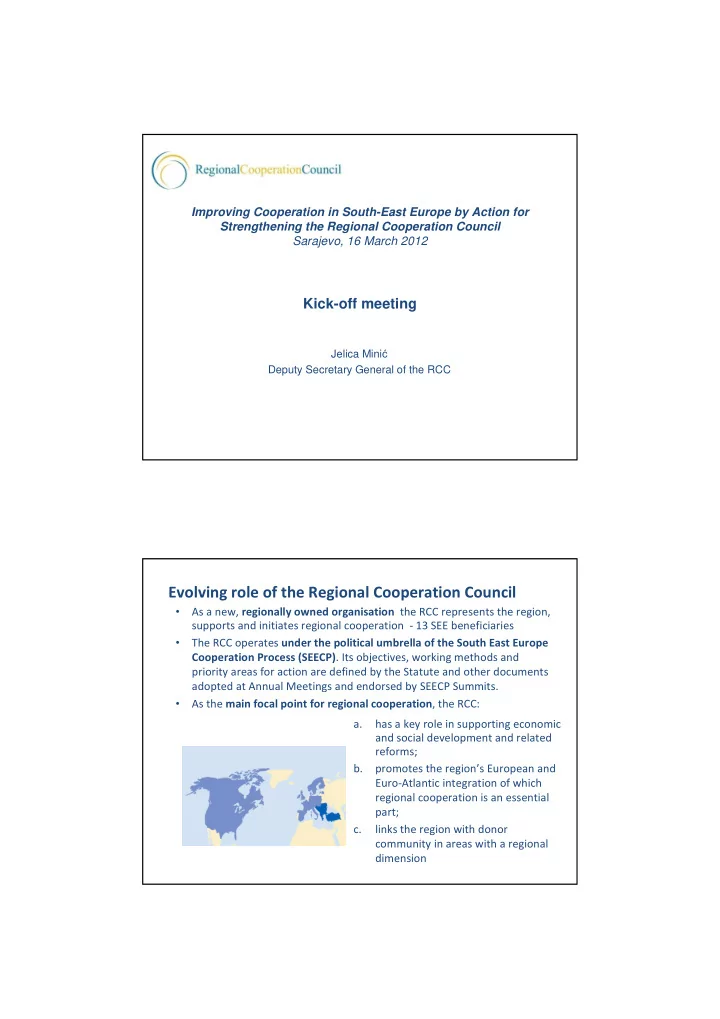
a. has a key role in supporting economic and social development and related reforms; b. promotes the region’s European and Euro-Atlantic integration of which regional cooperation is an essential part; c. links the region with donor community in areas with a regional dimension

slide-2
SLIDE 2

Main achievements of the RCC Secretariat in 2011 - horizontal activities Assist SEECP

  • contribution to different activities in the SEECP framework, in

particular in preparing a number of sectorial meetings organized

  • r to be organized by the SEECP C-i-Os and related to the RCC

Strategy and Work Programme 2011-2013.

  • consultations held with the high-level representatives of the

SEECP Monitored and streamlined regional activities

  • targeted informing
  • periodical stock taking (RCC Annual Reports, Survey of RI&TFs,

March 2011)

  • jointly planed and performed different activities
  • managing, monitoring and/or steering role in different bodies or

projects of other regional initiatives (CEFTA, eSEE, CeGD, SEETO, RENA, REC, ICAM/RBM, PPII/ADP, UNECE CSE, ISRBC, NALAS, RAI, SELEC, SEEPAG, MARRI, SEPCA, SEDM, SEEC – Forum for Western Balkans Defense Cooperation, US-Adriatic Charter (A5), SEESAC, DPPI, GTF, SEECEL, RESPA, ERI SEE, RCC TF CS, RCC TF BHC, CPF, RSPC etc.)

  • regular bilateral meetings and consultations with a number of

well-established RI&TFs, or emerging partners of the RCC SEE Public Private Partnership Network, Regional Network of Investment Promotion Agencies etc.)

slide-3
SLIDE 3

Exert strategic leadership in regional cooperation

  • development of regional platforms and/or strategies in all

priority areas such as: Social Agenda for the Western Balkans 2020, Regional Strategic Document and the Action Plan 2011- 2013 in Justice and Home Affairs, SEE Military Intelligence Chiefs Forum (SEEMIC), and Forum of the Heads of SEE National Security Authorities (SEENSA), Regional Strategy for Research and Development for Innovation for the Western Balkans etc.

  • support in elaborating the proposal on the need to launch

regional energy strategy and its forthcoming completion, and

  • thers

Provide a regional perspective in donor assistance

  • improved communication on regional cooperation activities in the

triangle RCC Secretariat and other regional initiatives, NIPAC offices and DG Enlargement

  • assisted/co-chaired the MB IPA Strategy Working Groups, Western

Balkans Investment Framework Steering Committee Meetings, as well as International Financial Institutions (IFI) Advisory Group meetings

  • established or intensified contacts with other DGs in the EC (DG

REGIO, DG MOVE, DG International Cooperation, DG Humanitarian Aid and Crisis Response, DG Research, Innovation and Science, DG Education and Culture, etc), as well as with the specialised units within the External Action Service, for the security cooperation area

  • consultations were also held with other donors interested in

regional projects (ADA, SIDA, FES, HBS, GIZ, UNDP, USAID, OSCE, World Bank, SDC, BTD etc.)

slide-4
SLIDE 4

Support increased involvement of civil society in regional activities

  • helping to launch (European Association of Public Service

Media in South East Europe, Network of National Councils of the European Movement in SEE, ECO Social Entrepreneurs Network in SEE) and consolidate cooperation with CSO networks

  • permanent dialogue and/or common activities were in place

with different CSO stakeholders from the region such as TACSO team, ICDT, BFPE, ICPE, ECPD, IENE, BCSDN etc.

  • cooperation with think tanks from the region and beyond

(LSE Network of SEE researchers, universities and research institutes).

Communication activities

  • the RCC Secretariat interacted with the media on a regular basis to increase

awareness of RCC activities and generate public interest

  • periodically presents the RCC’s activities to the COWEB
  • organized a Briefing for the diplomatic representatives of the SEECP member-

countries in Brussels, as well as briefing for the diplomatic community in Sarajevo presenting the results of implementation of the organization’s Strategy and Work Programme 2011-2013, as well as the results of the Third RCC Annual meeting

  • represents the region at different regional and international fora
  • 2,931 articles, interviews and statements on the RCC have been published in

South East European and international media since the beginning of operations

  • f the RCC Secretariat and 771,236 hits, 235,092 page views and 19,616 visits
  • f the website were registered
  • 17 issues of RCC Newsletter were published and circulated to a wide
  • audience. They focused on the RCC priority areas, Annual Meetings and general

political context of the regional cooperation in the SEE

slide-5
SLIDE 5
  • 1.ECONOMIC AND SOCIAL DEVELOPMENT
  • Transfer of the South East Europe Investment Committee from the

OECD to the RCC Secretariat and start of the operational activities in the beginning of 2012.

  • Launching a structured dialogue on the Western Balkans Social

Agenda 2020 with the aim of developing a regional response to the Europe 2020 Strategy.

  • Launching the project “Women Entrepreneurship – a job creation

engine for SEE” for which the RCC Secretariat was awarded a three year contract with Swedish International Development Agency (SIDA).

  • 2. ENERGY AND INFRASTRUCTURE
  • In the framework of the Sustainable Energy Development

Regional Initiative (SEDRI), jointly launched by the Central European Initiative and RCC Secretariat, the SEDRI Task Force was established and the initial project inventory was prepared.

  • Participated in the preparation of final draft project proposal

Expanding air transport links within the region of SEE

  • Initiative for regional strategic action regarding railway transport

and infrastructure development

  • Support to the establishment of Road Safety Training Centre
  • Initiated mapping of the activities in the area of Climate Change

Adaption in the SEE.

slide-6
SLIDE 6
  • 3. JUSTICE AND HOME AFFIRS
  • 2011 – 2013 Regional Strategic Document (RSD) and the Action

Plan for its implementation in the area of Justice and Home Affairs endorsed by the SEECP Ministers of Justice and Home Affairs.

  • Coordinated the Steering Group for the implementation of the

Regional Strategic Document which designed the Monitoring and Evaluation Mechanism (M&EM) to measure the progress and the results of the regional cooperation in justice and home affairs to be functional as of January 2012.

  • Established, in cooperation with the Regional Anti-Corruption

Initiative, the Integrity Experts Network-IEN as a SEE inter- governmental structure of the national agencies specialized in public

  • fficials’ assets declaration and incompatibilities regime.
  • Established, in cooperation with SEECP Chairmanship-in-Office and

MARRI, the Forum of the Heads of Consular Departments from SEECP Countries.

  • 4. SECURITY COOPERATION
  • Initiated, with full support of the EU Military Intelligence

Directorate, a regional cooperation mechanism among the Chiefs

  • f Military Intelligence - SEEMIC (three meetings already held).
  • Initiated regional cooperation of the Heads of the South East

European National Security Authorities-SEENSA (the first meeting has been held in Sofia).

  • Initiated regional cooperation of the South East European

Counter-Intelligence Chiefs Forum -SEECIC (preparation for holding the first meeting have been finalised and a draft concept agreed upon).

slide-7
SLIDE 7
  • 5. BUILDING HUMAN CAPITAL AND PARLIAMENTARY COOPERATION
  • The project Building Capacity for Structural Reform in Higher Education of

Western Balkan Countries (STREW) has been developed under the auspices of the RCC Secretariat, by the experts from the region and financed by TEMPUS, starting at the end of 2011.

  • The project on the Regional Strategy for Research and Development for

Innovation for the Western Balkans (RSRDI) has been developed under the auspices

  • f the RCC Secretariat, by the experts from the region and EC. The project will be

financed from MB IPA and its implementation is expected to start in November 2011.

  • Establishment of the RCC Task Force on Culture and Society (in the framework of

the transition of the Ljubljana Process to RCC), opening of RCC TF Secretariat in Cetinje, Montenegro, appointment of the TFCS Chair and Co-Chair and adoption of its Action Plan.

  • Active involvement in development and formulation of the project on the

Parliamentary Cooperation in the Western Balkans and Turkey - Support to the Cetinje Parliamentary Forum. The project is expected to start in the second part of 2012 and will be financed from MB IPA.

  • 6. MEDIA DEVELOPMENT ACTIVITIES
  • Initiated the establishment of the European Association of

Public Service Media in SEE (EAPSSEE)

  • Facilitated the signing of the Protocol on Regional Cooperation

in Education and Training among 12 members of the EAPSSEE.

slide-8
SLIDE 8

Fulfilment of objectives

  • 22 distinct objectives in six main priority areas are to be met by

the end of 2013

  • 16 have been accomplished between 30% and 70% in 2011,

measured against performance and timing planned in the Work Programme 2011-2013. One objective is fully accomplished, one has been dropped due to the lack of interest by SEE countries. Remaining 4 objectives have been accomplished between 10% and 25%

  • the overall trend of implementation is showing progress ahead of

schedule

  • RCC Secretariat has organized or co-organised 58 regional events

during 2011 that were attended by approximately 4,000 participants - almost 1/5 of 302 regional events on SEE. This dynamics also made Sarajevo a hub of regional cooperation with 64 regional events taking place in this town in 2011

Taskforces and Initiatives in SEE

Annex I

slide-9
SLIDE 9

Taskforces and Initiatives in SEE

Annex I

Taskforces and Initiatives in SEE

Country Regional Initiative Albania Bosnia and Herzegovina Bulgaria Croatia Greece Republic

  • f

Moldova Montene- gro Romania Serbia The Former Yugoslav Republic of Macedonia Turkey UNMIK/ Kosovo Slove- nia and Others

Annex I

slide-10
SLIDE 10

Taskforces and Initiatives in SEE

Country Regional Initiative Albania Bosnia and Herzegovina Bulgaria Croatia Greece Republic

  • f

Moldova Montene- gro Romania Serbia The Former Yugoslav Republic of Macedonia Turkey UNMIK/ Kosovo Others

Annex I

Taskforces and Initiatives in SEE

Country Regional Initiative Albania Bosnia and Herzegovina Bulgaria Croatia Greece Republic of Moldova Montenegro Romania Serbia The Former Yugoslav Republic

  • f Macedonia

Turkey UNMIK/ Kosovo Slovenia and Others

Annex I

slide-11
SLIDE 11

Taskforces and Initiatives in SEE

Country Regional Initiative Albania Bosnia and Herzego- vina Bulgaria Croatia Greece Republic

  • f

Moldova Montene- gro Romania Serbia The Former Yugoslav Republic of Macedonia Turkey UNMIK/ Kosovo Slovenia and Others Regional Cooperation Council x x x x x x x x x x x x x

Total: 42 38 40 24 39 9 20 39 25 39 39 13 17

Sloven.

12

Headquarters South East Europe: 26+ 4 rotating Per country:

4 2 6 1 2 2 3 4 2Slov. 7

  • thers

Annex I

slide-12
SLIDE 12

Additional suggestions

  • 1. Networking and information exchange – a number of RIs indicated

that there is a need for regular periodic meetings, both between the RIs and with donors in order to exchange information and network with others;

  • 2. Increasing awareness on regional cooperation initiatives and

structures – awareness raising activities to target not just a narrow circle of practitioners, but also the general public in the countries of the region;

  • 3. Better streamlining of existing RIs – avoiding and eliminating

duplication, while further strengthening successful structures and cooperation programmes;

  • 4. Involvement of regional civil society initiatives and networks

in the work of RCC and other sectoral organizations.