Evaluation: Simulate Effect on Simulation Results on Internet - - PDF document

evaluation simulate effect on simulation results on
SMART_READER_LITE
LIVE PREVIEW

Evaluation: Simulate Effect on Simulation Results on Internet - - PDF document

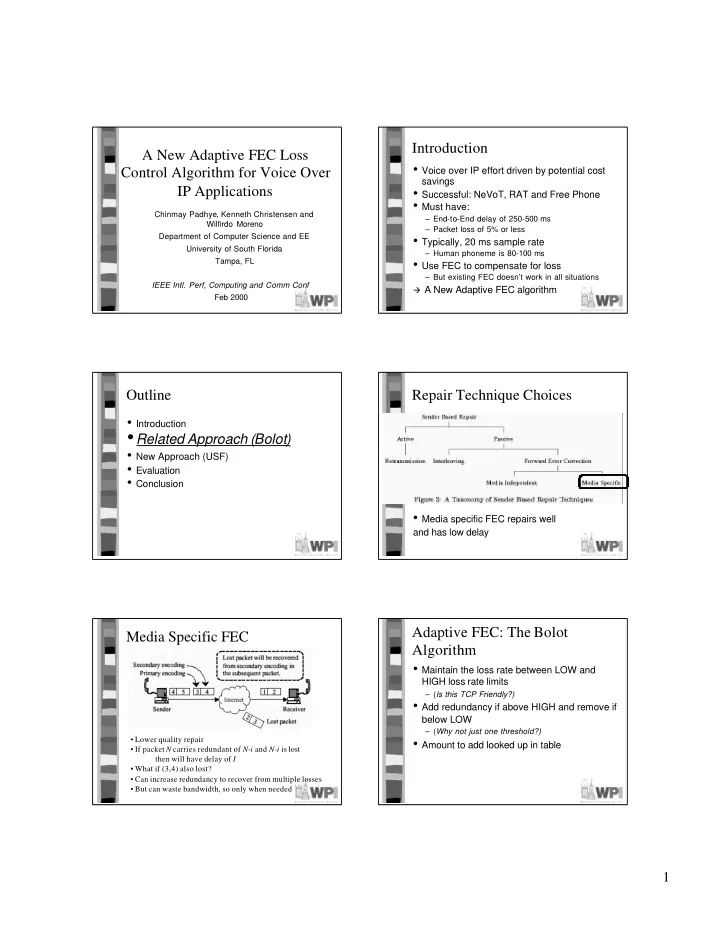
Introduction A New Adaptive FEC Loss Voice over IP effort driven by potential cost Control Algorithm for Voice Over savings IP Applications Successful: NeVoT, RAT and Free Phone Must have: Chinmay Padhye, Kenneth Christensen and


slide-1
SLIDE 1

1

A New Adaptive FEC Loss Control Algorithm for Voice Over IP Applications

Chinmay Padhye, Kenneth Christensen and Wilfirdo Moreno Department of Computer Science and EE University of South Florida Tampa, FL IEEE Intl. Perf, Computing and Comm Conf Feb 2000

Introduction

  • Voice over IP effort driven by potential cost

savings

  • Successful: NeVoT, RAT and Free Phone
  • Must have:

– End-to-End delay of 250-500 ms – Packet loss of 5% or less

  • Typically, 20 ms sample rate

– Human phoneme is 80-100 ms

  • Use FEC to compensate for loss

– But existing FEC doesn’t work in all situations A New Adaptive FEC algorithm

Outline

  • Introduction
  • Related Approach (Bolot)
  • New Approach (USF)
  • Evaluation
  • Conclusion

Repair Technique Choices

  • Media specific FEC repairs well

and has low delay

Media Specific FEC

  • Lower quality repair
  • If packet N carries redundant of N-i and N-i is lost

then will have delay of I

  • What if (3,4) also lost?
  • Can increase redundancy to recover from multiple losses
  • But can waste bandwidth, so only when needed

Adaptive FEC: The Bolot Algorithm

  • Maintain the loss rate between LOW and

HIGH loss rate limits

– (Is this TCP Friendly?)

  • Add redundancy if above HIGH and remove if

below LOW

– (Why not just one threshold?)

  • Amount to add looked up in table
slide-2
SLIDE 2

2

Bolot FEC Combinations

  • Reward is %loss

before / %loss after

  • empirically
  • (0,1) means

primary packet 0 and redundancy packet 1

Bolot Algorithm

  • RTCP packets carry number packets loss last 5 seconds

(Note! No notion of low quality)

Shortcomings of Bolot Algorithm

  • Reward is based on empirical results

– Current network may be different

  • Many burst losses of 10 or greater packets

– FEC cannot recover – Increasing redundancy a waste of bwidth

  • Even with LOW and HIGH may still have

cyclic (add/remove redundancy) behavior

Adaptive FEC: The New USF Algorithm

  • “Build upon” Bolot (key phrase)
  • Use RTCP with two extensions

– Number of packets lost after reconstruction – Number of packets lost in loss bursts

  • Increase delay first
  • Increase redundancy next

USF Alg.

  • Should prevent

cycles

  • Avoid adding

during bursts

Outline

  • Introduction
  • Related Approach (Bolot)
  • New Approach (USF)
  • Evaluation
  • Conclusion
slide-3
SLIDE 3

3

Evaluation: Simulate Effect on Network

  • Simulate network with empirical traces

– Audio conference

+ (used probes, too?)

– Receiver at Umass Amherst – Sender at LA, Seattle (20 ms) and Atlanta (40 ms) – Synthetic (queuing model) – Loss rates 1.4% to 3.8%

  • Simulate network with synthetic traces

– Get higher loss rates 1.7% to 35%

  • 4:6 interactive

To bulk

  • Audio 20 ms,
  • thers expn.

Simulation Results on Internet Traces

  • LOW and HIGH at 3% for USF and Bolot
  • MINIMUM_THRESHOLD 3% for USF
  • USF has ½ to 1/3 as much loss

Simulation Results on Internet Traces

  • How often loss above HIGH mark?

Packets Lost After Reconstruction

Bolot USF

USF better Bolot better

Simulation Results on Synthetic Traces

  • Target

loss rate is 3%

  • USF better

for low loss.

  • Same for

high loss

Simulation Results on Synthetic Traces

(Accuracy of Bolot reward prediction?)

slide-4
SLIDE 4

4

Error in Packet Loss by Bolot

(If we fix this (specific for these traces), better?

Tuned Bolot Algorithm

  • USF still

better

Tuned Bolot Algorithm

(Me: implied benefits from combos or bursts…)

Conclusions

  • Bolot uses empirical trace and independent

loss assumption

  • USF dynamically changes redundancy in

stream based on loss measured

  • Detects bursts of loss and ignores
  • USF works better than Bolot for loss rates of

1.5% to 35%

Future Work

  • Quantify bandwidth savings

– FEC had no impact on loss here

  • More packet traces
  • Quantify setting thresholds
  • Benefits to real audio in user study
  • (Me: Adaptive FEC based on available

bandwidth)

slide-5
SLIDE 5

5

Evaluation of Science?

  • Category of Paper
  • Science Evaluation (1-10)?
  • Space devoted to Experiments?