
SLIDE 1
18TH INTERNATIONAL CONFERENCE ON COMPOSITE MATERIALS
1 Introduction Recently, composite materials have been widely used in aircraft structures. However, most of them are direct replacements of materials from metals to composites retaining the same structural concept of a semi-monocoque structure. This structural concept is suitable for metal structures such as a sheet metal built-up one. Therefore, it is very difficult to realize the full potential capability of composite materials that are suitable for integral structures [1-2]. Research studies on suitable structural concepts for composite materials are necessary. A foam core sandwich panel structure is one of the suitable structural concepts to realize the full potential capability of composite materials for integral structures [3-9]. However, this structure has a critical problem, namely, no visual indications of impact damages due to a hail attack etc. were found. In our previous research, we estimated the reduction
- f the static and fatigue strengths quantitatively [10].
Moreover, an interfacial crack between a surface sheet and a foam core, initiated from the damage area, would propagate under the surface sheet without any indication. The suppression of the interfacial crack is necessary in the application of a foam core sandwich panel structure to actual airframe structures. Some researchers have conducted basic studies on crack suppression
- methods. These methods are unsuitable for airframe
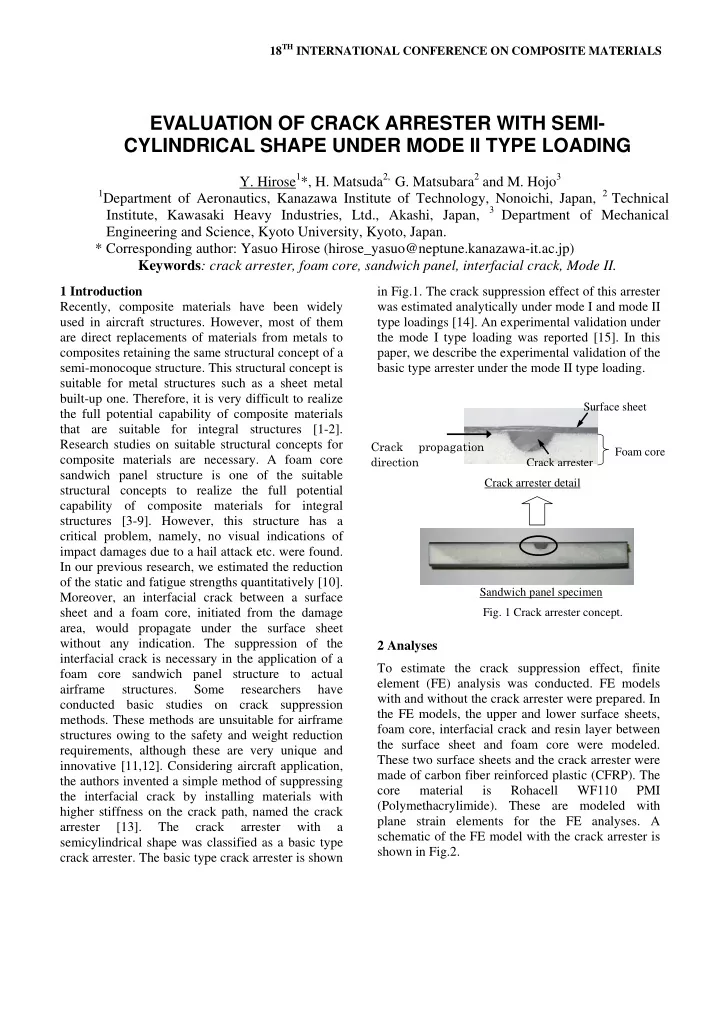
structures owing to the safety and weight reduction requirements, although these are very unique and innovative [11,12]. Considering aircraft application, the authors invented a simple method of suppressing the interfacial crack by installing materials with higher stiffness on the crack path, named the crack arrester [13]. The crack arrester with a semicylindrical shape was classified as a basic type crack arrester. The basic type crack arrester is shown in Fig.1. The crack suppression effect of this arrester was estimated analytically under mode I and mode II type loadings [14]. An experimental validation under the mode I type loading was reported [15]. In this paper, we describe the experimental validation of the basic type arrester under the mode II type loading. 2 Analyses To estimate the crack suppression effect, finite element (FE) analysis was conducted. FE models with and without the crack arrester were prepared. In the FE models, the upper and lower surface sheets, foam core, interfacial crack and resin layer between the surface sheet and foam core were modeled. These two surface sheets and the crack arrester were made of carbon fiber reinforced plastic (CFRP). The core material is Rohacell WF110 PMI (Polymethacrylimide). These are modeled with plane strain elements for the FE analyses. A schematic of the FE model with the crack arrester is shown in Fig.2.
EVALUATION OF CRACK ARRESTER WITH SEMI- CYLINDRICAL SHAPE UNDER MODE II TYPE LOADING
- Y. Hirose1*, H. Matsuda2, G. Matsubara2 and M. Hojo3
1Department of Aeronautics, Kanazawa Institute of Technology, Nonoichi, Japan, 2 Technical
Institute, Kawasaki Heavy Industries, Ltd., Akashi, Japan, 3 Department of Mechanical Engineering and Science, Kyoto University, Kyoto, Japan. * Corresponding author: Yasuo Hirose (hirose_yasuo@neptune.kanazawa-it.ac.jp) Keywords: crack arrester, foam core, sandwich panel, interfacial crack, Mode II.
- Fig. 1 Crack arrester concept.