
SLIDE 1
1
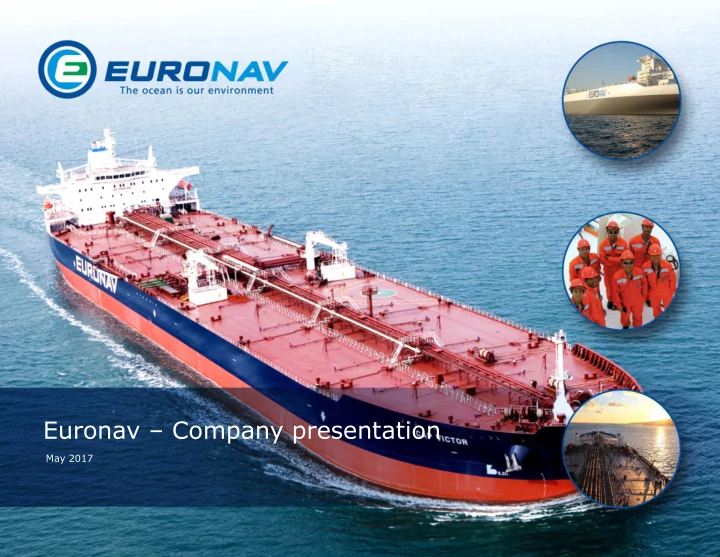
Euronav – Company presentation
May 2017
Euronav Company presentation May 2017 1 Forward Looking Statements - - PowerPoint PPT Presentation
Euronav Company presentation May 2017 1 Forward Looking Statements Matters discussed in this presentation may constitute forward-looking statements under U.S. federal securities laws, including the Private Securities Litigation Reform Act of
1
May 2017
Matters discussed in this presentation may constitute forward-looking statements under U.S. federal securities laws, including the Private Securities Litigation Reform Act of 1995. Forward-looking statements reflect the Company’s current views with respect to future events and financial performance and may include statements concerning plans, objectives, goals, strategies, future events or performance, and underlying assumptions and
historical facts, that address activities, events or developments that the Company expects, projects, believes or anticipates will or may occur in the future, including, without limitation, the delivery of vessels, the outlook for tanker shipping rates, general industry conditions future operating results of the Company’s vessels, capital expenditures, expansion and growth opportunities, bank borrowings, financing activities and other such matters, are forward-looking statements. Although the Company believes that its expectations stated in this presentation are based on reasonable assumptions, actual results may differ from those projected in the forward-looking
discussed in the forward-looking statements include the failure of counterparties to fully perform their obligations to us, the strength of the world economies and currencies, general market conditions, including changes in tanker vessel charter hire rates and vessel values, changes in demand for tankers, changes in our vessel operating expenses, including dry-docking, crewing and insurance costs, or actions taken by regulatory authorities, ability of customers of our pools to perform their obligations under charter contracts on a timely basis, potential liability from future litigation, domestic and international political conditions, potential disruption of shipping routes due to accidents and political events or acts by terrorists. We undertake no obligation to publicly update or revise any forward looking statement contained in this presentation, whether as a result of new information, future events or
events discussed in this presentation might not occur, and our actual results could differ materially from those anticipated in these forward-looking statements.
2
3
4
in addition to two 50% owned FSOs on long-term contracts
below 50% and a minimum 2 year operational liquidity-runway
markets
Suezmax Chartering platforms
Total) and four Suezmax 7 year time charter contracts (Valero Energy)
to market in 2017
demand for oil, increasing tanker ton-mile, lower newbuild ordering and financing becoming more restrictive
through the shipping cycles
2
5
INTRODUCTION
6
1. Adjusted EBITDA (a non-IFRS measure) represents operating earnings including the share of EBITDA of equity accounted investees before interest expense, income taxes and depreciation expense attributable to Euronav 2. Only 4 V-Plus vessels in world fleet
crude oil
a fleet of modern high quality tankers1
companies
sheet and high liquidity
shore side and globally 3,000 seafarers
capitalization of USD ~1.29 billion (as of 9 May 2017)
879 921 504 648 239 2016 2015 2014 1,235
Net interest bearing debt
FINANCIAL SUMMARY (USDm) 3 MM barrels 2.8 MM barrels
31 VLCC Up to 330,000 DWT
2MM barrels 1MM barrels
19 SUEZMAX (+4 NBs) 150,000 – 165,000 DWT 1 V – PLUS (2) Over 441,000 DWT 2 FSO Stripped water capacity 380k barrels Only 4 in world fleet
CURRENT FLEET – TOTAL 57 VESSELS – 14.3 MM DWT
Purchased 19 VLCCs IPO NYSE Purchased 2 VLCCs 4 Suezmax on 7 year TCE (2 in 2016 + 2 in 2017)
(1)
7
1989 2016 1995 1997 2000 2004 2005-2014 2008-2010 2014 2015
Started doing business under the name “Euronav” as a subsidiary of CNN Euronav Luxembourg created as a JV between CNN and CMB Initiated focus on larger sized and modern vessels: 6 VLCCs (double hull) ordered TANKERS INTERNATIONAL Pool founded Lists on Euronext Brussels Acquisition of 4 ULCCs in JV March 2005 Acquired 4 VLCCs March 2005 Acquisition of 16 Suezmaxes and 2 Aframaxes from Tanklog (Livanos Group) Added 5 Suezmaxes and 3 VLCCs newbuilds TI Asia and TI Africa conversion into FSO Asia and FSO Africa July 2014 Acquisition of 4 VLCCs January 2014 Acquisition of 15 VLCCs from Maersk August 2015 Acquisition of 4 VLCCs January 2015 IPO on the NYSE October 2016 Acquisition of 2 Suezmaxes August 2016 Acquisition of 2 VLCCs
8
SUEZMAX CHARTERING
VLCC POOL SUEZMAX POOL
Other VLCC Tanker Pools (Ships on the Water)
Source: Company reports 17 February 2017
Heidmar – VLCC Seawolf
13
Navig8 – VL8
37
China VLCC
32
Main Tanker Clients
9
EMPLOYMENT PER VESSEL HIGH QUALITY SHIPYARDS VESSEL ACQUISITION AND SALE TRACK RECORD Euronav employs its fleet based on assessment of where it can create the most value
20 40 60 80 100 120 140 160 180 2001 2002 2003 2004 2005 2006 2007 2008 2009 2010 2011 2012 2013 2014 2015 2016 2017 2018 2000 Suezmax 5 Year Old Secondhand Prices VLCC 5 Year Old Secondhand Prices
+4 +4 +4 +16 +1 +1 +1 +1 +1 +3 +15
Vessel acquisition Profitable vessel sale Loss-making vessel sale
+2 +4 +2 +1
Purchased 15 VLCCs from Maersk for $980M Purchased of 4 VLCCs ($477.5M) & 16 Suezmax + 2 Aframax from Tanklog ( $1,083M)
Korea Japan China Fleet of 51 vessels
1 6 16 17 4 3 4 Storage 1 Service Contract 2 Time Charter 11 Spot 20 TI Pool 23
10
FRAGMENTED VLCC MARKET OPEN FOR CONSOLIDATION Value Adjusted Equity ratio* (%) DYNAMICS IN THE SHIPPING INDUSTRY
tanker market
majors, Refinery majors and Oil traders
each cargo carriage price is set on an auction basis
TANKER MARKET CONSOLIDATION
6 5 16 14 32 11 10 10 22 21 25 34 31 30 39 46 49 22 22 24 26 27
37 32 22 42 46
17 17 31 31 32
124 116 142 206 241
0% 5% 10% 15% 20% 25% 50 100 150 200 250 300 2012 2013 2014 2015 2016
% of VLCC/Suezmax fleet Number of VLCC/Suezmax
DHT* TNK GNRT EURN NAT FRO BAHRI % of fleet
Source Clarkson’s – Total 715 VLCC ships @ 3 May 2017
Green indicates Captive or Sovereign fleet Blue indicates fleet in stock listed companies Small owners are data deficient (275 VLCCs)
Differentiate spot players vs industrial players
24 Angelicoussis Group 31 MOL 31 Euronav NV 32 China COSCO 33 Bahri 37 NIOC 40 China Merchants 41 1 Ship Owner 29 2 Ship Owner 34 3 Ship Owner 27 4-10 Ship Owner 185 10-15 Ship Owner 130 Nippon Yusen 19 Gener8 Maritime DHT 25 65 65
Top 10 owners control 43%
VLCC fleet
* Post BW acquisition
cure is to have a strong balance sheet and liquidity pool
that creates a three year runway through the cycles
liquidity at all times and maintain strong banking relationships
11
LIQUIDITY END MARCH 2017 (USDm)
620 144 60 416 Total liquidity pool Undrawn secured revolving facility Undrawn unsecured credit line Cash and cash equiv.
25 VESSELS ACQUISITION HIGH DIVIDEND YIELD
MAINTAIN STRONG BALANCE SHEET ≈ 50% (Leverage)
+
Leverage
As evidenced by
STRONG BALANCE SHEET HEDGE TOWARDS CYLICALITY CAPITAL ALLOCATION KEY TO GROWTH STRATEGY
12 Patrick Rodgers - CEO Hugo De Stoop - CFO
Owners Pollution Federation Fund since 2011
tankers
gas centre
Deputy CFO and Head of Investor Relations
UBS
Brian Gallagher – Head of IR
Management, before moving to Aberdeen Asset Management in 1996
Management before switching into Investor Relations as IR Director at APR Energy in 2011
13 Name Age Background Carl Steen (Chairman) 65 Strong background in finance, shipping,
Alice Wingfield Digby 42 Strong background in shipping (former Chartering Manager), ship owner in smaller tanker segment Daniel R. Bradshaw 69 Strong background in shipping and offshore Anne-Hélène Monsellato 48 Former Partner/ Auditor (EY), strong background in cross-border listing transactions, Audit Committee financial expert (SEC) Grace Reksten Skaugen 63 Strong background in corporate finance, venture capital and shipping, former board member of Statoil William Thomson 68 Strong background in shipping, former ship
Name Age Background Ludovic Saverys 33 Strong background in finance and shipping (CFO of CMB), ship owner (BOCIMAR (Dry bulk), Delphis (Container))
INDEPENDENT DIRECTORS
Shareholder Shares % Saverco - Marc Saverys 17,026,896 10.70% Victrix – Virginie Saverys 9,245,393 5.80% Total Family 26,272,289 16.50% Huber Capital 4,253,700 2.67% Argonaut 4,223,775 2.65% Dimensional Fund 3,823,695 2.40% Avenue Capital 2,593,936 1.63% Vanguard 2,582,388 1.62% Fidelity 2,565,774 1.61% Mellon Capital 2,459,193 1.54% Wisdomtree 2,330,323 1.46% SEB Investment Man 2,182,989 1.37% Norges Bank 2,177,398 1.37% Deutsche Bank Trust 1,913,762 1.20% Alyeska 1,800,148 1.13% Donald Smith 1,785,377 1.12%
SHAREHOLDERS
Name Age Background Paddy Rodgers (CEO) 57 CEO Euronav since 2000
NON-INDEPENDENT DIRECTORS EXECUTIVE DIRECTORS
14
Euronav Ship Management SAS France
Euronav UK Ltd United Kingdom Euronav Tankers NV Belgium Euronav SAS France Euronav Hong Kong Ltd Hong Kong Euronav Shipping NV Belgium
Euronav Ship Management (Antwerp) Branch Office Belgium Euronav Ship Management (Hellas) Ltd Liberia Euronav Singapore
Singapore Euronav Luxembourg SA Luxembourg Larvotto Shipholding Ltd Hong Kong Fiorano Shipholding Ltd Hong Kong TI Africa Ltd Hong Kong TI Asia Ltd Hong Kong E.S.M.C. Euro-Ocean Ship Management Ltd Cyprus Euronav Ship Management (Hellas) Branch Office Greece 100% 100% 100% 100% 100% 100% 100% 100% 100% 100% 100% 100%
50% 50%
100% 100%
1 vessel 1 vessel * 1 vessel * 1 FSO 1 FSO 3 vessels *
Belgium
47 Vessels*
*Vessel to be repatriated under main balance sheet
*All of our daughters are funded through shareholders’ loans. The excess of cash is repatriated through the repayment of these shareholders’ loans.
16
15
16
Q1-17 2016 62% 2015 63% 2014 48% 2013 37% 64% 909 879 921 Q1-17 2016 2015 2014 1,212 2013 1,059 620 597 423 264 97 Q1-17 2016 2015 2014 2013
LIQUIDITY (USDm) VALUE ADJUSTED EQUITY RATIO(1) (%) EBITDA FROM FIXED RATE CONTRACTS(2) (USDm) NET DEBT (USDm)
1) Book equity value adjusted for broker valuations 2) On proportionate basis covering all joint ventures
155 155 144 122 136 2013 LTM Q1-17 2014 2015 2016
SEASONALITY: AVERAGE MONTHLY VLCC RATE 1990 - 2016
1 YEAR TC VLCC
17
Source Clarkson Research Services Limited 2017
$0 $10 000 $20 000 $30 000 $40 000 $50 000 $60 000 $70 000 $80 000 $90 000 $100 000 Mar-00 Oct-01 May-03 Dec-04 Jul-06 Feb-08 Sep-09 Apr-11 Nov-12 Jun-14 Jan-16 1 Year TC VLCC Cash breakeven
$43 372 $40 048 $37 962 $32 615 $35 652 $36 851 $35 887 $29 567 $31 114 $36 315 $45 944 $51 236
$25 000 $30 000 $35 000 $40 000 $45 000 $50 000 $55 000 Jan Feb Mar Apr May Jun July Aug Sep Oct Nov Dec
Average VLCC rate
COMMENTS
breakeven rates
expected; interest, reduction and repayment of debt facilities)(1): – ~ USD 27,300 / day for VLCC (OpEx / day USD 8,165 and SG&A / day USD 1,600) – ~ USD 24,000 / day for Suezmax (OpEx / day USD 7,520and SG&A / day USD 1,600)
– ~ USD 18,500 / day for VLCC – ~ USD 15,750 / day for Suezmax
1. Before TC-in/fixed income 2. Before fixed rate contracts
Leverage 18
and 2.25%
revolving
international shipping banks
2020
$138m/year
loans: $55m/year
HIGHLIGHTS REPAYMENT SCHEDULE AND RCF REDUCTIONS STRONG & SUPPORTING BANKING RELATIONS COVENANTS
USD 620 million (Q1-17)
63.8% (Q1-17)
USD 582.5 million (Q1-17)
50 100 150 200 250 300 350 400 450 500 2017 2018 2019 2021 2023 2022 2020 Repayments Reductions Balloon
19
(In millions of USD) 2015 2016 Revenue 846.5 684.3 Other operating income 7.4 7.0 Total income 853.9 691.3 Voyage expenses and commissions
Vessel operating expenses
Charter hire expenses
General and administrative expenses
Net gain (loss) on disposal 5.3 26.2 EBITDA 613.7 476.4
144.0 155.0 Depreciation
Net finance expenses
Share
profit (loss)
equity accounted investees 51.6 40.5 Result before taxation 355.9 203.8 Tax benefit (expense)
0.1 Profit (loss) for the period 350.3 203.9
PROFIT AND LOSS COMMENTS
– Long-term seven year charters secured with Valero Energy Inc. for four Suezmax vessels starting in 2018 which will be served by four Ice-class new buildings
– Award of further five years contracts for the FSOs on the Al-Shaheen field offshore Qatar, owned and
generated annually from fixed income contracts (FSO + TC contracts)
freight rates
1. Before TC-in/fixed income 2. Proportionate consolidation method & FSO contribution current contract runs to Q3 2017
Leverage remains within company imposed limits at 45% loan to value Diversification of funding source Sale & Leaseback of 4 VLCCs opens new
HIGHLIGHTS
Liquidity position strengthened – providing
LIQUIDITY POSITION Bank Loans Refinancing of term loan facility Q4 2016 now means Euronav credit facilities are mostly RCFs CAPEX and newbuild debt capacity (current)
contracts) = USD 236m
175m
(In millions of USD) 2015 2016 Cash 131.5 206.6 Restricted cash 0.1 0.1 Other current assets 243.4 166.7 Long term assets: Newbuildings 93.9 86.1 Vessels 2,288.0 2,383.2 Other long term assets 283.8 203.9 Total assets 3,040.8 3,046.7 Current liabilities 179.5 189.1 Long term debt 952.4 966.4 Other long term liabilities 3.1 3.4 Equity 1,905.7 1,887.7 Total liabilities and stockholders’ equity 3,040.8 3,046.7
BALANCE SHEET
(In millions of USD) 2016 Q1-17 Cash & cash equivalent (incl. share of JV) 240 144 Undrawn secured revolving facility 297 416 Undrawn unsecured credit line 60 60 Total Liquidity 597 620 20
21
(In millions of USD) 2015 2016 Net Income 350.3 204.1 Depreciation and amortization 210.4 227.8 Other
Change in working capital
38.5 Net Cash from Operating Activities 450.5 438.3 Investment in fixed assets
Proceeds from sale of fixed assets 154.3 248.8 Net Cash for Investments
Change in net debt
Dividends
Change in equity 237.3
Other
Net Cash from Financing
Change in cash balance
76.5
COMMENTS CASH FLOW
active fleet management
amortizations, only fixed reductions of the facility sizes
assets down to zero over 20 years (industry standard 25 years down to scrap value)
5
22
23
Demand for oil ROBUST Supply of oil BALANCED Shipping demand Ton miles CHANGEABLE Shipping Supply Vessel supply
S/T HEADWINDS L/T MANAGEABLE IF OWNERS ARE DISCIPLINED
Financing & regulation NEW BARRIER TO ENTRY
Historical
last 25 years with yearly average 1.1 mbpd
growth since 1990 for global crude demand Present
growth 2017 OPEC Impact vs US Shale OPEC cuts impact on shipping
OPEC cut = Non OPEC increased supply
New Swing Producer very resilient & responsive
increase ton miles from 2017
increasing tonnage due to refinery maintenance and other factors
newbuildings fallen substantially & shipyards under reform pressure in the medium term
1 2 3 4 5
restricting lending Total amount of loans reduced
reduced risk appetite
predict if good or bad for Ton miles
1 Demand growth (million bpd)
Y/Y CHANGE IN GLOBAL DEMAND FOR OIL THE IEA ESTIMATES FOR OIL OIL PRICE OUTLOOK
24
10 20 30 40 50 60 70 80 90 2015 2016 2017 2018 2019 2020 2021 2022 2023 USD per barrel Demand/supply Disruptive Demand stimulating Neutral Demand Destructive Capex cuts in E&P Lack of disruption/market share game
Source IEA, McQuilling, Bernstein, Barclay, Petrowin and Bloomberg 0,3 1,0 0,5 0,3 1,0 1,5 1,9 2,0 0,3 1,7 0,8 0,7 0,7 1,5 3,1 1,4 1,0 1,6
3,1 0,8 1,1 1,3 0,7 1,8 1,6
0,5 1 1,5 2 2,5 3 3,5 1990 1991 1992 1993 1994 1995 1996 1997 1998 1999 2000 2001 2002 2003 2004 2005 2006 2007 2008 2009 2010 2011 2012 2013 2014 2015 2016 Million barrels per day
Average 1.1 million barrels per day 1,2 1,4 1,5 1,6 1,3 1,4 1,4 1,4 0,2 0,4 0,6 0,8 1 1,2 1,4 1,6 1,8 Nov 16 Dec 16 Jan 17 Feb 17 2016 forecast for oil demand 2017 forecast for oil demand
10 20 30 40 50 60 70 80 90 USD
0,6 2,5 3,0 3,1 3,3 3,5 4,4 4,6 5,0 5,7
Average field development (approval to start up) time by resource [years, selected areas]
Source SBC Analysis, Rystad Source Economist Source CLSA
2
84 000 86 000 88 000 90 000 92 000 94 000 96 000 98 000 2012 2013 2014 2015 2016 2017 mbpd
OIL SUPPLY ELEVATED BUT PRICE CAPPED SHALE OIL SPEED TO PRODUCTION IS KEY GLOBAL OIL SUPPLY IS GROWING MOST SHALE PRODUCTION KICKS IN AGAIN @ USD 50
25
Source IEA
1.4 mbpd x 365 days = 511m barrels 511m barrels / 2m capacity per VLCC = 256 cargoes 256 cargoes / 9 annual journeys for VLCC MEG – F East = 28 VLCCs Arabian Gulf to China 5,500 miles 21 days West Africa to China 9,650 miles 33 days LatAm to China 11,500 miles 44 days
26
1.4 mbpd x 365 days = 511m barrels 511m barrels / 2m capacity per VLCC = 256 cargoes 256 cargoes / 4.5 annual journeys for VLCC Atlantic – F East = 57 VLCCs Average oil demand growth 1990-2015 =1.1 mbpd
Importer
Exporter
Supply Demand Demand Supply 3
DEMAND GROWTH ALL FROM FAR EAST – FOR TANKERS IMPORTANT WHERE SUPPLY IS SOURCED FROM
Source Euronav, Morgan Stanley
West Africa LatAm / Caribs Middle East Asia Pacific China
28 VLCCs 57 VLCCs
LatAm / Carbs - Asia Pacific route Middle East - Asia Pacific route
Source Clarkson
Source Clarksons
VLCC order book ratio falls to 5.9%
months* Last 20 years order book ratio rarely been below 10% 4 Industrial players 50 Chinese 29 Captive fleet 10 Speculative 10
SMALL PORTION OF ORDERS ARE SPECULATIVE ORDERBOOK AS % OF FLEET IMPROVING PICTURE NEWBUILDING ORDERING ACTIVITY
27 1 2 3 4 5 6 7 8 9 Jan Feb Mar Apr May Jun Jul Aug Sep Oct Nov Dec Jan Feb Mar Apr May 2016 2017 VLCC Suezmax
at 13.6% of the total fleet and is scheduled to be delivered over the next 2-3 years
the order book is at healthy levels, although it has increased during 1Q 2017 due to historic low newbuilding prices from the yards
likely to continue to offer the compelling prices
10 20 30 40 50 60 % VLCC Orderbook % Fleet Suezmax Orderbook % Fleet
22.5 20 USD 4.0m 17.5 USD 3.5m 15 USD 2.5m 12.5 10 USD 2.0m 7.5 5 USD 1.5m
100% utilisation
28 Special Survey #1 Special Survey #2 Special Survey #3 Special Survey #4 Special Survey #5
4
Dry-dock costs increasing after 15 years Maintenance costs increasing Regulations costs
management
control Increased costs due to vessel age Decreasing utilisation (vettings) Lower market freight rates Lower earnings potential
TANKER SHIPPING – A HIGHLY REGULATED INDUSTRY
Vessel age
SCRAPPING MOTIVATION
29
DEMAND AND SUPPLY INTERACTION ON VLCC EQUIVALENTS 2016-2019 WHAT IEA DEMAND TRANSLATES INTO VLCC EQUIVALENTS REQUIRED PA
2016 2017 2018 2019 Total VLCC to be delivered 45 51 50 17 Total Suezmax equivalent to be delivered* 12 32 10 VLCC equivalents to be delivered* 57 83 60 17 +/- Gibsons Scrapping forecast
49 40 37 37 IEA demand forecast bpd m 1.6 1.4 1.2 1.2 = Yearly Net Surplus/(Deficit) 22
Cumulative Surplus/(Deficit) 8 30 30
IEA demand forecast m bpd VLCC equivalent* IEA demand forecast m bpd VLCC equivalent*
1.6 49 1.1 33 1.5 46 1.0 30 1.4 43 0.9 27 1.3 40 0.8 24 1.2 37 0.7 21
Source Clarksons, Gibsons * VLCC equivalent = 1 VLCC = 2 Suezmax
4
20 40 60 80 100 2016 2017 2018 2019 VLCC Equivalents
VLCC Equivalents to be delivered* Demand based on IEA forecast Cumulative Surplus/(Deficit)
4
VLCC ORDER BOOK SUEZMAX ORDER BOOK
17 54 62 49 30 24 23 47 19
50 32
20 40 60 80 2017
2016
2015
2014 2013 2012 2011 2010 2019 2018 Could be scrapped (≥ 20 years old) Must be scrapped (over 22.5 years old) Scrapped Forecast Additions Additions
38 43 45 27 24
19 46 10 8 17
10 20 30 40 50 60 2019 2018 2017 2016
2015 2010 2014 2013 2012 2011 Could be scrapped (≥ 20 years old) Must be scrapped (over 22.5 years old) Scrapped Forecast Additions Additions
30
Source Clarksons
Around USD 100bn withdrawn from shipping sector since 2009
flexibility severely curtailed due to Basel II & III
loans in distress
lending capital restricted for commercial reasons
the lack of liquidity implying a return to the sector difficult to realize
segments under severe financial pressure
have mixed fleets so pressure felt within
shipping segments leading to ship yard distress
actively adopted by shipyards driven by governments
Source: Tufton, Marine money london 2015
31
5
32
22
33
34
and locations
prices
and labour costs
concentration
Energy sources Oil market Newbuildings Transport capacity Ship owners and logistics operations
in the global energy supply chain
primarily driven by daily freight rates
the supply and demand for vessels and cargoes (need for movement of crude)
movement of cargo between a load port and a discharge port
is primarily affected by global and regional economics
environmental policies
Macro-economics DEMAND DRIVING FACTORS SUPPLY DRIVING FACTORS
35
Notes: 1. Established using a weighted average of the time charter equivalent (TCE) for each vessel on three selected voyages, which is then compared with an agreed reference
2. With the exception of any specific trading restrictions which owners may stipulate
All commercial decisions are handled by the Pool’s independent agent(2) Vessel owning companies pool their vessels together in
economies of scale The pool distributes net revenues to the pool members in accordance with the allocated pool points(1) Vessels chartered, mainly in the spot market All revenues and costs are pooled Charterer Pays all voyage related costs Charterer Pays monthly charter hire on a per day basis Responsible for the payment of all vessel
and capital costs
development, most FSOs are leased
rate contracts
structured as either a time charter
Both FSOs are deployed as floating storage units under service contracts with QP/Total 1 3 4 5 2
VLCC CHARTERING LTD. (TANKER POOL) TIME CHARTERS FSOs AND OFFSHORE SERVICE CONTRACTS
always repeats past mistakes
rates lower
ASSET VALUES
tanker earnings trend
support
OTHER INVENTORY
need to be cleared at some point thus reducing need for shipping
OPEC announced production cuts
adjustment tax
export cuts extended > 6 months
activity in response to discounting
necessary industry restructuring
CYCLICAL
SHIPYARDS DEMAND
demand forecasts
1.4m bpd growth
CHINA – GROWTH
range of factors
12m bpd = key
barrier to entry
supply growth
SUPPLY OIL
cuts
demand for shipping
GLOBAL GROWTH
BULL CASE BEAR CASE
36
SHIPYARDS FAR EAST FOLLOWING NATURAL LIFE CYCLE
37
Source CLSA
UK Western-Europe Japan Korea China Pre-1945 1945-1950s 1950s-1970s 1970s-1990s 1990s-2000s 2000s-present
Restructuring and cost reduction Cost leadership Technology, specialization and domestic markets Closure of industry Nationalization
38
ASC EURN NVGS KEX AVANCE DHT OSG GLNG MATX NAT 1 2 3 4 5 6 7 8 9 10 SDLP NAP NMM CAI FRO GNRT NNA CMRE KNOP SSW 22 23 24 25 26 27 28 29 30 31 GLOG TGH TK LPG TNK BWLPG GLOP GMLP RIGP TGP TOO 11 12 13 14 15 16 17 18 19 20 21 SBLK DSX DCIX ESEA CPLP SB TNP STNG SALT GASS DRYS 32 33 34 35 36 37 38 39 40 41 42
Quartile 1 Quartile 3 Quartile 2 Quartile 4 Merits of corporate governance are important to Euronav
The reason it is important is the future funding of tanker shipping
Euronav HAS a credible platform in capital markets
Tanker shipping MUST breakout from historical funding structures & embrace capital markets
Source Well Fargo Securities, LLC
39