EU -Russia/Ukraine: from Ring of Friends to Ring of Fire? The - - PowerPoint PPT Presentation

eu russia ukraine from ring
SMART_READER_LITE
LIVE PREVIEW

EU -Russia/Ukraine: from Ring of Friends to Ring of Fire? The - - PowerPoint PPT Presentation

EU -Russia/Ukraine: from Ring of Friends to Ring of Fire? The European Union: challenges and strategic responses Colloquium 27 October 2015 Dr. Graeme P. Herd , Professor of Transnational Security Studies, George C. Marshall


slide-1
SLIDE 1

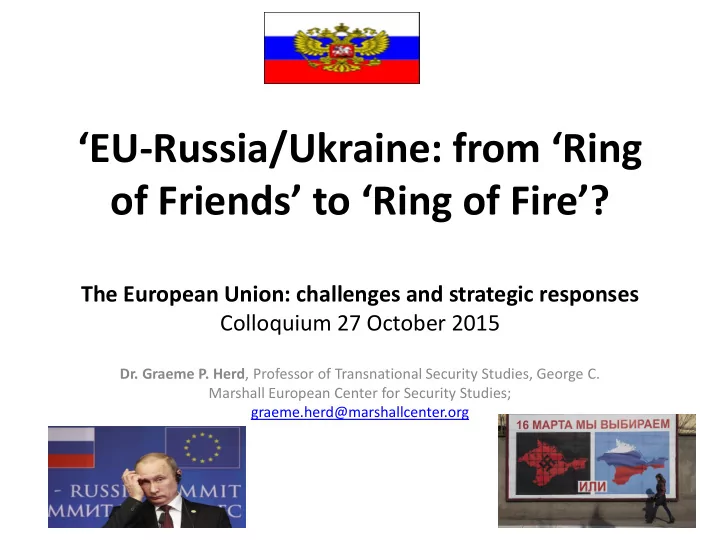
‘EU-Russia/Ukraine: from ‘Ring

  • f Friends’ to ‘Ring of Fire’?

The European Union: challenges and strategic responses Colloquium 27 October 2015

  • Dr. Graeme P. Herd, Professor of Transnational Security Studies, George C.

Marshall European Center for Security Studies; graeme.herd@marshallcenter.org

slide-2
SLIDE 2

Who is to blame? Four Narratives

  • EU to blame:

– Sub-optimal non-strategic foreign policy; DCFTA unrealistic, open markets before anything to sell, cumbersome, top heavy, too long term; humiliate Russia, not take into account its legitimate interests

  • Russia to blame:

– Status seeking foreign policy; zero sum thinking triumphs positive sum EU; negative mobilization processes around imperial revanchism

  • US to blame:

– EP US-supported Swedish-Polish buffer zone between EU and Russia; US ‘New Atlanticist’ policy to undermine EU-Russian cooperation

  • Human Condition:

– Misunderstanding/mis-perperceptions, sleepwalking into tragedy, cumulative and unintended effects of policies

slide-3
SLIDE 3

Structure-Agency and Moscow’s Motivations: Realist-Constructivist Russia and Putin

The Russia Factor

  • Realist:

– Rational objective calculations of national interest; self-reliance = national survival – Statehood absolute not qualified … – Regional: uphold order; Global: voice and veto in hotspots

  • Constructivist:

– Fear instability and encirclement – belief West use democracy, rule of law, HR to control weaker nations – Wounded ego, pride, dignity; conspiratorial – victim syndrome – Desire Great Power status/equality, belief that respect equals fear

The Putin Factor

  • Unique:

– System forming: ‘No Putin; no Russia’ historical-charismatic legitimation

  • Potent Power:

– Control FSB and TV: ‘the worse the better’; fear, greed, cynicism of elite

  • President Putin’s Choices:

– Ukraine: any Russian president would want influence, Putin chooses invasion not energy or bribes – Syria: any Russian present would want global-player status, Putin chooses intervention in a Muslim state outside perimeter of historical empire, not trade or UNSC

slide-4
SLIDE 4

2000 2008 2011-13 2014-15

Phase 1: ‘Golden Years’: 7% GDP – positive mobilization around performance legitimacy. Phase 2: ‘Moscow Maidan’ - crisis. Putin’s popularity sinks as economy rebounds . Negative long term economic trends . Need for new legitimation basis on return to power. Phase 3: ‘Great Russia Besieged Fortress’: negative mobilization - anti- Western foreign policy. Charismatic and historical legitimation. “Air in the Balloon

Problem”

Regime Consolidation and Long-Term Economic Decline: Implementing a Military-Patriotic Management Model?

Georgia Crimea “Scissors Problem”

Russia’s economic performance Putin’s popularity Putin’s popularity Russia’s economic performance

Middle Income Development Trap

slide-5
SLIDE 5

Belief/ Actors Russian Perception and Understanding of Relations with EU and Ukraine EU and Ukraine Perception and Understanding of Relations with Russia EU

‘Co-equal’ status means Russia has a sphere of influence via EEU equal to EU’s sphere; EU ‘dishonest and vindictive’ (Lavrov 2014); ‘The West has greatly exaggerated the effects of the latest sanctions on the Russian economy’ (S. Ivanov, 2015); “we are willing to resume full-scale cooperation with the EU and the United States after our Western partners abandon their current stance based on a futile policy of ultimatums and illegal sanctions.” (Lavrov, 14-10-15) EU sanctions an opportunity for import substitution and industrial self-reliance. EU as ‘the other’ - decadent, dysfunctional, destabilizing, amoral space v. Russian traditional conservative, Christian family

  • values. Zero Sum proposition – EEU or EU

AA/EP/DCFTA. Three tier sanctions. Hybrid war generates fear, uncertainty, disruption, anxiety. Values gap – freedom, HR, sovereignty compounded by victim

  • syndrome. No allies and sphere of influence
  • diminish. Focus on structural instabilities and

stagnation not renewal, personalized power system unsustainable; short term successes, long term costs

  • ‘Russia is weak’. EEU and EU AA/EP/DCFTA not

incompatible – either/or principle ‘is unacceptable’ (Merkel, May 2015). ‘Equal’ means equal to any

  • ther non-member aspiring to relationship with EU.

“I don’t think it’s a strategic partner anymore.’ (Mogherini, 2015). EEU-EU dialogue – about what? Liberalization?

Ukraine

“Former President Yanukovich said that he needed to think about signing the EU-Ukraine AA, maybe

  • btaining changes being made to it, and to consult

with Russia, Ukraine's primary economic and trading

  • partner. With that pretext, the disorders began in Kyiv,

actively back by both our European and our US

  • partners. That was followed by the coup d'etat, an

absolutely unconstitutional act.” (Putin, 27-4-15). Official discourse: genocidal fascist Junta and neo-Nazi western supported ultra-nationalists. Russian history/identity begins in Kyiv and Crimea (Russkiy Mir). Biggest market for natural gas exports, transit route to Europe, 7.5 million ethnic Russians. Note Russian position shift: 2004 Putin states UKR- EU membership (unlike NATO) a ‘positive step’. 2014 Russia hostile, negative, confrontational. UKR as sovereign and independent state free to choose - equality, legitimacy and common European home

  • discourse. Generalized and enduring resentment

against propaganda and demonization of political elites and society by Russia. Post-Yanukovich elite and society focus on ‘European path’, European values and principles. EEU has symbolic political value but no economic sense without Ukraine - Russia has lost Ukraine. ‘Russia without Ukraine is a

  • country. Russia with Ukraine is an empire.’
slide-6
SLIDE 6

2008 2014 2015 2016

Phase 2: Identifying and addressing the ‘Scissors Problem’ – ‘Besieged Fortress Paradigm’ Phase 3:. Putting Air into the Balloon = ‘Besieged Fortress’ charismatic and historical legitimation.

“Air in the Balloon Problem”

Phase 4: Refloating/Replacing an Exhausted Military Patriotic Management Model – after Syria – what’s next? Battle of Narratives in Elite?

Crimea

“Scissors Problem”

Russian Economy

“Great Power Strategic Renovation” – rebalance economy, pivot to Asia, foreign economic partnerships, technological sovereignty = Party of Economy (1-2% growth)

Managing Deflation

2024 “Great Power Besieged Fortress” – external (nuclear) blackmail and internal repression escalation and middle class revolts = Party of War (negative growth)

Mis-managing deflation = collapse “Dividing a Diminishing Cake Problem”

Syria as inflection point?

slide-7
SLIDE 7

Perception and Misperception

Issue Statements: Neutral, factual statements …. Putin/Russian Self-Perception: Consolidated state and society, on right side

  • f history, global player status, Putin is a

genius – ‘Russia is strong’ West External Perception: Structural instabilities , personalized power system unsustainable, short term success v long term costs - ‘Russia is weak’

Political system: super presidential system, with weak PM in a technical government; popular electoral autocracy; no alternatives

  • r checks and balances; non-systemic
  • pposition fragmented, fearful;

Power centralized, consolidated, Putin unassailable from within; interventions in Ukraine and Syria enhance Russian power, prosperity and support for political status quo; attractive model to non-western world; nationalism and anti- liberalism pervasive Trapped by polls/popular support, instability if support falls as no alternative; more isolated, imperial nationalist, authoritarian anti-Western populist - fuelled by economic depression; delegitimise elections as vehicle for peaceful change of power; ruling party a transmission belt Economy: in decline: inflation 15%+; 10% real term wage fall/4% GDP decline 2015; 50% rouble devaluation; GDP $2.3tr at peak, now $1.2tr (1998 = $700bn); exports of goods and services decline 40% Aug 2013- Aug 2014; energy sector = 98% corporate profits and 50% state budget revenues 10% cut in government spending but economy stable, investment opportunities, ‘There is no economic crisis in Russia’ (VTB Bank chair); rebalance the economy via import substitution policies and industrial self-reliance (textiles and agricultural sectors grow); forecast inflation fall to 4% by 2017 – ‘worst is over’ (Putin) Natural resource curse (‘Dutch disease’): 70% exports energy but US shale/Saudi Arabia sets global prices; gigantic, inefficient state monopolies; ‘sistema’, corruption, red tape all torpedo structural reform efforts; growth outlook poor – no investment, ‘running economy into the ground’ (Obama); ‘when there is no bread, the circuses have to be extremely interesting’ Military: rapid modernization; DIC growth sector; more high technology; from divisions to brigades; conscript to professional; more combat ready; source of triumphalism and patriotism Deploy with efficiency and speed; pride in polite little green men and nuclear triad; Syria

  • perational testing ground and exemplify military

prowess and utility of increased coercive (hard) power; decisive thrusts to neutralize opponents strengths and exploit weaknesses. Reassessment : no longer a ‘paper tiger’; but military and misinformation tools reflect one dimensional power; spending rise 8.1% of GDP in real terms 2014 – 15% rise 2015 with 60% increase arms procurement but weak R&D; increasing need to justify costs = Syrian quagmire; military overstretch bankrupt USSR – RF? Elite interests: those that run Russia own Russia – rich, young, pragmatic, dynastic – 110 billionaires controlled 35% GDP ($420bn) – largest inequality globally Strategic economic assets under strong managers with vested interest to protect Russian sovereignty; nationalized elites; patriotic; increased competition over power/property Vested interest in avoiding structural economic reform creates long term instability; given up on Perestroika-II; bound to Putin by cynicism, greed, fear, not loyalty or belief; uncertain Putin protect interests National security decision-making: executive: Putin, Pres. Admin., Security Council; secretive informal small groupings;

  • paque process; no oversight – Senate and

Duma /MFA explain to the world Strategic surprise: efficient/effective; can pre- empt, counter and pivot quickly - improvisation,

  • pportunism, and ‘post hoc diplomacy’: negotiate

after action to consolidate results/achieve leverage ‘End of world’ survivalist mentality, addicted to extraordinary situations and no rules politics (destabilization and spoiler strategy); short term ad hoc, impulsive, risky; narcissism, personal drama and messaging inner circle/elite that Putin is successful Society: apolitical/apathetic; closed off from elite; relatively free if not political; state controlled media and informational regime – genuine but not deep support Trust in power institutions increase ; ‘the worse the better’ for negative mobilization and consolidation - young and elderly especially super- patriotic ; endurance capacity Negative mobilization v external/internal threats: 5th columnists, foreign agents, national traitors; destroy civil society; disintegration of institutions; demographic decline; health indices poor; creative class ‘brain drain’
slide-8
SLIDE 8

Putin and the West: Chaos or Stability? Identifying the Binary Choice

Option 1: Negative Sum ‘Status Quo’

  • ‘Contain, Confront and Encircle

Russia’: ‘The worse the better’ – continuity of status quo mobilizes support for regime, makes it stronger - regime ‘anti-fragile’ (vulnerable to tranquility not instability)

  • Unpredictability/Instability:

– ‘Spoiler power’: make Russia stronger by weakening others (pain threshold is higher and power is relative); – Use maskirovka, TOC and protracted conflicts (5 of 6 in EP) to control and export instability and thereby gain negative spheres

  • f influence

Option 2: Positive Sum ‘Grand Bargain’

  • ‘Constructive Yalta-II Equality’:

Fixed superpower distribution of spheres of influence (Russkiy Mir) where Russia make and break rules; accept a more powerful Russia as guarantor of stability at cost of EU retreat from its values

  • Predictability and Stability:

– Agreement de-escalates instability e.g. Syrian migrants to Europe; Donbass violence and creates positive spheres of influence – EU-Eurasian Economic Union co- equals – “single economic area stretching from Lisbon to Vladivostok”.

slide-9
SLIDE 9

Conclusions:

  • Putin’s Russian Federation 2016: expect strategic surprise?

– Russia to become more assertive/aggressive and unpredictable – ‘perfect storm’ of internal and external factors gathering:

  • Internal: nature of legitimation shift; elite addiction to no-rules politics,

extraordinary situations and survivalist mentality; lack of internal enemies

  • r ability/will to undertake structural reform;
  • External: status seeking; need to show utility of costly military and Putin in

charge (but trapped by polls); basic clash of interests/divergent strategies

  • EU’s Global Strategy June 2016: aligning interests, values, security?

– Refuse and reject: binary either/or proposition of chaos/Yalta-II - short term stability at expense of values and greater long-term instability when

  • pportunity costs higher

– Revise and realize: ENP to GEO, UKR, MOLD – stability and prosperity a positive sum proposition which can benefit Russia – though likely Russia continues to argue containment, encirclement and confrontation – Re-imagine and respect: audit relationship: how vital energy, economic links? Factor in other markets, other ‘essential partners’ and opportunity costs of focusing on failure; respect Russia’s right to undertake suicidal state-craft