EU National Herman B.W.M. Koter, MSc, Committees DTox, ERT Chair - - PowerPoint PPT Presentation

eu national
SMART_READER_LITE
LIVE PREVIEW

EU National Herman B.W.M. Koter, MSc, Committees DTox, ERT Chair - - PowerPoint PPT Presentation

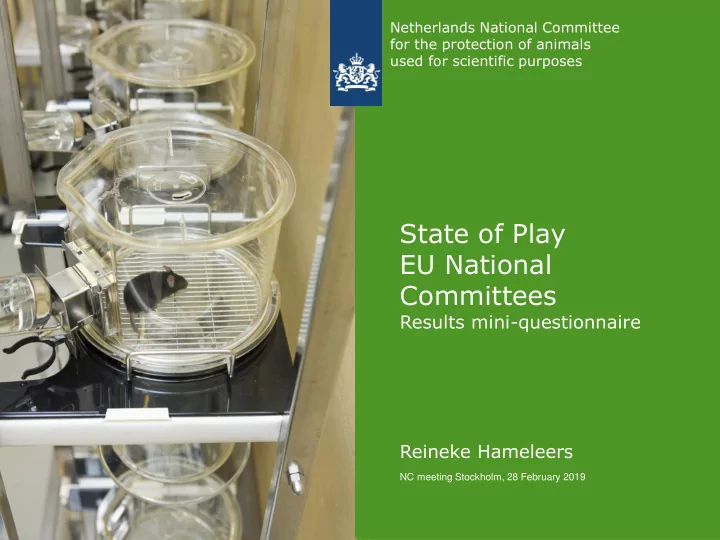
Netherlands National Committee for the protection of animals used for scientific purposes State of Play EU National Herman B.W.M. Koter, MSc, Committees DTox, ERT Chair of the Netherlands National Results mini-questionnaire Committee for


slide-1
SLIDE 1

Herman B.W.M. Koëter, MSc, DTox, ERT Chair of the Netherlands National Committee for the protection of animals used for scientific purposes

State of Play EU National Committees

Results mini-questionnaire Reineke Hameleers

NC meeting Stockholm, 28 February 2019

Netherlands National Committee for the protection of animals used for scientific purposes

slide-2
SLIDE 2

2

NC-meeting Stockholm, 28 February 2019

Background questionnaire

  • NC-meeting Brussels spring 2018
  • Questionnaire: obtain more insight in

structure and organisation EU NC’s

  • Responses from 14 NCs:

Croatia, Czech Republic, Denmark, Germany, Greece, Hungary, Ireland, Italy, Poland, Romania, Slovakia, Sweden, The Netherlands and United Kingdom

slide-3
SLIDE 3

NC meeting Stockholm, 28 February 2019

Key conclusions: establishment, accountability, independence

  • Most NCs have been established

around 2013 by their government, some are part of their goverment

  • Most NCs are accountable

to their government

  • Most NCs deem themselves independent
slide-4
SLIDE 4

NC meeting Stockholm, 28 February 2019

Debate intermezzo: what do you think? ? If part of government,

how is independence guaranteed?

? What are your experiences

with (constructively) criticising your government or other involved bodies

slide-5
SLIDE 5

NC meeting Stockholm, 28 February 2019

Key conclusions: formal mandate

  • Mandate flows from art. 49 in the Directive
  • Four NC’s have additional

‘legal’ responsibilities:

1) Denmark: supporting AWBs 2) Hungary: also competent authority for project evaluation 3) Poland: body of appeal 4) The Netherlands: promoting alternatives

slide-6
SLIDE 6

NC meeting Stockholm, 28 February 2019

Debate intermezzo: what do you think?

Quick round:

? How do you see your key role? ? In other words, what is your most important

responsibility?

slide-7
SLIDE 7

NC meeting Stockholm, 28 February 2019

Key conclusion: Composition

  • NCs size varies from

rather few members (4) to bigger committees (15 members)

  • NCs composition varies from solely research
  • riented to broad representation
  • In some cases members of the competent

authority or civil servants are part of the NC

slide-8
SLIDE 8

NC meeting Stockholm, 28 February 2019

Debate intermezzo: what do you think? ? How does participation

by competent authorities

  • r government officials

affect independence?

? Do we have a view on

the ideal composition?

? How is the relationship

between NCs and 3R centres?

slide-9
SLIDE 9

NC meeting Stockholm, 28 February 2019

Key conclusion: relationship with designated bodies

  • In most cases NC’s advise and support CAs,

AWBs and ethics cie through formal and informal relationships

  • Many NCs advise CA and AWB’s

in harmonising working procedures

  • Exemptions: NC and CA are one body
  • r NC is body of appeal
slide-10
SLIDE 10

NC meeting Stockholm, 28 February 2019

Debate intermezzo: what do you think? ? What are your views on

the ideal relation between NC and CA?

? How are the AWBs organised

in your country?

? Is there a central body and

how is it operating?

slide-11
SLIDE 11

NC meeting Stockholm, 28 February 2019

Key conclusions: achievements

  • Respondents indicated their

key achievements relate to the establishment of the committee and developing networks

  • Most respondents indicated their

achievements relate to education and harmonisation of CA, AWB and ethics cie

  • Most respondents indicate their achievements

relate to issued opinions and recommendations

slide-12
SLIDE 12

NC meeting Stockholm, 28 February 2019

Key conclusions: future plans

  • Most NCs aim to continue working
  • n harmonising project licensing
  • Most NCs aim to improve

their visibillity and network

  • Most NCs will focus on supporting and

educating other designated bodies Other topics:  increasing transparancy  phasing out animal use  reducing publication bias  regulation of GMO- animals

slide-13
SLIDE 13

NC meeting Stockholm, 28 February 2019

Debate intermezzo: what do you think? ? Is CIRCABC a good tool for us to

learn from each other achievements?

? Any other views on how to optimise exchange

  • n our achievements?

? How we can better reinforce

each other’s work and perhaps partner up on specific reports?

slide-14
SLIDE 14

NC meeting Stockholm, 28 February 2019

Thank you for your attention!

Questions?