Estuarine Nutrient Numeric Endpoint San Francisco Bay Stakeholder - - PowerPoint PPT Presentation
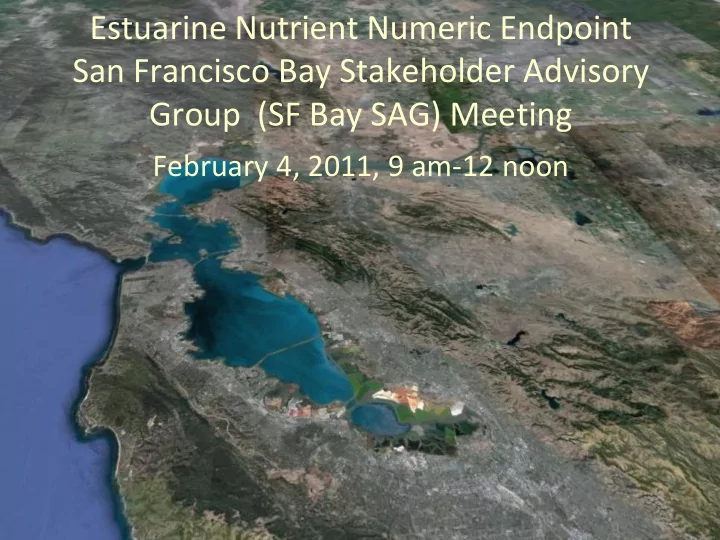
Estuarine Nutrient Numeric Endpoint San Francisco Bay Stakeholder Advisory Group (SF Bay SAG) Meeting February 4, 2011, 9 am-12 noon Context for Todays Meeting SWRCB is Developing Nutrient Objectives for California Waterbodies
Context for Today’s Meeting
SWRCB is Developing Nutrient Objectives for California Waterbodies
- Completed nutrient numeric endpoint (NNE) framework for
streams & lakes (EPA 2006)
- Conceptual approach and work plan drafted for NNE
development in California estuaries (EPA 2008)
- In 2008, SWRCB staff initiated a project to develop NNE
framework for estuaries
- Scope of effort called for literature review and work plan
specific for San Francisco Bay
Project Organization- SF Bay
State Water Resources Control Board (SWRCB) SF Bay SAG
SF RWQCB
STRTAG
SF Bay Technical Team Science Advisory Board (SAB)
Developing NNE Workplan for SF Bay- Process
NNE Workplan for SF Bay
Science
- Form technical team
- Review literature on use of
NNE candidate indicators in SF Bay
- Identify “promising”
indicators, data gaps and recommended next steps
Stakeholders
- Form SF Bay SAG
- Review NNE framework &
background documents
- Provide feedback on
literature review, data gaps and prioritize next steps
Timeframe for Literature Review Form technical team Review conceptual
approach and identify candidate indicators Complete lit. review, data gaps & next steps Finalize lit. review
Form SF Bay SAG
Review background docs Comment on lit. review
Oct 2010 Dec 2010 Jan 2011 Feb 2011 Mar 2011
SF Bay Tech Team SF Bay SAG
Meeting Goals
- Revisit SF Bay SAG membership
– Additional members?
- Discuss and provide feedback on broad conceptual
approach to development of nutrient water quality
- bjectives
- Process to develop NNE framework for SF Bay
– Recommendations from SF Bay Tech Team (Dec 2010 mtg)
SF Bay SAG: Groups
- Municipal dischargers
- Bay/ Delta and by region of the Bay
- Industrial/refineries
- Agriculture
- Environmental
- Land owners/managers
- South Bay Salt Pond Restoration (CC/UFWS)
- Commercial and recreational fisheries
California’s Approach to Nutrient Objectives: Nutrient Numeric Endpoint Framework
SWRCB Staff Strategy: Narrative objectives with numeric guidance (coined as “NNE”) to interpret narrative objectives
- Narrative objectives promulgated once
- Numeric guidance can change as science evolves,
collectively referred to as the “nutrient numeric endpoint “ (NNE) framework
Nutrient Objectives Are Scientifically Challenging
- Nutrients are required to support
life
- How much is too much?
- Toxicity is rarely the endpoint of
interest
- Adverse effects occur at much lower
levels
- Using ambient concentrations can
give false positives or negatives
Three Basic Approaches to Nutrient Objectives
EPA guidance on nutrient criteria development suggests three basic approaches (EPA 2001)
Reference Empirical stress-response models Mechanistic cause-effect models
Reference Approach
- Characterize distributions of nutrient in “minimally
disturbed” waterbodies
- Choose nutrient concentrations at some statistical
percentile of reference waterbodies
75th Percentile of Florida Panhandle Reference Streams
Empirical Stress-Response Approach
- Identify biological response indicator of interest (e.g.
algal biomass)
- Analyze statistical relationships between nutrient
concentrations and response
Correlation Between Chl a and TP in Alkaline Lakes
Cause – Effect Approach
- Diagnosis based on response indicators
– Cause-effect relationships between response indicators and beneficial uses
- Need mechanistic models to link response indicators
to nutrients
– Nutrient loads rather than ambient concentration
Algae and Aquatic Plants
Sediment & Water Chemistry (Dissolved Oxygen, pH)
NNE Based on Cause-Effect Approach
Cause – effect approach has several advantages
- Direct linkage with beneficial uses
- More precise diagnosis of adverse effects
Other approaches are problematic
- Reference sites are unavailable for many waterbody
types, particularly estuaries
- Empirical stress-response is data intensive and
statistical relationships can be spurious, or have lots of unexplained variability
Tenets of California’s Approach
Diagnosis based on response indicators
- Assessing eutrophication, not nutrient overenrichment
- More direct linkage to beneficial use
- More integrative measure than nutrient concentrations
Conceptual Model: Linking Nutrients, Ecological Response, & Beneficial Uses Co-factors modulate ecological response
- B. Ecological Response
Primary Producers Water/Sediment Chemistry Consumers (Invertebrates, Birds, Fish, Mammals)
Ecological Services Habitat, Food for Birds, Fish, Invertebrates, and Mammals Protection of Biodiversity, Spawning, Migration and Threatened/Rare Species Production of Commercial Recreational Fish and Invertebrates Human Services Aesthetics, Odor Good Water Quality, Taste
Ecosystem Services and Beneficial Uses
Beneficial Uses EST, MAR, WILD SPWN, MIGR, RARE COMM, SHELL, AQUA REC2 REC1
- A. Increased Nutrient/Organic Matter Loads, and/or Altered
N:P:Si Ratios
- C. Co-Factors, e.g.:
Hydraulic Residence Time Climate Suspended Sediment Stratification Estuarine circulation Hyposgraphy Top-down grazing Denitrification
Three Tenets of California’s Approach to Nutrient Objectives
- Diagnosis based on response indicators
– More direct link to beneficial use – More integrative measure than nutrient concentrations
- Multiple lines of evidence
– More robust diagnosis
- Need models to link response indicators to nutrients
– Nutrient loads rather than ambient concentration
Indicators Will Vary By Aquatic Habitat
Streams and Rivers Lakes Ocean Estuaries
19
Stream NNE: Example of 303(d) Algal Biomass Thresholds by Beneficial Use
Response Indicator Beneficial Use COLD WARM REC-1 &-2 MUN SPWN MIGR Benthic Algal Biomass (mg chl a m-2) 150 200 Same as WARM/COLD 100 100 Not Defined
Diatoms
Soft –Bodied Algal (and Cyanobacteria)
Benthic Algal Biomass + pH + Dissolved Oxygen
20
NNE Benthic Biomass Spreadsheet Tool
- Spreadsheet tools to
convert response targets to site- specific TN and TP concentration goals
Account for co-
factors that modify biological response to nutrients
- Used for initial screening – defer to more complete
modeling / monitoring studies
Status of Nutrient Objective Development by Waterbody Type
Waterbody Type Status Streams Endpoints and tools drafted Lakes Endpoints and tools drafted Enclosed Bays & Estuaries Endpoints under development Nearshore Coastal Waters No work undertaken
Take Home Message
NNE “framework” consists of two components:
- Numeric endpoints based on ecological response
- Requires models to link ecological response
indicators back to nutrients and other co-factors controlling eutrophication or oligotrophication NNE assesses “eutrophication” or “oligotrophication”, not nutrient overenrichment
Feedback on NNE Conceptual Approach
Questions? Comments?
Process to Develop NNE Framework for SF Bay
- Specify geographic scope and habitat types included
- Develop conceptual models and ID candidate
indicators
- Review utility of indicators vis-à-vis evaluation criteria
- Identify data gaps and recommended next steps to:
– Develop diagnostic framework and select endpoints – Develop load-response models
- Work plan – Consensus on prioritized steps to develop
NNE
SF Bay Technical Team Roster
- Rafael Kudela (UC Santa Cruz)
- Jim Cloern (USGS)
- Kathy Boyer (SFSU)
- Dick Dugdale (SFSU)
- Lester McKee (SFEI)
- Martha Sutula (SCCWRP)
Recommended Geographic Scope of SF Bay Literature Review and Initial NNE Development
Scope synonymous with SFRWQCB boundary
- Represents transition in
hydrology & salinity regime
- Natural boundary for
development of hydrodynamic and water quality models
Recommended Habitat Types To Include in SF Bay NNE Framework
Deepwater
- r Turbid
Subtidal Shallow Subtidal Intertidal Flats Marsh
1 2 3
- Include intertidal flats,
shallow and deepwater subtidal
- Exclude emergent marsh
- Include estuarine diked
baylands and restored salt ponds
Process to Develop NNE Framework for SF Bay
Specify geographic scope and habitat types included
- Develop conceptual models and ID candidate
indicators
- Review utility of indicators vis-à-vis evaluation criteria
- Identify data gaps and recommended next steps to:
– Develop diagnostic framework and select endpoints – Develop load-response models
- Work plan – Consensus on prioritized steps to develop
NNE
Conceptual Model: Linking Nutrients, Ecological Response, & Beneficial Uses Co-factors modulate ecological response
- B. Ecological Response
Primary Producers Water/Sediment Chemistry Consumers (Invertebrates, Birds, Fish, Mammals)
Ecological Services Habitat, Food for Birds, Fish, Invertebrates, and Mammals Protection of Biodiversity, Spawning, Migration and Threatened/Rare Species Production of Commercial Recreational Fish and Invertebrates Human Services Aesthetics, Odor Good Water Quality, Taste
Ecosystem Services and Beneficial Uses
Beneficial Uses EST, MAR, WILD SPWN, MIGR, RARE COMM, SHELL, AQUA REC2 REC1
- A. Increased Nutrient/Organic Matter Loads, and/or Altered
N:P:Si Ratios
- C. Co-Factors, e.g.:
Hydraulic Residence Time Climate Suspended Sediment Stratification Estuarine circulation Hyposgraphy Top-down grazing Denitrification
SF Bay Estuarine NNE Framework:
Candidate Indicators
Physiochemical Indicators
- Dissolved oxygen
- Light attenuation
- Toxic metabolites
(HAB toxins)
- Urea
- Ammonia: nitrate
ratio
Primary Producers Indicators
- Phytoplankton
- Macroalgae
- Submerged aquatic
vegetation Consumer Indicators
- Benthic macro-
invertebrates
- Jellyfish
List of Candidate NNE Indicators For SF Bay by Habitat Type
Indicator Habitat Type Tidal Flats Subtidal Unvegetat ed Seagrass/ brackish SAV Deepwater /turbid subtidal Dissolved oxygen Macroalgae biomass/% Cover Epiphyte load & light attenuation Phytoplankton biomass, community composition and/or growth efficiency HAB sp. abundance and/or toxin conc. Macrobenthos taxonomy/ biomass Ammonia:nitrate ratios, urea Jelly fish
Process to Develop NNE Framework for SF Bay
Specify geographic scope and habitat types included Develop conceptual models and ID candidate
indicators
- Review utility of indicators vis-à-vis evaluation criteria
- Identify data gaps and recommended next steps to:
– Develop diagnostic framework and select endpoints – Develop load-response models
- Work plan – Consensus on prioritized steps to develop
NNE
Indicator Review Criteria
- Clear understanding of how indicator changes along disturbance
gradient (pristine to most disturbed)
- Dose – response relationship exists between indicator & higher
trophic level (link to beneficial use)
- Can develop predictive model between nutrient loads, other co-
factors, and ecological response (statistical, spreadsheet, or dynamic simulation models)
- Scientifically sound and practical measurement process
- Show a detectable trend in eutrophication or oligotrophication
(signal: noise ratio is acceptable)
SF Bay Literature Review- Outline
- Introduction and purpose
- Conceptual models, beneficial uses, list of candidate
indicators, & indicator review criteria
- Geographic setting
- Trends and data gaps in estimation of nutrient loads
in SF Bay
- Evaluation of Candidate NNE Indicators for Use in SF
Bay
- Synthesis, data gaps, and recommended next steps
Status of Literature Review
- Draft complete
- Initial review by SF Bay Tech Team on Feb 11, 2011
- Final draft targeted for March 2011 for distribution
to SF Bay SAG
Process to Develop NNE Framework for SF Bay
Specify geographic scope and habitat types included Develop conceptual models and ID candidate
indicators
- Review utility of indicators vis-à-vis evaluation criteria
- Identify data gaps and recommended next steps to:
– Develop diagnostic framework and select endpoints – Develop load-response models
- Work plan – Consensus on prioritized steps to develop
NNE
Discussion on Development of Workplan
- Coordination on development of RMP nutrient strategy
Wrap Up and Next Steps
- Next SF Bay SAG Meeting
- Late March or early April
- Coordination with RMP nutrient strategy
Review of Science for NNE in Estuaries: Example for Mudflat Habitat
Macroalgal Mats in Mugu Lagoon, Southern California (Photo Credit L. Green)
Indicator Review Criteria
- Clear understanding of how indicator changes along
disturbance gradient (pristine to most disturbed)
- Dose – response relationship exists between indicator & higher
trophic level (link to beneficial use)
- Scientifically sound and practical measurement process
- Show a detectable trend in eutrophication (signal: noise ratio
is acceptable)
- Can develop predictive model between nutrient loads, other
co-factors, and ecological response (statistical, spreadsheet, or dynamic simulation models)
% Dominance
N loading rate
macroalgae
Micro- phytobenthos
* depends on tidal elevation and water residence time
+ mediated by herbivory # depends on benthic topography +
cyano- bacterial mats
*#
Conceptual model of relationships among N-loading rate and the community composition of primary producers in shallow subtidal and intertidal flats of perennially tidal estuaries (Adapted from Valiela et al. 1997)
Unvegetated Intertidal N loading rate
Macroalgae
seagrass
epi phytes
+
cyano- bacterial mats
*#
Shallow Subtidal
% Dominance
Micro- Phyto- benthos
Minimally Disturbed Undergoing Eutrophication Light bioturbati
- n
Low Organic Matter Burial O2 N Loss Anoxic Respiration N cycling & loss Anoxic Respiration (Sulfide) Light High Organic Matter Burial Increased Nutrient Availability Nutrient load Nutrient load bioturbation O2 O2 respiration Anaerobic Respiration N cycling and loss N Loss O2 respiration
Conceptual Model of Effects of Macroalgae On Infauna in Intertidal Flats
Documented Link with Beneficial Uses: Two Tests
- Weight of scientific evidence demonstrating linkage?
- Dose-response data that support selection of a
threshold?
Benthic Infauna Diversity Macroalgal Mat Biomass
Effects on Management Endpoints of Concern
- Poor surface water quality (strong diel DO fluctuations and
hypoxia, increased bacterial growth) and aesthetics: REC1, REC2, EST, MAR, SPWN, RARE, COMM
- Poor benthic habitat quality (Increased sediment organic
matter accumulation, increased pore water sulfide, ammonia, etc.): EST, MAR, RARE, COMM, AQUA
- Changes in food web (shifts in food supply for upper trophic
levels)
- Loss of critical habitat for fisheries, birds, esp. T&E species
Summary of Studies Documenting Effects of Macroalgae on Infauna on Intertidal Flats
- Lots of studies demonstrating effects
- Comparison difficult because of disparate methods
- Studies cannot be used to evaluate thresholds, with
exception of:
- Green 2010 (Mugu Lagoon, so. Calif.)
- Bona et al. 2006 (European Mediterranean)
Macroalgal Blooms on Intertidal Flats Cause Declines in Benthic Infauna Diversity and Abundance
Spionids
0.5 1 1.5 2 2.5 3 3.5 4 Mean Spionids /m
2 (x10 4)
Treatment 0.5 cm 1.5 cm 4.0 cm
P<0.0001
Week 2 Week 4 Week 6 Week 8
Lauri Green, Ph.D. Dissertation, UCLA Department of Biology (Spring 2010) P=0.017
2000 4000 6000 8000 10000
0.5 cm 1.5 cm 4.0 cm
Mean Sulfide mg/L Mat depth
Mean Sulfide (μM)
Macroalgal Blooms Reduce in Availability
- f Invertebrate Forage Food for Birds and
Fish
Indicators of Macroalgal community structure
Abundance–Scientifically well-vetted means of measuring
- Biomass (thickness)
- Percent cover
Taxonomic composition – not relevant for California estuaries
Macroalgae Has A Well-Documented Relationship with Nutrient Loading
- Yes - best example is Waquoit Bay (MA)
– Total nutrient loads predict algal biomass in 3 sub- basins with differing loads – But the relationship is complex (easiest where river sources are dominant)
- Data to establish empirical load-macroalgal response
relationships for California estuaries do not exist
- Few examples of use dynamic simulation modeling
exist, none local
Information Needs to Be Synthesized into an Assessment Framework
Example of Macroalgal Assessment Framework From EU WDR (from Scalan et
- al. 2007)
Macroalgae on Intertidal Flats: Summary
- Macroalgae meets criteria as “acceptable” indicator
- Additional data on effects of macroalgal mats on
infauna in intertidal flats
- Need various treatment levels and duration
- Response may vary by sediment type and organic matter
content, time of year, estuarine class, climate, etc.
- Lack of information on range of biomass and % cover
found over disturbance gradient in California estuaries
- Lack of information on precision and accuracy of
nutrient load-response models
Comments? Questions?
Developing NNE Workplan for SF Bay- Process
Science
- Form technical team
- Review literature on use of
NNE candidate indicators in SF Bay
- Identify “promising”
indicators, data gaps and recommended next steps
Stakeholders
- Form SF Bay SAG
- Review NNE framework
& background documents
- Provide feedback on SF
Bay literature review, data gaps and prioritize next steps
Developing NNE Workplan for SF Bay- Process
NNE Workplan for SF Bay
Science
- Form technical team
- Review literature on use of
NNE candidate indicators in SF Bay
- Identify “promising”
indicators, data gaps and recommended next steps
Stakeholders
- Form SF Bay SAG
- Review NNE framework &
background documents
- Provide feedback on
literature review, data gaps and prioritize next steps
Geographic Scope of SF Bay Literature Review and Initial NNE Development
Timeframe for Effort
Form technical team Complete lit. review, data gaps & next steps Draft work plan Final work plan Form SF Bay SAG Review background docs Comment on lit. review Comment on draft work plan
Sept 2010 Nov 2010 Jan 2011 Mar 2012 May 2012
SF Bay Tech Team SF Bay SAG
Clearinghouse for NNE Documents
http://californiaestuarinenneproject.shutterfly.com/
Questions? Comments?
Agenda
- Welcome, introductions, meeting goals, logistics
- Overview of NNE project, organization and key staff
- NNE conceptual approach and workplan
development for San Francisco Bay
- Role and selection of San Francisco Bay stakeholder
advisory group members and alternates (SF Bay SAG)
- Summary of action items, next steps
Agenda
- Welcome, introductions, meeting goals, logistics
- Overview of NNE project, organization and key staff
- NNE conceptual approach and workplan
development for San Francisco Bay
- Role and selection of San Francisco Bay stakeholder
advisory group members and alternates (SF Bay SAG)
- Summary of action items, next steps
Proposed Groups
- Municipal dischargers
- Bay/ Delta and by region of the Bay
- Industrial/refineries
- Agriculture
- Environmental
- Land owners/managers
- South Bay Salt Pond Restoration (CC/UFWS)
- Commercial and recreational fisheries
Action Items, Next Steps
- Confirm members and alternates
- Set date for first SF Bay SAG meeting- November