Common Endpoint Locator Pools Common Endpoint Locator Pools Common - - PowerPoint PPT Presentation

common endpoint locator pools common endpoint locator
SMART_READER_LITE
LIVE PREVIEW

Common Endpoint Locator Pools Common Endpoint Locator Pools Common - - PowerPoint PPT Presentation

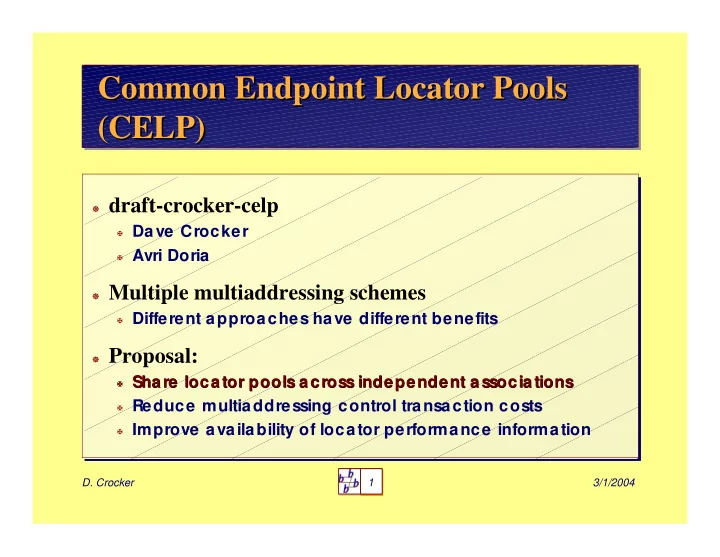
Common Endpoint Locator Pools Common Endpoint Locator Pools Common Endpoint Locator Pools (CELP) (CELP) (CELP) draft-crocker-celp draft-crocker-celp Dave Crocker Dave Crocker Avri Doria Avri Doria Multiple


slide-1
SLIDE 1
  • D. Crocker

3/1/2004 1 1

Common Endpoint Locator Pools (CELP) Common Endpoint Locator Pools Common Endpoint Locator Pools (CELP) (CELP)

draft-crocker-celp Dave Crocker Avri Doria Multiple multiaddressing schemes Different approaches have different benefits Proposal: Share locator pools across independent associations Reduce multiaddressing control transaction costs Improve availability of locator performance information draft-crocker-celp Dave Crocker Avri Doria Multiple multiaddressing schemes Different approaches have different benefits Proposal: Share locator pools across independent associations

Share locator pools across independent associations

Reduce multiaddressing control transaction costs Improve availability of locator performance information

slide-2
SLIDE 2
  • D. Crocker

3/1/2004 2 2

Synergy Across Associations Synergy Across Associations Synergy Across Associations

Transport-based schemes

  • Multiplex control exchange in data stream, so control

data does not increase packet overhead

  • Can naturally obtain path quality information

Wedge-based schemes

  • Multiaddressing for legacy transports
  • Naturally independent of individual transport associations
  • Can operate asynchronously of associations, deferring

control exchanges, often needing no exchange

  • Can maintain pools with different referential granularity

Transport-based schemes

  • Multiplex control exchange in data stream, so control

data does not increase packet overhead

  • Can naturally obtain path quality information

Wedge-based schemes

  • Multiaddressing for legacy transports
  • Naturally independent of individual transport associations
  • Can operate asynchronously of associations, deferring

control exchanges, often needing no exchange

  • Can maintain pools with different referential granularity
slide-3
SLIDE 3
  • D. Crocker

3/1/2004 3 3

Framework Framework Framework

Variable granularity

{local, remote} {local, remote, flow} {local, remote, protocol, port} {local, remote, type of service}

Status

Reachability Performance

Variable granularity

{local, remote} {local, remote, flow} {local, remote, protocol, port} {local, remote, type of service}

Status

Reachability Performance

Wedge MA Tport MA TCP IP

H1 H1all

all

EP2 EP2file

file

EP2 EP2sip

sip

H = host EP = endpoint MA = multiaddressing

Locator Locator Pools Pools

Add Delete Modify

slide-4
SLIDE 4
  • D. Crocker

3/1/2004 4 4

Issues Issues Issues

  • Path selection
  • Which paths are available or better?
  • Suggestion: Defer generality; start with primary and fallback choices
  • Local/Remote combinatorials
  • Suggestion: Defer generality; start with just {remote} or {local, remote}
  • Security
  • Different schemes have different degrees of security concern about

weakest participant affects entire service

  • Maintaining synchrony among different modifiers of pool
  • Referential commonality
  • Different schemes use different identifiers
  • How to know that different locators refer to same endpoint?
  • Suggestion: T

hat’s what domain names are for…

  • Path selection
  • Which paths are available or better?
  • Suggestion: Defer generality; start with primary and fallback choices
  • Local/Remote combinatorials
  • Suggestion: Defer generality; start with just {remote} or {local, remote}
  • Security
  • Different schemes have different degrees of security concern about

weakest participant affects entire service

  • Maintaining synchrony among different modifiers of pool
  • Referential commonality
  • Different schemes use different identifiers
  • How to know that different locators refer to same endpoint?
  • Suggestion: T

hat’s what domain names are for…

slide-5
SLIDE 5
  • D. Crocker

3/1/2004 5 5

Next Steps Next Steps Next Steps

Resolve

Differential security issues Near-term vs. long-term issues Determining common endpoint referencing

Formulate CELP service model details

Data structures Operations

Resolve

Differential security issues Near-term vs. long-term issues Determining common endpoint referencing

Formulate CELP service model details

Data structures Operations