Estuaries: Looking Into the Black Box Estuaries: Looking Into the - - PowerPoint PPT Presentation

estuaries looking into the black box estuaries looking
SMART_READER_LITE
LIVE PREVIEW

Estuaries: Looking Into the Black Box Estuaries: Looking Into the - - PowerPoint PPT Presentation

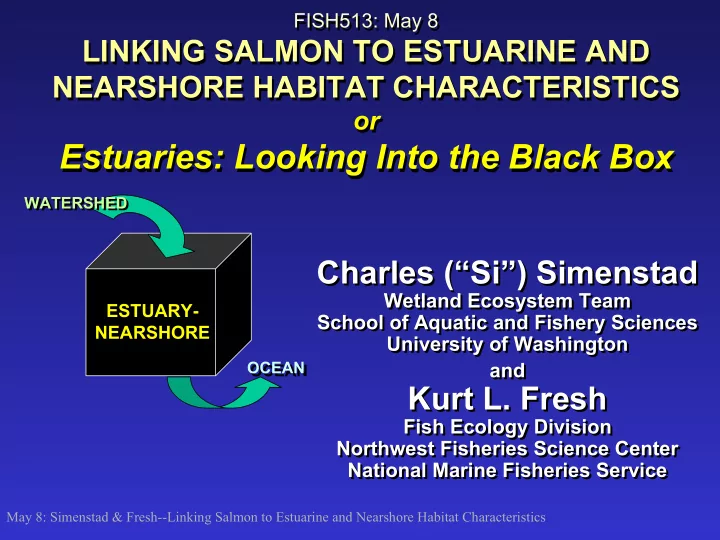
FISH513: May 8 FISH513: May 8 LINKING SALMON TO ESTUARINE AND LINKING SALMON TO ESTUARINE AND NEARSHORE HABITAT CHARACTERISTICS NEARSHORE HABITAT CHARACTERISTICS or or Estuaries: Looking Into the Black Box Estuaries: Looking Into the Black


slide-1
SLIDE 1

May 8: Simenstad & Fresh--Linking Salmon to Estuarine and Nearshore Habitat Characteristics

FISH513: May 8

LINKING SALMON TO ESTUARINE AND NEARSHORE HABITAT CHARACTERISTICS

  • r

Estuaries: Looking Into the Black Box

FISH513: May 8

LINKING SALMON TO ESTUARINE AND NEARSHORE HABITAT CHARACTERISTICS

  • r

Estuaries: Looking Into the Black Box

Charles (“Si”) Simenstad

Wetland Ecosystem Team School of Aquatic and Fishery Sciences University of Washington and

Kurt L. Fresh

Fish Ecology Division Northwest Fisheries Science Center National Marine Fisheries Service

Charles (“Si”) Simenstad

Wetland Ecosystem Team School of Aquatic and Fishery Sciences University of Washington and

Kurt L. Fresh

Fish Ecology Division Northwest Fisheries Science Center National Marine Fisheries Service

ESTUARY- NEARSHORE

WATERSHED WATERSHED OCEAN OCEAN

slide-2
SLIDE 2

May 8: Simenstad & Fresh--Linking Salmon to Estuarine and Nearshore Habitat Characteristics

GENERAL QUESTIONS GENERAL QUESTIONS

  • 1. How do nearshore and estuarine habitat

characteristics affect salmon in one or more life stages, and how do you recommend that those effects be translated into predictions about population capacity, growth or productivity?

  • 2. What are the 2 (or 3 or 4) biggest sources of

uncertainty in making predictions about how nearshore and estuarine habitat characteristics affects salmon in one or more life stages?

  • 3. What 2 (or 3 or 4) alternative scenarios of

current or future conditions would you suggest should be explored to make our model predictions about the effects of nearshore and estuarine habitat change on salmon more robust to uncertainties?

  • 1. How do nearshore and estuarine habitat

characteristics affect salmon in one or more life stages, and how do you recommend that those effects be translated into predictions about population capacity, growth or productivity?

  • 2. What are the 2 (or 3 or 4) biggest sources of

uncertainty in making predictions about how nearshore and estuarine habitat characteristics affects salmon in one or more life stages?

  • 3. What 2 (or 3 or 4) alternative scenarios of

current or future conditions would you suggest should be explored to make our model predictions about the effects of nearshore and estuarine habitat change on salmon more robust to uncertainties?

slide-3
SLIDE 3

May 8: Simenstad & Fresh--Linking Salmon to Estuarine and Nearshore Habitat Characteristics

STUDENT QUESTIONS STUDENT QUESTIONS

1) Si: Onc 1) Si: Once est estuarine arine habit habitats have bee have been removed or removed or ext extensively nsively modified by

  • dified by developmen

development, how s how successf essfully can lly can t their f eir func nction

  • nali

ality as sa y as salmo lmon rearing rearing habit habitats be rest be restored (ca

  • red (can y

you rew rewind t nd the f e funct nction of est

  • f estuarine

arine areas, areas, onc

  • nce dis

disturbed)? Is res bed)? Is restoration of m

  • f modera

derate to hig highly ly d disturbed es bed estuarine areas an effec arine areas an effectiv ive e use of manag e of manageme ment dollars, dollars, or w

  • r would t

d these ese funds be bet nds be better spe er spent limit limiting ing developme development and modif and modifica cation

  • n of less dis
  • f less disturbed es

bed estuarine arine areas? areas? 2) K 2) Kurt: Ca : Can y n you disc discuss t s to w what at level research level researchers have been able ers have been able to qu quantify fy t the e eff effect cts of s of individ individual fac al factors on t s on the es e estuarine environ arine environment ent (on (on smol smolt s survi rvival) and dis l) and distin ingu guish salm h salmon

  • n

es estuarine s arine survival from marine s rvival from marine survival. Are more s

  • rvival. Are more studies

ies need needed in t ed in this area? In w is area? In what areas are w areas are we missing missing informa informatio ion, i.e wha i.e what type pes of s s of studies sh ies shou

  • uld be pr

ld be prior ioritized zed to unders derstand and enhanc and enhance es e estuarine arine surv rvival of ju ival of juvenile nile salmo salmonids? s? 3) S Si: W We k know th that s someth thing o

  • n th

the o

  • rder of 70% of

70% of P Puget So Sound es d estuarine arine wetland areas and areas have be have been lost lost to develo developmen pment, b but we we h have ve seen seen s some l me large r recen cent ru runs o

  • f chu

chum salm salmon

  • n

in t in the so e south P h Puget So Sound area. I d area. In o

  • ther ar

her areas, lik eas, like H e Hood Canal,

  • d Canal, c

chum salmo salmon remai remain liste ted a and r returns r relati tively l

  • low. C

Can w we c correlate te th the d drainages w with th g greate ter c chum ret returns w s with available est available estuarine arine area areas, s, or are o

  • r are other fact

her factors a

  • rs at work?

rk? 4) K Kurt rt: M : Much of y

  • f your rec

recent w work ha rk has invo s involved lved ch chin inook s

  • ok salmon
  • n in

in Lake Lake W Washingt

  • shington. J
  • n. Juvenil

nile chi chinook spe

  • ok spend a sig

d a signif ifican icant period of period of time rear me rearin ing in g in La Lake Wa Washin ington before movi before moving ng in into est estuarine areas, a some arine areas, a somewhat at unusual be l behavior fo havior for th the s

  • species. A

Are th these f fish su substi tituti ting the lake environmen e lake environment fo for an r an es estuarine rearin arine rearing h habita tat t (are th the tw two a areas s serving s similar eco ecolog

  • gical f

ical funct nctions?). Do Lak s?). Do Lake W Washingt shington

  • n Chinook spe

inook spent a correspo a corresponding dingly ly lesser t lesser time in me in est estuarine areas t arine areas than o an other chi her chinook popu

  • ok populations

s that do not do not pass pass thro rough a lak h a lake enviro vironmen nment d during ring their o eir outmig igra ration? 5) 5) Si/ Si/Kurt: Can yo Can you cont contrast patt patterns o erns of use and relat e and relative im ve import portance of est ance of estuarine areas t arine areas to ch chum and fall ch and fall chinook pop inook popula lations in Pu

  • ns in Puget Sou

Sound? d? 1) Si: Onc 1) Si: Once est estuarine arine habit habitats have bee have been removed or removed or ext extensively nsively modified by

  • dified by developmen

development, how s how successf essfully can lly can t their f eir func nction

  • nali

ality as sa y as salmo lmon rearing rearing habit habitats be rest be restored (ca

  • red (can y

you rew rewind t nd the f e funct nction of est

  • f estuarine

arine areas, areas, onc

  • nce dis

disturbed)? Is res bed)? Is restoration of m

  • f modera

derate to hig highly ly d disturbed es bed estuarine areas an effec arine areas an effectiv ive e use of manag e of manageme ment dollars, dollars, or w

  • r would t

d these ese funds be bet nds be better spe er spent limit limiting ing developme development and modif and modifica cation

  • n of less dis
  • f less disturbed es

bed estuarine arine areas? areas? 2) K 2) Kurt: Ca : Can y n you disc discuss t s to w what at level research level researchers have been able ers have been able to qu quantify fy t the e eff effect cts of s of individ individual fac al factors on t s on the es e estuarine environ arine environment ent (on (on smol smolt s survi rvival) and dis l) and distin ingu guish salm h salmon

  • n

es estuarine s arine survival from marine s rvival from marine survival. Are more s

  • rvival. Are more studies

ies need needed in t ed in this area? In w is area? In what areas are w areas are we missing missing informa informatio ion, i.e wha i.e what type pes of s s of studies sh ies shou

  • uld be pr

ld be prior ioritized zed to unders derstand and enhanc and enhance es e estuarine arine surv rvival of ju ival of juvenile nile salmo salmonids? s? 3) S Si: W We k know th that s someth thing o

  • n th

the o

  • rder of 70% of

70% of P Puget So Sound es d estuarine arine wetland areas and areas have be have been lost lost to develo developmen pment, but we we h have ve seen seen s some l me large recen cent r runs of chu

  • f chum salm

salmon

  • n

in t in the so e south P h Puget So Sound area. I d area. In o

  • ther ar

her areas, lik eas, like H e Hood Canal,

  • d Canal, c

chum salmo salmon remai remain liste ted a and r returns r relati tively l

  • low. C

Can w we c correlate te th the d drainages w with th g greate ter c chum ret returns w s with available est available estuarine arine area areas, s, or are o

  • r are other fact

her factors a

  • rs at work?

rk? 4) K Kurt rt: M : Much of y

  • f your rec

recent w work ha rk has invo s involved lved ch chin inook s

  • ok salmon
  • n in

in Lake Lake W Washingt

  • shington. J
  • n. Juvenil

nile chi chinook spe

  • ok spend a sig

d a signif ifican icant period of period of time rear me rearin ing in g in La Lake Wa Washin ington before movi before moving ng in into est estuarine areas, a some arine areas, a somewhat at unusual be l behavior fo havior for th the s

  • species. A

Are th these f fish su substi tituti ting the lake environmen e lake environment fo for an r an es estuarine rearin arine rearing h habita tat t (are th the tw two a areas s serving s similar eco ecolog

  • gical f

ical funct nctions?). Do Lak s?). Do Lake W Washingt shington

  • n Chinook spe

inook spent a correspo a corresponding dingly ly lesser t lesser time in me in est estuarine areas t arine areas than o an other chi her chinook popu

  • ok populations

s that do not do not pass pass thro rough a lak h a lake enviro vironmen nment d during ring their o eir outmig igra ration? 5) 5) Si/ Si/Kurt: Can yo Can you cont contrast patt patterns o erns of use and relat e and relative im ve import portance of est ance of estuarine areas t arine areas to ch chum and fall ch and fall chinook pop inook popula lations in Pu

  • ns in Puget Sou

Sound? d?

slide-4
SLIDE 4

May 8: Simenstad & Fresh--Linking Salmon to Estuarine and Nearshore Habitat Characteristics

RESILIENCE RESILIENCE

Should fish production be the only metric for salmon recovery?

For species that are so pervasively affected by ocean variability, what about population resilience = strength to stand up to shocks, especially the ability

  • f an ecosystem to return to it’s normal state after

being disturbed Fundamental assumptions: – Population resilience derives from life history diversity – Life history diversity is related to habitat diversity/complexity

  • Thus, from a metapopulation perspective, population

resilience depends upon habitat diversity in both freshwater and estuarine-nearshore (and ocean?) phases of juvenile salmon; likely are linked.

Should fish production be the only metric for salmon recovery?

For species that are so pervasively affected by ocean variability, what about population resilience = strength to stand up to shocks, especially the ability

  • f an ecosystem to return to it’s normal state after

being disturbed Fundamental assumptions: – Population resilience derives from life history diversity – Life history diversity is related to habitat diversity/complexity

  • Thus, from a metapopulation perspective, population

resilience depends upon habitat diversity in both freshwater and estuarine-nearshore (and ocean?) phases of juvenile salmon; likely are linked.

slide-5
SLIDE 5

May 8: Simenstad & Fresh--Linking Salmon to Estuarine and Nearshore Habitat Characteristics

PERSPECTIVES ON SALMON RECOVERY:

Production vs. Resilience

PERSPECTIVES ON SALMON RECOVERY:

Production vs. Resilience

Diffusion is more desirable Core habitat is target Diversity and sub-optimal life history types and habitat just as important Seeks optimization of habitat Cumulative factors Bottlenecks Stochastic Deterministic

Resilience Production

slide-6
SLIDE 6

May 8: Simenstad & Fresh--Linking Salmon to Estuarine and Nearshore Habitat Characteristics

SALMON AND ESTUARIES SALMON AND ESTUARIES

  • Life histories
  • Patterns of occurrence
  • How and why they use them
  • So what?
  • Implications for salmon

recovery

  • Life histories
  • Patterns of occurrence
  • How and why they use them
  • So what?
  • Implications for salmon

recovery

slide-7
SLIDE 7

May 8: Simenstad & Fresh--Linking Salmon to Estuarine and Nearshore Habitat Characteristics

10 20 30 40 50 60 70 80 90 100

Umpqua Alsea Yaquina Nestucca Sand Lake Tillamook Nehalem Columbia Willapa Bay Grays Harbor Dungeness Skokomish Nisqually Puyallup Duwamish Snohomish Stillaguamish Skagit Samish Lummi Noosack

Wetland Loss (%) Wetland Loss (%)

Estuarine Wetland Loss in the Pacific Northwest Estuarine Wetland Loss in the Pacific Northwest Estuarine Wetland Loss in the Pacific Northwest

Estuary Estuary

slide-8
SLIDE 8

May 8: Simenstad & Fresh--Linking Salmon to Estuarine and Nearshore Habitat Characteristics

SUBESTUARY DEVELOPMENT OF HOOD CANAL AND EASTERN STRAIT OF JUAN DE FUCA

0.00 5.00 10.00 15.00 20.00 25.00 30.00 35.00 Union Big Mission Tahuya Skokomish Lilliwaup Hamma Hamma Dewatto Duckabush Dosewallips Anderson Stavis Seabeck Big Quilcene Little Quilcene Tarboo Big Beef Chimacum Snow/Salmon Creeks Jimmycomelately Dungeness Subestuary Proportion Lost (%)

% Diked % Filled % Excavated

(Source: Simenstad, unpubl.)

slide-9
SLIDE 9

May 8: Simenstad & Fresh--Linking Salmon to Estuarine and Nearshore Habitat Characteristics

DUWAMISH RIVER/ELLIOTT BAY ESTUARINE HABITAT LOSS 1854-1986

100 200 300 400 500 600 700 800 TIDAL SWAMPS TIDAL MARSHES SHALLOWS AND MUDFLATS GRAVEL- COBBLE BEACHES SANDSPITS HABITATS HABITAT AREA (hectares) 10 20 30 40 50 60 70 80 90 100 RELATIVE LOSS (%)

1854 1986 % Change

slide-10
SLIDE 10

May 8: Simenstad & Fresh--Linking Salmon to Estuarine and Nearshore Habitat Characteristics

WATERSHED-SCALE CHANGES IMPACTING ESTUARIES

Changes in Duwamish River Watershed: 1912 Diversion of White River to Puyallup River watershed (-25.2%) 1916 Diversion of Cedar and Lake Washington-Lake Sammamish watersheds to Lake Washington Ship Canal (-40.6%) = 70-75% reduction in freshwater inflow to estuary

HISTORICAL CHANGES IN DUWAMISH RIVER DISCHARGE, 1860-1986

1000 2000 3000 4000 5000 6000 7000 8000 9000 10000 J F M A M J J A S O N D

Month Discharge (cfs)

1860 1936 1960 1986

slide-11
SLIDE 11

May 8: Simenstad & Fresh--Linking Salmon to Estuarine and Nearshore Habitat Characteristics

FOR PACIFIC SALMON, LIFE IS JUST A CONTIMUUM OF BOTTLENECKS! FOR PACIFIC SALMON, LIFE IS JUST A CONTIMUUM OF BOTTLENECKS!

Species-LH Type Freshwater Residence Downstream Migration Estuarine Residence Estuary- Ocean Transition Ocean Residence Possible Life History Types

PINK Virtually none Immediate & rapid, as fry Short; ~2 weeks Rapid Fixed; 2 years 1 CHUM Virtually none Immediate, as fry Short-moderate, 2-3 weeks Rapid Variable; 1-5 years 10 SOCKEYE-lake type Extensive, 1-3 years in lakes Relatively rapid, as smolts; I-2 weeks Short; few days Highly variable Variable; 1-3 years 9

  • ocean type

Short Rapid, as fry Often extensive; 1 week-5 months Unknown Fixed; 1 years 1 COHO-stream type Extensive; 1-4 years Relatively rapid, as smolts; 1-2 weeks Short; few days Highly variable Variable; 1-5 years 11

  • ocean type

Virtually none Rapid, as fry Long? May involve protracted

  • verwintering, and

return upstream to rear? Unknown? Fixed; 1 year 1 CHINOOK-stream type Variable; 1-2 years Variable; few days to months Short; few days Highly variable Variable; <1 to 6 years >13

  • ocean type

Variable; few days to months Variable; rapid as fry, longer as fingerlings Highly variable; days to 6 months Highly variable;

  • ften prolonged

Variable; <1 to 6 years 36

slide-12
SLIDE 12

May 8: Simenstad & Fresh--Linking Salmon to Estuarine and Nearshore Habitat Characteristics

PACIFIC SALMON ECOSCAPE, Puget Sound

denoting freshwater, estuarine and nearshore habitat continuum, where different salmon species and life history stages diversify

PACIFIC SALMON ECOSCAPE, Puget Sound

denoting freshwater, estuarine and nearshore habitat continuum, where different salmon species and life history stages diversify

Adapted by C. Simenstad from an original illustration by the GIS & Visual Communications Unit, King County Department of Natural Resources

slide-13
SLIDE 13

May 8: Simenstad & Fresh--Linking Salmon to Estuarine and Nearshore Habitat Characteristics

STUDENT QUESTIONS STUDENT QUESTIONS

1) 1) Si: Once es Si: Once estuar arine habi ine habita tats ha have ve be been re en remove ved or e d or extensively nsively modif ifie ied by develop d by developmen ent, t, how s how successf ccessfully ly can t can their f eir funct nctionali

  • nality as salm

y as salmon re

  • n reari

aring habit habitats be be r rest stored (can y (can you rewind t rewind the f e funct nction of es

  • n of estuari

arine e areas, areas, once dist

  • nce disturbed)

bed)? Is rest ? Is restora

  • ration of m

ion of moderat derate t to hig highly ly dist disturbed bed est estuari arine areas an effec e areas an effective ive use of e of managem gement dollars, dollars, or w

  • r would t

d these f ese funds be better sp nds be better spent l t limi miting d development a t and mo modificati tion o

  • f less

dis disturbed est bed estuari arine areas? e areas? 2) 2) K Kurt rt: Can y : Can you dis discuss t s to wha what le level rese vel researchers ha chers have been able ve been able to q quan antify fy the effec e effects of individ s of individual al fac factors on t

  • rs on the es

e estu tuarine environ e environment ent (on s (on smolt

  • lt s

surviv rvival) al) and dist and distin inguish sal h salmon est

  • n estuari

arine s e survival fro ival from marine su rine surv rviva

  • ival. Are m

. Are more re s studies nee ies needed in t in this is area? In what area? In what areas are we areas are we m missing ng i informat atio ion, n, i.e i.e what what typ types of st s of studies sho ies should be pr be priorit ioritized zed to u underst derstand and enhanc nd and enhance es e estuari arine e surviva ival of j

  • f juvenile

nile sal salmonids?

  • nids?

3) Si: We know t 3) Si: We know that something on the order of 70% of Puget Sound at something on the order of 70% of Puget Sound estuarine wetland areas have been lost to development, but we have estuarine wetland areas have been lost to development, but we have seen some large recent runs of c seen some large recent runs of chum salmon in the south Pug hum salmon in the south Puget Sound t Sound

  • area. In ot
  • area. In other areas, like Hood Canal, chum salmon remain listed and

r areas, like Hood Canal, chum salmon remain listed and returns relatively low. C returns relatively low. Can we correlate the drainages wit n we correlate the drainages with greater greater chum returns with available chum returns with available estuarin estuarine areas, or are other factors at e areas, or are other factors at work? work?

4) 4) K Kurt rt: M : Much of yo ch of your recent recent work ha work has involve s involved chin chinook sal

  • ok salmon in Lake
  • n in Lake Washi

Washingt gton.

  • n. Juveni

nile chi le chinook spend

  • ok spend

a si a signific ifican ant period of period of time rearin rearing in Lake g in Lake Washi Washingt gton before m

  • n before movin

ving int into es estuarine area arine areas, a so a somewha what unusual beha l behavior for t vior for the sp e spec

  • ecies. Are t
  • ies. Are these fish

ese fish subst bstitu tuting ng the lake environ e lake environmen ent for an es for an estuarine e rearing h g habita tat ( t (are th the tw two a areas s serving s g similar e ecologic ical f functions?)

  • ns?). Do

Do Lake Wa Washin ington Ch Chin inoo

  • ok

spen spent a c a correspondin rrespondingly les ly lesser t er time in es in estuari arine ar e areas t eas than ot an other chi her chinook pop

  • ok populat

lations t

  • ns that

at do not do not pass pass thro rough a lak h a lake environ environment ent d during ring their o their outmigra ration? 5) 5) Si/K Si/Kurt: Can yo Can you cont contra rast p patt tterns of ns of use and rela e and relati tive i ve importan ance of es

  • f estuarin

arine areas areas to ch chum and fall and fall chi chinook pop

  • ok populat

lations in P

  • ns in Puget So

Sound? d? 1) 1) Si: Once es Si: Once estuar arine habi ine habita tats ha have ve be been re en remove ved or e d or extensively nsively modif ifie ied by develop d by developmen ent, t, how s how successf ccessfully ly can t can their f eir funct nctionali

  • nality as salm

y as salmon re

  • n reari

aring habit habitats be be r rest stored (can y (can you rewind t rewind the f e funct nction of es

  • n of estuari

arine e areas, areas, once dist

  • nce disturbed)

bed)? Is rest ? Is restora

  • ration of m

ion of moderat derate t to hig highly ly dist disturbed bed est estuari arine areas an effec e areas an effective ive use of e of managem gement dollars, dollars, or w

  • r would t

d these f ese funds be better sp nds be better spent l t limi miting d development a t and mo modificati tion o

  • f less

dis disturbed est bed estuari arine areas? e areas? 2) 2) K Kurt rt: Can y : Can you dis discuss t s to wha what le level rese vel researchers ha chers have been able ve been able to q quan antify fy the effec e effects of individ s of individual al fac factors on t

  • rs on the es

e estu tuarine environ e environment ent (on s (on smolt

  • lt s

surviv rvival) al) and dist and distin inguish sal h salmon est

  • n estuari

arine s e survival fro ival from marine su rine surv rviva

  • ival. Are m

. Are more re s studies nee ies needed in t in this is area? In what area? In what areas are we areas are we m missing ng i informat atio ion, n, i.e i.e what what typ types of st s of studies sho ies should be pr be priorit ioritized zed to u underst derstand and enhanc nd and enhance es e estuari arine e surviva ival of j

  • f juvenile

nile sal salmonids?

  • nids?

3) Si: We know t 3) Si: We know that something on the order of 70% of Puget Sound at something on the order of 70% of Puget Sound estuarine wetland areas have been lost to development, but we have estuarine wetland areas have been lost to development, but we have seen some large recent runs of c seen some large recent runs of chum salmon in the south Pug hum salmon in the south Puget Sound t Sound

  • area. In ot
  • area. In other areas, like Hood Canal, chum salmon remain listed and

r areas, like Hood Canal, chum salmon remain listed and returns relatively low. C returns relatively low. Can we correlate the drainages wit n we correlate the drainages with greater greater chum returns with available chum returns with available estuarin estuarine areas, or are other factors at e areas, or are other factors at work? work?

4) 4) K Kurt rt: M : Much of yo ch of your recent recent work ha work has involve s involved chin chinook sal

  • ok salmon in Lake
  • n in Lake Washi

Washingt gton.

  • n. Juveni

nile chi le chinook spend

  • ok spend

a si a signific ifican ant period of period of time rearin rearing in Lake g in Lake Washi Washingt gton before m

  • n before movin

ving int into es estuarine area arine areas, a so a somewha what unusual beha l behavior for t vior for the sp e spec

  • ecies. Are t
  • ies. Are these fish

ese fish subst bstitu tuting ng the lake environ e lake environmen ent for an es for an estuarine e rearing h g habita tat ( t (are th the tw two a areas s serving s g similar e ecologic ical f functions?)

  • ns?). Do

Do Lake Wa Washin ington Ch Chin inoo

  • ok

spen spent a c a correspondin rrespondingly les ly lesser t er time in es in estuari arine ar e areas t eas than ot an other chi her chinook pop

  • ok populat

lations t

  • ns that

at do not do not pass pass thro rough a lak h a lake environ environment ent d during ring their o their outmigra ration? 5) 5) Si/K Si/Kurt: Can yo Can you cont contra rast p patt tterns of ns of use and rela e and relati tive i ve importan ance of es

  • f estuarin

arine areas areas to ch chum and fall and fall chi chinook pop

  • ok populat

lations in P

  • ns in Puget So

Sound? d?

slide-14
SLIDE 14

May 8: Simenstad & Fresh--Linking Salmon to Estuarine and Nearshore Habitat Characteristics

STREAM MOUTH, Puget Sound STREAM MOUTH, Puget Sound

Adapted by C. Simenstad from an original illustration by the GIS & Visual Communications Unit, King County Department of Natural Resources

slide-15
SLIDE 15

May 8: Simenstad & Fresh--Linking Salmon to Estuarine and Nearshore Habitat Characteristics

ERODING BLUFF, Puget Sound Nearshore ERODING BLUFF, Puget Sound Nearshore

Adapted by C. Simenstad from an original illustration by the GIS & Visual Communications Unit, King County Department of Natural Resources

slide-16
SLIDE 16

May 8: Simenstad & Fresh--Linking Salmon to Estuarine and Nearshore Habitat Characteristics

STUDENT QUESTIONS STUDENT QUESTIONS

1) Si: Onc 1) Si: Once est estuarine arine habit habitats have bee have been removed or removed or ext extensively nsively modified by

  • dified by developmen

development, how s how successf essfully can lly can t their f eir func nction

  • nali

ality as sa y as salmo lmon rearing rearing habit habitats be rest be restored (ca

  • red (can y

you rew rewind t nd the f e funct nction of est

  • f estuarine

arine areas, areas, onc

  • nce dis

disturbed)? Is res bed)? Is restoration of m

  • f modera

derate to hig highly ly d disturbed es bed estuarine areas an effec arine areas an effectiv ive e use of manag e of manageme ment dollars, dollars, or w

  • r would t

d these ese funds be bet nds be better spe er spent limit limiting ing developme development and modif and modifica cation

  • n of less dis
  • f less disturbed es

bed estuarine arine areas? areas? 2) K 2) Kurt: Ca : Can y n you disc discuss t s to w what at level research level researchers have been able ers have been able to qu quantify fy t the e eff effect cts of s of individ individual fac al factors on t s on the es e estuarine environ arine environment ent (on (on smol smolt s survi rvival) and dis l) and distin ingu guish salm h salmon

  • n

es estuarine s arine survival from marine s rvival from marine survival. Are more s

  • rvival. Are more studies

ies need needed in t ed in this area? In w is area? In what areas are w areas are we missing missing informa informatio ion, i.e wha i.e what type pes of s s of studies sh ies shou

  • uld be pr

ld be prior ioritized zed to unders derstand and enhanc and enhance es e estuarine arine surv rvival of ju ival of juvenile nile salmo salmonids? s? 3) S Si: W We k know th that s someth thing o

  • n th

the o

  • rder of 70% of

70% of P Puget So Sound es d estuarine arine wetland areas and areas have be have been lost lost to develo developmen pment, b but we we h have ve seen seen s some l me large r recen cent ru runs o

  • f chu

chum salm salmon

  • n

in t in the so e south P h Puget So Sound area. I d area. In o

  • ther ar

her areas, lik eas, like H e Hood Canal,

  • d Canal, c

chum salmo salmon remai remain liste ted a and r returns r relati tively l

  • low. C

Can w we c correlate te th the d drainages w with th g greate ter c chum ret returns w s with available est available estuarine arine area areas, s, or are o

  • r are other fact

her factors a

  • rs at work?

rk? 4) K Kurt rt: M : Much of y

  • f your rec

recent w work ha rk has invo s involved lved ch chin inook s

  • ok salmon
  • n in

in Lake Lake W Washingt

  • shington. J
  • n. Juvenil

nile chi chinook spe

  • ok spend a sig

d a signif ifican icant period of period of time rear me rearin ing in g in La Lake Wa Washin ington before movi before moving ng in into est estuarine areas, a some arine areas, a somewhat at unusual be l behavior fo havior for th the s

  • species. A

Are th these f fish su substi tituti ting the lake environmen e lake environment fo for an r an es estuarine rearin arine rearing h habita tat t (are th the tw two a areas s serving s similar eco ecolog

  • gical f

ical funct nctions?). Do Lak s?). Do Lake W Washingt shington

  • n Chinook spe

inook spent a correspo a corresponding dingly ly lesser t lesser time in me in est estuarine areas t arine areas than o an other chi her chinook popu

  • ok populations

s that do not do not pass pass thro rough a lak h a lake enviro vironmen nment d during ring their o eir outmig igra ration? 5) 5) Si/ Si/Kurt: Can yo Can you cont contrast patt patterns o erns of use and relat e and relative im ve import portance of est ance of estuarine areas t arine areas to ch chum and fall ch and fall chinook pop inook popula lations in Pu

  • ns in Puget Sou

Sound? d? 1) Si: Onc 1) Si: Once est estuarine arine habit habitats have bee have been removed or removed or ext extensively nsively modified by

  • dified by developmen

development, how s how successf essfully can lly can t their f eir func nction

  • nali

ality as sa y as salmo lmon rearing rearing habit habitats be rest be restored (ca

  • red (can y

you rew rewind t nd the f e funct nction of est

  • f estuarine

arine areas, areas, onc

  • nce dis

disturbed)? Is res bed)? Is restoration of m

  • f modera

derate to hig highly ly d disturbed es bed estuarine areas an effec arine areas an effectiv ive e use of manag e of manageme ment dollars, dollars, or w

  • r would t

d these ese funds be bet nds be better spe er spent limit limiting ing developme development and modif and modifica cation

  • n of less dis
  • f less disturbed es

bed estuarine arine areas? areas? 2) K 2) Kurt: Ca : Can y n you disc discuss t s to w what at level research level researchers have been able ers have been able to qu quantify fy t the e eff effect cts of s of individ individual fac al factors on t s on the es e estuarine environ arine environment ent (on (on smol smolt s survi rvival) and dis l) and distin ingu guish salm h salmon

  • n

es estuarine s arine survival from marine s rvival from marine survival. Are more s

  • rvival. Are more studies

ies need needed in t ed in this area? In w is area? In what areas are w areas are we missing missing informa informatio ion, i.e wha i.e what type pes of s s of studies sh ies shou

  • uld be pr

ld be prior ioritized zed to unders derstand and enhanc and enhance es e estuarine arine surv rvival of ju ival of juvenile nile salmo salmonids? s? 3) S Si: W We k know th that s someth thing o

  • n th

the o

  • rder of 70% of

70% of P Puget So Sound es d estuarine arine wetland areas and areas have be have been lost lost to develo developmen pment, but we we h have ve seen seen s some l me large recen cent r runs of chu

  • f chum salm

salmon

  • n

in t in the so e south P h Puget So Sound area. I d area. In o

  • ther ar

her areas, lik eas, like H e Hood Canal,

  • d Canal, c

chum salmo salmon remai remain liste ted a and r returns r relati tively l

  • low. C

Can w we c correlate te th the d drainages w with th g greate ter c chum ret returns w s with available est available estuarine arine area areas, s, or are o

  • r are other fact

her factors a

  • rs at work?

rk? 4) K Kurt rt: M : Much of y

  • f your rec

recent w work ha rk has invo s involved lved ch chin inook s

  • ok salmon
  • n in

in Lake Lake W Washingt

  • shington. J
  • n. Juvenil

nile chi chinook spe

  • ok spend a sig

d a signif ifican icant period of period of time rear me rearin ing in g in La Lake Wa Washin ington before movi before moving ng in into est estuarine areas, a some arine areas, a somewhat at unusual be l behavior fo havior for th the s

  • species. A

Are th these f fish su substi tituti ting the lake environmen e lake environment fo for an r an es estuarine rearin arine rearing h habita tat t (are th the tw two a areas s serving s similar eco ecolog

  • gical f

ical funct nctions?). Do Lak s?). Do Lake W Washingt shington

  • n Chinook spe

inook spent a correspo a corresponding dingly ly lesser t lesser time in me in est estuarine areas t arine areas than o an other chi her chinook popu

  • ok populations

s that do not do not pass pass thro rough a lak h a lake enviro vironmen nment d during ring their o eir outmig igra ration? 5) 5) Si/ Si/Kurt: Can yo Can you cont contrast patt patterns o erns of use and relat e and relative im ve import portance of est ance of estuarine areas t arine areas to ch chum and fall ch and fall chinook pop inook popula lations in Pu

  • ns in Puget Sou

Sound? d?

slide-17
SLIDE 17

May 8: Simenstad & Fresh--Linking Salmon to Estuarine and Nearshore Habitat Characteristics

ROLE OF ESTUARIES IN SALMON EARLY LIFE HISTORY ROLE OF ESTUARIES IN SALMON EARLY LIFE HISTORY

  • Juveniles of “ocean-type” salmon, rather than

“stream-type” and typical hatchery races, e.g., are the most estuarine dependent (and frequently in jeopardy?)

  • Physiological transition during migration
  • Significant shift in feeding and predation

regimes

  • Buffer freshwater rearing during extreme events
  • Juveniles of “ocean-type” salmon, rather than

“stream-type” and typical hatchery races, e.g., are the most estuarine dependent (and frequently in jeopardy?)

  • Physiological transition during migration
  • Significant shift in feeding and predation

regimes

  • Buffer freshwater rearing during extreme events
slide-18
SLIDE 18

May 8: Simenstad & Fresh--Linking Salmon to Estuarine and Nearshore Habitat Characteristics

VARIABILITY IN ESTUARINE AND NEARSHORE DEPENDENCE BY PACIFIC SALMON VARIABILITY IN ESTUARINE AND NEARSHORE DEPENDENCE BY PACIFIC SALMON high dependence high dependence ocean type chinook

chum

  • cean type coho (?)

pink stream type chinook stream type coho steelhead sockeye

  • cean type chinook

chum

  • cean type coho (?)

pink stream type chinook stream type coho steelhead sockeye

low dependence low dependence

slide-19
SLIDE 19

May 8: Simenstad & Fresh--Linking Salmon to Estuarine and Nearshore Habitat Characteristics

“HABITATS” OF ANADROMOUS SALMONIDS “HABITATS” OF ANADROMOUS SALMONIDS

  • Traditional definition of habitat: locality, site, and

particular type of local environment in which an

  • rganism is found (“oikos”)
  • In contrast, juvenile salmon migration across the land

margin: – spans habitat mosaics and corridors = landscaoe ir “ecoscapes” – is dynamic and punctuated – depends on both opportunity to occupy preferred environments and capacity of those environments to support fish growth and survival

  • Traditional definition of habitat: locality, site, and

particular type of local environment in which an

  • rganism is found (“oikos”)
  • In contrast, juvenile salmon migration across the land

margin: – spans habitat mosaics and corridors = landscaoe ir “ecoscapes” – is dynamic and punctuated – depends on both opportunity to occupy preferred environments and capacity of those environments to support fish growth and survival

slide-20
SLIDE 20

May 8: Simenstad & Fresh--Linking Salmon to Estuarine and Nearshore Habitat Characteristics

ANADROMOUS PUNCTUATED MIGRATION ANADROMOUS PUNCTUATED MIGRATION

tidal-freshwater tidal-freshwater brackish-oligohaline brackish-oligohaline euhaline-euryhaline euhaline-euryhaline

Optimum conditions:

  • Shallow water 0.3-1.5 m depth

(sloughs, tidal channels, flats)

  • Vegetated edge (marsh,

eelgrass)

  • Abundant epibenthic (sometimes

neustonic) prey

  • LWD?

JUVENILE SALMON “ECOSCAPES” JUVENILE SALMON “ECOSCAPES”

slide-21
SLIDE 21

May 8: Simenstad & Fresh--Linking Salmon to Estuarine and Nearshore Habitat Characteristics

ANADROMOUS PUNCTUATED MIGRATION ANADROMOUS PUNCTUATED MIGRATION

tidal-freshwater tidal-freshwater brackish-oligohaline brackish-oligohaline euhaline-euryhaline euhaline-euryhaline

Optimum conditions:

  • Shallow water 0.3-1.5 m depth

(sloughs, tidal channels, flats)

  • Vegetated edge (marsh,

eelgrass)

  • Abundant epibenthic (sometimes

neustonic) prey

  • LWD?

JUVENILE SALMON “ECOSCAPES” JUVENILE SALMON “ECOSCAPES”

OVERWINTERING OVERWINTERING

slide-22
SLIDE 22

May 8: Simenstad & Fresh--Linking Salmon to Estuarine and Nearshore Habitat Characteristics

ANADROMOUS PUNCTUATED MIGRATION ANADROMOUS PUNCTUATED MIGRATION

tidal-freshwater tidal-freshwater brackish-oligohaline brackish-oligohaline euhaline-euryhaline euhaline-euryhaline

Optimum conditions:

  • Shallow water 0.3-1.5 m depth

(sloughs, tidal channels, flats)

  • Vegetated edge (marsh,

eelgrass)

  • Abundant epibenthic (sometimes

neustonic) prey

  • LWD?

JUVENILE SALMON “ECOSCAPES” JUVENILE SALMON “ECOSCAPES”

OVERWINTERING OVERWINTERING

slide-23
SLIDE 23

May 8: Simenstad & Fresh--Linking Salmon to Estuarine and Nearshore Habitat Characteristics

ANADROMOUS PUNCTUATED MIGRATION ANADROMOUS PUNCTUATED MIGRATION

TIDAL / EVENT TIDAL / EVENT tidal-freshwater tidal-freshwater brackish-oligohaline brackish-oligohaline euhaline-euryhaline euhaline-euryhaline

Optimum conditions:

  • Shallow water 0.3-1.5 m depth

(sloughs, tidal channels, flats)

  • Vegetated edge (marsh,

eelgrass)

  • Abundant epibenthic (sometimes

neustonic) prey

  • LWD?

JUVENILE SALMON “ECOSCAPES” JUVENILE SALMON “ECOSCAPES”

OVERWINTERING OVERWINTERING

slide-24
SLIDE 24

May 8: Simenstad & Fresh--Linking Salmon to Estuarine and Nearshore Habitat Characteristics

ANADROMOUS PUNCTUATED MIGRATION ANADROMOUS PUNCTUATED MIGRATION

TIDAL / EVENT TIDAL / EVENT tidal-freshwater tidal-freshwater brackish-oligohaline brackish-oligohaline euhaline-euryhaline euhaline-euryhaline

Optimum conditions:

  • Shallow water 0.3-1.5 m depth

(sloughs, tidal channels, flats)

  • Vegetated edge (marsh,

eelgrass)

  • Abundant epibenthic (sometimes

neustonic) prey

  • LWD?

JUVENILE SALMON “ECOSCAPES” JUVENILE SALMON “ECOSCAPES”

OVERWINTERING OVERWINTERING

slide-25
SLIDE 25

May 8: Simenstad & Fresh--Linking Salmon to Estuarine and Nearshore Habitat Characteristics

ANADROMOUS PUNCTUATED MIGRATION ANADROMOUS PUNCTUATED MIGRATION

TIDAL / EVENT TIDAL / EVENT EXTENDED REARING EXTENDED REARING tidal-freshwater tidal-freshwater brackish-oligohaline brackish-oligohaline euhaline-euryhaline euhaline-euryhaline

Optimum conditions:

  • Shallow water 0.3-1.5 m depth

(sloughs, tidal channels, flats)

  • Vegetated edge (marsh,

eelgrass)

  • Abundant epibenthic (sometimes

neustonic) prey

  • LWD?

JUVENILE SALMON “ECOSCAPES” JUVENILE SALMON “ECOSCAPES”

OVERWINTERING OVERWINTERING

slide-26
SLIDE 26

May 8: Simenstad & Fresh--Linking Salmon to Estuarine and Nearshore Habitat Characteristics

OVERWINTERING OVERWINTERING

ANADROMOUS PUNCTUATED MIGRATION ANADROMOUS PUNCTUATED MIGRATION

TIDAL / EVENT TIDAL / EVENT EXTENDED REARING EXTENDED REARING tidal-freshwater tidal-freshwater brackish-oligohaline brackish-oligohaline euhaline-euryhaline euhaline-euryhaline

Optimum conditions:

  • Shallow water 0.3-1.5 m depth

(sloughs, tidal channels, flats)

  • Vegetated edge (marsh,

eelgrass)

  • Abundant epibenthic (sometimes

neustonic) prey

  • LWD?

JUVENILE SALMON “ECOSCAPES” JUVENILE SALMON “ECOSCAPES”

slide-27
SLIDE 27

May 8: Simenstad & Fresh--Linking Salmon to Estuarine and Nearshore Habitat Characteristics

ANADROMOUS PUNCTUATED MIGRATION ANADROMOUS PUNCTUATED MIGRATION

TIDAL / EVENT TIDAL / EVENT EXTENDED REARING EXTENDED REARING tidal-freshwater tidal-freshwater brackish-oligohaline brackish-oligohaline euhaline-euryhaline euhaline-euryhaline

Optimum conditions:

  • Shallow water 0.3-1.5 m depth

(sloughs, tidal channels, flats)

  • Vegetated edge (marsh,

eelgrass)

  • Abundant epibenthic (sometimes

neustonic) prey

  • LWD?

JUVENILE SALMON “ECOSCAPES” JUVENILE SALMON “ECOSCAPES”

OPPORTUNISTIC REOCCUPATION OPPORTUNISTIC REOCCUPATION OVERWINTERING OVERWINTERING

slide-28
SLIDE 28

May 8: Simenstad & Fresh--Linking Salmon to Estuarine and Nearshore Habitat Characteristics

ANADROMOUS PUNCTUATED MIGRATION ANADROMOUS PUNCTUATED MIGRATION

TIDAL / EVENT TIDAL / EVENT EXTENDED REARING EXTENDED REARING tidal-freshwater tidal-freshwater brackish-oligohaline brackish-oligohaline euhaline-euryhaline euhaline-euryhaline

Optimum conditions:

  • Shallow water 0.3-1.5 m depth

(sloughs, tidal channels, flats)

  • Vegetated edge (marsh,

eelgrass)

  • Abundant epibenthic (sometimes

neustonic) prey

  • LWD?

OPPORTUNISTIC REOCCUPATION OPPORTUNISTIC REOCCUPATION

JUVENILE SALMON “ECOSCAPES” JUVENILE SALMON “ECOSCAPES”

OVERWINTERING OVERWINTERING

slide-29
SLIDE 29

May 8: Simenstad & Fresh--Linking Salmon to Estuarine and Nearshore Habitat Characteristics Historic and contemporary early life history types for one-brood year of chinook salmon in the Columbia River estuary. Historic timing and relative abundance based on historic sampling throughout the lower estuary (Rich 1920). Contemporary timing and relative abundance derived from Dawley et al. (1985) sampling at Jones Beach (Bottom et al. in prep.) Historic and contemporary early life history types for one-brood year of chinook salmon in the Columbia River estuary. Historic timing and relative abundance based on historic sampling throughout the lower estuary (Rich 1920). Contemporary timing and relative abundance derived from Dawley et al. (1985) sampling at Jones Beach (Bottom et al. in prep.)

Jan Feb Mar Apr May Jun Jul Aug Sep Oct Nov Dec Jan Feb Mar Apr May Jun Relative Abundance Subyearling Natal / Adfluvial Rearing Yearling

Contemporary

Jan Feb Mar Apr May Jun Jul Aug Sep Oct Nov Dec Jan Feb Mar Apr May Jun Relative Abundance Fry with platelets only Fry (<60 mm) Fingerling -Recent Arrivals Fingerling - Adfluvial rearing Fingerling - Estuarine Rearing Fingerling - Adfluvial and additional rearing Yearling

Historic

HISTORIC LOSS IN JUVENILE CHINOOK SALMON LIFE HISTORY DIVERSITY IN THE COLUMBIA RIVER ESTUARY HISTORIC LOSS IN JUVENILE CHINOOK SALMON LIFE HISTORY DIVERSITY IN THE COLUMBIA RIVER ESTUARY

slide-30
SLIDE 30

May 8: Simenstad & Fresh--Linking Salmon to Estuarine and Nearshore Habitat Characteristics

TACTICAL TYPES OF JUVENILE CHINOOK SALMON FRESHWATER AND ESTUARINE REARING IN SIXES RIVER (Reimers 1973) TACTICAL TYPES OF JUVENILE CHINOOK SALMON FRESHWATER AND ESTUARINE REARING IN SIXES RIVER (Reimers 1973)

Type 1 emergent fry move directly downstream and into the ocean within a few weeks (least abundant) [0%] Type 2 juveniles rear in the main river or remain in tributaries until early summer, then emigrate into the estuary for a short period of rearing and enter the ocean before the improved growth in late summer (most abundant) [2.5%] Type 3 juveniles rear in the main river or tributaries until early summer, then emigrate into the estuary for extended rearing during the period of improved growth in late summer and enter the ocean in autumn (intermediate abundance) [90.7%] Type 4 juveniles remain in the tributary streams (or rarely in the main river) until autumn rains, then emigrate to the ocean (intermediate abundance) [3.7%] Type 5 juvenile remain in the tributary streams (or rarely in the main river) through the summer, rear in Sixes River until the following spring, and enter the ocean as yearlings (least abundant) [3.1%]

slide-31
SLIDE 31

May 8: Simenstad & Fresh--Linking Salmon to Estuarine and Nearshore Habitat Characteristics

ESTUARINE DEPENDENCY (SURVIVAL) OF CHINOOK SALMON ON THE CAMPBELL RIVER ESTUARY (Levings et al. 1989) ESTUARINE DEPENDENCY (SURVIVAL) OF CHINOOK SALMON ON THE CAMPBELL RIVER ESTUARY (Levings et al. 1989)

  • 0.2

0.4 0.6 0.8 1 1.2 1.4 1.6 1983 1984 1985 Mean YEAR

CAMPBELL RIVER CHINOOK SURVIVAL 1983-1985

River Estuary Transition Marine

  • Total
slide-32
SLIDE 32

May 8: Simenstad & Fresh--Linking Salmon to Estuarine and Nearshore Habitat Characteristics

STUDENT QUESTIONS STUDENT QUESTIONS

1) Si: Once estuarine habitats have been removed or extensively 1) Si: Once estuarine habitats have been removed or extensively modified

  • dified

by by development, how successfully development, how successfully can t can their functionality as salmon eir functionality as salmon rearing habitats be restored (can yo rearing habitats be restored (can you rewind t u rewind the funct e function of estuarine

  • n of estuarine

areas, o areas, once dist ce disturbed)? Is restorat urbed)? Is restoration of moderate to highly disturbed ion of moderate to highly disturbed estuarine areas an effective use of estuarine areas an effective use of management dollars, or would management dollars, or would these hese funds be better spent limiting deve funds be better spent limiting development and modification of less lopment and modification of less disturbed estuarine areas? disturbed estuarine areas?

2) 2) K Kurt rt: Can y : Can you dis discuss t s to wha what le level rese vel researchers ha chers have been able ve been able to q quan antify fy the effec e effects of individ s of individual al fac factors on t

  • rs on the es

e estu tuarine environ e environment ent (on s (on smolt

  • lt s

surviv rvival) al) and dist and distin inguish sal h salmon est

  • n estuari

arine s e survival fro ival from marine su rine surv rviva

  • ival. Are m

. Are more re s studies nee ies needed in t in this is area? In what area? In what areas are we areas are we m missing ng i informat atio ion, n, i.e i.e what what typ types of st s of studies sho ies should be pr be priorit ioritized zed to u underst derstand and enhanc nd and enhance es e estuari arine e surviva ival of j

  • f juvenile

nile sal salmonids?

  • nids?

3) 3) Si: We know t Si: We know that so some meth thing on t g on the order of 70% of P e order of 70% of Puget Sou Sound d est estuarine we arine wetland area tland areas have been lost s have been lost to develop developmen ent, t, b but we we have seen have seen some some large large recen recent r runs of ch ns of chum s salmon in t in the so e south P h Puget So Sound d are

  • area. In o

. In other are her areas, like like Hood Hood Canal, Canal, ch chum s salm lmon rem

  • n remain list

in listed an ed and re d returns rela rns relative vely lo ly low. Can we

  • w. Can we

correla correlate t the dra e draina nage ges w s with gre greater ch r chum re returns wit s with available available est stuari rine areas, ne areas, or are o

  • r are other fac

her factors at

  • rs at

work? work? 4) 4) K Kurt rt: M : Much of yo ch of your recent recent work ha work has involve s involved chin chinook sal

  • ok salmon in Lake
  • n in Lake Washi

Washingt gton.

  • n. Juveni

nile chi le chinook spend

  • ok spend

a si a signific ifican ant period of period of time rearin rearing in Lake g in Lake Washi Washingt gton before m

  • n before movin

ving int into es estuarine area arine areas, a so a somewha what unusual beha l behavior for t vior for the sp e spec

  • ecies. Are t
  • ies. Are these fish

ese fish subst bstitu tuting ng the lake environ e lake environmen ent for an es for an estuarine e rearing h g habita tat ( t (are th the tw two a areas s serving s g similar e ecologic ical f functions?)

  • ns?). Do

Do Lake Wa Washin ington Ch Chin inoo

  • ok

spen spent a c a correspondin rrespondingly les ly lesser t er time in es in estuari arine ar e areas t eas than ot an other chi her chinook pop

  • ok populat

lations t

  • ns that

at do not do not pass pass thro rough a lak h a lake environ environment ent d during ring their o their outmigra ration? 5) 5) Si/K Si/Kurt: Can yo Can you cont contra rast p patt tterns of ns of use and rela e and relati tive i ve importan ance of es

  • f estuarin

arine areas areas to ch chum and fall and fall chi chinook pop

  • ok populat

lations in P

  • ns in Puget So

Sound? d?

1) Si: Once estuarine habitats have been removed or extensively 1) Si: Once estuarine habitats have been removed or extensively modified

  • dified

by by development, how successfully development, how successfully can t can their functionality as salmon eir functionality as salmon rearing habitats be restored (can yo rearing habitats be restored (can you rewind t u rewind the funct e function of estuarine

  • n of estuarine

areas, o areas, once dist ce disturbed)? Is restorat urbed)? Is restoration of moderate to highly disturbed ion of moderate to highly disturbed estuarine areas an effective use of estuarine areas an effective use of management dollars, or would management dollars, or would these hese funds be better spent limiting deve funds be better spent limiting development and modification of less lopment and modification of less disturbed estuarine areas? disturbed estuarine areas?

2) 2) K Kurt rt: Can y : Can you dis discuss t s to wha what le level rese vel researchers ha chers have been able ve been able to q quan antify fy the effec e effects of individ s of individual al fac factors on t

  • rs on the es

e estu tuarine environ e environment ent (on s (on smolt

  • lt s

surviv rvival) al) and dist and distin inguish sal h salmon est

  • n estuari

arine s e survival fro ival from marine su rine surv rviva

  • ival. Are m

. Are more re s studies nee ies needed in t in this is area? In what area? In what areas are we areas are we m missing ng i informat atio ion, n, i.e i.e what what typ types of st s of studies sho ies should be pr be priorit ioritized zed to u underst derstand and enhanc nd and enhance es e estuari arine e surviva ival of j

  • f juvenile

nile sal salmonids?

  • nids?

3) 3) Si: We know t Si: We know that so some meth thing on t g on the order of 70% of P e order of 70% of Puget Sou Sound d est estuarine we arine wetland area tland areas have been lost s have been lost to develop developmen ent, t, b but we we have seen have seen some some large large recen recent r runs of ch ns of chum s salmon in t in the so e south P h Puget So Sound d are

  • area. In o

. In other are her areas, like like Hood Hood Canal, Canal, ch chum s salm lmon rem

  • n remain list

in listed an ed and re d returns rela rns relative vely lo ly low. Can we

  • w. Can we

correla correlate t the dra e draina nage ges w s with gre greater ch r chum re returns wit s with available available est stuari rine areas, ne areas, or are o

  • r are other fac

her factors at

  • rs at

work? work? 4) 4) K Kurt rt: M : Much of yo ch of your recent recent work ha work has involve s involved chin chinook sal

  • ok salmon in Lake
  • n in Lake Washi

Washingt gton.

  • n. Juveni

nile chi le chinook spend

  • ok spend

a si a signific ifican ant period of period of time rearin rearing in Lake g in Lake Washi Washingt gton before m

  • n before movin

ving int into es estuarine area arine areas, a so a somewha what unusual beha l behavior for t vior for the sp e spec

  • ecies. Are t
  • ies. Are these fish

ese fish subst bstitu tuting ng the lake environ e lake environmen ent for an es for an estuarine e rearing h g habita tat ( t (are th the tw two a areas s serving s g similar e ecologic ical f functions?)

  • ns?). Do

Do Lake Wa Washin ington Ch Chin inoo

  • ok

spen spent a c a correspondin rrespondingly les ly lesser t er time in es in estuari arine ar e areas t eas than ot an other chi her chinook pop

  • ok populat

lations t

  • ns that

at do not do not pass pass thro rough a lak h a lake environ environment ent d during ring their o their outmigra ration? 5) 5) Si/K Si/Kurt: Can yo Can you cont contra rast p patt tterns of ns of use and rela e and relati tive i ve importan ance of es

  • f estuarin

arine areas areas to ch chum and fall and fall chi chinook pop

  • ok populat

lations in P

  • ns in Puget So

Sound? d?

slide-33
SLIDE 33

May 8: Simenstad & Fresh--Linking Salmon to Estuarine and Nearshore Habitat Characteristics

RESTORING ESTUARINE- NEARSHORE HABITAT RESTORING ESTUARINE- NEARSHORE HABITAT

  • Return processes, not simply habitat

(attributes) – Restore tidal inundation – Restore sediment transport

  • Promote both habitat diversity and complexity

(both optimal and sub-optimal)

  • Adopt landscape (watershed-nearshore)

perspective; need to be strategic

  • Avoid habitat creation
  • Don’t expect instant response…..ecosystems

take time to (re)develop; but salmon are robust and will use restoring systems

  • Return processes, not simply habitat

(attributes) – Restore tidal inundation – Restore sediment transport

  • Promote both habitat diversity and complexity

(both optimal and sub-optimal)

  • Adopt landscape (watershed-nearshore)

perspective; need to be strategic

  • Avoid habitat creation
  • Don’t expect instant response…..ecosystems

take time to (re)develop; but salmon are robust and will use restoring systems

slide-34
SLIDE 34

May 8: Simenstad & Fresh--Linking Salmon to Estuarine and Nearshore Habitat Characteristics

THE ESTUARY-NEARSHORE LIFE HISTORY STAGE AS A “BLACK BOX” THE ESTUARY-NEARSHORE LIFE HISTORY STAGE AS A “BLACK BOX”

WATERSHED WATERSHED ESTUARY-NEARSHORE OCEAN OCEAN

slide-35
SLIDE 35

May 8: Simenstad & Fresh--Linking Salmon to Estuarine and Nearshore Habitat Characteristics

OVERVIEW OVERVIEW

  • A. Looking into the black box
  • 1. Certainties
  • 2. Uncertainties
  • 3. What can we know
  • B. Role of Estuaries in the Recovery of

Salmon Populations

  • A. Looking into the black box
  • 1. Certainties
  • 2. Uncertainties
  • 3. What can we know
  • B. Role of Estuaries in the Recovery of

Salmon Populations

slide-36
SLIDE 36

May 8: Simenstad & Fresh--Linking Salmon to Estuarine and Nearshore Habitat Characteristics

NMFS CONCEPTUAL MODEL NMFS CONCEPTUAL MODEL

Processes Processes Habitat Habitat Biological Response Biological Response Land Use Land Use

slide-37
SLIDE 37

May 8: Simenstad & Fresh--Linking Salmon to Estuarine and Nearshore Habitat Characteristics

HABITAT OPPORTUNITY

(ACCESS)

HABITAT OPPORTUNITY

(ACCESS)

HABITAT CAPACITY

(QUALITY)

HABITAT CAPACITY

(QUALITY)

PERFORMANCE

(GROWTH & SURVIVAL)

PERFORMANCE

(GROWTH & SURVIVAL)

SALMON POPULATION STRUCTURE

(LIFE HISTORY DIVERSITY)

SALMON POPULATION STRUCTURE

(LIFE HISTORY DIVERSITY)

REGIONAL CLIMATE VARIABILITY REGIONAL CLIMATE VARIABILITY NON- INDIGENOUS SPECIES NON- INDIGENOUS SPECIES

PRODUCTIVE CAPACITY FOR WILD, SUBYEARLING SALMON PRODUCTIVE CAPACITY FOR WILD, SUBYEARLING SALMON

FOOD WEB FOOD WEB

? ? ? ?

RIVER FLOW REGULATION RIVER FLOW REGULATION

? ?

HATCHERY STRATEGIES HATCHERY STRATEGIES ESTUARINE MODIFICATIONS ESTUARINE MODIFICATIONS WATERSHED MODIFICATIONS WATERSHED MODIFICATIONS

slide-38
SLIDE 38

May 8: Simenstad & Fresh--Linking Salmon to Estuarine and Nearshore Habitat Characteristics

KEY ESTUARINE AND NEARSHORE PROCESSES KEY ESTUARINE AND NEARSHORE PROCESSES

  • ESTUARINE

– INTERACTION BETWEEN RIVER INFLOW, BATHYMETRY AND TIDAL REGIME – AFFECTS ON HABITAT STRUCTURE AND SALINITY

  • ESTUARINE

– INTERACTION BETWEEN RIVER INFLOW, BATHYMETRY AND TIDAL REGIME – AFFECTS ON HABITAT STRUCTURE AND SALINITY

  • NEARSHORE

– SEDIMENT PROCESSING – DETRITUS FOOD WEBS

  • NEARSHORE

– SEDIMENT PROCESSING – DETRITUS FOOD WEBS

STRUCTURE STRUCTURE FUNCTION FUNCTION

abiotic abiotic biotic biotic input (output) input (output) production production cycling cycling storage storage

  • utput (source)
  • utput (source)

hydrological hydrological sedimentological sedimentological geochemical geochemical biological/ecological biological/ecological

PROCESS PROCESS

slide-39
SLIDE 39

May 8: Simenstad & Fresh--Linking Salmon to Estuarine and Nearshore Habitat Characteristics PROCESSES INFLUENCING JUVENILE SALMON PERFORMANCE IN THE COLUMBIA RIVER ESTUARY Factors Influencing Habitat Opportunity PROCESSES INFLUENCING JUVENILE SALMON PERFORMANCE IN THE COLUMBIA RIVER ESTUARY Factors Influencing Habitat Opportunity

Bathymetry Bathymetry River Discharge

  • volume
  • hydroperiod

River Discharge

  • volume
  • hydroperiod

Flow Regulation

  • Hydropower
  • Flood control

Flow Regulation

  • Hydropower
  • Flood control

Salinity and Temperature Distribution Water Level Fluctuation Velocity Distribution

ESTUARINE CIRCULATION disturbance disturbance

Natural Shoaling

  • r

Erosion Natural Shoaling

  • r

Erosion Anthropogenic Modifications (dredging, filling) Anthropogenic Modifications (dredging, filling)

HABITAT OPPORTUNITY (access) HABITAT OPPORTUNITY (access)

Spatial Distribution and Complexity of Shallow-Water Habitats Spatial Distribution and Complexity of Shallow-Water Habitats

Tidal Regime Tidal Regime Irrigation Withdrawal Irrigation Withdrawal Regional Climate Regional Climate

Spatial Distribution of Limiting Water Velocities and Salinities Spatial Distribution of Limiting Water Velocities and Salinities

slide-40
SLIDE 40

May 8: Simenstad & Fresh--Linking Salmon to Estuarine and Nearshore Habitat Characteristics

ERODING BLUFF, Puget Sound Nearshore ERODING BLUFF, Puget Sound Nearshore

Adapted by C. Simenstad from an original illustration by the GIS & Visual Communications Unit, King County Department of Natural Resources

slide-41
SLIDE 41

May 8: Simenstad & Fresh--Linking Salmon to Estuarine and Nearshore Habitat Characteristics

ESTUARINE AND NEARSHORE HABITAT ESTUARINE AND NEARSHORE HABITAT

  • ESTUARINE

HABITAT – HABITAT ASSESSMENT – SPATIAL ARRAY OF HABITATS – WHAT HABITAT ATTRIBUTES ARE IMPORTANT TO FISH USE

  • ESTUARINE

HABITAT – HABITAT ASSESSMENT – SPATIAL ARRAY OF HABITATS – WHAT HABITAT ATTRIBUTES ARE IMPORTANT TO FISH USE

  • NEARSHORE

HABITAT – HABITAT ASSESSMENT – SEDIMENT AND VEGETATION – RIPARIAN (IS FW A USEFUL MODEL)

  • NEARSHORE

HABITAT – HABITAT ASSESSMENT – SEDIMENT AND VEGETATION – RIPARIAN (IS FW A USEFUL MODEL)

slide-42
SLIDE 42

May 8: Simenstad & Fresh--Linking Salmon to Estuarine and Nearshore Habitat Characteristics

NEARSHORE MARGIN, Puget Sound

with watershed and shoreline development

NEARSHORE MARGIN, Puget Sound

with watershed and shoreline development

Adapted by C. Simenstad from an original illustration by the GIS & Visual Communications Unit, King County Department of Natural Resources

slide-43
SLIDE 43

May 8: Simenstad & Fresh--Linking Salmon to Estuarine and Nearshore Habitat Characteristics

Adapted by C. Simenstad from an original illustration by the GIS & Visual Communications Unit, King County Department of Natural Resources

STREAM MOUTH, Puget Sound

with shoreline development

STREAM MOUTH, Puget Sound

with shoreline development

slide-44
SLIDE 44

May 8: Simenstad & Fresh--Linking Salmon to Estuarine and Nearshore Habitat Characteristics

CUMULATIVE IMPACTS CUMULATIVE IMPACTS

slide-45
SLIDE 45

May 8: Simenstad & Fresh--Linking Salmon to Estuarine and Nearshore Habitat Characteristics

BIOLOGICAL RESPONSE BIOLOGICAL RESPONSE

  • QUANTIFY PERFORMANCE

– USE DOES NOT EQUAL PERFORMANCE

  • HOW SALMON USE THE ESTUARINE

AND NEARSHORE LANDSCAPE

  • FISH USE OF ESTUARY,

NEARSHORE, OFFSHORE, MIDWATER

  • QUANTIFY PERFORMANCE

– USE DOES NOT EQUAL PERFORMANCE

  • HOW SALMON USE THE ESTUARINE

AND NEARSHORE LANDSCAPE

  • FISH USE OF ESTUARY,

NEARSHORE, OFFSHORE, MIDWATER

slide-46
SLIDE 46

May 8: Simenstad & Fresh--Linking Salmon to Estuarine and Nearshore Habitat Characteristics

STUDENT QUESTIONS STUDENT QUESTIONS

1) 1) Si: Once es Si: Once estuar arine habi ine habita tats ha have ve be been re en remove ved or e d or extensively nsively modif ifie ied by develop d by developmen ent, t, how s how successf ccessfully ly can t can their f eir funct nctionali

  • nality as salm

y as salmon re

  • n reari

aring habit habitats be be r rest stored (can y (can you rewind t rewind the f e funct nction of es

  • n of estuari

arine e areas, areas, once dist

  • nce disturbed)

bed)? Is rest ? Is restora

  • ration of m

ion of moderat derate t to hig highly ly dist disturbed bed est estuari arine areas an effec e areas an effective ive use of e of managem gement dollars, dollars, or w

  • r would t

d these f ese funds be better sp nds be better spent l t limi miting d development a t and mo modificati tion o

  • f less

dis disturbed est bed estuari arine areas? e areas? 2) 2) K Kurt rt: Can y : Can you dis discuss t s to wha what le level rese vel researchers ha chers have been able ve been able to q quan antify fy the effec e effects of individ s of individual al fac factors on t

  • rs on the es

e estu tuarine environ e environment ent (on s (on smolt

  • lt s

surviv rvival) al) and dist and distin inguish sal h salmon est

  • n estuari

arine s e survival fro ival from marine su rine surv rviva

  • ival. Are m

. Are more re s studies nee ies needed in t in this is area? In what area? In what areas are we areas are we m missing ng i informat atio ion, n, i.e i.e what what typ types of st s of studies sho ies should be pr be priorit ioritized zed to u underst derstand and enhanc nd and enhance es e estuari arine e surviva ival of j

  • f juvenile

nile sal salmonids?

  • nids?

3) 3) Si: We know t Si: We know that so some meth thing on t g on the order of 70% of P e order of 70% of Puget Sou Sound d est estuarine we arine wetland area tland areas have been lost s have been lost to develop developmen ent, t, b but we we have seen have seen some some large large recen recent r runs of ch ns of chum s salmon in t in the so e south P h Puget So Sound d are

  • area. In o

. In other are her areas, like like Hood Hood Canal, Canal, ch chum s salm lmon rem

  • n remain list

in listed an ed and re d returns rela rns relative vely lo ly low. Can we

  • w. Can we

correla correlate t the dra e draina nage ges w s with gre greater ch r chum re returns wit s with available available est stuari rine areas, ne areas, or are o

  • r are other fac

her factors at

  • rs at

work? work?

4) Kurt: Much of your rec 4) Kurt: Much of your recent work nt work has involved chinook salmon in Lake has involved chinook salmon in Lake Washington.

  • Washington. Juvenile chinook sp

Juvenile chinook spend a significant period of time end a significant period of time rearing in Lake Washington before rearing in Lake Washington before movin moving int into estuarine areas, a estuarine areas, a somewhat unusual b somewhat unusual behavior for the spec havior for the species. Are

  • s. Are these fish substituting

these fish substituting the lake environment for an estuar the lake environment for an estuarine rearing habitat (are the two ine rearing habitat (are the two areas serving similar ecological fu areas serving similar ecological functions?). Do Lake W nctions?). Do Lake Washington shington Chinook spent a correspondingly lesse Chinook spent a correspondingly lesser time in estuarine areas than r time in estuarine areas than

  • ther chinook pop
  • ther chinook populations that do

lations that do not pass t not pass through a lake environment rough a lake environment during their outmigration? during their outmigration?

5) 5) Si/K Si/Kurt: Can yo Can you cont contra rast p patt tterns of ns of use and rela e and relati tive i ve importan ance of es

  • f estuarin

arine areas areas to ch chum and fall and fall chi chinook pop

  • ok populat

lations in P

  • ns in Puget So

Sound? d? 1) 1) Si: Once es Si: Once estuar arine habi ine habita tats ha have ve be been re en remove ved or e d or extensively nsively modif ifie ied by develop d by developmen ent, t, how s how successf ccessfully ly can t can their f eir funct nctionali

  • nality as salm

y as salmon re

  • n reari

aring habit habitats be be r rest stored (can y (can you rewind t rewind the f e funct nction of es

  • n of estuari

arine e areas, areas, once dist

  • nce disturbed)

bed)? Is rest ? Is restora

  • ration of m

ion of moderat derate t to hig highly ly dist disturbed bed est estuari arine areas an effec e areas an effective ive use of e of managem gement dollars, dollars, or w

  • r would t

d these f ese funds be better sp nds be better spent l t limi miting d development a t and mo modificati tion o

  • f less

dis disturbed est bed estuari arine areas? e areas? 2) 2) K Kurt rt: Can y : Can you dis discuss t s to wha what le level rese vel researchers ha chers have been able ve been able to q quan antify fy the effec e effects of individ s of individual al fac factors on t

  • rs on the es

e estu tuarine environ e environment ent (on s (on smolt

  • lt s

surviv rvival) al) and dist and distin inguish sal h salmon est

  • n estuari

arine s e survival fro ival from marine su rine surv rviva

  • ival. Are m

. Are more re s studies nee ies needed in t in this is area? In what area? In what areas are we areas are we m missing ng i informat atio ion, n, i.e i.e what what typ types of st s of studies sho ies should be pr be priorit ioritized zed to u underst derstand and enhanc nd and enhance es e estuari arine e surviva ival of j

  • f juvenile

nile sal salmonids?

  • nids?

3) 3) Si: We know t Si: We know that so some meth thing on t g on the order of 70% of P e order of 70% of Puget Sou Sound d est estuarine we arine wetland area tland areas have been lost s have been lost to develop developmen ent, t, b but we we have seen have seen some some large large recen recent r runs of ch ns of chum s salmon in t in the so e south P h Puget So Sound d are

  • area. In o

. In other are her areas, like like Hood Hood Canal, Canal, ch chum s salm lmon rem

  • n remain list

in listed an ed and re d returns rela rns relative vely lo ly low. Can we

  • w. Can we

correla correlate t the dra e draina nage ges w s with gre greater ch r chum re returns wit s with available available est stuari rine areas, ne areas, or are o

  • r are other fac

her factors at

  • rs at

work? work?

4) Kurt: Much of your rec 4) Kurt: Much of your recent work nt work has involved chinook salmon in Lake has involved chinook salmon in Lake Washington.

  • Washington. Juvenile chinook sp

Juvenile chinook spend a significant period of time end a significant period of time rearing in Lake Washington before rearing in Lake Washington before movin moving int into estuarine areas, a estuarine areas, a somewhat unusual b somewhat unusual behavior for the spec havior for the species. Are

  • s. Are these fish substituting

these fish substituting the lake environment for an estuar the lake environment for an estuarine rearing habitat (are the two ine rearing habitat (are the two areas serving similar ecological fu areas serving similar ecological functions?). Do Lake W nctions?). Do Lake Washington shington Chinook spent a correspondingly lesse Chinook spent a correspondingly lesser time in estuarine areas than r time in estuarine areas than

  • ther chinook pop
  • ther chinook populations that do

lations that do not pass t not pass through a lake environment rough a lake environment during their outmigration? during their outmigration?

5) 5) Si/K Si/Kurt: Can yo Can you cont contra rast p patt tterns of ns of use and rela e and relati tive i ve importan ance of es

  • f estuarin

arine areas areas to ch chum and fall and fall chi chinook pop

  • ok populat

lations in P

  • ns in Puget So

Sound? d?

slide-47
SLIDE 47

May 8: Simenstad & Fresh--Linking Salmon to Estuarine and Nearshore Habitat Characteristics

ROLE OF ESTUARY IN RECOVERY OF SALMON ROLE OF ESTUARY IN RECOVERY OF SALMON

  • CHINOOK POPULATIONS PERSIST WITH

A VARIETY OF ESTUARY-NEARSHORE TYPES

  • MUST BE STRATEGIC

– RECOVERY REQUIRES FISH, WATERSHED, ESTUARY, NEARSHORE AND OCEAN.

  • RESILENCE
  • CHINOOK POPULATIONS PERSIST WITH

A VARIETY OF ESTUARY-NEARSHORE TYPES

  • MUST BE STRATEGIC

– RECOVERY REQUIRES FISH, WATERSHED, ESTUARY, NEARSHORE AND OCEAN.

  • RESILENCE
slide-48
SLIDE 48

May 8: Simenstad & Fresh--Linking Salmon to Estuarine and Nearshore Habitat Characteristics

CHINOOK OCEAN TYPE LIFE HISTORY MODEL- Ocean Type

Spawners Eggs Deposited Fry 1(straight to nearshore-10%) Estuary Nearshore Fry 2 (to estuary to rear- 60%) Fry 2 Early Estuary Nearshore Fry 2 Late Parr (25%) Parr 1 Early Estuary Nearshore Parr 2 Late Yearling (5%) Estuary Nearshore Spawners Eggs Deposited Fry 1(straight to nearshore-10%) Estuary Nearshore Fry 2 (to estuary to rear- 60%) Fry 2 Early Estuary Nearshore Fry 2 Late Parr (25%) Parr 1 Early Estuary Nearshore Parr 2 Late Yearling (5%) Estuary Nearshore

slide-49
SLIDE 49

May 8: Simenstad & Fresh--Linking Salmon to Estuarine and Nearshore Habitat Characteristics

CHINOOK OCEAN TYPE LIFE HISTORY MODEL- Stream Type

Parr Parr 1 Estuary Nearshore Ocean 2 Year Olds 3 Year Olds 4 Year Olds Parr 2 5 Year Olds Estuary 6 Year Olds Nearshore Ocean 2 Year Olds 3 Year Olds 4 Year Olds 5 Year Olds 6 Year Olds

slide-50
SLIDE 50

May 8: Simenstad & Fresh--Linking Salmon to Estuarine and Nearshore Habitat Characteristics

LIFE HISTORY DIVERSITY SCENARIOS LIFE HISTORY DIVERSITY SCENARIOS

R/S Mean of Last 5 Years to First 5 FW Rearing Impact Estuary Impact Flooding

Chum Chinook 3 Chinook 2 Chinook 1 .96 .32 None 25% Permanent Loss Yes .95 .53 Temporary for 4 years 25% Permanent Loss Yes 1.1 2.4 Temporary for 4 years None Yes .96 .60 None 25% Permanent Loss Yes

slide-51
SLIDE 51

May 8: Simenstad & Fresh--Linking Salmon to Estuarine and Nearshore Habitat Characteristics

MODELING- LESSONS #1 MODELING- LESSONS #1

  • TRACK LIFE HISTORY TYPES

SEPERATELY.

  • SOME VARIABILITY MIGHT BE MORE

PREDICTABLE- – FLOODING – El Niño

  • TRACK LIFE HISTORY TYPES

SEPERATELY.

  • SOME VARIABILITY MIGHT BE MORE

PREDICTABLE- – FLOODING – El Niño

slide-52
SLIDE 52

May 8: Simenstad & Fresh--Linking Salmon to Estuarine and Nearshore Habitat Characteristics

MODELING- LESSONS #2 MODELING- LESSONS #2

  • ROLE OF DISTURBANCE

– PRESSED= PERMANENT – PULSED= TEMPORARY

  • TIMING OF EVENTS IS CRITICAL
  • STRAYING
  • LARGER TIME SCALES
  • CHUM MORE SENSITIVE TO ESTUARY LOSS

BECAUSE THEY HAVE LESS DIVERSITY

  • WHERE ARE SUCCESSFUL RECRUITS COMING

FROM

  • HATCHERIES
  • IMPORTANCE OF TIME, SIZE, SPATIAL

ARRANGEMENT

  • ROLE OF DISTURBANCE

– PRESSED= PERMANENT – PULSED= TEMPORARY

  • TIMING OF EVENTS IS CRITICAL
  • STRAYING
  • LARGER TIME SCALES
  • CHUM MORE SENSITIVE TO ESTUARY LOSS

BECAUSE THEY HAVE LESS DIVERSITY

  • WHERE ARE SUCCESSFUL RECRUITS COMING

FROM

  • HATCHERIES
  • IMPORTANCE OF TIME, SIZE, SPATIAL

ARRANGEMENT

slide-53
SLIDE 53

May 8: Simenstad & Fresh--Linking Salmon to Estuarine and Nearshore Habitat Characteristics

STUDENT QUESTIONS STUDENT QUESTIONS

1) 1) Si: Once es Si: Once estuar arine habi ine habita tats ha have ve be been re en remove ved or e d or extensively nsively modif ifie ied by develop d by developmen ent, t, how s how successf ccessfully ly can t can their f eir funct nctionali

  • nality as salm

y as salmon re

  • n reari

aring habit habitats be be r rest stored (can y (can you rewind t rewind the f e funct nction of es

  • n of estuari

arine e areas, areas, once dist

  • nce disturbed)

bed)? Is rest ? Is restora

  • ration of m

ion of moderat derate t to hig highly ly dist disturbed bed est estuari arine areas an effec e areas an effective ive use of e of managem gement dollars, dollars, or w

  • r would t

d these f ese funds be better sp nds be better spent l t limi miting d development a t and mo modificati tion o

  • f less

dis disturbed est bed estuari arine areas? e areas?

2) Kurt: Can you discuss to what level researchers have been able to 2) Kurt: Can you discuss to what level researchers have been able to quantify the effects of individual factors on the estuarine environment quantify the effects of individual factors on the estuarine environment (on smolt survival) (on smolt survival) and distinguish and distinguish salmon est salmon estuarine surviv arine survival from al from marine survival. Are more studies n marine survival. Are more studies needed in t eeded in this area? In what is area? In what areas areas are we missing information, i. are we missing information, i.e wh e what types of studies should be at types of studies should be prioritized to understand and enhanc prioritized to understand and enhance e estuarine survival of juvenile estuarine survival of juvenile salmonids? salmonids?

3) 3) Si: We know t Si: We know that so some meth thing on t g on the order of 70% of P e order of 70% of Puget Sou Sound d est estuarine we arine wetland area tland areas have been lost s have been lost to develop developmen ent, t, b but we we have seen have seen some some large large recen recent r runs of ch ns of chum s salmon in t in the so e south P h Puget So Sound d are

  • area. In o

. In other are her areas, like like Hood Hood Canal, ch Canal, chum sal salmon re

  • n rema

main lis in listed an ed and re d returns rela rns relative vely lo ly low. Can we

  • w. Can we

correla correlate t the dra e draina nage ges w s with gre greater ch r chum re returns wit s with available available est stuari rine areas, ne areas, or are o

  • r are other fac

her factors at

  • rs at

work? work? 4) 4) K Kurt rt: M : Much of yo ch of your recent recent work ha work has involve s involved chin chinook

  • ok sal

salmon in Lake

  • n in Lake Washi

Washingt gton.

  • n. Juveni

nile chi le chinook spend

  • ok spend

a si a signific ifican ant period of period of time rearin rearing in Lake g in Lake Washi Washingt gton before m

  • n before movin

ving int into es estuarine area arine areas, a so a somewha what unusual beha l behavior for t vior for the sp e spec

  • ecies. Are t
  • ies. Are these fish

ese fish subst bstitu tuting ng the lake environ e lake environmen ent for an es for an estuarine e rearing h g habita tat ( t (are th the tw two a areas s serving s g similar e ecologic ical f functions?)

  • ns?). Do

Do Lake Wa Washin ington Ch Chin inoo

  • ok

spen spent a c a correspondin rrespondingly les ly lesser t er time in es in estuari arine ar e areas t eas than ot an other chi her chinook pop

  • ok populat

lations t

  • ns that

at do not do not pass pass thro rough a lak h a lake environ environment ent d during ring their o their outmigra ration? 5) 5) Si/K Si/Kurt: Can yo Can you cont contra rast p patt tterns of ns of use and rela e and relati tive i ve importan ance of es

  • f estuarin

arine areas areas to ch chum and fall and fall chi chinook pop

  • ok populat

lations in P

  • ns in Puget So

Sound? d? 1) 1) Si: Once es Si: Once estuar arine habi ine habita tats ha have ve be been re en remove ved or e d or extensively nsively modif ifie ied by develop d by developmen ent, t, how s how successf ccessfully ly can t can their f eir funct nctionali

  • nality as salm

y as salmon re

  • n reari

aring habit habitats be be r rest stored (can y (can you rewind t rewind the f e funct nction of es

  • n of estuari

arine e areas, areas, once dist

  • nce disturbed)

bed)? Is rest ? Is restora

  • ration of m

ion of moderat derate t to hig highly ly dist disturbed bed est estuari arine areas an effec e areas an effective ive use of e of managem gement dollars, dollars, or w

  • r would t

d these f ese funds be better sp nds be better spent l t limi miting d development a t and mo modificati tion o

  • f less

dis disturbed est bed estuari arine areas? e areas?

2) Kurt: Can you discuss to what level researchers have been able to 2) Kurt: Can you discuss to what level researchers have been able to quantify the effects of individual factors on the estuarine environment quantify the effects of individual factors on the estuarine environment (on smolt survival) (on smolt survival) and distinguish and distinguish salmon est salmon estuarine surviv arine survival from al from marine survival. Are more studies n marine survival. Are more studies needed in t eeded in this area? In what is area? In what areas areas are we missing information, i. are we missing information, i.e wh e what types of studies should be at types of studies should be prioritized to understand and enhanc prioritized to understand and enhance e estuarine survival of juvenile estuarine survival of juvenile salmonids? salmonids?

3) 3) Si: We know t Si: We know that so some meth thing on t g on the order of 70% of P e order of 70% of Puget Sou Sound d est estuarine we arine wetland area tland areas have been lost s have been lost to develop developmen ent, t, b but we we have seen have seen some some large large recen recent r runs of ch ns of chum s salmon in t in the so e south P h Puget So Sound d are

  • area. In o

. In other are her areas, like like Hood Hood Canal, Canal, ch chum s salm lmon rem

  • n remain list

in listed an ed and re d returns rela rns relative vely lo ly low. Can we

  • w. Can we

correla correlate t the dra e draina nage ges w s with gre greater ch r chum re returns wit s with available available est stuari rine areas, ne areas, or are o

  • r are other fac

her factors at

  • rs at

work? work? 4) 4) K Kurt rt: M : Much of yo ch of your recent recent work ha work has involve s involved chin chinook sal

  • ok salmon in Lake
  • n in Lake Washi

Washingt gton.

  • n. Juveni

nile chi le chinook spend

  • ok spend

a si a signific ifican ant period of period of time rearin rearing in Lake g in Lake Washi Washingt gton before m

  • n before movin

ving int into es estuarine area arine areas, a so a somewha what unusual beha l behavior for t vior for the sp e spec

  • ecies. Are t
  • ies. Are these fish

ese fish subst bstitu tuting ng the lake environ e lake environmen ent for an es for an estuarine e rearing h g habita tat ( t (are th the tw two a areas s serving s g similar e ecologic ical f functions?)

  • ns?). Do

Do Lake Wa Washin ington Ch Chin inoo

  • ok

spen spent a c a correspondin rrespondingly les ly lesser t er time in es in estuari arine ar e areas t eas than ot an other chi her chinook pop

  • ok populat

lations t

  • ns that

at do not do not pass pass thro rough a lak h a lake environ environment ent d during ring their o their outmigra ration? 5) 5) Si/K Si/Kurt: Can yo Can you cont contra rast p patt tterns of ns of use and rela e and relati tive i ve importan ance of es

  • f estuarin

arine areas areas to ch chum and fall and fall chi chinook pop

  • ok populat

lations in P

  • ns in Puget So

Sound? d?

slide-54
SLIDE 54

May 8: Simenstad & Fresh--Linking Salmon to Estuarine and Nearshore Habitat Characteristics