Estimating Delays Would be nice to have a back of the envelope - - PDF document

estimating delays
SMART_READER_LITE
LIVE PREVIEW

Estimating Delays Would be nice to have a back of the envelope - - PDF document

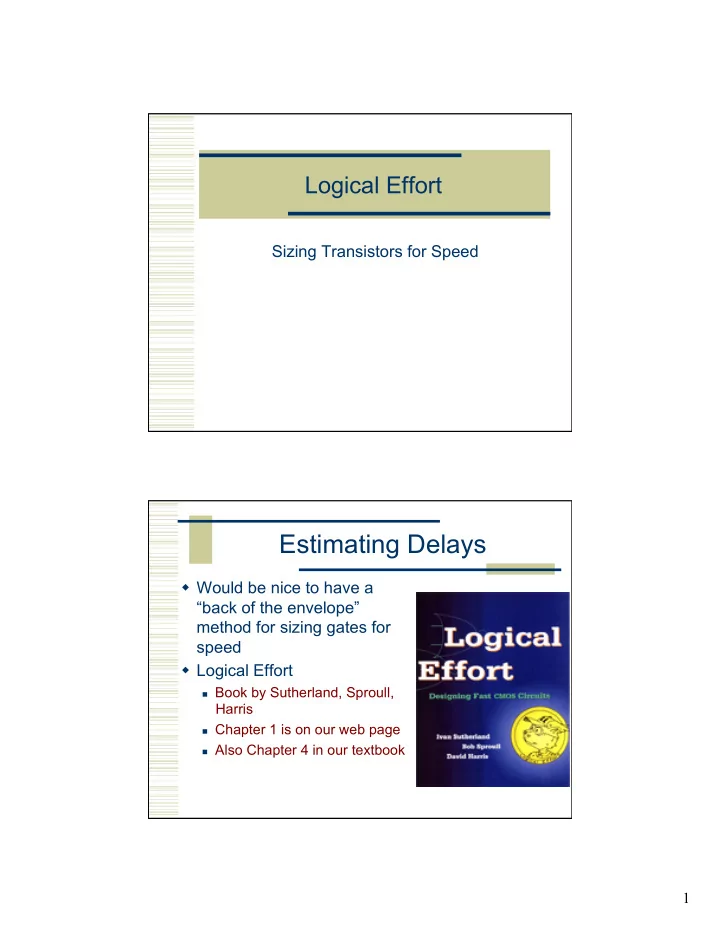
Logical Effort Sizing Transistors for Speed Estimating Delays Would be nice to have a back of the envelope method for sizing gates for speed Logical Effort Book by Sutherland, Sproull, Harris Chapter 1 is on our web page


slide-1
SLIDE 1

1

Logical Effort

Sizing Transistors for Speed

Estimating Delays

 Would be nice to have a “back of the envelope” method for sizing gates for speed  Logical Effort

 Book by Sutherland, Sproull,

Harris

 Chapter 1 is on our web page  Also Chapter 4 in our textbook

slide-2
SLIDE 2

2

Gate Delay Model

 First, normalize a model of delay to dimensionless units to isolate fabrication effects  dabs = d τ

 τ is the delay of a minimum inverter driving another

minimum inverter with no parasitics

 In a 0.6u process, this is approx 40ps  Now we can think about delay in terms of d and

scale it to whatever process we’re using

Gate Delay

 Delay of a gate d has two components

 A fixed part called parasitic delay p  A part proportional to the load on the output called

the effort delay or stage effort f

 Total delay is measured in units of τ, and is sum of

these delays

 d = f + p

slide-3
SLIDE 3

3

Effort Delay

 The effort delay (due to load) can be further broken down into two terms: f = g * h

 g = logical effort which captures properties of the gate’s

structure

 h = electrical effort which captures properties of load and

transistor sizes

 h = Cout/Cin  Cout is capacitance that loads the output  Cin is capacitance presented at the input

 So, d = gh + p

Logical Effort

 Logical effort normalizes the output drive capability of a gate to match a unit inverter

 How much more input capacitance does a gate need

to present to offer the same drive as an inverter? g = 1 g = 4/3 g = 5/3

slide-4
SLIDE 4

4

Computing Logical Effort

 DEF: Logical effort is the ratio of the input capacitance of a gate to the input capacitance

  • f an inverter delivering the same output

current.  Measure from delay vs. fanout plots  Or estimate by counting transistor widths

Logical Effort of Other Gates

 Logical effort of common gates assuming that P/N size ratio is 2

Number of inputs

slide-5
SLIDE 5

5

Electrical Effort

 Value of logical effort g is independent of transistor size

 It’s related to the ratios and the topology

 Electrical effort h captures the drive capability

  • f the transistors via sizing

 Electrical effort h = Cout/Cin  Note that as transistor sizes for a gate increase, h

decreases because Cin goes up

Parasitic Delay

 Parasitic delay p is caused by the internal capacitance of the gate

 It’s constant and independent of transistor size  As you increase the transistor size, you also

increase the cap of the gate/source/drain areas which keeps it constant

 For our purposes, normalize pinv to 1

 N-input NAND = n*pinv  N-input NOR = n*pinv  N-way mux = 2n*pinv  XOR = 4* pinv

slide-6
SLIDE 6

6

Plots of Gate Delay Delay Estimation

Remember, τ in Our process ~ 40ps ~200ps ~240ps

slide-7
SLIDE 7

7

Delay Estimation

Remember, τ in Our process ~ 40ps ~200ps ~240ps τ in 180nm = ~ 12ps FO4 Inverter delay = 60ps FO4 NAND delay = 72ps

Example: Ring Oscillator

 Estimate the frequency of an N-stage ring

  • scillator

Logical Effort: g = Electrical Effort: h = Parasitic Delay: p = Stage Delay: d = Period of osc =

slide-8
SLIDE 8

8

Example: Ring Oscillator

 Estimate the frequency of an N-stage ring

  • scillator

Logical Effort: g = 1 Electrical Effort: h = 1 Parasitic Delay: p = 1 Stage Delay: d = 2 so dabs = 80ps Period: 2*N*dabs = 4.96ns, Freq = ~200MHz

For N = 31

Example: FO4 Inverter

 Estimate the delay of a fanout-of-4 (FO4) inverter Logical Effort: g = Electrical Effort: h = Parasitic Delay: p = Stage Delay: d =

slide-9
SLIDE 9

9

Example: FO4 Inverter

 Estimate the delay of a fanout-of-4 (FO4) inverter Logical Effort: g = 1 Electrical Effort: h = 4 Parasitic Delay: p = 1 Stage Delay: d = gh + p = 5

The FO4 delay is about 200 ps in 0.6 µm process 60 ps in a 180 nm process f/3 ns in an f µm process

Delay Estimation

 If Cin = x, Cout = 10x, thus h = 10  g = 9/3 = 3  d = gh + p = 3*10 + 4*1 = 34 (1360 ps)

slide-10
SLIDE 10

10

Multi Stage Delay Off-Path Load

Ctotal Cuseful

slide-11
SLIDE 11

11

Summary – multistage networks

 Logical effort generalizes to multistage networks  Path Logical Effort  Path Electrical Effort  Path Effort  Can we write F = GH?

Branching Effort

 Remember branching effort

 Accounts for branching between stages in path

 Now we compute the path effort

 F = GBH

Note:

slide-12
SLIDE 12

12

Multistage Delays

 Path Effort Delay  Path Parasitic Delay  Path Delay

Designing Fast Circuits

 Delay is smallest when each stage bears same effort  Thus minimum delay of N stage path is  This is a key result of logical effort

 Find fastest possible delay  Doesn’t require calculating gate sizes

slide-13
SLIDE 13

13

Minimizing Path Delay Choosing Transistor Sizes

slide-14
SLIDE 14

14

Example

1 2 minD=N*F 1/N + P = 3*(1.3333) + 6 = 10

Example, continued

f(min) = gi * bi * hi

slide-15
SLIDE 15

15

Transistor Sizes for Example Another Example, Larger Load

slide-16
SLIDE 16

16

8C Load Example Cont. Example 1.6 from Chap 1

1 2

slide-17
SLIDE 17

17

Example 1.6 Continued

f(min) = gi * bi * hi

Example: 3-stage path

 Select gate sizes x and y for least delay from A to B

slide-18
SLIDE 18

18

Example: 3-stage path

Logical Effort G = Electrical Effort H = Branching Effort B = Path Effort F = Best Stage Effort Parasitic Delay P = Delay D =

Example: 3-stage path

Logical Effort G = (4/3)*(5/3)*(5/3) = 100/27 Electrical Effort H = 45/8 Branching Effort B = 3 * 2 = 6 Path Effort F = GBH = 125 Best Stage Effort Parasitic Delay P = 2 + 3 + 2 = 7 Delay D = 3*5 + 7 = 22 = 4.4 FO4

slide-19
SLIDE 19

19

Example: 3-stage path

 Work backward for sizes y = x =

Example: 3-stage path

 Work backward for sizes y = 45 * (5/3) / 5 = 15 (gi*bi*Cout)/fmin= Cin x = (15*2) * (5/3) / 5 = 10

15 4:1 ratio 10 2:3 ratio 8 1:1 ratio f(min) = gi * bi * hi

slide-20
SLIDE 20

20

Example 1.7 from Chap 1

Note: Don’t care about parasitics for gate sizing, only if you want to know absolute delay…

(gi*bi*Cout)/fmin=Cin

  • Misc. Comments

 Note that you never size the first gate

 This gate is assumed to be fixed  If you were allowed to size it, the algorithm would try

to make it as large as possible

 This is an estimation algorithm

 Authors claim that sizing a gate by 1.5x too big or

small still results in a path delay within 15% of minimum

slide-21
SLIDE 21

21

Sensitivity Analysis

 How sensitive is delay to using exactly the best number of stages?  2.4 < ρ < 6 gives delay within 15% of optimal

 We can be sloppy!  I like ρ = 4

Evaluating Different Options

slide-22
SLIDE 22

22

Option #1 Option #2

What if we consider gate area and power? What about a 4-input NOR?

slide-23
SLIDE 23

23

How many stages?

 Consider three alternatives for driving a load 25 times the input capacitance

 One inverter  Three inverters in series  Five inverters in series

 They all do the job, but which one is fastest?

How many stages?

 In all cases: G = 1, B = 1, and H = 25  Path delay is N(25)1/N + N Pinv

 N = 1, D = 26 units  N = 3, D = 11.8 units  N = 5, D = 14.5 units

 Since N=3 is best, each stage will bear an effort of (25)1/3 = 2.9

 So, each stage is ~3x larger than the last  In general, the best stage effort is between 3 and 4

(not e as often stated)

 The e value doesn’t use parasitics…

slide-24
SLIDE 24

24

Choosing the Best # of Stages

 You can solve the delay equations to determine the number of stages N that will achieve the minimum delay

 Approximate by Log4F

Example

 String of inverters driving an off-chip load

 Pad cap and load = 40pf  Equivalent to 20,000 microns of gate cap  Assume first inverter in chain has 7.2u of input cap  How many stages in inv chain?

 H = 20,000/7.2 = 2777  From the table, 6 stages is best  Stage effort = f = (2777)1/6 = 3.75  Path delay D = 6*3.75 +6*Pinv = 28.5

 D = 1.14ns if τ = 40ps

slide-25
SLIDE 25

25

Other N’s?

 N=2: f=(2777)1/2 = 52.7

 delay = 2(52.7) +2 = 158.1 = 6.324ns

 N=3: f=(2777)1/3 = 14

 delay = 3(14) +3 = 45 = 1.8ns

 N=4: f=(2777)1/4 = 7.26

 delay = 4(7.26) + 4 = 33.04 = 1.32ns

 N=5: f=(2777)1/5 = 4.88

 delay = 5(4.88) +5 = 29.4 = 1.18ns

 N=6: delay = 1.14ns  N=7: f=(2777)1/7 = 3.105

 delay = 7(3.105) +7 = 28.7 = 1.15ns

Summary

 Compute path effort F = GBH  Use table, or estimate N = log4F to decide on number of stages  Estimate minimum possible delay D = NF1/N + Σpi  Add or remove stages in your logic to get close to N  Compute effort at each stage fmin = F1/N  Starting at output, work backwards to compute transistor sizes Cin = (gi * bi * Cout)/fmin

slide-26
SLIDE 26

26

Limits of Logical Effort

 Chicken and egg problem

 Need path to compute G  But don’t know number of stages without G

 Simplistic delay model

 Neglects input rise time effects

 Interconnect

 Iteration required in designs with wire

 Maximum speed only

 Not minimum area/power for constrained delay

Summary

 Logical effort is useful for thinking of delay in circuits

 Numeric logical effort characterizes gates  NANDs are faster than NORs in CMOS  Paths are fastest when effort delays are ~4  Path delay is weakly sensitive to stages, sizes  But using fewer stages doesn’t mean faster paths  Delay of path is about log4F FO4 inverter delays  Inverters and NAND2 best for driving large caps

 Provides language for discussing fast circuits

 But requires practice to master