
SLIDE 1
2/15/16 ¡ 1 ¡
#SPEDAhead
ESSA
Every Student Succeeds Act
Finding ways to help every child succeed is not just your priority, it is a national “call to action” with passage of legislation December 10, 2015 #SPEDAhead
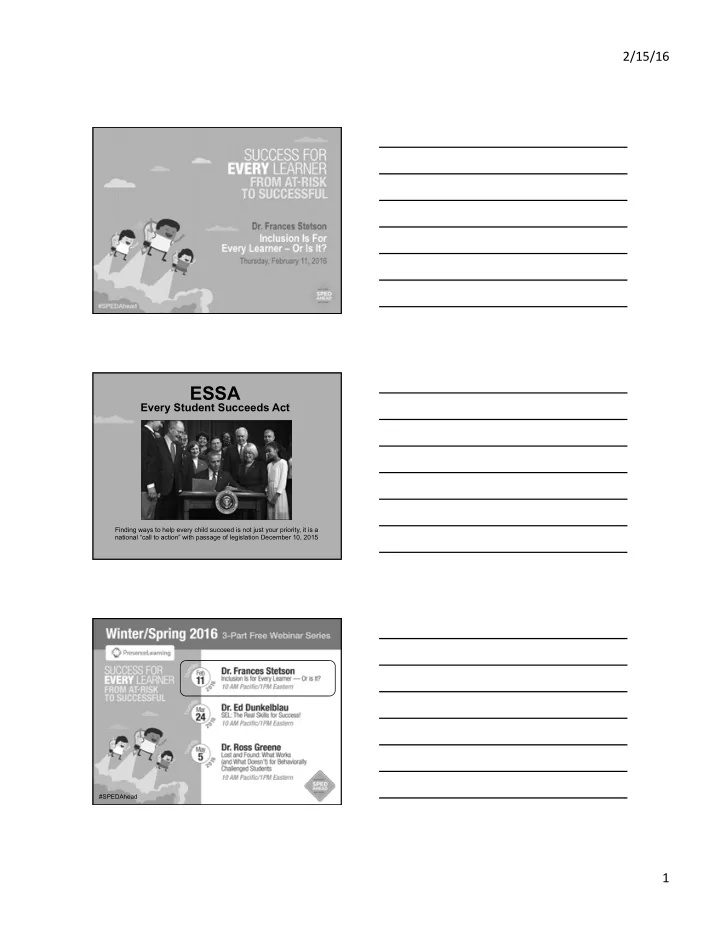
ESSA Every Student Succeeds Act Finding ways to help every child - - PDF document
2/15/16 #SPEDAhead ESSA Every Student Succeeds Act Finding ways to help every child succeed is not just your priority, it is a national call to action with passage of legislation December 10, 2015 #SPEDAhead 1 2/15/16
2/15/16 ¡ 1 ¡
#SPEDAhead
Every Student Succeeds Act
Finding ways to help every child succeed is not just your priority, it is a national “call to action” with passage of legislation December 10, 2015 #SPEDAhead
2/15/16 ¡ 2 ¡
#SPEDAhead
Inclusive Schools Network
training and technical assistance for the US Department of Education
for Houston ESC #SPEDAhead
2/15/16 ¡ 3 ¡
#SPEDAhead #SPEDAhead #SPEDAhead
2/15/16 ¡ 4 ¡
The National Center on Educational Restructuring and Inclusion ¡
“Providing to all students, including those with significant disabilities, equitable opportunities to receive
effective educational services, with the needed
supplementary aids and support services, in age appropriate classrooms in their neighborhood schools, in order to prepare students for productive lives as full members of society.”
What does it mean?
Brown vs. Board of Education 1954
Segregated schools are inherently unequal and therefore, unconstitutional.
HuffingtonPost.com ¡
Over 60 years after Brown vs. BOE, students with behavior challenges or disabilities and children of color are
classrooms, disconnected pods and other segregated settings.
2/15/16 ¡ 5 ¡
IDEA (Individuals with Disabilities Education Act) 1975
Guaranteed a Free and Appropriate Education in the Least Restrictive Environment
Unsettling Data
Even with a 20 year focus on inclusionary practices, there has been… ¡
Over the same time period, % of students served in segregated settings increased slightly. ¡
After 9 years, only an 11.6% increase in students educated >80%
2/15/16 ¡ 6 ¡
#SPEDAhead #SPEDAhead
…In Our Attitudes …In the Classroom …In Leadership & Systems
Three topics for this webinar… ¡
2/15/16 ¡ 7 ¡
differences in cultures
about the teaching environment
teacher and student
Consider our own thinking and the thoughts of educators we work with.
“The first thing is to be honest with
never have an impact on society if you have not changed yourself.”
~Nelson Mandela, 1993 ¡ #SPEDAhead
2/15/16 ¡ 8 ¡
2/15/16 ¡ 9 ¡
Allows individuals to interact effectively with people who are different from them. But what professional development
More diversity in our classrooms: culture, language, socio-economic and learning styles
Not Enough Time for Professional Development
2/15/16 ¡ 10 ¡
#SPEDAhead
Six Stages of Cultural Proficiency
#SPEDAhead
2/15/16 ¡ 11 ¡ Six Stages of Cultural Proficiency
#SPEDAhead
#SPEDAhead
Speak disparagingly
#SPEDAhead
Elevating the superiority of your own cultural values and beliefs
2/15/16 ¡ 12 ¡
#SPEDAhead
Acting as if differences in cultures don’t even exist
Proficiency Competence Pre-Competence
Honoring differences among cultures, viewing diversity as a benefit; interacting knowledgeably and respectfully among a variety of cultural groups.
Interacting with other cultural groups in ways that recognize and value their differences, motivates you to assess and adapt your behavior.
2/15/16 ¡ 13 ¡
Leadership Question:
Introduced during 2015 Special Agents
“White privilege is like an invisible weightless knapsack of special provisions, maps, passports, codebooks, visas, clothes, tools, and blank checks.”
2/15/16 ¡ 14 ¡
#SPEDAhead
Unpacking the Invisible Backpack
An essay by: Peggy McIntosh ¡
Unconscious, unplanned advantages for individuals who are white
2/15/16 ¡ 15 ¡
We must do the work to move to the next level of fidelity and make real changes in
#SPEDAhead
#SPEDAhead
for learning
“Teachers (all educators) possess the power to create conditions that can help students learn a great deal – or keep them from learning much at all. Teaching is the intentional act of creating those conditions…”
2/15/16 ¡ 16 ¡
Are we really doing it well?
supports
Components of Culturally Responsive Classroom
2/15/16 ¡ 17 ¡
Principles and Applications for Becoming a Culturally Responsive Teacher
2/15/16 ¡ 18 ¡
Positive Behavioral Supports Building Authentic Relationships Higher Expectations
Scaffolding and Process Skills Student Responsibility for Learning #SPEDAhead
2/15/16 ¡ 19 ¡
Who Am I?
Building Authentic Relationships
#SPEDAhead
Student Interest Surveys
2/15/16 ¡ 20 ¡
Student Interest Surveys
Help you understand and appreciate each student’s interests, challenges and needs
Creating Culturally Responsive Classrooms
2/15/16 ¡ 21 ¡
Creating a Culturally Responsive Classroom
Invite community members to speak to the class Ask students to write about family traditions Attend community events that are important to students Post photos of students around the room Provide for levels of movement and conversation
Building Authentic Relationships
2/15/16 ¡ 22 ¡ Practical tools make teachers feel more competent and confident
#SPEDAhead
Teachers believe that children of color are less likely than their white peers to achieve a college degree.
2/15/16 ¡ 23 ¡
Are my expectations of my students biased? Am I giving
messages in the way I teach? Do my biases interfere with the quality of my interactions?
#SPEDAhead
2/15/16 ¡ 24 ¡
Learning Objective
Graphic Organizers Word Banks Task Lists Timer
Make it easier to achieve learning
level or beyond
Types of Scaffolds
2/15/16 ¡ 25 ¡
If a Student Has Difficulty, Try This
2/15/16 ¡ 26 ¡
If it didn’t work before, it probably won’t work now.
"Insanity: doing the same thing over and
expecting different results.”
2/15/16 ¡ 27 ¡
#SPEDAhead
Are we teaching, monitoring, and reinforcing process skills? What process skills does each student have? What process skills proficiency is required?
2/15/16 ¡ 28 ¡
#SPEDAhead
2/15/16 ¡ 29 ¡
Black males – 1:3 chance of going to prison Latino males – 1:6 chance of going to prison Texas spends 2.3x per prisoner as per student
#SPEDAhead
“…overrepresentation of Black (or minority) children in special education is a civil rights violation and a major culprit in the school to prison pipeline, with low teacher expectations yielding low quality instruction, which in turn leads to low quality education.”
From 2012 Position Paper
2/15/16 ¡ 30 ¡
equitable quality services
external supports
#SPEDAhead
“Mobilizing people to make progress on the hardest of problems”
Be courageous. State non-negotiables.
responsibility
decisions for referrals and IEP
for professional development
2/15/16 ¡ 31 ¡
Individual teachers cannot be solely responsible for changes needed to ensure student success. There has to be shared ownership and a district-wide success system.
Provide intensive PD for educators that address cultural bias, privilege and prejudice and opportunities for discussions and reflection
Address individuals and groups when attitudes are counter to expectations for cultural proficiency
Facilitate Group Discussions
2/15/16 ¡ 32 ¡
Provide Consistent External Supports
Strive for consistency so students are being helped by familiar behavior specialists and therapists Enable educators to review their successes, challenges and concerns with an expectation of continuous growth and increased ownership
Create a Debriefing Process that Explores Successes
attitudes
system processes
Changes in:
2/15/16 ¡ 33 ¡
continuous growth
for all students
and challenges
concerns focusing
“Acknowledge adult responsibility for establishing practices that promote positive student
not on the child – it is
#SPEDAhead
2/15/16 ¡ 34 ¡
#SPEDAhead
Under what circumstances is a student with special needs better supported in an all day segregated program rather than with an inclusion model? Why are students
likely to be at-risk?
#SPEDAhead
What is the most important thing we can we do to reduce instances of inappropriate identification of minority students for special education services?
#SPEDAhead
2/15/16 ¡ 35 ¡
Behavior seems to be
teachers become more responsive in the ever-growing world
#SPEDAhead
What can be done to change the mindset of regular educators that kids in SPED should be segregated from the gen ed classroom?
#SPEDAhead
How can we ensure that students are prepared for job interviews, the workplace, and potentially for upward mobility, without social stigmas against the way they speak, which may reflect their culture?
#SPEDAhead
2/15/16 ¡ 36 ¡
Is inclusion appropriate at any age level – even preschool?
#SPEDAhead #SPEDAhead
Interested in Becoming an Online Provider?
Refer your colleagues:
plearn.co/apply-to-pl
PresenceLearning has
#SPEDAhead #SPEDAhead
2/15/16 ¡ 37 ¡
A Certificate of Attendance will be sent to attendees who have:
To receive CE credit:
included valid ASHA membership ID & contact information
required information for self-reporting Questions? Email SPEDforum@presencelearning.com Look for follow-up email soon with the link to webinar recording and associated materials
PresenceLearning.com PresenceLearn PresenceLearning
#SPEDAhead