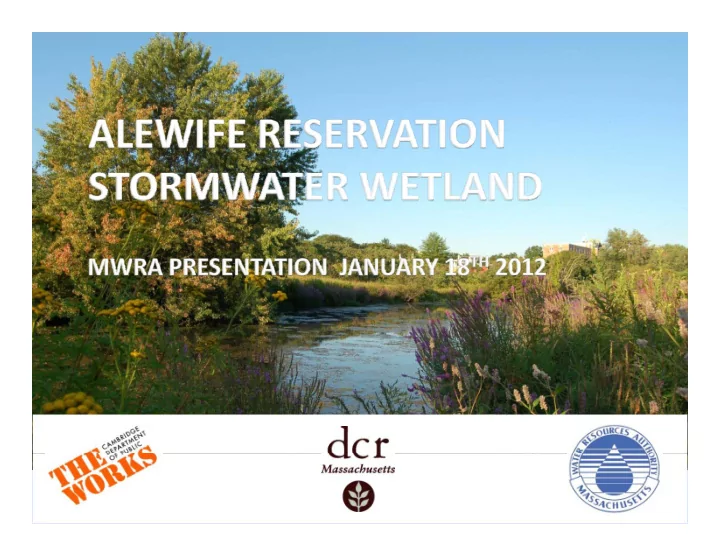
Erosion and sedimentation control Wildlife impacts Wildlife - - PowerPoint PPT Presentation

erosion and sedimentation control wildlife impacts
SMART_READER_LITE
LIVE PREVIEW

Erosion and sedimentation control Wildlife impacts Wildlife - - PowerPoint PPT Presentation

Erosion and sedimentation control Wildlife impacts Wildlife impacts Multi Use Path detour and signage g g MWRAs LTCP for CSO Control Sewer separation of CAM004 To be completed by December 2015. b l d b b 20


slide-1
SLIDE 1
slide-2
SLIDE 2
  • Erosion and sedimentation control
  • Wildlife impacts
  • Wildlife impacts
  • Multi‐Use Path detour and signage

g g

slide-3
SLIDE 3

MWRA’s LTCP for CSO Control

  • Sewer separation of CAM004

b l d b b 20 To be completed by December 2015.

  • Closure of the CAM004 regulator
  • Reduces volume and frequency of CSOs

to the Alewife Brook ▪ 50mg annually  7 3mg ▪ 50mg annually  7.3mg ▪ 63 activations per year  7

slide-4
SLIDE 4
slide-5
SLIDE 5

BMP Devices (temporary) BMP Devices (temporary) Sediment control basins Flood protection berm Cover crop seed mix and/or matting Alewife Reservation Compost filter socks/silt fences Turbidity curtain

slide-6
SLIDE 6

Stormwater Stormwater wetlands provide water quality t t t th h treatment through the interaction of the water, soil and , plants.

slide-7
SLIDE 7

 Sedimentation  Adsorption to Sediments  Physical filtration  Microbial breakdown  Plant Uptake

Volatilization NH3 Volatile organics

CO2, CH4

Decomposition

N2

Denitrification

Plant storage

 Plant Uptake  Extra Detention and/or

Plant uptake

Organic C

Inflow

NO3

Sedimentation

xtra etention and/or Retention

Soil storage (peat) Burial

Adsorption ‐ NH4

+, metals, P, organics

(to clays, Fe / Al hydroxides,

  • rganic matter)

Precipitation ‐ P (with Fe, Al, Ca) ‐ Metals (with sulfides) Metals (with sulfides)

Source: K.R. Reddy

slide-8
SLIDE 8

Habitat Creation

  • Deep, emergent and high marsh
  • Wet meadow, broadleaf floodplain and open water
  • Scrub/shrub and riparian woodland

O 115 000 tl d l t

  • Over 115,000 new wetland plants
  • Over 3,800 new upland plants
slide-9
SLIDE 9

DCR Reservation Features

  • Multi‐use connector path (Mass DOT)
  • Trails and boardwalks (1,600 linear feet)
  • Overlooks (3)
  • Amphitheatre

p

  • Benches and bike racks
  • DCR Kiosk and interpretive signage
slide-10
SLIDE 10

b Forebay = 0.27 acres (50ft x 170ft)

slide-11
SLIDE 11
slide-12
SLIDE 12

Stormwater Wetland Stormwater Wetland Footprint = 3.4 acres Primary Wetland = 2.8 ac. y Peninsula = 0.2 acres Habitat Diversity Habitat Diversity High Marsh Low Marsh Low Marsh Open Water Upland Island p

slide-13
SLIDE 13
  • Erosion and sedimentation control
  • Wildlife impacts
  • Wildlife impacts
  • Multi‐Use Path detour and signage

g g

slide-14
SLIDE 14

Wildlife Impact/Risk Assessment Conclusions: Wildlife Impact/Risk Assessment Conclusions:

October start maximizes use of food resource

Minimal breeding season/migratory bird risks A id Littl Ri di t b d i Al if

Avoid Little River disturbance during Alewife run Licensed Wildlife Trappers were consulted:

American Woodcock

pp

  • Predicted resident wildlife

will leave work area when clearing and grubbing commence

  • Relocate wildlife outside of
  • Relocate wildlife outside of

the work area

slide-15
SLIDE 15

Preconstruction Wildlife Reconnaissance Preconstruction Wildlife Reconnaissance

 Search work area for burrows, dens, nest sites  Provide “gaps” in construction fencing  Site monitoring to detect any fauna at risk

Preconstruction Rare Plant Reconnaissance

 Botanist searched entire impact area

slide-16
SLIDE 16

P W l d A i i i W tl d C t ti

 Pre Wetland Activities

  • Utilities relocation
  • Species identification

 Wetland Construction

  • Grubbing

E h k il i

  • Species identification
  • Erosion control and impact

mitigation

  • Earthwork: soil excavation

and berms

  • Cover crop planting
  • Clearing – began October 1

Cover crop planting

  • Boardwalk and

amphitheater construction

  • Wetland soils, plantings

and seeding Fi l th i

  • Final path paving
slide-17
SLIDE 17
  • Fall/Winter 2011‐2012

Spring 2012 Fall 2012/Spring 2013

slide-18
SLIDE 18

Alewife Reservation

slide-19
SLIDE 19

 Observe plant growth  Observe plant growth  Replace vegetation as needed

d if i i i f l

 Identify invasive species for removal

E l i F i Exclusion Fencing

slide-20
SLIDE 20

Alewife Reservation Project Benefits

Fully integrated with DCR Alewife Reservation and

j

Greenway Master Plan:

  • Water Quality Improvements: 3.4 acre treatment wetland, and

future closure of the CAM004 regulator future closure of the CAM004 regulator

  • Ecological enhancements of fish and wildlife habitat quality
  • Mitigation of invasive plant species

g p p

  • Improved site amenities
  • Educational and recreational opportunities
slide-21
SLIDE 21
slide-22
SLIDE 22

Cambridge in 1777