ERISA Retirement Plan Successor Liability: Due Diligence Strategies - - PowerPoint PPT Presentation

erisa retirement plan successor liability due diligence
SMART_READER_LITE
LIVE PREVIEW

ERISA Retirement Plan Successor Liability: Due Diligence Strategies - - PowerPoint PPT Presentation

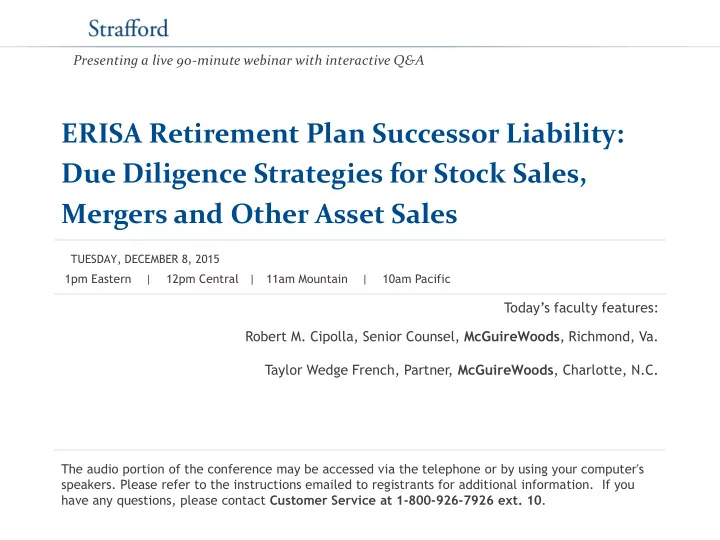
Presenting a live 90-minute webinar with interactive Q&A ERISA Retirement Plan Successor Liability: Due Diligence Strategies for Stock Sales, Mergers and Other Asset Sales TUESDAY, DECEMBER 8, 2015 1pm Eastern | 12pm Central | 11am


slide-1
SLIDE 1

The audio portion of the conference may be accessed via the telephone or by using your computer's

  • speakers. Please refer to the instructions emailed to registrants for additional information. If you

have any questions, please contact Customer Service at 1-800-926-7926 ext. 10.

Presenting a live 90-minute webinar with interactive Q&A

ERISA Retirement Plan Successor Liability: Due Diligence Strategies for Stock Sales, Mergers and Other Asset Sales

Today’s faculty features:

1pm Eastern | 12pm Central | 11am Mountain | 10am Pacific TUESDAY, DECEMBER 8, 2015

Robert M. Cipolla, Senior Counsel, McGuireWoods, Richmond, Va. Taylor Wedge French, Partner, McGuireWoods, Charlotte, N.C.

slide-2
SLIDE 2

Tips for Optimal Quality

Sound Quality If you are listening via your computer speakers, please note that the quality

  • f your sound will vary depending on the speed and quality of your internet

connection. If the sound quality is not satisfactory, you may listen via the phone: dial 1-866-258-2056 and enter your PIN when prompted. Otherwise, please send us a chat or e-mail sound@straffordpub.com immediately so we can address the problem. If you dialed in and have any difficulties during the call, press *0 for assistance. Viewing Quality To maximize your screen, press the F11 key on your keyboard. To exit full screen, press the F11 key again.

FOR LIVE EVENT ONLY

slide-3
SLIDE 3

Continuing Education Credits

In order for us to process your continuing education credit, you must confirm your participation in this webinar by completing and submitting the Attendance Affirmation/Evaluation after the webinar. A link to the Attendance Affirmation/Evaluation will be in the thank you email that you will receive immediately following the program. For additional information about continuing education, call us at 1-800-926-7926

  • ext. 35.

FOR LIVE EVENT ONLY

slide-4
SLIDE 4

Program Materials

If you have not printed the conference materials for this program, please complete the following steps:

  • Click on the ^ symbol next to “Conference Materials” in the middle of the left-

hand column on your screen.

  • Click on the tab labeled “Handouts” that appears, and there you will see a

PDF of the slides for today's program.

  • Double click on the PDF and a separate page will open.
  • Print the slides by clicking on the printer icon.

FOR LIVE EVENT ONLY

slide-5
SLIDE 5

www.mcguirewoods.com

ERISA Retirement Plan Successor Liability

Taylor French tfrench@mcguirewoods.com Robert Cipolla rcipolla@mcguirewoods.com

slide-6
SLIDE 6

McGuireWoods | 6

CONFIDENTIAL

Retirement Plan Liabilities

  • PBGC’s single-employer program protects more than 30 million

workers and retirees in about 24,000 pension plans.

  • PBGC’s multiemployer program protects about 10 million

workers and retirees in about 1,500 multiemployer pension plans (aka Taft-Hartley plans)

– Vast majority are not fully funded for withdrawal liability purposes; many face insolvency and mass withdrawals.

  • FY 2014 Annual Report: PBGC deficit increased to a record $61

billion.

  • Both PBGC and multiemployer plans look to controlled group

members to satisfy unfunded pension liabilities.

slide-7
SLIDE 7

McGuireWoods | 7

CONFIDENTIAL

Controlled Group Liability

  • Statutory liability that applies to both single-employer and

multiemployer plans

  • Liability arises without regard to controlled group member’s

knowledge or intent

  • Notice to signatory employer of withdrawal liability constitutes

notice to all controlled group members and triggers the time period for raising defenses of all controlled group members.

  • Employers who fail to timely initiate arbitration waive their right to

challenge determination of withdrawal liability and are immediately liable for amount of withdrawal liability demanded

slide-8
SLIDE 8

McGuireWoods | 8

CONFIDENTIAL

Successor Liability in Mergers, Consolidations, or Divisions

  • Generally, a multiemployer plan withdrawal will not occur

solely because of changes in corporate structure. ERISA §§ 4218, 4069

– Single-employer liabilities generally follow the successors in corporate reorganizations. ERISA § 4069(b).

  • Teamsters Pension Trust Fund of Phila. & Vicinity v. Littlejohn,

155 F.3d 206 (3d Cir. 1998) - imposition of successor liability in context of a merger, even where successor did not have notice of the liability.

  • CenTra Inc. v. Central States Se. and Sw. Areas Pension Fund,

578 F.3d 592 (7th Cir. 2009) - a reorganized corporation “inherited” the contribution histories of its old subsidiaries for purposes of determining withdrawal liability.

slide-9
SLIDE 9

McGuireWoods | 9

CONFIDENTIAL

Avoiding Seller’s Withdrawal Liability in Asset Sale.

  • ERISA 4204 requires “a bona fide, arm’s length sale of assets to

an unrelated party”

  • Purchaser must have an obligation to contribute for substantially

the same number of contribution base units and must timely post a bond for five years (unless exemption applies)

  • Seller must agree, in the sale contract, to secondary liability in

the event buyer defaults within five years

  • Seller also must post bond or escrow in the event of liquidation
  • r distribution of substantially all assets within the five year

period

  • In a properly executed 4204 asset sale, the buyer effectively

assumes the seller’s contribution history.

slide-10
SLIDE 10

McGuireWoods | 10

CONFIDENTIAL

Successor Liability in Asset Sales

  • Generally an asset purchaser does not assume liabilities of the

seller, except for express or implicit assumption. PBGC Opinion Letter 78-10, or ERISA 4204 transaction.

  • BUT purchaser of assets may have successor liability for

delinquent multiemployer plan contributions or withdrawal liability where there is continuity of operations and alleged successor had notice of the liability. Upholsterers’ Int’l Union Pension Fund v. Artistic Furniture, 920 F.3d 1323 (7th Cir. 1990)

  • Chapter 7 liquidation is not a per se bar to successor liability for

withdrawal liability where notice of liability and continuity in

  • perations. Chicago Truck Drivers, Helpers & Warehouse

Workers Union (Indep.) Pension Fund v. Tasemkin, Inc., 59 F.3d 48 (7th Cir. Ill. 1995)

slide-11
SLIDE 11

McGuireWoods | 11

CONFIDENTIAL

Successor Liability in Asset Sales – 7th Cir.

  • Tsareff v. Manweb Services, 794 F.3rd 841 (7th Cir. 2015) Court of

Appeals found successor liability based on the following:

1) Notice of claim before the acquisition; 2) Substantial continuity in the operation of the business after sale; and 3) Equitable considerations dictate liability should be found on the successor.

  • Employer could have protected itself by insisting on price reduction
  • r promise by the Seller to indemnify the buyer against withdrawal

liability.

  • Remanded to district court for determination of the second factor.
slide-12
SLIDE 12

McGuireWoods | 12

CONFIDENTIAL

Successor Liability in Asset Sales - 9th Cir.

  • Resilient Floor Covering Pension Trust Fund Board of Trustees v.

Michael’s Floor Covering, Inc., Case No. 12-17675, 2015 WL 5295091, found successor liability on substantial continuity between

  • ld and new business based on following factors:
  • Continuity in workforce and business
  • Same customers
  • Same working conditions, location
  • Same supervisors
  • Same products or services produced
  • Same production methods
  • Whether successor is required to bargain with the same union
  • Any change in business that could have affected employee
slide-13
SLIDE 13

McGuireWoods | 13

CONFIDENTIAL

Successor Liability in Asset Sales.

  • Einhorn v. Ruberton Construction Co., 632 F.3d 89 (3d Cir. 2011)

followed Artistic Furniture to permit successor liability to multiemployer plan contributions where there was sufficient continuity

  • f operations and notice of the liability.
  • But see Boland v. Thermal Specialties Inc., 55 EBC 2729 (D. D.C.

June 19, 2013) Purchaser was not liable for seller’s multiemployer pension fund obligations even though substantial overlap existed in management, business, purpose, operations, equipment, and customers. Purchaser and seller had different ownership and engaged in protracted and arms-length negotiations with legitimate business purpose. (Rejecting alter ego theory and not discussing Einhorn).

slide-14
SLIDE 14

McGuireWoods | 14

CONFIDENTIAL

Transactions to Evade or Avoid Withdrawal Liability

  • ERISA § 4212(c): “If a principal purpose of any transaction is to

evade or avoid liability under [the provisions governing employer withdrawals from multi-employer plans, those provisions] shall be applied (and liability shall be determined and collected) without regard to such transaction.”

  • Test for disregarding a transaction:

– Was a principal purpose to evade or avoid withdrawal liability? – The transaction need not be a sham or constitute fraud – See Santa Fe Pacific Corporation v. Central States S.E. & S.W. Area Pension Fund, 22 F.3d 725, 727 (7th Cir. 1994) (“It needn’t be the only purpose; it need only have been one

  • f the factors that weighed heavily in the Seller’s thinking”)

Sale of stock disregarded where the principal purpose was to avoid withdrawal liability.

slide-15
SLIDE 15

McGuireWoods | 15

CONFIDENTIAL

Transactions to Evade or Avoid Withdrawal Liability

  • Can cover otherwise bona-fide, arms-length transactions. See

e.g., SuperValu, Inc. v. Bd of Trustees of S.W. Pa. and W. Md. Teamsters & Employers Pension Fund, 500 F3d 334 (3rd Cir. 2007)(Section 4212(c) applied to CBA where the union understood, and agreed with, company’s goal of avoiding liability).

  • Where § 4212(c) applies, the transaction in question must be

disregarded in determining withdrawal liability

  • Courts have allowed the assertion of liability against non-

employers under this provision. See IUE AFL-CIO Pension Fund v. Herrmann, 9 F.3d 1049 (2d Cir. 1993)(assets transferred by an agreement that violates §4212(c) are recoverable from transferee).

slide-16
SLIDE 16

McGuireWoods | 16

CONFIDENTIAL

Transactions to Evade or Avoid Withdrawal Liability

  • Teamsters Joint Council No. 83 of the Virginia Pension Fund v.

Empire Beef Co., Inc., 2011 WL 201492, 50 EBC 1824 (E.D.

  • Va. Jan. 20, 2011), on remand from the 4th Circuit, reviewed

whether defendant’s transfer of property to a creditor was a transaction for which a principal purpose was the evading or avoiding of withdrawal liability.

  • Single shareholder corporation transferred its interest in a

general partnership to one creditor in exchange for cancellation

  • f $1.3 million loan. Purpose of the transfer was protection

against unsecured creditors, including withdrawal liability.

  • The court held that a principal purpose of the transfer was not to

evade or avoid withdrawal liability, but to protect against all creditors, some of whom were owed more than the pension plan.

slide-17
SLIDE 17

McGuireWoods | 17

CONFIDENTIAL

Transactions to Evade or Avoid Withdrawal Liability

  • LoPresti v. Pace Press, Inc., et al., 2011 WL 2150458 (S.D.N.Y. May

31, 2011). Defendant purchaser’s asset purchase agreement did not address buyer’s withdrawal liability. Court held that although the parties’ agreement did not satisfy ERISA 4204 requirements, this did not bar the plan’s “evade or avoid” claim against the purchaser.

  • Einhorn v. Twentieth Century Refuse Removal Company, 2011 WL

6779760 (D.N.J. Dec. 22, 2011). Fund alleged that owners of company "engaged in a series of transactions to divest 20th Century Refuse" of assets to pay its withdrawal liability, which "included transferring the Assets to their own use.“ Court held this alleged causes of action against owners of defunct corporation under an “evade or avoid” ERISA § 4212(c) theory and under ERISA 502(a)(3) for equitable subrogation or constructive trust.

slide-18
SLIDE 18

McGuireWoods | 18

CONFIDENTIAL

Transactions to Evade or Avoid Single Employer Plan Liability

  • For single-employer plans, ERISA § 4069(a) (transaction must

become effective within 5 years before plan termination).

  • PBGC v. White Consolidated Indus., 215 F.3d 407 (3d Cir.

2000), company engaged in an evasion by transferring underfunded plans in a highly-leveraged buyout.

slide-19
SLIDE 19

McGuireWoods | 19

CONFIDENTIAL

Alter Ego Liability

  • Retirement Plan of UNITE HERE National Retirement

Fund v. Kombassan Holdings, 629 F.3d 282 (2d Cir. 2010) commonality of control and business purpose between corporation and contributing employer to pension plan.

  • Board of Trustees, Sheet Metal Workers v. Palladium

Partners, 722 F. Supp. 2d 854 (E.D. Mich. 2010) Factors may include degree of overlap in management, business purpose, operation, equipment, customers, supervision, and ownership

  • Cheatham v. R.C.A. Rubber Co. of Am., 56 EBC 2365

(M.D. Tenn. July 23, 2013) Parent company liable for funding health benefits for defunct subsidiary’s retirees under corporate veil-piercing theory.

slide-20
SLIDE 20

McGuireWoods | 20

CONFIDENTIAL

Alter Ego Liability

  • Should apply only where the separate entity structure is

disregarded by the entities themselves such that there is no real distinction between them.

  • At least one court has rejected extension of alter ego theory to

apply to a trade or business under common control with a contributing employer. Government Dev. Bank for Puerto Rico

  • v. Holt Marine Terminal, No. 02-7825, 2011 WL 1135944 (E.D.
  • Pa. Mar. 24, 2011)
slide-21
SLIDE 21

McGuireWoods | 21

CONFIDENTIAL

Sullivan v. Running Waters Irrigation, Inc., 739 F.3d 354 (7th Cir. 2014)

  • Multiemployer Fund obtained judgment against Alpine for

unpaid pension contributions, then moved to substitute Running Waters and JV under FRCP 25 as the proper party defendants.

  • Court determined that Running Waters and JV were successors

to Alpine and substituted them as defendants for Alpine, making them judgment debtors.

  • Running Waters and JV were established contemporaneously with

Alpine’s closing and hired Alpine’s employees.

  • Owner controlled all three entities who operated out of same

location.

  • Substantial overlap in customer lists.
slide-22
SLIDE 22

McGuireWoods | 22

CONFIDENTIAL

Sullivan v. Running Waters Irrigation, Inc.,

  • Seventh Circuit affirmed relying on Artistic Furniture, supra.
  • No evidentiary hearing was required because defendants failed

to request hearing and failed to show what evidence they would have introduced to rebut finding of successorship.

  • This is an exception “developed in the context of ERISA actions

. . . To recover delinquent pension fund contributions.” 739 F.3d at 357.

  • “The ERISA test specifically allows the [Fund] to proceed

against the purchaser of the violator’s business , even if it’s a true sale, provided that two conditions are satisfied: 1) the successor had notice of the claim before the acquisition and 2) there is substantial continuity of operation of the business before and after the sale.”

slide-23
SLIDE 23

McGuireWoods | 23

CONFIDENTIAL

Chicago Reg'l Council of Carpenters Pension Fund v. Longshore/Daly, Inc. 2014 U.S. Dist. LEXIS 23844 (N.D. Ill. Feb. 25, 2014)

  • Distinguishes Sullivan: FRCP Rule 25(c) motion denied, but limited

discovery permitted.

  • Alleged successor’s prior notice of predecessor's liability was

undisputed.

  • No successorship because
  • No transfer of assets from predecessor to alleged “successor.”
  • Ownership overlap and use of the same phone and address do not

establish continuity of operations.

  • Alleged successor established eight years before demise of predecessor.
  • Companies shared only small fraction of customers and handful of

employees.

slide-24
SLIDE 24

McGuireWoods | 24

CONFIDENTIAL

Beyond Qualified Plans – Top Hat Plans

  • In more limited circumstances courts have applied successor

liability concepts to executive retirement plans (“top hat” plans)

  • Brend v. Sames Corp., 2002 WL 1488877 (N.D. Ill. 2002) - A

federal district court held that a company purchasing the assets

  • f a business could become responsible for top hat plan

liabilities

  • Purchase agreement specifically provided that these liabilities

would not be assumed by the buyer

  • Court did not distinguish top hat plans from other ERISA

retirement plans

  • Applied the notice and substantial continuity test
slide-25
SLIDE 25

McGuireWoods | 25

CONFIDENTIAL

Beyond Qualified Plans – Top Hat Plans

  • Feinberg v. RM Acquisition, LLC (629 F.3d 671) Court did not

impose that top hat plan liabilities on a purchaser of assets because the purchaser had not (i) formally assumed the liabilities, (ii) connived to deprive plan participants of their benefits, or (iii) the plaintiff did not show that the buyer was a mere continuation of the seller

  • Decision recites Artistic Furniture standards for applying successor

liability

slide-26
SLIDE 26

McGuireWoods | 26

CONFIDENTIAL

Beyond Qualified Plans – Retiree Welfare Benefits

  • Courts have also applied successor liability doctrines to retiree

health obligations under ERISA welfare plans – notice and continuity of operations often key factors

  • Grimm v. Healthmont, Inc., 2002 WL 31549095 (D. Or., 2002)

Oregon District Court extended liability for union negotiated retiree medical benefits to a purchaser of assets

  • Purchasers is a successor employer “if it hires most of its

employees from the previous employer’s workforce and conducts essentially the same business as the predecessor without a fundamental change in working conditions”

slide-27
SLIDE 27

McGuireWoods | 27

CONFIDENTIAL

Beyond Qualified Plans – Retiree Welfare Benefits

  • Bish, et. Al., v. Aquarion Services Co., et. al., 289 F. Supp 2d

134 (D. Conn., 2003) Court rejected successor employer’s motion to dismiss claims for retiree medical benefits under successor liability theory

  • US Filter employees had a CBA to provide waste water treatment

services

  • Aquarion enterred into a contract to provide these services and

hired employees of US Filter – sent letters to US Filter indicating no disruption in pension benefits, but did not mention retiree medical benefits

  • Court found that successor liability has been recognized in similar

instances and that dismissal was not appropriate

slide-28
SLIDE 28

McGuireWoods | 28

CONFIDENTIAL

Beyond Qualified Plans – Retiree Welfare Benefits

  • Schilling v. Interim Healthcare of Upper Valley, Inc., 44 EBC

1988 (S.D. Ohio 2008) Court held that under Artistic Furniture test, buyer was liable for unpaid medical claims under an ERISA health plan

  • Bender v. Newell Window Furnishing Inc., 681 F. 3d 253 (6th
  • Cir. 2012) Circuit Court upheld trial court decision that

purchaser of window manufacturing plan is liable as a successor under collective bargaining agreements for retiree medical benefits

slide-29
SLIDE 29

McGuireWoods | 29

CONFIDENTIAL

Transaction Considerations

  • Given successor liability case law what are the key

considerations for buyers / acquirers:

  • Due diligence process
  • Structuring options

– Acquisitions of entire organizations – Acquisitions of a portion of an organization

  • How to craft the transaction agreement
slide-30
SLIDE 30

McGuireWoods | 30

CONFIDENTIAL

Due Diligence: Successor Liability Recap

  • Successor liability in general:
  • Stock Sale – Buyer will be responsible for seller’s benefit plan

liabilities

  • Merger – Acquirer will be responsible for target’s benefit plan

liabilities

  • Asset Sale – Potential transfer of seller’s benefit plan liabilities
slide-31
SLIDE 31

McGuireWoods | 31

CONFIDENTIAL

Due Diligence: Transaction Type

  • Stock Sales and Mergers
  • Clear need to perform due diligence seller’s / target’s benefit plans

since liabilities will transfer to buyer / acquirer

  • Asset Sales
  • Temptation to skip due diligence based on the belief that there is no

successor liability

  • Can a buyer simply “diligence through representations”?
slide-32
SLIDE 32

McGuireWoods | 32

CONFIDENTIAL

Due Diligence: Asset purchases

  • Asset purchase transaction due diligence is still important
  • Significant and often ignored body of case law assigning successor

liability to purchasers of assets

  • As funding continues to erode, multiemployer plans will likely

continue to aggressively assert successor liability claims

  • PBGC likely to pursue similar positions with respect to single-

employer plans

  • Courts seem willing to entertain successor liability claims by

sympathetic plaintiffs

  • Courts also willing to apply successor liability concepts to other

types of ERISA plans (top hat plans and retiree medical plans)

slide-33
SLIDE 33

McGuireWoods | 33

CONFIDENTIAL

Due Diligence: Practical Considerations

  • Practical reason for due diligence
  • Applies to all types of transactions (stock sales, mergers, asset

purchases)

  • Buyer / acquirer often assumes significant or all of the seller’s /

target’s workforce

  • Employee benefit plan problems can cause headaches for buyers /

acquirers even absent a successor liability claim

– E.g., Code Section 409A violations with seller’s executive retirement

plan

– E.g., 401(k) plan disqualification

slide-34
SLIDE 34

McGuireWoods | 34

CONFIDENTIAL

Due Diligence: Ostrich Approach to Asset Deals?

  • Tension between successor liability case law and need to

perform due diligence in asset purchase transactions

  • Case law looks at (1) continuity of operations, and (2)

knowledge of obligations

  • Should asset purchasers take the “ostrich approach” ?
  • Asset purchase will involve other legal and financial due diligence
  • Disclosure of benefit plan liabilities in some fashion likely
  • Better practice for specialists to be involved in the process to avoid

inadvertent overlooking of key benefits due diligence

slide-35
SLIDE 35

McGuireWoods | 35

CONFIDENTIAL

Due Diligence: Transaction Structuring Considerations

  • Additional considerations – potential impact on deal structure
  • Transaction structure usually not driven by employee benefits

concerns

  • However, uncovering of significant benefit plan liabilities may lead

a buyer / acquirer to favor one structure over another

  • Also may have an impact on transaction document provisions, as

will be discussed later

slide-36
SLIDE 36

McGuireWoods | 36

CONFIDENTIAL

Due Diligence: A How To Guide

  • Hone your due diligence request list
  • Should be designed with the “cast a wide net” approach in mind
  • Use references to specific types of benefit plans to jog the seller’s /

target’s memory

  • What to ask for:
  • Plans, policies, agreements, arrangements, practices, including all

amendments / restatements

– Written and unwritten

  • Government communications – annual reports, determination

letters, correction applications, audit materials

  • Participant communications – SPDs, SMMs, forms, notices
slide-37
SLIDE 37

McGuireWoods | 37

CONFIDENTIAL

Due Diligence: A How To Guide (cont.)

  • What to ask for: (cont.)
  • Funding arrangements – trusts, insurance policies, etc.
  • Compliance matters – litigation, prohibited transactions, etc.
  • Controlled group information – Title IV plans within the controlled

group that might not be a part of the transaction

  • Terminated plans or plans previously withdrawn from
  • Vendor agreements

– Costs – Indemnities

slide-38
SLIDE 38

McGuireWoods | 38

CONFIDENTIAL

Due Diligence: A How To Guide (cont.)

  • Engagement with seller / target benefits professionals
  • Use diligence materials to generate follow-up questions
  • Discussion of how benefit plans generally are operated at the seller

/ target

  • Conversations helpful to:

– Understand current operations and participant expectations – Obtain information not readily available from documents

slide-39
SLIDE 39

McGuireWoods | 39

CONFIDENTIAL

Transaction Structure: Acquisition of Entire Organization

  • Stock Sales / Mergers
  • Mistaken belief that buyers / acquirers have little options other than

negotiating representations and indemnity provisions

– Certainly important and due diligence can have profound impact on

deal terms

  • Use plan termination as a way to jettison unwanted plans prior to

closing

– 401(k) plans – Executive retirement plans – Other employee benefit plans (health and welfare, etc.)

  • Liabilities will transfer to buyer / acquirer
slide-40
SLIDE 40

McGuireWoods | 40

CONFIDENTIAL

Transaction Structure: Acquisition of Entire Organization (cont.)

  • Asset Sale
  • Buyer can pick and choose which plans, if any, to assume

– Due diligence review should inform buyer of potential compliance

risks with any assumed plans

  • Despite case law, many types of retirement plan liabilities not

likely to transfer to a buyer of assets

  • Identify which plans may need to be recreated by buyer for

transferred employees

– Example – “mirror” 401(k) plan

slide-41
SLIDE 41

McGuireWoods | 41

CONFIDENTIAL

Transaction Structure: Acquisition of Entire Organization

  • Asset Sales (cont.)
  • Practical tips:

– Engage HR / benefits personnel early in the process and inform them

  • f potential ability to shield buyer from benefit plan liabilities

– Begin process of creating replacement or mirror plans early to avoid

pressure to assume seller’s benefit plans

– Identify benefit plans that case law suggests potential for successor

liability transfers and target for due diligence

– Inform buyers of potential successor liability claims in advance

slide-42
SLIDE 42

McGuireWoods | 42

CONFIDENTIAL

Transaction Structure: Acquisition of Part of an Organization

  • Stock Sale or Merger
  • Ability to terminate plans prior to closing
  • Can also require seller / target move plans to other parts of the
  • rganization to avoid automatic assumption
  • Moving plans generally requires board resolutions and plan

amendments

  • Buyer / acquirer may still be responsible for pre-closing liabilities
  • Risk of claims against buyer / acquirer may be less if seller / target

continues significant operations

slide-43
SLIDE 43

McGuireWoods | 43

CONFIDENTIAL

Transaction Structure: Acquisition of Part of an Organization (cont.)

  • Asset Sale
  • Same structuring options as a purchase of the entire organization

– Pick and choose plans to assume / leave with seller

  • Can also move plans to other parts of the business that are not

being sold

slide-44
SLIDE 44

McGuireWoods | 44

CONFIDENTIAL

The Transaction Agreement

  • Stock Sale / Merger
  • Equity provisions

– Company retirement plans with company stock funds – Rabbi trusts

  • Employee benefits representations

– Should be extensive to address plan document and operation issues

  • Covenants

– Consider carve-outs from general prohibition on changes to address

structuring considerations

– Seller / target required actions to address compliance issues

  • Indemnities

– Negotiated – Can be used to address identified compliance issues

slide-45
SLIDE 45

McGuireWoods | 45

CONFIDENTIAL

The Transaction Agreement (cont.)

  • Asset Sale
  • List assumed / excluded liabilities and acquired / excluded assets
  • Employee benefits representations

– Generally more streamlined; however, consider successor liability

potential

– Also can be used to identify problems that can cause practical

problems for acquirer (e.g., Code Section 409A)

  • Covenants

– Consider carve-outs from general prohibition on changes to address

structuring consideration

– Seller / target required actions to address compliance issues

  • Indemnities are still important
slide-46
SLIDE 46

McGuireWoods | 46

CONFIDENTIAL

The Transaction Agreement (cont.)

  • Asset Sale (cont.)
  • ERISA Section 4204

– Withdrawal does not occur as a result of an asset sale if:

  • Buyer obligated to contribute a similar amount
  • Buyer posts a bond for 5 years after transaction for average annual

contribution amount

  • Purchase agreement provides seller is secondarily liable if buyer

withdraws during 5 years after transaction

  • If the seller sells substantially all of its assets within 5 years after the

transaction, the seller must post a bond

slide-47
SLIDE 47

McGuireWoods | 47

CONFIDENTIAL

Questions or Comments?

www.mcguirewoods.com