SLIDE 1
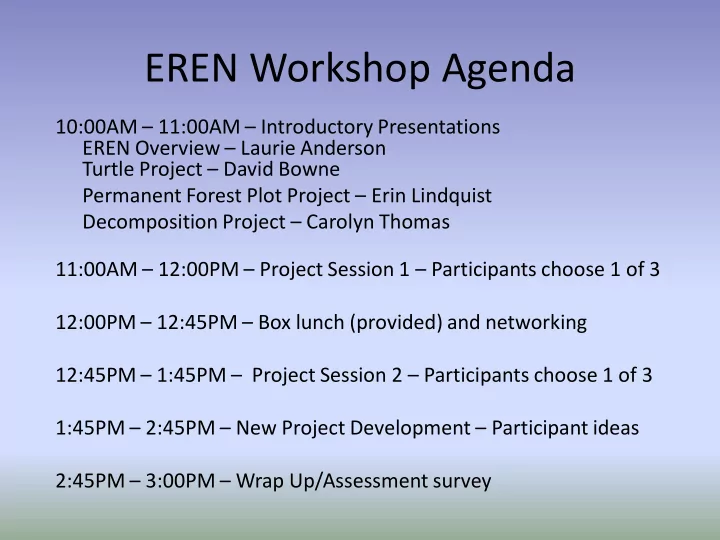
EREN Workshop Agenda
10:00AM – 11:00AM – Introductory Presentations EREN Overview – Laurie Anderson Turtle Project – David Bowne Permanent Forest Plot Project – Erin Lindquist Decomposition Project – Carolyn Thomas 11:00AM – 12:00PM – Project Session 1 – Participants choose 1 of 3 12:00PM – 12:45PM – Box lunch (provided) and networking 12:45PM – 1:45PM – Project Session 2 – Participants choose 1 of 3 1:45PM – 2:45PM – New Project Development – Participant ideas 2:45PM – 3:00PM – Wrap Up/Assessment survey
SLIDE 2
A Research Coordination Network (RCN) Funded by the NSF Research Coordination Network- Undergraduate Biology Education Program
SLIDE 3 The EREN Mission
- To create a model for collaborative ecological
research that generates high-quality, publishable data involving undergraduate students and faculty at primarily undergraduate institutions (PUIs)
SLIDE 4
Coordinating undergraduate research across many sites will enhance the scientific and educational value of these activities.
SLIDE 5 EREN Founders
- Anderson, Laurel - Ohio Wesleyan Univ., OH*
- Bowne, David - Elizabethtown College, PA
- Gartner, Tracy - Carthage College, WI*
- Kuers, Karen - Sewanee: The Univ. of the South, TN*
- Downing, Amy - Ohio Wesleyan Univ., OH
- Dosch, Jerald - Macalester College, MN
- Hoopes, Martha - Mount Holyoke College, MA
- Hornbach, Dan - Macalester College, MN
- Johnson, David - Ohio Wesleyan Univ., OH
- Lindquist, Erin - Meredith College, NC*
- Machado, Jose-Luis - Swarthmore College, PA*
- O’Reilly, Catherine - Bard College, NY
- Pohlad, Bob - Ferrum College, VA*
- Simmons, Jeffrey - Mount St. Mary’s Univ., MD*
- LoGiudice, Kathleen - Union College, NY
- Shea, Kathy - St. Olaf College, MN
- Thomas, Carolyn - Ferrum College, VA*
- Woods, Kerry - Bennington College, VT
The EREN Founders are 18 scientist-educators from 14 PUI institutions. * = Grant Co-PI
SLIDE 6 Some of EREN’s Founders meeting at Ohio Wesleyan University, March 2009
SLIDE 7
EREN now includes 53 institutions across the USA and Canada!
SLIDE 8 Specific Goals of EREN
- Develop collaborative research projects among PUIs that
work for scientists with significant teaching responsibilities
- Enhance the roles of PUI scientists and their students in
existing and emerging ecological research networks
- Maximize student engagement in authentic science while
generating publication quality data
- Develop team-taught, continental ecology course modules
using the data from the PUI network
- Create an online database for the PUI network
SLIDE 9 What will EREN provide?
- Models for collaborative ecological projects at PUIs
- Opportunities to participate in and develop publishable
collaborative projects using the EREN model
- Opportunities to meet and network about collaborative
research with other PUI faculty (travel funds provided)
- Professional development opportunities to learn new
research techniques
- Protocols for integrating EREN projects into teaching
- Website for PUI datasets and protocols
- Note: EREN has funds only for Founder pilot projects
SLIDE 10 CHIEF Acronym for EREN Research CHIEF projects are:
- Collaborative
- High Impact science and education
- Ecological or environmental research
- Feasible for all kinds of institutions
SLIDE 11 What is EREN doing now?
- Developing pilot collaborative projects to see what
works for PUI faculty and students.
- Testing a data sharing and authorship policy model for
collaborative projects.
- Inviting EREN members to use our network to find
collaborators and develop collaborative grant proposals.
- Today’s workshop will introduce three pilot projects for
EREN members to join, and invite participants to start developing ideas for their own projects.
SLIDE 12
Example: EREN Pilot Project Underway
Effects of riparian vegetation on stream temperature Lead Scientist: Dr. Jeff Simmons, Mount St. Mary’s Univ.
– 12 participating institutions, in a North-South gradient from PA to NC and East-West out to British Columbia – Objective: To quantify the extent and nature of change in stream temperature regime caused by vegetated riparian zones over a wide geographic range. – Data collection began June 1, 2011 with data-loggers installed in vegetated and unvegetated stream reaches at each site.
SLIDE 13 EREN Pilot Projects Launching Today
- Turtle Mark and Recapture Study (TurtlePop)
- Permanent Forest Plots Project
- Decomposition of invasive and native plants in
terrestrial and aquatic habitats.
- The PLAN: Listen to the project descriptions,
choose one project session to attend before lunch, choose a second session after lunch.
SLIDE 14
EREN Workshop Agenda
10:00AM – 11:00AM – Introductory Presentations EREN Overview – Laurie Anderson Turtle Project – David Bowne Permanent Forest Plot Project – Erin Lindquist Decomposition Project – Carolyn Thomas 11:00AM – 12:00PM – Project Session 1 – Participants choose 1 of 3 12:00PM – 12:45PM – Box lunch (provided) and networking 12:45PM – 1:45PM – Project Session 2 – Participants choose 1 of 3 1:45PM – 2:45PM – New Project Development – Participant ideas 2:45PM – 3:00PM – Wrap Up/Assessment survey