EQUITY, ACCESS & EXCELLENCE MATH VERTICAL TEAM FOR EQUITY, - - PowerPoint PPT Presentation

equity access excellence
SMART_READER_LITE
LIVE PREVIEW

EQUITY, ACCESS & EXCELLENCE MATH VERTICAL TEAM FOR EQUITY, - - PowerPoint PPT Presentation

MATH VERTICAL TEAM: Update: May 14, 2018 EQUITY, ACCESS & EXCELLENCE MATH VERTICAL TEAM FOR EQUITY, ACCESS AND EXCELLENCE IN MATH Marty Martorelli, Grade 1 Teacher, NPE Joe Buecheler, Interim Principal. WES Sue Gaur, Grade 2 Teacher, WES


slide-1
SLIDE 1

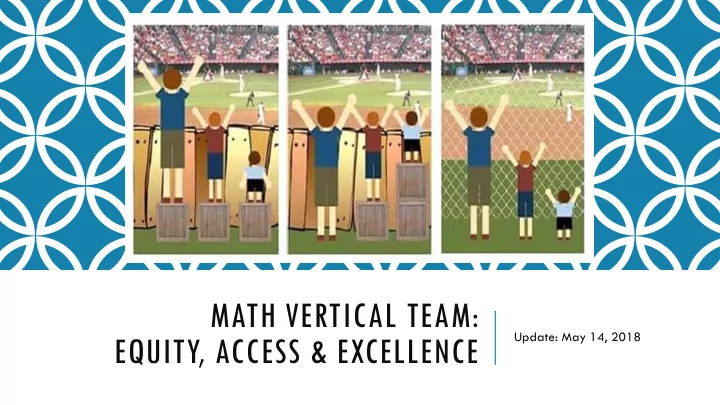
MATH VERTICAL TEAM: EQUITY, ACCESS & EXCELLENCE

Update: May 14, 2018
slide-2
SLIDE 2

MATH VERTICAL TEAM FOR EQUITY, ACCESS AND EXCELLENCE IN MATH

Marty Martorelli, Grade 1 Teacher, NPE Sue Gaur, Grade 2 Teacher, WES Michael Haines, Grade 2 Teacher, SRS Melissa Haebel, Grade 3 Teacher, WES Katie Pulos, Grade 3 Teacher, NPE Rebecca Berman, Grade 4 Teacher, WES Renee Strehle, Grade 5 Teacher, SRS MC Petras, Learning Support Teacher, Grades 4 & 5, SRS Leslee Wagner, Learning Support Teacher, Grade 4 & 5, NPE Al Heinle, Principal, NPE Angela Tuck, Principal, SRS

Joe Buecheler, Interim Principal. WES Larry Miller, Gifted Education Coordinator

Lynn Bowers, SHMS Math Department Co-Chair Cheryl Atkinson, SHMS Math Department Co-Chair Andrew Benzing, SHHS Math Department Chair George King, SHMS Principal Christopher Matsanka, SHMS Assistant Principal Kristopher Brown, SHHS Assistant Principal Denise Citarelli Jones, Director of Secondary Education Jennifer Gaudioso, Director of Elementary Education

slide-3
SLIDE 3

Review Develop Implement Monitor

2012-13 MIF Year 1 6-8 Math Vertical Team Review & Development 2013-14 MIF Year 1 K-5 2012-13 Grouping in 3rd-5th Gifted Education Monitoring 2011 Penn Review

Continuous Improvement Cycle in 3rd -5th

slide-4
SLIDE 4

DISTRICT EQUITY AND EXCELLENCE GOAL

“Provide equity and excellence in educational programming, in expectations

  • f students, and in service and resource
  • provision. Increase achievement for all

students and subgroups”

slide-5
SLIDE 5

2017-18 PROCESS

  • Review of recommendations from MIF on-site Monitoring 2016-2017
  • Review of feedback from two 2016-17 pilots in grades 3-4
  • Site Visits
  • Review of Research-Based Practices
  • HMH System Diagnostic Consultation 2017-18
  • County Directors MIF User Group
  • Redesign of pathways from grade 3 to 12
  • Design thinking
  • Gifted Coordinator Consultation
slide-6
SLIDE 6

TEAM CONCLUSIONS

Developing self-efficacy is critical. Schools should be doing more of what has positive impact with a strong effect size. (See Hattie’s effect size list: Hattie, Fisher, & Frey, 2017; Hattie, 2008) Acceleration does have a high effect size. Not labeling students has a high effect size. Ability grouping can be an institutional obstacle to equity/access. Fixed ability grouping does not have enough positive impact on achievement to outweigh the negative impacts for students placed in “lower” ability groups. Advanced students need access to high levels of challenge/enrichment.

slide-7
SLIDE 7

SELF-EVALUATION/GUIDING QUESTIONS

Does the proposal increase use of best practices? Does the proposal increase student sense of self- efficacy? Does the proposal have any chance of limiting students’ sense of self-efficacy? (intended/ unintended) Does the proposal include options for students with demonstrated need for acceleration?

slide-8
SLIDE 8

SELF-EVALUATION/GUIDING QUESTIONS (CONT’D)

Does the proposal lead to any fixed groupings? Does the proposal impose limiting labels on students? (Formal/informal? Intended/unintended?) Does the proposal impose any obstacles to equity/access?

  • Formal/informal?
  • Intended/unintended?
  • Short term/Long-term?
slide-9
SLIDE 9

RECOMMENDATIONS: INSTRUCTIONAL PRACTICES

slide-10
SLIDE 10

RECOMMENDATION 1: GRADES K-4

  • Grades K-3 will remain as currently configured with

heterogeneous classes and differentiation.

  • In Grade 4, all classes will maintain heterogeneous

grouping for math starting in 2018-2019.

slide-11
SLIDE 11

RECOMMENDATION 2: GRADE 5

Maintain two levels starting in 2018-19:

  • An enriched level
  • A heterogeneous on-level group

Factors considered include increased content complexity in grade five and the transition to middle school.

slide-12
SLIDE 12

K-5- ACROSS ALL GRADES AND LEVELS

Increase alignment with the approach of the core program: Promote social learning and self-efficacy Implement the program lesson design which includes differentiation options Develop additional differentiated resources to support and extend continued enrichment beyond the core.

slide-13
SLIDE 13

ALL K-5 GRADES/LEVELS (CONTINUED)

Continue to involve gifted coordinators in evaluating needs for acceleration and supporting classroom teachers with individualized enrichment to meet needs of all advanced students (GIEP/non-GIEP) Increase opportunities for advanced students to experience depth and real world problem-solving. Maintain supplemental intervention instruction beyond the core math block to support students and ensure remediation needs do not interfere with the rigor of the core instructional block

slide-14
SLIDE 14

RECOMMENDATION 3: GROUPING PRACTICES

Grades 6-8:

  • Move toward elimination of the transition math classes
  • Increase in-class supports (redesign of learning

support)

  • Maintain continual data review to ensure appropriate

levels of rigor for all students

  • Maintain focus on differentiation to support greater

access to individualized challenge across all levels

slide-15
SLIDE 15

Summer Packet & Placement Test

Grade 6 Grade 7 Grade 8 Grade 9

Accelerated Math 6/7 Accelerated Math 7/8

  • Adv. Alg. 1 (H)

Geometry (H) Enriched Math 6 Enriched Math 7 Enriched Math 8

  • Adv. Alg. 1 (H)

Math 6 Math 7 Math 8

  • Adv. Alg. 1

Transition Math 6 Transition Math 7 Transition Math 8 Foundations of Algebra

5th Grade Math

slide-16
SLIDE 16

SYNCHRONOUS SUPPORTS: WHAT CAME BEFORE?

  • Long-term sustained professional development in math
  • District-wide training and PLC initiatives focused on collaborative analysis of student

learning information to improve instruction and student achievement

  • Gifted education review and development of cohesive team of gifted education

coordinators focused on regular education opportunities for challenge. Includes routines for identifying students in need of acceleration.

  • K-5 Implementation of system wide math intervention resources – to ensure the core

instructional block remains rigorous core instruction and remediation is supplemented beyond the core

  • Successful heterogeneous pilots in grades 3 and 4
  • 5th Grade districtwide goal: Developing perseverance/growth mindset with

mathematical problem-solving

  • Schoolwide enrichment practices focused on design thinking and growth mindset
slide-17
SLIDE 17

SYNCHRONOUS SUPPORTS FOR 2018-19

Curriculum Framework Review Cycle:

  • 2012-13 Gifted Education Review: Adopted Schoolwide

Enrichment model, expanded role of Gifted coordinators to provide leadership in GIEP/non-GIEP schoolwide enrichment

  • 2018-19 Enrichment/Gifted Education Review: Review/

alignment of enrichment practices, quarterly parent (GIEP/non- GIEP) focus groups on enrichment experiences, student surveys/interviews

slide-18
SLIDE 18

THE CHALLENGE OF MATH EDUCATION TODAY

New standards require more: Depth and flexibility of understanding Application of learning to novel situations/real world problems Ability to explain and defend reasoning Rote algorithms are insufficient: Focus on depth of understanding, flexibility of thinking. Slow down to go deeper. Greater opportunity for small group problem-solving, collaboration, high level discourse with peers, flexible thinking, non-routine problems

slide-19
SLIDE 19

FOCUS ON MATHEMATICAL PRACTICES

Make sense of problems and persevere in solving them. Reason abstractly and quantitatively. Construct viable arguments and critique the reasoning of others. Model with mathematics. Use appropriate tools strategically. Attend to precision. Look for and make use of structure. Look for and express regularity in repeated reasoning.

slide-20
SLIDE 20

SUPPORTING ENRICHMENT FOR ALL STUDENTS

Academic development, intellectual growth, and personal excellence within a context that supports: Social/emotional development Development of strong habits of mind/growth mindset to support long-term success and excellence with increasing levels of challenge

slide-21
SLIDE 21

VIDEO: SCHOOLWIDE ENRICHMENT FOR ALL

slide-22
SLIDE 22

ADDITIONAL RECOMMENDATIONS: LONG TERM CONTINUOUS IMPROVEMENT

Maintain strong professional development in math Continue professional development in differentiation [K-5] Add monthly/quarterly stand-alone data meetings for advanced student focus. Include gifted coordinator to consult on data, goals and practices (Currently addressed through regular team data meetings) [6-12] Consider requirement for remediation block/mini-block at secondary level Maintain team/development focus on the core questions of a PLC*

slide-23
SLIDE 23

NEXT STEPS IN COMMUNICATION:

  • Math Parent Information Night: May 30th, 2018
  • District letter updating parents about improvements in design of

instruction.

  • Updated parent information on district website