
SLIDE 1
Digital Equity Matters
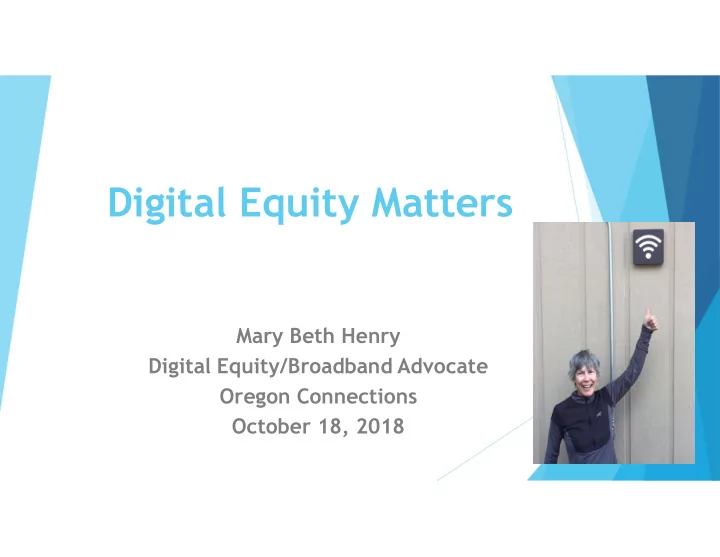
Mary Beth Henry Digital Equity/Broadband Advocate Oregon Connections October 18, 2018
Digital Equity Matters Mary Beth Henry Digital Equity/Broadband - - PowerPoint PPT Presentation
Digital Equity Matters Mary Beth Henry Digital Equity/Broadband Advocate Oregon Connections October 18, 2018 Digital Equity Matters Agenda What is digital equity/digital divide/digital inclusion & why does it matter? What Does the
Mary Beth Henry Digital Equity/Broadband Advocate Oregon Connections October 18, 2018
What is digital equity/digital divide/digital
inclusion & why does it matter?
Oregon’s Homegrown Success Stories: Access &
Digital Inclusion
Community-Building in the Digital Age Call to Action:
Final Thoughts
2
National Digital Inclusion Alliance
3
Digital Equity ensures all individuals and communities have the information technology capacity needed for full participation in our society, democracy, and economy. Digital Equity is necessary for civic and cultural participation, employment, lifelong learning, and access to essential services
Refers to the difference/gap between people
who have easy access to the Internet, have devices, have digital skills and those who don’t.
The digital divide is really “digital divides”:
income levels, education, special needs or disabilities,
4
5
Digital Inclusion refers to the activities necessary to ensure that all individuals and communities, including the most disadvantaged, have access to, and use of, information and communication technologies (ICTs
“
6
1) Affordable, robust broadband Internet service; 2) Internet-enabled devices that meet the needs of the user; 3) Access to digital literacy training; 4) Quality technical support; and 5) Applications and online content designed to enable and encourage self-sufficiency, participation, and collaboration.
“
Broadband infrastructure supports and enables
everything – it is foundational
Digital skills underpin nearly every aspect of work
and life
Economic Opportunity, Democracy, Healthcare,
Education, Environment
>$1,850 per household per year in economic benefits 1 in 5 Oregonians don’t have internet at home
7
8
9
66% 58% 17% 66% 50% 15% Oregon National Oregon National Oregon National Penetration by Geography 10 Mbps/1 Mbps 25 Mbps/3 Mbps 100 Mbps/10 Mbps
Broadband Status
Total Portland Central Coast Central Oregon SW Oregon NW Coast North Central South Central Eastern
Broadband at home 82% 85% 83% 83% 79% 78% 76% 69% 67%
10
Higher penetration Lower penetration
Many rural and urban Oregonians lack broadband access at home
11
Low cost Broadband available @ home Connecting training with relevant content & services Low cost computers available Public access computing centers Regional collaborations/initiatives – partners Funding for program sustainability Outcome-based evaluation Whole community strategy
12
United States Department of Agriculture (USDA)
National Telecommunications Information Administration (NTIA)
Federal Communications Commission (FCC)
13
Oregon Broadband Advisory Council
Oregon Universal Service Fund
Oregon Fiber Partnership Net Neutrality
14
Minnesota California Maine
15
Governor’s Task Force on Broadband Development
(2008): Develops policies and action plans to promote broadband.
Office of Broadband Development (2013): Expands high
speed broadband access to all households, businesses, schools and government buildings by 2026.
St. Paul Neighborhood Network (SPNN) – Community
Technology Empowerment Project (CTEP) - AmeriCorps
16
California Emerging Technology Fund – (CETF) (2005)
Provides leadership statewide to close the "Digital Divide" by accelerating the deployment and adoption of broadband to unserved and underserved communities and populations.
California Broadband Council (2010)
To promote broadband deployment in unserved and underserved areas of the state as defined by the Public Utilities Commission, and broadband adoption throughout the state.
Broadband and Digital Literacy Office
The Mission is to establish digital literacy throughout the state
and 90% adoption by 2023
17
ConnectME (2006): establishes unserved/underserved
criteria, promotes use, supports investment, facilitates state support, collects and disseminates info, and administers funds.
deployment for unserved (defined as < 25/3). Maine goal is 100/10
Axiom: Private rural provider (2004) Axiom Education & Training Center
Initiative (2017)
18
19
Douglas Fast Net Eastern Oregon Telecom SandyNet EugNet MINET OnlineNW LS Networks
20
Formed by Douglas Electric Coop (2001) Partners
Roseburg and Douglas County Douglas County Fire District #2 State of Oregon Mercy Medical Center Umpqua Community College Nine city governments, thirteen school districts, countless
business and medical facilities and residential.
$39.99 to $89.99 per month (100MPS to 1 Gig) 11,000 active circuits that include residential and non-
residential
21
Hermiston/Umatilla County EOT was formed in 1999, and was initially owned by
Umatilla and Douglas Electric Coops, four telephone cooperatives and a telecommunications consulting firm
Initially offering telephone services, EOT expanded to
high-speed internet in 2003
Employee buyout to facilitate expansion All bi-lingual staff 3,500 customers
.
22
Municipal broadband utility: started with wireless Partnered with OFS & launched fiber construction
in 2014
Take rate was 60% in first year, has grown to 68% 300 Mbps synchronous - $39.95 1 Gbps synchronous – $59.95
23
24
Economic Development Partnership – City of Eugene,
Eugene Water and Electric Board, Lane Council of Governments, with support from Technology Association of Oregon
Open Access – publicly owned and available to lease
by any ISP
About 70 buildings have signed up to connect About 10 x faster and half the cost of other providers New businesses and existing businesses expanding
Cities of Monmouth & Independence Lit up triple-play fiber to the home system in 2007 Leveraging network for education and economic
development
Key assets are agility and alignment Proximity to University partners (WOU, OSU) Agricultural technology is a niche
In the Mid-Willamette Valley
Develop strategic partnerships: Critical one being Innovate Oregon, a
part of the Technology Association of Oregon (TAO)
Create a new story: Build the first 10 Gig fiber network on the West
Coast, introduce new Agile mindsets, skillsets and toolsets to the school and community, build an Innovation Fund with revenues from the network subscribers
Focus on the big story: Creating a new “opportunity paradigm” for
rural communities
Tell the story: Use resources from the community to share the story
both within the communities and to other communities
Public Private Partnership
community
Open Network
“Better Broadband than Portland”
Discount Internet Guidebook Comcast Internet Essentials CenturyLink Internet Basics Spectrum Internet Assist Frontier
29
Libraries Schools ChickTech Non-Profit Technology Network (NTEN) Free Geek Open Signal MetroEast Community Media
“Libraries are becoming more rather than less popular and
Invaluable in promoting digital inclusion Primary source of internet access for many Americans 70% of rural libraries are the only free Internet access
Majority believe libraries should teach digital skills
30
Homework Gap Refers to the difficulty students experience completing homework when they
lack internet access at home, compared to those who have access.
Only 61% of US homes with school-age children have internet @ home 75% of US school systems do not have any off-campus strategies for providing
connectivity to students at home and after school
Beaverton School District Extended Library Hours Wi-Fi Map & Hotspots in all High Schools & Middle Schools Latino Technology Nights TechSmart Initiative for Student Success - Mt Hood Cable Regulatory Commission $19 million technology investment over 10 years David Douglas, Parkrose, Reynolds, Portland Public Schools,
Gresham-Barlow, and Centennial
75% of school systems
31
ChickTech envisions a safe, inclusive, and innovative technology future that includes equal pay, participation, and treatment of women. In the last year: 6,126 Adults Served 1,471 Volunteers 73 Girls in Tech Events 171 Women in Tech Events
ChickTech was founded locally in 2012 and now has over 25 chapters across North America, we have built a multi- generational movement where we are improving the lives
industry as a whole.
Learn more: nten.org/DIF leana@nten.org
Launched in 2015, the Digital Inclusion Fellowship supports people in building critical digital literacy skills by providing training and capacity building to nonprofits. Fellows participate in a one-year, project-based professional development cohort to expand digital inclusion programs in their community.
FREEGEEK.ORG
Sustainable Reuse
Digital Access
Education
Sustainably reuses technology, enables digital access and provides education to create a community that empowers people to realize their potential.
DIGITAL INCLUSION EFFORTS
Free Macintosh Basics classes for adults Introduction to media technology and media literacy classes for
middle and high school students and houseless youth
Introduction to digital video tools for Spanish speakers Media classes for members of the disabled community Free public media library, including MacBookPro laptops and
iPads
Free wifi access at our community facility Free public video production and animation labs
36
WASH & LEARN INITIATIVE (WALI) PC’s For People Tech Goes Home Older Adult Technology Services (OATS)
37
Broadband connectivity Knowledge workforce Innovation Digital equity Are you telling your story? Sustainability
38
Establish an Office for Broadband Establish an Office for Broadband Add wireless & VOIP to the OUSF Add wireless & VOIP to the OUSF Tax wireless to fund digital inclusion Tax wireless to fund digital inclusion Establish a broadband investment fund Establish a broadband investment fund Update Broadband Adoption Survey Update Broadband Adoption Survey Update Broadband Map & independently verify Update Broadband Map & independently verify Facilitate community broadband planning Facilitate community broadband planning Adopt policies that support broadband deployment Adopt policies that support broadband deployment Engage AmeriCorps Engage AmeriCorps Engage philanthropic community Engage philanthropic community Engage OSU Extension Engage OSU Extension Engage universities & community colleges Engage universities & community colleges Encourage tech talent to run for
Encourage tech talent to run for
Evaluate policies using a Digital Equity Lens Evaluate policies using a Digital Equity Lens Reach out to Federal Reserve Reach out to Federal Reserve
39
Wait…What? I wonder if…? Couldn’t we at least…? How can I help? What truly matters to me?
40
MBH2
Slide 40 MBH2
Mary Beth Henry, 10/16/2018
The internet is the new essential utility, yet many Oregonians lack broadband access The digital divide(s) is a critical economic challenge for both rural and urban areas There are many successful digital inclusion models at state and community levels Oregon needs to fund a comprehensive broadband and digital equity strategy Community-specific broadband strategies are needed to prosper in the digital age
41
THANKS
Chris Tamarin Joe Franell
Adam Haas Rebecca Gibbons Vailey Oehlke David Olson Dave Sabala Robert Gallardo Geoff Daily Susan Walters Susan Corbett Sam Pastrick Joe Knapp Shawn Irvine Geoff Daily Sheldon Renan Joanne Hovis James Fallows Colin Rhinesmith James Ryan Lucas Turpin Vince Adams Mike Burnett Cindy Gibbon Rebecca Burrell Doug Dawson Angela Seifert Roberto Gallardo Ed Parker Chris Mitchell Rebecca Gibbons Thompson Morrison Danna MacKenzie OATOA Julie Omelchuck Brant Wolf Michael Hanna Colleen Dixon Drew Pizzolato Leif Hansen Dan Bartholomew Rich Bader Bryan Adams Bryan Conway Matthew Hiefield Blair Levin Matt Timberlake Ben Burnett Laura Bell Karl Mundorf
42
Everyone in this room! National Digital Inclusion Alliance - NDIA Gigabit Cities – Technical strategies for facilitating public or private
broadband construction in your community.
Coalition for Local Internet Choice (CLIC) The Next Generation Network Connectivity Handbook Next Century Cities NATOA/OATOA Oregon Broadband Advisory Council
43