Equations with the Same Equations with the Same How could you start - - PDF document

equations with the same equations with the same
SMART_READER_LITE
LIVE PREVIEW

Equations with the Same Equations with the Same How could you start - - PDF document

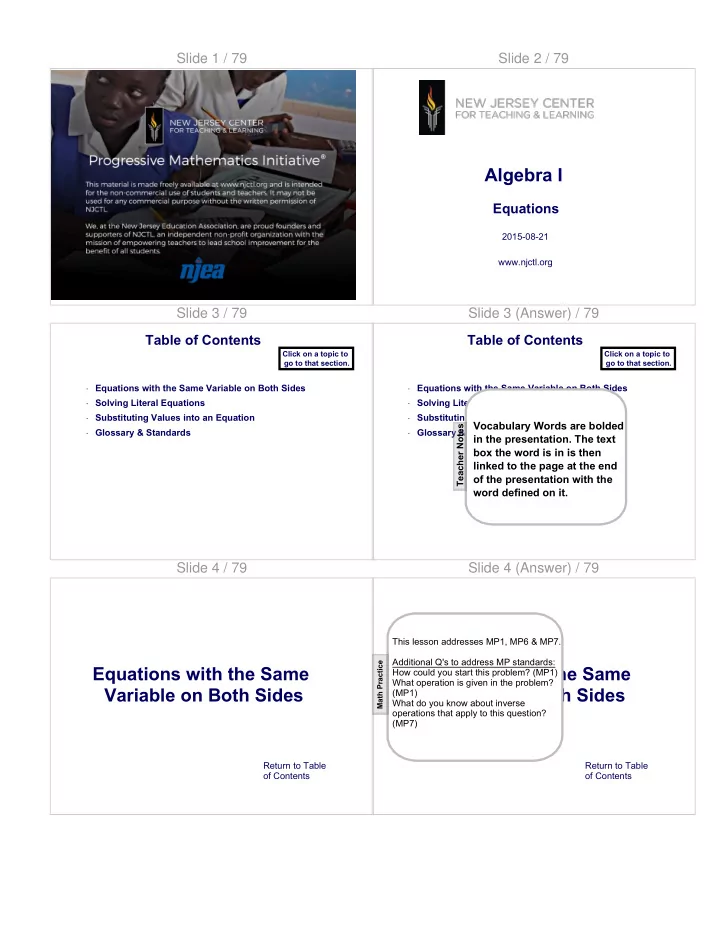
Slide 1 / 79 Slide 2 / 79 Algebra I Equations 2015-08-21 www.njctl.org Slide 3 / 79 Slide 3 (Answer) / 79 Table of Contents Table of Contents Click on a topic to Click on a topic to go to that section. go to that section. Equations


slide-1
SLIDE 1

Slide 1 / 79 Slide 2 / 79

Algebra I

Equations

2015-08-21 www.njctl.org

Slide 3 / 79 Table of Contents

Click on a topic to go to that section.

· Equations with the Same Variable on Both Sides · Solving Literal Equations · Glossary & Standards · Substituting Values into an Equation

Slide 3 (Answer) / 79 Table of Contents

Click on a topic to go to that section.

· Equations with the Same Variable on Both Sides · Solving Literal Equations · Glossary & Standards · Substituting Values into an Equation

[This object is a pull tab]

Teacher Notes

Vocabulary Words are bolded in the presentation. The text box the word is in is then linked to the page at the end

  • f the presentation with the

word defined on it.

Slide 4 / 79

Equations with the Same Variable on Both Sides

Return to Table

  • f Contents

Slide 4 (Answer) / 79

Equations with the Same Variable on Both Sides

Return to Table

  • f Contents

[This object is a pull tab]

Math Practice

This lesson addresses MP1, MP6 & MP7. Additional Q's to address MP standards: How could you start this problem? (MP1) What operation is given in the problem? (MP1) What do you know about inverse

  • perations that apply to this question?

(MP7)

slide-2
SLIDE 2

Slide 5 / 79

Now, we will be given an equation with the same variable on both

  • sides. These equations will look similar to the following:

These require one additional step to get all the terms with that variable to one side or the other. It doesn't matter which side you choose to move the variables to, but it’s typically most helpful to choose the side in which the coefficient of the variable will remain positive.

Variables on Both Sides

Previously, you solved equations with variables on one side, similar to the following:

Slide 5 (Answer) / 79

Now, we will be given an equation with the same variable on both

  • sides. These equations will look similar to the following:

These require one additional step to get all the terms with that variable to one side or the other. It doesn't matter which side you choose to move the variables to, but it’s typically most helpful to choose the side in which the coefficient of the variable will remain positive.

Variables on Both Sides

Previously, you solved equations with variables on one side, similar to the following:

[This object is a pull tab]

Math Practice

MP6: Attend to precision. Emphasize performing the inverse

  • peration to BOTH sides of the equation.

Slide 6 / 79

When you have finished solving, discuss the meaning of your answer with your neighbor.

Meaning of Solutions

Before we encounter the new equations, let's practice how to solve an equation with the variable on only one side. Solve for x:

Slide 6 (Answer) / 79 Slide 7 / 79 Meaning of Solutions

Remember that you always have the ability to check your answers by substituting the value you solved for back in to the original equation. It isn't necessary to show on each problem, but is encouraged if you feel unsure about your answer.

Slide 8 / 79

Which side do you think would be easiest to move the variables to?

Variables on Both Sides

slide-3
SLIDE 3

Slide 8 (Answer) / 79 Slide 9 / 79 Variables on Both Sides

Which side do you think would be easiest to move the variables to?

Slide 9 (Answer) / 79 Slide 10 / 79

Example: What do you think about this equation? What is the value of x?

Slide 10 (Answer) / 79 Slide 11 / 79

Example: What do you think about this equation? What is the value of x?

slide-4
SLIDE 4

Slide 11 (Answer) / 79 Slide 12 / 79

1 Solve for f:

Slide 12 (Answer) / 79 Slide 13 / 79

2 Solve for h:

Slide 13 (Answer) / 79 Slide 14 / 79

3 Solve for x:

slide-5
SLIDE 5

Slide 14 (Answer) / 79 Slide 15 / 79

Sometimes, you get an interesting answer. What do you think about this? What is the value of x? 3x - 1 = 3x + 1

  • 3x
  • 3x
  • 1 = +1

Since the equation is false, there is no solution! No value will make this equation true.

No Solution Slide 16 / 79

How about this one? What do you think about this? What is the value of x? 3(x - 1) = 3x - 3 3x - 3 = 3x - 3

  • 3x
  • 3x
  • 3 = -3

Since the equation is true, there are infinitely many solutions! The equation is called an identity. Any value will make this equation true.

Identity Slide 17 / 79

4 Solve for r: A r = 0 B r = 2 C infinitely many solutions (identity) D no solution

Slide 17 (Answer) / 79

4 Solve for r: A r = 0 B r = 2 C infinitely many solutions (identity) D no solution

[This object is a pull tab]

Answer

C infinitely many solutions (identity)

Slide 18 / 79

5 Solve for w: A w = -8 B w = -1 C infinitely many solutions (identity) D no solution

slide-6
SLIDE 6

Slide 18 (Answer) / 79 Slide 19 / 79

6 Solve for x: A x = 0 B x = 24 C infinitely many solutions (identity) D no solution

Slide 19 (Answer) / 79

6 Solve for x: A x = 0 B x = 24 C infinitely many solutions (identity) D no solution

[This object is a pull tab]

Answer

D no solution

Slide 20 / 79 Slide 20 (Answer) / 79 Slide 21 / 79

8 In the accompanying diagram, the perimeter of ∆MNO is equal to the perimeter of square ABCD. If the sides of the triangle are represented by 4x + 4, 5x - 3, and 17, and one side of the square is represented by 3x, find the length of a side of the square.

5x – 3 4x + 4 17 O M N 3x A B C D

From the New York State Education Department. Office of Assessment Policy, Development and

  • Administration. Internet. Available from www.nysedregents.org/IntegratedAlgebra; accessed 17, June, 2011.
slide-7
SLIDE 7

Slide 21 (Answer) / 79

8 In the accompanying diagram, the perimeter of ∆MNO is equal to the perimeter of square ABCD. If the sides of the triangle are represented by 4x + 4, 5x - 3, and 17, and one side of the square is represented by 3x, find the length of a side of the square.

5x – 3 4x + 4 17 O M N 3x A B C D

From the New York State Education Department. Office of Assessment Policy, Development and

  • Administration. Internet. Available from www.nysedregents.org/IntegratedAlgebra; accessed 17, June, 2011.

[This object is a pull tab]

Answer

18

Slide 22 / 79

· When solving an equation with variables on both sides, choose a side to move all of them to, then continue working to isolate the variable. · When solving an equation where all variables are eliminated and the remaining equation is false, there is No Solution. · When solving an equation where all variables are eliminated and the remaining equation is true, there are Infinite Solutions.

RECAP Slide 23 / 79

Solving Literal Equations

Return to Table

  • f Contents

Slide 23 (Answer) / 79

Solving Literal Equations

Return to Table

  • f Contents

[This object is a pull tab]

Math Practice

This lesson addresses MP1, MP2, MP6 & MP7. Additional Q's to address MP standards: How could you start this problem? (MP1) What operation is given in the problem? (MP1) What do you know about inverse

  • perations that apply to this question?

(MP7)

Slide 24 / 79

A good example is , which you may have seen in your physics course. Another example is which we use when studying geometry. In some cases, it is actually easier to work with literal equations since there are only variables and no numbers.

Literal Equations

A literal equation is an equation in which known quantities are expressed either wholly or in part by using letters.

Slide 25 / 79

The variables in this equation are s, d and t. Solving for a variable means having it alone, or isolated. This equation is currently solved for s.

Literal Equations

Our goal is to be able to solve any equation for any variable that appears in it. Let's look at a simple equation first.

slide-8
SLIDE 8

Slide 26 / 79

When solving a literal equation you will be asked to isolate a particular variable in the equation. For example, with the formula: you might be asked to solve for p. This means that p will be on one side of the equation by itself. The new formula will look this: You can transform a formula to describe one quantity in terms of the

  • thers by following the same steps as solving an equation.

Literal Equations Slide 26 (Answer) / 79

When solving a literal equation you will be asked to isolate a particular variable in the equation. For example, with the formula: you might be asked to solve for p. This means that p will be on one side of the equation by itself. The new formula will look this: You can transform a formula to describe one quantity in terms of the

  • thers by following the same steps as solving an equation.

Literal Equations

[This object is a pull tab]

Teacher Notes Work through the steps with students, to show them that the same rules apply when moving variables as numbers.

Slide 27 / 79

  • 2. You can do anything you want (except divide by zero) to one

side of an equation, as long as you do the same thing to the

  • ther.
  • 3. If there is more than one operation going on, you must undo

them in the opposite order in which you would do them, the

  • pposite of the "order of operations."
  • 4. You can always switch the left and right sides of an equation.

Tips for Solving Equations

  • 1. To "undo" a mathematical operation, you must perform the

inverse operation.

Slide 28 / 79

  • 1. To "undo" a mathematical operation, you must do the opposite.

We learned earlier that for every mathematics operation, there is an inverse operation which undoes it: when you do both

  • perations, you get back to where you started.

When the variable for which we are solving is connected to something else by a mathematical operation, we can eliminate that connection by using the inverse of that operation.

Tips Explained Slide 29 / 79

  • 2. You can do anything you want (except divide by zero) to one

side of an equation, as long as you do the same to the other side. If the two expressions on the opposite sides of the equal sign are equal to begin with, they will continue to be equal if you do the same mathematical operation to both of them. This allows you to use an inverse operation on one side, to undo an operation, as long as you also do it on the other side. You can just never divide by zero (or by something which turns out to be zero) since the result of that is always undefined.

Tips Explained Slide 30 / 79

  • 3. If there is more than one operation going on, you must undo

them in the opposite order in which you would do them, the

  • pposite of the "order of operations."

The operations which are connected to a variable must be "undone" in the reverse order from the Order of Operations. So, when solving for a variable, you: first have to undo addition/subtraction, then multiplication/division, then exponents/roots, finally parentheses. The order of the steps you take to untie a knot are the reverse of the order used to tie it.

Tips Explained

slide-9
SLIDE 9

Slide 31 / 79

  • 4. You can always switch the left and right sides of an equation.

Once an equation has been solved for a variable, it is typically easier to use if that variable is moved to the left side. Mathematically, this has no effect since the both sides are equal.

Tips Explained Slide 32 / 79

Examples: Solve for : Solve for :

Literal Equations Slide 32 (Answer) / 79

Examples: Solve for : Solve for :

Literal Equations

[This object is a pull tab]

Answer

*Some students may need to see the division take place in 2 steps; before seeing you can divide by both variables at the same time.

Slide 33 / 79

Let's solve this equation for d That means that when we're done we'll have d isolated.

Practice Solving for a Variable Slide 34 / 79

9 First, is d already alone? If not, what is with it? A s B d C t D it is already alone

Slide 34 (Answer) / 79

9 First, is d already alone? If not, what is with it? A s B d C t D it is already alone

[This object is a pull tab]

Answer

C

slide-10
SLIDE 10

Slide 35 / 79

10 What mathematical operation connects d and t? A d is added to t B d is multiplied by t C d is divided by t D t is subtracted from d

Slide 35 (Answer) / 79

10 What mathematical operation connects d and t? A d is added to t B d is multiplied by t C d is divided by t D t is subtracted from d

[This object is a pull tab]

Answer

C

Slide 36 / 79

11 What is the opposite of dividing d by t? A dividing t by d B dividing by s into t C multiplying d by t D multiplying by t by d

Slide 36 (Answer) / 79

11 What is the opposite of dividing d by t? A dividing t by d B dividing by s into t C multiplying d by t D multiplying by t by d

[This object is a pull tab]

Answer

C

Slide 37 / 79

12 What must we also do if we multiply the right side by t?

A divide the left side by t B multiply the left side by t C divide the left side by d D divide the left side by d

Slide 37 (Answer) / 79

12 What must we also do if we multiply the right side by t?

A divide the left side by t B multiply the left side by t C divide the left side by d D divide the left side by d

[This object is a pull tab]

Answer

B

slide-11
SLIDE 11

Slide 38 / 79

13 Is there more than one mathematical operation acting

  • n d?

Yes No

Slide 38 (Answer) / 79

13 Is there more than one mathematical operation acting

  • n d?

Yes No

[This object is a pull tab]

Answer

No

Slide 39 / 79

14 What is the final equation, solved for d? A B C D

Slide 39 (Answer) / 79

14 What is the final equation, solved for d? A B C D

[This object is a pull tab]

Answer

B

Slide 40 / 79 Slide 40 (Answer) / 79

slide-12
SLIDE 12

Slide 41 / 79

A common kinematics equation is given below. Although they use the same letter, and are different variables. Let's solve this equation for .

Solving for vo

is pronounced "vee naught" & represents the initial (or starting) velocity.

Slide 42 / 79

16 Is already alone? If not, what is with it? A only a B only t C a and t D it is already alone

Slide 42 (Answer) / 79

16 Is already alone? If not, what is with it? A only a B only t C a and t D it is already alone

[This object is a pull tab]

Answer

C

Slide 43 / 79

17 What mathematical operation connects a and t to ? A at is being divided by vo B at is being added to vo C vo is being multiplied by at D vo is being divided by at

Slide 43 (Answer) / 79

17 What mathematical operation connects a and t to ? A at is being divided by vo B at is being added to vo C vo is being multiplied by at D vo is being divided by at

[This object is a pull tab]

Answer

B

Slide 44 / 79

18 What is the opposite of adding at to ? A dividing by vo by at into t B subtracting vo from at C subtracting at from vo D dividing at by vo

slide-13
SLIDE 13

Slide 44 (Answer) / 79

18 What is the opposite of adding at to ? A dividing by vo by at into t B subtracting vo from at C subtracting at from vo D dividing at by vo

[This object is a pull tab]

Answer

C

Slide 45 / 79

19 What must we do, if we subtract at from the right side?

A add at to the left side B multiply the left side by at C subtract at from the left side D divide the left side by vo

Slide 45 (Answer) / 79

19 What must we do, if we subtract at from the right side?

A add at to the left side B multiply the left side by at C subtract at from the left side D divide the left side by vo

[This object is a pull tab]

Answer

C

Slide 46 / 79

20 Is there more than one mathematical operation acting

  • n ?

Yes No

Slide 46 (Answer) / 79

20 Is there more than one mathematical operation acting

  • n ?

Yes No

[This object is a pull tab]

Answer

No

Slide 47 / 79

21 What is your final equation for ? A B C D

slide-14
SLIDE 14

Slide 47 (Answer) / 79

21 What is your final equation for ? A B C D

[This object is a pull tab]

Answer

D

Slide 48 / 79

22 Which of the following correctly shows the equation solved for the variable a? A B C D

Slide 48 (Answer) / 79

22 Which of the following correctly shows the equation solved for the variable a? A B C D

[This object is a pull tab]

Answer

C

Slide 49 / 79

23 To convert Fahrenheit temperature to Celsius you use the formula: A B C D Which of the following shows the equation correctly solved for F?

Slide 49 (Answer) / 79

23 To convert Fahrenheit temperature to Celsius you use the formula: A B C D Which of the following shows the equation correctly solved for F?

[This object is a pull tab]

Answer

B

Slide 50 / 79

24 Solve for h: A B C D

slide-15
SLIDE 15

Slide 50 (Answer) / 79

24 Solve for h: A B C D

[This object is a pull tab]

Answer

B Slide 51 / 79

Literal Equation questions may be posed in various ways, while still wanting you to isolate a variable. You may encounter some

  • f the following phrases.

· Which equation is equivalent... · Solve for ___ in terms of ____ · Isolate the variable ___ · Transform the formula to find ___ · ___ is given by... Remember, the steps for solving all remain the same!

Slide 52 / 79

25 If A represents the area of a circular horse corral, the following equation correctly shows , solved for r. True False

Slide 52 (Answer) / 79

25 If A represents the area of a circular horse corral, the following equation correctly shows , solved for r. True False

[This object is a pull tab]

Answer TRUE Good question for discussion. While it is true that when you initially solve for r, you must include the ± version, we are given a real life situation in where the radius of the horse corral cannot be negative.

Slide 53 / 79

26 Solve for t in terms of s: A B C D

Slide 53 (Answer) / 79

26 Solve for t in terms of s: A B C D

[This object is a pull tab]

Answer

A

slide-16
SLIDE 16

Slide 54 / 79

27 A satellite's speed as it orbits the Earth is found using the formula . In this formula, m stands for the mass of the Earth. Transform this formula to find the mass of the Earth. A B C D

Slide 54 (Answer) / 79

27 A satellite's speed as it orbits the Earth is found using the formula . In this formula, m stands for the mass of the Earth. Transform this formula to find the mass of the Earth. A B C D

[This object is a pull tab]

Answer

D

Slide 55 / 79

28 Which equation is equivalent to ? A B C D

From the New York State Education Department. Office of Assessment Policy, Development and Administration. Internet. Available from www.nysedregents.org/IntegratedAlgebra; accessed 17, June, 2011.

Slide 55 (Answer) / 79

28 Which equation is equivalent to ? A B C D

From the New York State Education Department. Office of Assessment Policy, Development and Administration. Internet. Available from www.nysedregents.org/IntegratedAlgebra; accessed 17, June, 2011. [This object is a pull tab]

Answer

C

Slide 56 / 79 Slide 56 (Answer) / 79

slide-17
SLIDE 17

Slide 57 / 79

30 The formula for finding the perimeter, P, of a rectangle with length l and with width w is given. Which formula shows how the length of a rectangle can be determined from the perimeter and the width? A B C D

From PARCC PBA sample test calculator #1

Slide 57 (Answer) / 79

30 The formula for finding the perimeter, P, of a rectangle with length l and with width w is given. Which formula shows how the length of a rectangle can be determined from the perimeter and the width? A B C D

From PARCC PBA sample test calculator #1

[This object is a pull tab]

Answer

B Slide 58 / 79

31 Caroline knows the height and the required volume of a cone-shaped vase she's designing. Which formula can she use to determine the radius of the vase? Recall the formula for volume of a cone: Select the correct answer. A B C D

From PARCC EOY sample test calculator #8

Slide 58 (Answer) / 79

31 Caroline knows the height and the required volume of a cone-shaped vase she's designing. Which formula can she use to determine the radius of the vase? Recall the formula for volume of a cone: Select the correct answer. A B C D

From PARCC EOY sample test calculator #8

[This object is a pull tab]

Answer

B Slide 59 / 79

Substituting Values into an Equation

Return to Table

  • f Contents

Slide 59 (Answer) / 79

Substituting Values into an Equation

Return to Table

  • f Contents

[This object is a pull tab]

Math Practice

This lesson addresses MP1, MP2, MP3, MP4, MP6 & MP7. Additional Q's to address MP standards: How could you start this problem? (MP1) What operation is given in the problem? (MP1) How does Substitution relate to Evaluating Equations and Literal Equations? What do you know about inverse

  • perations that apply to this question?

(MP7)

slide-18
SLIDE 18

Slide 60 / 79 Evaluating Expressions

In previous courses you have learned to evaluate expressions given the values for specific variables. Recall - Evaluate given In this section we will extend that knowledge to include literal equations, and use substitution to solve for unknown quantities.

Slide 61 / 79

The value of any variable in an equation depends on the values of the other variables. To find an unknown value:

  • 1. Identify an equation, if not given to you, which relates the values of

the variables you know with that of the variable you don't know.

  • 2. Solve for the variable of interest.
  • 3. Substitute numbers for the known variables (using parentheses

around each number).

  • 4. Then do the arithmetic to find the unknown value.
  • 5. Assign units to solution, if necessary.

Solving for Unknowns Slide 62 / 79 Slide 62 (Answer) / 79 Slide 63 / 79 Solving for Unknowns

The units to the solution in the last question turned out to be . Discuss with your neighbor why this was the case.

Slide 63 (Answer) / 79 Solving for Unknowns

The units to the solution in the last question turned out to be . Discuss with your neighbor why this was the case.

[This object is a pull tab]

Teacher Notes

no units feet feet

slide-19
SLIDE 19

Slide 64 / 79

Example: A car travels 800m in 480s. At what speed was it traveling?

  • 1. Identify a useful equation:
  • 2. Solve for the unknown:
  • 3. Substitute known values:
  • 4. Calculate:
  • 5. Assign units:

(Can you think of any equations to relate distance and time?)

Solving for Unknowns Slide 64 (Answer) / 79

Example: A car travels 800m in 480s. At what speed was it traveling?

  • 1. Identify a useful equation:
  • 2. Solve for the unknown:
  • 3. Substitute known values:
  • 4. Calculate:
  • 5. Assign units:

(Can you think of any equations to relate distance and time?)

Solving for Unknowns

[This object is a pull tab]

Answer The equation is already solved for s.

Slide 65 / 79

Example: A car travels at a speed of 75 miles/hour for 1.5 hours. How far did it travel?

  • 1. Identify a useful equation:
  • 2. Solve for the unknown:
  • 3. Substitute known values for variables:
  • 4. Calculate:
  • 5. Apply units:

Solving for Unknowns Slide 65 (Answer) / 79

Example: A car travels at a speed of 75 miles/hour for 1.5 hours. How far did it travel?

  • 1. Identify a useful equation:
  • 2. Solve for the unknown:
  • 3. Substitute known values for variables:
  • 4. Calculate:
  • 5. Apply units:

Solving for Unknowns

[This object is a pull tab]

Answer

Slide 66 / 79

Acceleration is found using the following formula, which takes the change in velocity over time. Turn to a partner, where do you hear about acceleration outside of class?

Acceleration

acceleration = change of velocity elapsed time

Slide 66 (Answer) / 79

Acceleration is found using the following formula, which takes the change in velocity over time. Turn to a partner, where do you hear about acceleration outside of class?

Acceleration

acceleration = change of velocity elapsed time

[This object is a pull tab]

Teacher Notes Students in PSI Algebra based Physics are learning about acceleration in their first unit, Kinematics. They may have heard about acceleration when referring to cars, roller coasters, gravity, etc.

slide-20
SLIDE 20

Slide 67 / 79 Units for Acceleration

You can derive the units for acceleration by substituting the correct units into the right hand side of the equation. Change in velocity (v - v0) is in meters/second (m/s) Time, t, is in seconds (s) Acceleration, a, is in meters/seconds (m/s2)

Slide 67 (Answer) / 79 Units for Acceleration

You can derive the units for acceleration by substituting the correct units into the right hand side of the equation. Change in velocity (v - v0) is in meters/second (m/s) Time, t, is in seconds (s) Acceleration, a, is in meters/seconds (m/s2)

[This object is a pull tab]

Teacher Notes MP6: Attend to Precision On the next 7 slides, the students are only entering the numerical answer with their Responder, so emphasize the correct units of measurement for each question with the class, since not all responders let you put in units.

Slide 68 / 79

32 A particle traveled for 10 seconds at a rate of 32 m/s. How far did the particle travel?

Slide 68 (Answer) / 79

32 A particle traveled for 10 seconds at a rate of 32 m/s. How far did the particle travel?

[This object is a pull tab]

Answer d = rt d = 32(10) d = 320 m

Slide 69 / 79

33 A particle traveled for 2.5 seconds at a rate of 25 m/s. How far did the particle travel?

Slide 69 (Answer) / 79

33 A particle traveled for 2.5 seconds at a rate of 25 m/s. How far did the particle travel?

[This object is a pull tab]

Answer d = rt d = 25(2.5) d = 62.5 m

slide-21
SLIDE 21

Slide 70 / 79

34 A particle increased its speed from 18 m/s to 98 m/s in 25

  • seconds. What is the acceleration of the particle?

Slide 70 (Answer) / 79

34 A particle increased its speed from 18 m/s to 98 m/s in 25

  • seconds. What is the acceleration of the particle?

[This object is a pull tab]

Answer a = (v - vo) / t a = (98 - 18) /(25) a = 3.2 m/s2

Slide 71 / 79

35 A particle increased its speed from 20 m/s to 65 m/s in 40

  • seconds. What is the acceleration of the particle?

Slide 71 (Answer) / 79

35 A particle increased its speed from 20 m/s to 65 m/s in 40

  • seconds. What is the acceleration of the particle?

[This object is a pull tab]

Answer a = (v - vo) / t a = (65 - 20) /(40) a = 1.125 m/s2

Slide 72 / 79

36 A particle increased its speed from 12 m/s to 87 m/s in 30

  • seconds. What is the acceleration of the particle?

Slide 72 (Answer) / 79

36 A particle increased its speed from 12 m/s to 87 m/s in 30

  • seconds. What is the acceleration of the particle?

[This object is a pull tab]

Answer a = (v - vo) / t a = (87 - 12) /(30) a = 2.5 m/s2

slide-22
SLIDE 22

Slide 73 / 79

Glossary & Standards

Return to Table

  • f Contents

Slide 73 (Answer) / 79

Glossary & Standards

Return to Table

  • f Contents

[This object is a pull tab]

Teacher Notes

Vocabulary Words are bolded in the presentation. The text box the word is in is then linked to the page at the end

  • f the presentation with the

word defined on it.

Slide 74 / 79

Back to Instruction

Equation

A mathematical statement, in symbols, that two things are exactly the same (or equivalent).

4x + 2 = 14 3y + 2 = 11 11 - 1 = 3z + 1 7x = 21 a.k.a. function d = rt

Slide 75 / 79

Back to Instruction

Identity

An equation that has infinitely many solutions.

3(x - 1) = 3x - 3

3x - 3 = 3x - 3

  • 3x -3x
  • 3 = -3

7(2x + 1) = 14x + 7 14x + 7 = 14x + 7

  • 14x -14x

7 = 7

3x - 1 = 3x + 1

  • 3x -3x
  • 1 = +1

Slide 76 / 79

Back to Instruction

Inverse Operation

The operation that reverses the effect of another operation.

Addition Subtraction Multiplication Division + _ x ÷ 11 = 3y + 2

  • 2
  • 2

9 = 3y ÷ 3 ÷ 3 3 = y

  • 5 + x = 5

x = 10 + 5 + 5

Slide 77 / 79

Back to Instruction

Literal Equation

An equation in which known quantities are expressed either wholly or in part by means

  • f letters.
slide-23
SLIDE 23

Slide 78 / 79

Back to Instruction

No Solution

An equation that is false.

3x - 1 = 3x + 1

  • 3x -3x
  • 1 = +1

8x - 4 = 8x + 6

  • 8x -8x
  • 4 = 6

3(x - 1) = 3x - 3 3x - 3 = 3x - 3

  • 3x -3x
  • 3 = -3

Slide 79 / 79

Throughout this unit, the Standards for Mathematical Practice are used. MP1: Making sense of problems & persevere in solving them. MP2: Reason abstractly & quantitatively. MP3: Construct viable arguments and critique the reasoning of

  • thers.

MP4: Model with mathematics. MP6: Attend to precision. MP7: Look for & make use of structure. MP8: Look for & express regularity in repeated reasoning. Additional questions are included on the slides using the "Math Practice" pull-tabs (e.g. a blank one is shown to the right on this slide) with a reference to the standards used. If questions already exist on a slide, then the specific MPs that the questions address are listed in the pull-tab.

Slide 79 (Answer) / 79

Throughout this unit, the Standards for Mathematical Practice are used. MP1: Making sense of problems & persevere in solving them. MP2: Reason abstractly & quantitatively. MP3: Construct viable arguments and critique the reasoning of

  • thers.

MP4: Model with mathematics. MP6: Attend to precision. MP7: Look for & make use of structure. MP8: Look for & express regularity in repeated reasoning. Additional questions are included on the slides using the "Math Practice" pull-tabs (e.g. a blank one is shown to the right on this slide) with a reference to the standards used. If questions already exist on a slide, then the specific MPs that the questions address are listed in the pull-tab.

[This object is a pull tab]

Math Practice