Equality One of the most important relations is equality ( identity - - PowerPoint PPT Presentation

equality
SMART_READER_LITE
LIVE PREVIEW

Equality One of the most important relations is equality ( identity - - PowerPoint PPT Presentation

Equality One of the most important relations is equality ( identity ). Elements x and y are equal, written x = y , if they are the same element. Equality can be expressed as a predicate, e.g., we can choose that P ( x , y ) represents proposition


slide-1
SLIDE 1

Equality

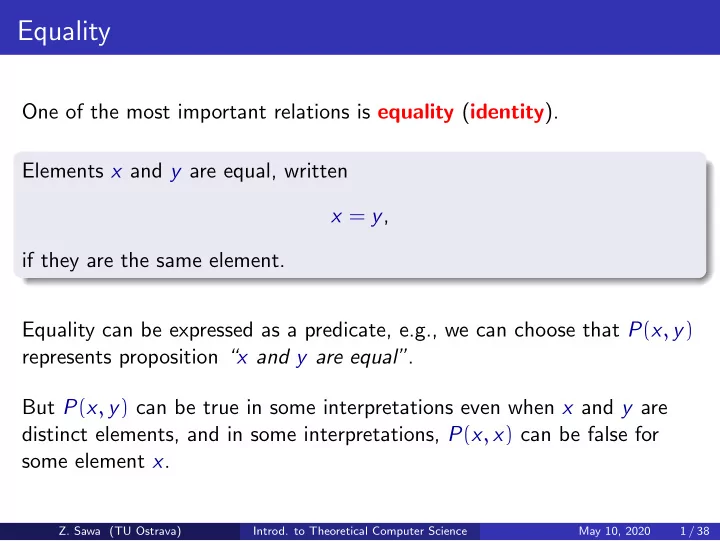
One of the most important relations is equality (identity). Elements x and y are equal, written x = y, if they are the same element. Equality can be expressed as a predicate, e.g., we can choose that P(x, y) represents proposition “x and y are equal”. But P(x, y) can be true in some interpretations even when x and y are distinct elements, and in some interpretations, P(x, x) can be false for some element x.

  • Z. Sawa (TU Ostrava)
  • Introd. to Theoretical Computer Science

May 10, 2020 1 / 38

slide-2
SLIDE 2

Equality

Example: We would like to describe relationship “x is a sibling of y” using a binary predicate R, where R(x, y) means “x is a parent of y”. An attempt for a possible solution: “x is a sibling of y” iff ∃z(R(z, x) ∧ R(z, y)) Problem: If for a given x there is an element z such that R(z, x), then it is true that ∃z(R(z, x) ∧ R(z, x)), and so it is also true that “x is a sibling of x”.

  • Z. Sawa (TU Ostrava)
  • Introd. to Theoretical Computer Science

May 10, 2020 2 / 38

slide-3
SLIDE 3

Equality

Alphabet: . . . Symbol for equality: “=” . . .

Atomic formulas (cont.)

. . . If x and y are variables then x = y is a well-formed atomic formula. . . . Symbol “=” is interpreted as equality in every interpretation, i.e., in every interpretation A and valuation v is: A, v | = x = y iff v(x) = v(y).

  • Z. Sawa (TU Ostrava)
  • Introd. to Theoretical Computer Science

May 10, 2020 3 / 38

slide-4
SLIDE 4

Equality

Example: The relationship “x is a sibling of y” can be expressed by formula ¬(x = y) ∧ ∃z(R(z, x) ∧ R(z, y)), where R(x, y) means that “x is a parent of y”. Remark: The notation x = y is often used instead of ¬(x = y).

  • Z. Sawa (TU Ostrava)
  • Introd. to Theoretical Computer Science

May 10, 2020 4 / 38

slide-5
SLIDE 5

Equality

“There exists exactly one x such that P(x)”: ∃x(P(x) ∧ ∀y(P(y) → x = y)) “There exist at least two elements x such that P(x)”: ∃x∃y(P(x) ∧ P(y) ∧ ¬(x = y)) “There exist exactly two elements x such that P(x)”: ∃x∃y(P(x) ∧ P(y) ∧ ¬(x = y) ∧ ∀z(P(z) → (z = x ∨ z = y))) “There exists exactly one x, for which ϕ holds”: ∃x(ϕ ∧ ∀y(ϕ[y/x] → x = y))

  • Z. Sawa (TU Ostrava)
  • Introd. to Theoretical Computer Science

May 10, 2020 5 / 38

slide-6
SLIDE 6

Constants

Sometimes we want to talk about some particular element of the universe. Example: “There exists at least one x such that John Smith is a parent

  • f x and x is a woman.” (I.e., “John Smith has at least one daughter.”)

If the value assigned to variable y is “John Smith”: ∃x(R(y, x) ∧ S(x)) R(x, y) — “x is a parent of y” S(x) — “x is a woman” We could introduce an unary predicate N representing property “to be John Smith”: ∀y(N(y) → ∃x(R(y, x) ∧ S(x)))

  • Z. Sawa (TU Ostrava)
  • Introd. to Theoretical Computer Science

May 10, 2020 6 / 38

slide-7
SLIDE 7

Constants

If we have some unary predicate N where we are interested only in those interpretations where exists exactly one element x, for which N(x) holds, it would be convenient to have some way to name this element and refer to it directly instead of using of the predicate N. Constant symbols (constants) can be used for this purpose. Alphabet: . . . constant symbols: “a”, “b”, “c”, “d”, . . . . . .

  • Z. Sawa (TU Ostrava)
  • Introd. to Theoretical Computer Science

May 10, 2020 7 / 38

slide-8
SLIDE 8

Constants

In atomic formulas, constants can occur at the same places as variables: P(c, x) Q(d) R(a, a) x = a Constants must not be used in quantifiers — e.g., ∃cP(x, c) is not a well-formed formula. Values assigned to constant symbols are determined by a given interpretation: A given interpretation A (with universe A) assigns to every constant symbol c some element of the universe A. This element is denoted cA. So cA ∈ A.

  • Z. Sawa (TU Ostrava)
  • Introd. to Theoretical Computer Science

May 10, 2020 8 / 38

slide-9
SLIDE 9

Constants

Example: “There exists at least one x such that John Smith is a parent

  • f x and x is a woman.”

∃x(R(a, x) ∧ S(x)) R(x, y) — “x is a parent of y” S(x) — “x is a woman” a — constant symbol representing “John Smith”

  • Z. Sawa (TU Ostrava)
  • Introd. to Theoretical Computer Science

May 10, 2020 9 / 38

slide-10
SLIDE 10

Constants

Example: “Every prime is greater than one.” ∀x(P(x) → R(x, e)) P(x) — “x is a prime” R(x, y) — “x is greater than y” e — constant symbol representing value 1

  • Z. Sawa (TU Ostrava)
  • Introd. to Theoretical Computer Science

May 10, 2020 10 / 38

slide-11
SLIDE 11

Functions

A binary relation R is a (unary) function if for each x there exists at most

  • ne y such that

(x, y) ∈ R. This function is total if for each x there exists exactly one such y. Example: Binary relation R on the set of natural numbers N where (x, y) ∈ R iff y = x + 1 We have R = {(0, 1), (1, 2), (2, 3), (3, 4), (4, 5), . . . }

  • Z. Sawa (TU Ostrava)
  • Introd. to Theoretical Computer Science

May 10, 2020 11 / 38

slide-12
SLIDE 12

Functions

Similarly, a ternary relation T is a (binary) function if for every pair of elements x1 and x2 there exists at most one (resp., exactly one for total function) y such that (x1, x2, y) ∈ T. Example: Addition on the set of real numbers R can be viewed as a ternary relation S (i.e., as a set of triples of real numbers) where (x1, x2, y) ∈ S iff x1 + x2 = y

  • Z. Sawa (TU Ostrava)
  • Introd. to Theoretical Computer Science

May 10, 2020 12 / 38

slide-13
SLIDE 13

Functions

In predicate logic, functions can be expressed using predicates representing the corresponding relations — this is not very straightforward nor convenient. Example: “For each x and y it holds that x + y ≥ y + x.” ∀x∀y∃z∃w(S(x, y, z) ∧ S(y, x, w) ∧ P(z, w)) S(x, y, z) — “z is the sum of values x and y” P(x, y) — “x greater than or equal to y” Remark: Moreover, we must assume that for every pair of elements x and y there exists exactly one element z such that S(x, y, z).

  • Z. Sawa (TU Ostrava)
  • Introd. to Theoretical Computer Science

May 10, 2020 13 / 38

slide-14
SLIDE 14

Functions

In predicate logic, functions can be represented by function symbols. Alphabet: . . . function symbols: “f ”, “g”, “h”, . . . . . . Every function symbol must have a specified arity corresponding to the arity of a function represented by this symbol (i.e., the number of arguments of this function).

  • Z. Sawa (TU Ostrava)
  • Introd. to Theoretical Computer Science

May 10, 2020 14 / 38

slide-15
SLIDE 15

Terms

Terms — expressions, consisting of variables, constant symbols, and function symbols; values of terms are elements of the universe Example: Let us say that we have a predicate F where we assume that for every x there exists exactly one y such that F(x, y). Instead of binary predicate F, we can use unary function symbol f . Term f (x) represents this one particular element y, for which F(x, y) holds. Instead of ∃y(F(x, y) ∧ P(y)), we can write P(f (x)).

  • Z. Sawa (TU Ostrava)
  • Introd. to Theoretical Computer Science

May 10, 2020 15 / 38

slide-16
SLIDE 16

Terms

Example: Let us say that we have a ternary predicate G where we assume that for every pair of elements x1 and x2 there exists exactly one y such that G(x1, x2, y). Instead of ternary predicate G, we can use binary function symbol g. Term g(x1, x2) represents this one particular element y, for which G(x1, x2, y) holds.

  • Z. Sawa (TU Ostrava)
  • Introd. to Theoretical Computer Science

May 10, 2020 16 / 38

slide-17
SLIDE 17

Terms

Example: “For each x and y it holds that x + y ≥ y + x.” ∀x∀yP(f (x, y), f (y, x)) f — binary function symbol where f (x, y) represents the sum of values x and y P — binary predicate symbol where P(x, y) represents relation “x is greater than or equal to y”

  • Z. Sawa (TU Ostrava)
  • Introd. to Theoretical Computer Science

May 10, 2020 17 / 38

slide-18
SLIDE 18

Terms

Variables, constant symbols and function symbols can be composed in terms in arbitrary way — it is only necessary to comply with the arity of the symbols (to apply each function symbol to a correct number of arguments). Example: c — constant symbol f — unary function symbol g — binary function symbol h — binary function symbol Examples of terms: x f (y) g(c, x) g(h(x, x), f (c)) g(h(x, f (x)), g(f (c), g(y, f (f (z)))))

  • Z. Sawa (TU Ostrava)
  • Introd. to Theoretical Computer Science

May 10, 2020 18 / 38

slide-19
SLIDE 19

Terms

The syntactic tree of term g(h(x, f (x)), g(f (c), g(y, f (f (z))))) c f f f f g g g h x x y z

  • Z. Sawa (TU Ostrava)
  • Introd. to Theoretical Computer Science

May 10, 2020 19 / 38

slide-20
SLIDE 20

Terms in Formulas

The syntactic tree of formula ∃x(∀y(R(f (x), f (g(c, y))) ∨ y = f (y)) → ∃z(P(g(x, f (z))) ∧ ¬Q(z)))

P Q R c f f f f g g x x x y y y y z z z ¬ ∧ ∨ → ∀ ∃ ∃ =

  • Z. Sawa (TU Ostrava)
  • Introd. to Theoretical Computer Science

May 10, 2020 20 / 38

slide-21
SLIDE 21

Terms in Formulas

Example: For each x, y, and z it holds that (x + y) + z = x + (y + z): ∀x∀y∀z(f (f (x, y), z) = f (x, f (y, z))) For each x it holds that x + 0 = x and 0 + x = x: ∀x(f (x, e) = x ∧ f (e, x) = x) For each x there exists y such that x + y = 0: ∀x∃y(f (x, y) = e) Constant and function symbols: f — binary function symbol representing “addition” (operation “+”) e — constant symbol representing element “0”

  • Z. Sawa (TU Ostrava)
  • Introd. to Theoretical Computer Science

May 10, 2020 21 / 38

slide-22
SLIDE 22

Terms in Formulas

Example: For each x, y, and z it holds that x · (y + z) = x · y + x · z: ∀x∀y∀z(g(x, f (y, z)) = f (g(x, y), g(x, z))) For each x and y such that x ≤ y it holds that x + z ≤ y + z: ∀x∀y(R(x, y) → ∀zR(f (x, y), f (y, z))) Constant and function symbols: f — binary function symbol representing “addition” (operation “+”) g — binary function symbol representing “multiplication” (operation “·”) R — binary predicate symbol representing relation “less than or equal to” (relation “≤”)

  • Z. Sawa (TU Ostrava)
  • Introd. to Theoretical Computer Science

May 10, 2020 22 / 38

slide-23
SLIDE 23

Syntax of Formulas of Predicate Logic

Alphabet: logical connectives — “¬”, “∧”, “∨”, “→”, “↔” quantifiers — “∀” and “∃” equality — “=” auxiliary symbols — “(”, “)”, and “,” variables — “x”, “y”, “z”, . . . , “x0”, “x1”, “x2”, . . . predicate symbols — for example symbols “P”, “Q”, “R”, etc. (for each symbols, there must be specified its arity) function symbols — for example symbols “f ”, “g”, “h”, etc. (for each symbol, there must be specified its arity) constant symbols — for example symbols “a”, “b”, “c”, etc. Remark: Constant symbols can be viewed as function symbols of arity 0.

  • Z. Sawa (TU Ostrava)
  • Introd. to Theoretical Computer Science

May 10, 2020 23 / 38

slide-24
SLIDE 24

Syntax of Formulas of Predicate Logic

Definition

Well-formed terms are defined as follows:

1 If x is a variable then x is a well-formed term. 2 If c is a constant symbol then c is a well-formed term. 3 If f is a function symbol of arity n and t1, t2, . . . , tn are well-formed

terms then f (t1, t2, . . . , tn) is a well-formed term.

4 There are no other well-formed terms than those constructed

according to the previous rules.

  • Z. Sawa (TU Ostrava)
  • Introd. to Theoretical Computer Science

May 10, 2020 24 / 38

slide-25
SLIDE 25

Syntax of Formulas of Predicate Logic

Definition

Well-formed atomic formulas are defined as follows:

1 If P is a predicate symbol of arity n and t1, t2, . . . , tn are well-formed

terms then P(t1, t2, . . . , tn) is a well-formed atomic formula.

2 If t1 and t2 are well-formed terms then

t1 = t2 is a well-formed atomic formula.

3 There are no other well-formed atomic formulas than those

constructed according to the previous rules.

  • Z. Sawa (TU Ostrava)
  • Introd. to Theoretical Computer Science

May 10, 2020 25 / 38

slide-26
SLIDE 26

Syntax of Formulas of Predicate Logic

Definition (a previously stated definition repeated)

Well-formed formulas of predicate logic are sequences of symbols constructed according to the following rules:

1 Well-formed atomic formulas are well-formed formulas. 2 If ϕ and ψ are well-formed formulas, then also (¬ϕ), (ϕ ∧ ψ),

(ϕ ∨ ψ), (ϕ → ψ) a (ϕ ↔ ψ) are well-formed formulas.

3 If ϕ is a well-formed formula and x is a variable, then ∀xϕ and ∃xϕ

are well-formed formulas.

4 There are no other well-formed formulas than those constructed

according to the previous rules.

  • Z. Sawa (TU Ostrava)
  • Introd. to Theoretical Computer Science

May 10, 2020 26 / 38

slide-27
SLIDE 27

Semantics of Predicate Logic

Interpretation A: universe A to every predicate symbol P of arity n, an n-ary relation PA is assigned, where PA ⊆ A × A × · · · × A to every function symbol f of arity n, an n-ary function f A is assigned, where f A : A × A × · · · × A → A to every constant symbol c, an element of the universe cA is assigned, i.e., cA ∈ A Remark: In interpretations, only total functions, i.e., functions whose values are defined for all possible values of arguments, are assigned to function symbols.

  • Z. Sawa (TU Ostrava)
  • Introd. to Theoretical Computer Science

May 10, 2020 27 / 38

slide-28
SLIDE 28

Semantics of Predicate Logic

The value of a term in interpretation A and valuation v: Term x, where x is a variable — the value of this term is an element a ∈ A such that v(x) = a. Term c, where c is a constant symbol — the value of this term is the element cA ∈ A. Term f (t1, t2, . . . , tn), where f is a function symbol with arity n and t1, t2, . . . , tn are terms — the value of this term is the element b ∈ A such that b = f A(a1, a2, . . . , an), where a1, a2, . . . , an are values of terms t1, t2, . . . , tn in interpretation A and valuation v.

  • Z. Sawa (TU Ostrava)
  • Introd. to Theoretical Computer Science

May 10, 2020 28 / 38

slide-29
SLIDE 29

Semantics of Predicate Logic

Example: Interpretation A where the universe is the set of natural numbers N = {0, 1, 2, . . . }. aA = 0 f A is the function “successor”, i.e., f A(x) = x + 1 gA is the function “sum”, i.e., gA(x, y) = x + y Valuation v where v(x) = 5, v(y) = 13, v(z) = 2, . . . Values of terms in interpretation A and valuation v: Term x — value 5 Term a — value 0 Term f (a) — value 1 (0 + 1 = 1) Term f (f (a)) — value 2 (1 + 1 = 2) Term g(x, f (f (a))) — value 7 (5 + 2 = 7) Term g(z, y) — value 15 (2 + 13 = 15) Term f (g(z, y)) — value 16 (15 + 1 = 16)

  • Z. Sawa (TU Ostrava)
  • Introd. to Theoretical Computer Science

May 10, 2020 29 / 38

slide-30
SLIDE 30

Semantics of Predicate Logic

Truth values of atomic formulas in interpretation A and valuation v: A, v | = P(t1, t2, . . . , tn), where P is a predicate symbol of arity n and where t1, t2, . . . , tn are terms, holds iff (a1, a2, . . . , an) ∈ PA, where a1, a2, . . . , an are values of terms t1, t2, . . . , tn in interpretation A and valuation v. A, v | = t1 = t2, where t1 and t2 are terms, holds iff a1 = a2, where a1 and a2 are values of terms t1 and t2 in interpretation A and valuation v.

  • Z. Sawa (TU Ostrava)
  • Introd. to Theoretical Computer Science

May 10, 2020 30 / 38

slide-31
SLIDE 31

Semantics of Predicate Logic

Example: Interpretation A where the universe is the set of natural numbers N = {0, 1, 2, . . . }. f A is the function “successor”, i.e., f A(x) = x + 1 gA is the function “sum”, i.e., gA(x, y) = x + y PA is the set of all primes QA is the binary relation “<” i.e., (x, y) ∈ QA iff x < y Valuation v where v(x) = 5, v(y) = 13, v(z) = 2, . . . A, v | = P(x) (5 is a prime) A, v | = Q(y, z) (it is not the case that 13 < 2) A, v | = Q(f (f (z)), g(x, y)) ((2 + 1) + 1 < 5 + 13) A, v | = P(f (g(z, x))) ((2 + 5) + 1 = 8 and 8 is not a prime)

  • Z. Sawa (TU Ostrava)
  • Introd. to Theoretical Computer Science

May 10, 2020 31 / 38

slide-32
SLIDE 32

Predicate Logic — Additional Comments

The logic described here is the first order predicate logic — it is possible to quantify only over the elements of the universe (in the second order predicate logic, it is possible to quantify over relations).

  • Z. Sawa (TU Ostrava)
  • Introd. to Theoretical Computer Science

May 10, 2020 32 / 38

slide-33
SLIDE 33

Predicate Logic — Additional Comments

As commonly used in mathematics, it is ofter the case that formulas are not written according to the precise syntax of predicate logic but many kinds of conventions and abbreviations are used. For binary function and predicate symbols, it is common to use infix notation: For example, f (x, y) and R(x, y) can be written as x f y x R y To denote predicate, function and constant symbols, many different kinds of symbols are used: For example, R(f (x, y), g(z)) can be written as x + δ ≤ |ε|

  • r for example as

x ◦ y ⊐ G(z)

  • Z. Sawa (TU Ostrava)
  • Introd. to Theoretical Computer Science

May 10, 2020 33 / 38

slide-34
SLIDE 34

Predicate Logic — Additional Comments

Examples of formulas representing propositions from set theory: x is an elements of set A: x ∈ A “∈” — binary predicate symbol representing the relation “to be an element of” “x”, “A” — variables If we would do the following changes:

instead of symbol “∈”, we would use binary predicate symbol E, instead of variable A we would use variable y,

then the formula would look as follows: E(x, y)

  • Z. Sawa (TU Ostrava)
  • Introd. to Theoretical Computer Science

May 10, 2020 34 / 38

slide-35
SLIDE 35

Predicate Logic — Additional Comments

Two sets are equal iff they contain the same elements: A = B ↔ ∀x(x ∈ A ↔ x ∈ B) If we use predicate E instead of “∈”, and y and z instead of A and B, the formula would look as follows: y = z ↔ ∀x(E(x, y) ↔ E(x, z)) The definition of relation “to be a subset” (denoted by symbol “⊆”): A ⊆ B ↔ ∀x(x ∈ A → x ∈ B) If we use binary predicate symbol S instead of “⊆”: S(y, z) ↔ ∀x(E(x, y) → E(x, z))

  • Z. Sawa (TU Ostrava)
  • Introd. to Theoretical Computer Science

May 10, 2020 35 / 38

slide-36
SLIDE 36

Predicate Logic — Additional Comments

The definition of operation “union” (denoted by symbol “∪”): ∀x(x ∈ A ∪ B ↔ (x ∈ A ∨ x ∈ B)) If we use binary function symbol f instead of “∪”: ∀x(E(x, f (y, z)) ↔ (E(x, y) ∨ E(x, z)))

  • Z. Sawa (TU Ostrava)
  • Introd. to Theoretical Computer Science

May 10, 2020 36 / 38

slide-37
SLIDE 37

Predicate Logic — Additional Comments

Sometimes ∃x(x ∈ A ∧ . . . ) is written in an abbreviated way as (∃x ∈ A)( . . . ) I.e., instead of “there exists x such that x ∈ A and . . . ” we can say “there exists x ∈ A such that . . . ” Similarly, ∃x(x ≥ 1 ∧ . . .) can be written in an abbreviated way as (∃x ≥ 1)( . . . )

  • Z. Sawa (TU Ostrava)
  • Introd. to Theoretical Computer Science

May 10, 2020 37 / 38

slide-38
SLIDE 38

Predicate Logic — Additional Comments

Sometimes ∀x(x ∈ A → . . . ) is written in an abbreviated way as (∀x ∈ A)( . . . ) I.e., instead of “for each x, for which x ∈ A holds, we have . . . ” we can say “for each x ∈ A we have . . . ” Similarly, ∀x(x ≥ 1 → . . .) can be written in an abbreviated way as (∀x ≥ 1)( . . . )

  • Z. Sawa (TU Ostrava)
  • Introd. to Theoretical Computer Science

May 10, 2020 38 / 38