Environment and Natural Resources Trust Fund 2012-2013 Request for - - PDF document

environment and natural resources trust fund 2012 2013
SMART_READER_LITE
LIVE PREVIEW

Environment and Natural Resources Trust Fund 2012-2013 Request for - - PDF document

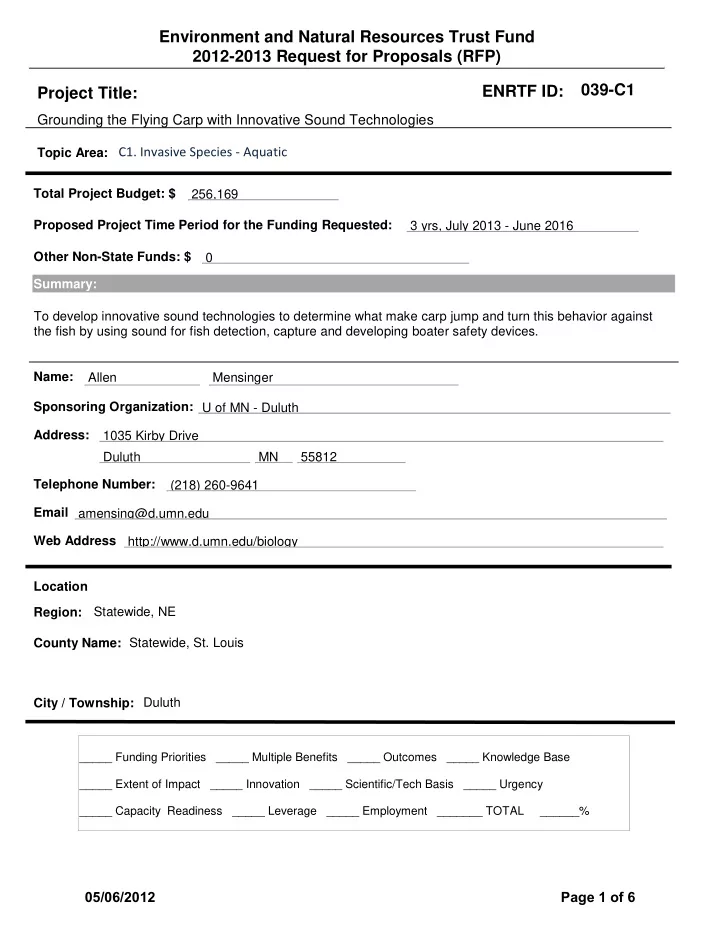
Environment and Natural Resources Trust Fund 2012-2013 Request for Proposals (RFP) 039-C1 ENRTF ID: Project Title: Grounding the Flying Carp with Innovative Sound Technologies C1. Invasive Species Aquatic Topic Area: Total Project Budget:


slide-1
SLIDE 1

Environment and Natural Resources Trust Fund 2012-2013 Request for Proposals (RFP) Project Title:

Total Project Budget: $ Proposed Project Time Period for the Funding Requested: Other Non-State Funds: $ Name: Sponsoring Organization: Address: Telephone Number: Email Web Address County Name: City / Township: Region: Summary: Location

Grounding the Flying Carp with Innovative Sound Technologies

256,169 3 yrs, July 2013 - June 2016 To develop innovative sound technologies to determine what make carp jump and turn this behavior against the fish by using sound for fish detection, capture and developing boater safety devices. Allen U of MN - Duluth 1035 Kirby Drive Duluth MN 55812 (218) 260-9641 amensing@d.umn.edu http://www.d.umn.edu/biology Statewide, NE Statewide, St. Louis Duluth Mensinger

_____ Funding Priorities _____ Multiple Benefits _____ Outcomes _____ Knowledge Base _____ Extent of Impact _____ Innovation _____ Scientific/Tech Basis _____ Urgency _____ Capacity Readiness _____ Leverage _____ Employment _______ TOTAL ______%

  • C1. Invasive Species ‐ Aquatic

ENRTF ID: 039-C1

Topic Area:

05/06/2012 Page 1 of 6

slide-2
SLIDE 2

Environment and Natural Resources Trust Fund (ENRTF) 2012‐2013 Main Proposal

1 PROJECT TITLE: Grounding the flying carp with innovative sound technologies

  • I. PROJECT STATEMENT

The Asian silver carp, one of four invasive carp species, is migrating north via the Mississippi River and threatening native fish in Minnesota rivers and lakes by outcompeting them for food supplies. Its unique jumping ability places recreational boaters in danger of being injured during collisions with airborne fish. However, this jumping ability is a weakness that can be exploited to detect, manage and control fish populations in addition to developing boater safety devices. The goals of this proposal are: 1) isolate the sound stimulus that causes the fish to jump and apply this information to develop identification and early detection systems 2) develop management techniques to exhaust the fish on the surface or to herd the fish into shallow waters for capture and removal 3) develop methods to modify the sound produced by boat motors or create devices that can be used by boaters to cause the fish to leap before the threat of impact We will determine the sound stimulus that causes the fish to jump. It is predicted that this sound will be

  • f higher frequencies than most native and game fish and thus will not harm these species. Once the

correct sound is determined, we will develop strategies to use underwater speakers to stimulate carp jumping in large outdoors tanks and then in infested rivers or lakes. The jumping episodes will be filmed with video cameras to ascertain if an early detection/identification system can be developed. We will then use sound to stimulate continuous jumping to exhaust the fish on the surface and/or use sound to herd the fish into shallow water or nets for easy capture. Finally, we will characterize the sound emitted by boat engines to determine if the sounds that cause the carp to jump can be reduced by modifying the sound produced by the motors. Additionally we will develop an inexpensive (<$150) underwater speaker system that recreational boaters can use to amplify sounds using an iPod or smart phone to stimulate the carp to jump well in advance of the boat to eliminate the chance of collision.

  • II. DESCRIPTION OF PROJECT ACTIVITIES

Activity 1: Determining the sounds that make carp jump Budget: $95,000 Silver carp of different size and age classes will be maintained at the UMD Research and Field Studies Center in large tanks. Both above and below water video cameras will be used to record fish behavior. Underwater speakers and hydrophones will generate and record sound respectively. Fish behavior (ie jumping) will be correlated with specific sound levels and frequencies. As fish behavior is related to age (size) and temperature, the sound will be tested on both juvenile and adult fish at different

  • temperatures. Once the sound is characterized, we will travel to carp infested waters to determine if

the sounds will initiate jumping in the wild. If so, then an early warning detection system will be developed consisting of a buoy with underwater speakers and above water cameras to monitor the presence or absence of carp in the system and their size and condition. Outcome Completion Date

  • 1. Determining the sound that makes carp jump

Summer 2014

  • 2. Develop early warning/detection buoy system

Summer 2015 Activity 2: Using sound to exhaust and/or herd carp for easy capture Budget: $90,000 Aerial jumps are energetically expensive for fish and salmon that migrate hundreds of miles upstream, need to rest before jumping successive water falls. If carp are stimulated to jump repeatedly, it may be

05/06/2012 Page 2 of 6

slide-3
SLIDE 3

Grounding the flying carp with innovative sound technologies 2 possible to exhaust them to the point where they will float on the surface and easily be netted. Alternatively, several species of fish or aquatic mammals used sound to herd prey fish. Even if we cannot exhaust the fish, it is anticipated that multiple arrays of speakers could be used to concentrate the fish into shallows for capture. The advantage in using this technique for carp, is their jumping allows them to be tracked, and make the necessary adjustments to speaker location to corral the fish. Outcome Completion Date

  • 1. Using sound to stimulate multiple jumping in Silver carp to drive the fish to

exhaustion for easy capture at the surface Summer 2015

  • 2. Using sound to drive or herd Silver carp onto the shore, into shallow water or

into nets to remove carp from rivers and lakes Summer 2015 Activity 3: Boater safety Budget: $71,169 Carp are stimulated to jump by the sound of motorized watercraft. We will characterize the sound emitted by outboard motors to determine if the sound can be modified to decrease jumping. The initial tests will be conducted in the large tanks and if successful, field trials will be conducted in carp infested

  • water. Additionally, we will develop a downloadable sound application for boaters to use with their

smartphones that can be played through an inexpensive underwater speaker/amplifier to detect and/or stimulate carp to jump before the boat arrives in the area. Outcome Completion Date

  • 1. Modifying the sound emitted by outboard boat engines to reduce the chances
  • f silver carp jumping

Summer 2016

  • 2. Design a sound system for boaters that will cause the carp to jump well in

advance of the boats and reduce injuries Summer 2016

  • III. PROJECT STRATEGY
  • A. Project Partners: Professor Allen Mensinger of the University of Minnesota Duluth who is an expert
  • n fish sound and hearing will supervise all aspects of the project. Graduate students will come from

the Integrated Biosciences Program and undergraduate students will be recruited from the Department

  • f Biology at UMD. Mensinger will train the graduate students to develop the technology, conduct the

experiments, and complete the field trials. Undergraduate students will be recruited to assist with the

  • experiments. Mensinger will work with MN Sea Grant and the Great Lakes Aquarium to disseminate

results to MN state residents.

  • B. Timeline Requirements: Year 1 ‐Expansion of the outdoor aquatic facilities, sound testing

experiments and develop carp detection systems using sound; Year 2‐ Experiments to exhaust the carp through repeated jumping or to herd them using sound to expedite capture and removal; Year 3 – Develop boater safety strategies by modifying engine noise and developing early warning systems.

  • C. Long‐Term Strategy: The overall goal of the project is to understand what make carp jump and turn

this strategy against the fish. Outdoor tank and river/lake trials will be conducted to determine the efficacy of the above stated deliverables. These techniques/devices will be made available for interested parties (ie DNR) as part of a multipronged strategy to battle the invasive carp. When possible, the technology will be patented to provide future resources for the MN Environmental Trust Fund.

05/06/2012 Page 3 of 6

slide-4
SLIDE 4

BUDGET ITEM Personnel: PI Allen F. Mensinger PhD. The PI has a 9 month position at the University of Minnesota Duluth. A total of 3 months of summer salary (1 month /yr ) is requested. Total reflects 73.5% salary and 26.5% fringe Graduate student - support is requested for 36 months of support for one PhD graduate

  • student. Total reflects 55.2% salary and 44.8% fringe

Graduate student summer salary. 50% summer salary is requested for one Masters student for 3 summers (total 4.5 months) 80.6% salary and 19.4% fringe Undergraduate student summer salary: 2 months summer salary is requested for two undergraduate students each summer (total 12 months) 73.5% salary and 26.5% fringe Equipment/Tools/Supplies: 4 x 16' diameter above ground fish tanks @$1800 each Pumps, filters, heaters, chillers and plumbing for fish tanks Fish food and water test kits ($1000/year) Underwater speakers, hydrophones and amplifiers Video cameras (under and above water) and digital video recorders Lumber to build tank observation platforms Outboard boat motors to test what noise cause fish to jump Travel - One week travel per summer for outdoor trials in areas of MN where the silver carp have been located. 3 trips * 2 people per trip. Rental car ($300/week), lodging ($750/week), meals ($300/week)On Additional Budget Items: Expand and secure the outdoor fish holding facilities at the UMD Research and Field Studies Center. A 40' x 40' concrete pad will be built to support the large fish tanks and surrounded by a 8' chain link fence to provide security for housing invasive species. Additionally, anti bird neting will be used to prevent birds from removing the fish. (note: these items will be retained at the end of the budget period to continue to investigate the effects of noise on native fish) TOTAL ENVIRONMENT AND NATURAL RESOURCES TRUST FUND $ REQUEST = SOURCE OF FUNDS AMOUNT Status Other Non State $ Being Applied to Project During Project Period: The Integrated Bioscience program will provide summer salary match for the masters student requested in the project (4.5 months summer salary) 9,516 $ pending Undergraduate research opportunity grants are available from UMD to further support the undergraduate students selected for the this grant. Typically each student in the Mensinger lab is awarded $1400 in support from this program each year 8,400 $ pending UMD Indirect costs recovery funds from the UMD biology department. $10,000 has been requested as a partial match to improving and expanding the fish holding facilities 10,000 $ pending In-kind Services During Project Period: The PI (Mensinger) is on a 9 month academic

  • appointment. He will provide two months of his academic year salary as in kind suppor for

this proposal 79,324 $ secured Remaining $ from Current ENRTF Appropriation (if applicable): 2010 -2013 Bioacoustic Traps for Management of Round Goby $175,000 The information gathered to date in this proposal has advanced our knowledge of using sound to control invasive species and will provide a solid foundation to continue this work in battling the silver carp 70,000 $ Obligated to be spent on round goby grant by summer 2013

2012-2013 Detailed Project Budget

  • IV. TOTAL ENRTF REQUEST BUDGET 3 years

AMOUNT 4,050 $ 24,000 $ 128,156 $

  • V. OTHER FUNDS

34,960 $ 256,169 $ 7,200 $ 9,516 $ 16,787 $

  • $

4,000 $ 3,000 $ 5,000 $ 5,000 $ 2,500 $ 12,000 $

I:\ML2013\RFP\proposals_recevied\mensinger-allen_0412-2-154-Budget

05/06/2012 Page 4 of 6

slide-5
SLIDE 5

Grounding the flying carp with innovative sound technologies

Determine what sound makes carp jump

  • Detection
  • Use sound to detect and indentify carp
  • Management , control and removal
  • Use sound to exhaust carp through jumping or
  • Herding them into shallows for easy capture
  • Boater safety
  • Use sound to make carp jump in advance of boater collisions

with airborne fish

mri.usd.edu

No carp zone = no fly zone

AP File Photo

05/06/2012 Page 5 of 6

slide-6
SLIDE 6

Grounding the flying carp with innovative sound technologies

  • Dr. Allen Mensinger is a professor at the University of MN Duluth and is an expert on fish hearing. He has been

working on sound producing fish and how fish interpret sound for over 20 yrs. He is currently developing with ENRTF funding a fish trap that uses sound to capture the invasive round goby. The laboratory recently has been the first to demonstrate the ability to lure round gobies into unbaited traps by just using sound and trials in the Duluth-Superior Harbor are scheduled this summer. CURRICULUM VITAE Allen F. Mensinger Present position: Professor University of Minnesota Duluth, Biology Department, Duluth, MN 55811 Areas of expertise: Fish bioacoustics, invasive fish and sensory physiology Education: 1983 B.S. – Biology, Duke University, Durham, North Carolina 1991 Ph.D. University of California, Santa Barbara Professional experience: 1991-94 Post-doctoral fellow, Vanderbilt University Nashville, TN. 1992 Grass Fellow in Neuroscience, Friday Harbor, Washington. 1994 Research Associate, Washington Univ. School of Medicine,

  • St. Louis, MO.

1996-99 Research Instructor, Washington Univ. School of Medicine,

  • St. Louis, MO.

1997-98 NASA Life Sciences Fellow, MBL, Woods Hole, MA 2000-05 Assistant Professor, University of Minnesota-Duluth 2005- Associate Professor, University of Minnesota Duluth 2010 Professor, University of MN Duluth Relevant peer reviewed publications: (34 total publications) Lynch, M. P. and A. F. Mensinger. 2012. Temporal patterns in the growth and survival of the round goby (Neogobius melanostomus) over a 13 month period in the Duluth-Superior Harbor. Journal of Fish Biology. (submitted) Lynch, M. P. and A. F. Mensinger. 2012. Seasonal abundance and movement of the invasive round goby (Neogobius melanostomus) on rocky substrate in the Duluth-Superior Harbor of Lake Superior. Ecology of Freshwater Fish. 21:64-74. Bergstrom, M.A. and A. F. Mensinger. 2009. Interspecific resource competition between the invasive round goby and three native species: logperch, slimy sculpin and spoonhead sculpin. Transactions of the American Fisheries Society. 138:1009-1017 Maruska, K. P. and A. F. Mensinger. 2009. Acoustic characteristics and variations in grunt vocalizations in the

  • yster toadfish Opsanus tau. Environmental Biology of Fishes. 84:325-337.

Maruska, K. P., W. J. Korzan and A. F. Mensinger. 2009. Individual, temporal, and environmental-related variations in circulating 11-ketotestosterone and estradiol concentrations in the oyster toadfish Opsanus tau. Comparative Biochemistry and Physiology A – Molecular and Integrative Physiology. 152:569-578. Bergstrom, M. A., L. M. Evard and A. F. Mensinger. 2008. Distribution, abundance, and range expansion of the round goby, Apollonia melanostoma, in the Duluth-Superior Harbor and St. Louis River Estuary, 1998-2004. Journal of Great Lakes Research. 535-543. Palmer, L. M., M. Deffenbaugh and A. F. Mensinger. 2005. Sensitivity of the anterior lateral line to natural stimuli in the oyster toadfish, Opsanus tau (Linnaeus). Journal of Experiment Biology. 208:3441-3450. Richmond, H. E., T.R. Hrabik and A. F. Mensinger. 2004. Light intensity, prey detection and foraging mechanisms of age 0 year yellow perch. Journal of Fish Biology 65:195-205. The University of Minnesota Duluth serves northern Minnesota, the state, and the nation as a medium-sized comprehensive university dedicated to excellence in all of its programs and operations. As a university community in which knowledge is sought as well as taught, its faculty recognizes the importance of scholarship and service, the intrinsic value of research, and the significance of a primary commitment to quality instruction.

05/06/2012 Page 6 of 6