ENLOE MEDICAL CENTER SUBSTANCE USE NAVIGATOR PROGRAM Amanda - - PDF document

enloe medical center substance use navigator program
SMART_READER_LITE
LIVE PREVIEW

ENLOE MEDICAL CENTER SUBSTANCE USE NAVIGATOR PROGRAM Amanda - - PDF document

3/5/2020 JM1 ENLOE MEDICAL CENTER SUBSTANCE USE NAVIGATOR PROGRAM Amanda Wilkinson, Manager, Case Management Jake Miller, Substance Use Navigator 1 BUTTE COUNTY 2,501 individuals with an opioid use disorder (OUD) (2016) Up to


slide-1
SLIDE 1

3/5/2020 1

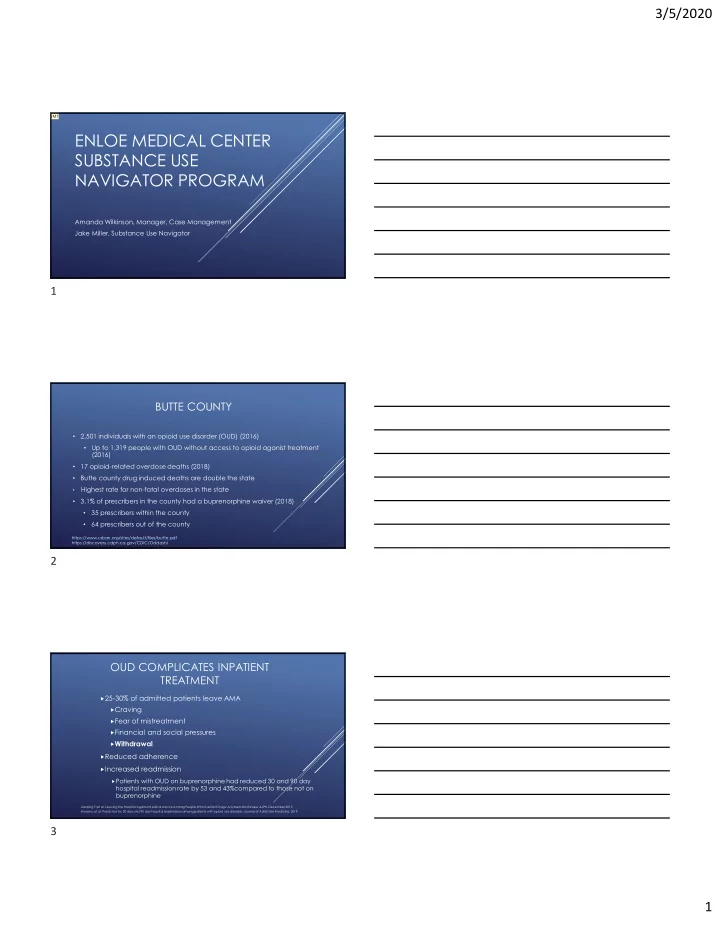
ENLOE MEDICAL CENTER SUBSTANCE USE NAVIGATOR PROGRAM

Amanda Wilkinson, Manager, Case Management Jake Miller, Substance Use Navigator

JM1

BUTTE COUNTY

  • 2,501 individuals with an opioid use disorder (OUD) (2016)
  • Up to 1,319 people with OUD without access to opioid agonist treatment

(2016)

  • 17 opioid-related overdose deaths (2018)
  • Butte county drug induced deaths are double the state
  • Highest rate for non-fatal overdoses in the state
  • 3.1% of prescribers in the county had a buprenorphine waiver (2018)
  • 35 prescribers within the county
  • 64 prescribers out of the county

https://www.urban.org/sites/default/files/butte.pdf https://discovery.cdph.ca.gov/CDIC/Oddash/

OUD COMPLICATES INPATIENT TREATMENT

25-30% of admitted patients leave AMA Craving Fear of mistreatment Financial and social pressures Withdrawal Reduced adherence Increased readmission

Patients with OUD on buprenorphine had reduced 30 and 90 day

hospital readmission rate by 53 and 43%compared to those not on buprenorphine

Lianping Ti et al. Leaving the Hospital Against Medical Advice Among People Who Use Illicit Drugs: A Systematic Review AJPH, December 2015 Moreno, et al. Predictors for 30 day and 90 day hospital readmission among patients with opioid use disorder. Journal of Addiction Medicine. 2019.

1 2 3

slide-2
SLIDE 2

Slide 1 JM1

Jake Miller, 11/12/2019

slide-3
SLIDE 3

3/5/2020 2

2 31.7 14.9 10.6 0. 10. 20. 30. 40. No hospital admission 28 days after discharge 1-3 months 3 months-1 year White S et al. Drugs-Related Death Soon after Hospital-Discharge among Drug Treatment Clients in Scotland: Record Linkage, Validation, and Investigation of Risk-Factors.; PLoS One. 2015; 10(11): e0141073

DRUG RELATED DEATH RATE PER 1000 POST DISCHARGE

Chutuape, M et al. One-, three-, and six-month outcomes after brief inpatient opioid detoxification. The American Journal of Drug and Alcohol

  • Abuse. Vol 27:1, 2001.

DETOX DOESN’T LAST ADDICTION NEUROSCIENCE 101

4 5 6

slide-4
SLIDE 4

3/5/2020 3

CALIFORNIA’S STRATEGY

In 2017, California Department of Health Care Services (CDHCS) received the State Targeted Response to the Opioid Crisis (Opioid STR) Grant

 Medication Assisted Treatment (MAT) Expansion Project  California Hub and Spoke System (CA HSS&S)

 Aims to increase access to MAT services throughout the state,

particularly in counties with the highest overdose rates  Increase the availability and utilization of buprenorphine  The Tribal MAT Project

California Department of Health Care Services https://www.dhcs.ca.gov/Documents/State-Opioid-Response-Grant_Performance-Progress-Report-Year-1.pdf

HUB AND SPOKE SYSTEM

H&SS aims to increase access to MAT services throughout the state, particularly in counties with the highest overdose rates.

 Hub is a Narcotics Treatment Program (NTP) that specializes in

treating patients with OUD

 Spokes can be an FQHC, mental health center, private practice or

community clinic where a buprenorphine prescriber or potential prescriber is available

California Department of Health Care Services https://www.dhcs.ca.gov/Documents/State-Opioid-Response-Grant_Performance-Progress-Report-Year-1.pdf

CALIFORNIA STRATEGY IMPLEMENTATION

 In 2018, CDHCS received the State Opioid Response (SOR) Grant.

With SOR funding, CDHCS implemented the MAT Expansion Project 2.0

 Increase access to MAT  Reduce unmet treatment needs  Reduce opioid overdose related deaths through prevention,

treatment, and recovery services

California Department of Health Care Services https://www.dhcs.ca.gov/Documents/State-Opioid-Response-Grant_Performance-Progress-Report-Year-1.pdf

7 8 9

slide-5
SLIDE 5

3/5/2020 4

ACCOMPLISHMENTS

 For the period of September 30, 2018 through September 29, 2019:  Provided treatment to approximately 22,000 new patients  Saved approximately 7,500 lives with opioid overdose reversal medication naloxone (Narcan)

 More than 240,000 naloxone kits distributed  Created 650 new access point locations where patients can receive

treatment for OUD

 Trained 395 new providers to prescribe buprenorphine  Established 52 hospitals and emergency rooms as centers for stabilization

and referral to treatment for OUD

 2,340 individuals on buprenorphine  Expanded access to treatment in jails and drug courts in 29 counties,

which have provided MAT services to 1,646 clients

California Department of Health Care Services https://www.dhcs.ca.gov/Documents/State-Opioid-Response-Grant_Performance-Progress-Report-Year-1.pdf JM [2]2

The California Bridge Program is developing hospitals and emergency rooms into primary access points for the treatment of acute symptoms of substance use disorders by way of motivation, resources, and encouragement for patients to enter and remain in treatment.

GOAL: Ensure that people with substance use disorder receive 24/7 high-quality care in every California health system by 2025

CA BRIDGE ACCOMPLISHMENTS

 Increased number of primary access points for Medication

Assisted Treatment (MAT)

 52 health care facilities across 35 counties have initiated MAT  2,060 individuals referred into treatment  4,302 individuals provided recovery services

10 11 12

slide-6
SLIDE 6

Slide 10 JM [2]2 Jake Miller, 2/20/2020

slide-7
SLIDE 7

3/5/2020 5

BUTTE COUNTY VS CALIFORNIA

California Opioid Overdose Surveillance Dashboard; https://skylab.cdph.ca.gov/ODdash/

WHAT IS A SUBSTANCE USE NAVIGATOR (SUN)?

 Improves access to Medication Assisted

Treatment (MAT).

 Embedded in Case Management and working

in both emergency department and inpatient settings

 The SUN will assist with connecting patients to

treatment and follow-up support

WHAT DO SUNS DO?

 Initial assessments  Introduce patients to MAT programs and services  Expedite appointments to MAT clinics  Coaching patients and on-going contact  Community collaboration activities  Process: 1. Patient with Substance Use Disorder (SUD) identified 2. SUN talks about treatment with patient 3. SUN consults with provider to initiate treatment if possible 4. SUN guides patient through process of accessing treatment once discharged 5. SUN continues to support patient after discharge to address any barriers

13 14 15

slide-8
SLIDE 8

3/5/2020 6

SUN STATS

 2019-2020 Fiscal Year (Q1/Q2)  Quarters 1 & 2 (7/1/19 – 12/31/19)  Total 258 patients seen  73 MAT patients, 55 MAT starts

 49 Suboxone, 6 methadone  14 already engaged in MAT, 4 Vivitrol  44 patients referred to community providers by SUN  20 remain in treatment, 7 no longer attending, 16

intake “no show”

 74% of patients who enrolled in services (attended

intake with provider) are still engaged in treatment

SUN STATS (CONT’D)

32% of all patients had co-occurring mental health dx 18% of all patients were homeless DRUG OF CHOICE

Heroin Other Opiates ETOH Meth Poly Cannabis Cocaine/Crack Benzos Hallucinogens Other/NA Q1 (FY 19/20) 25 15 34 36 10 4 1 1 5 Q1 % 19.1% 11.5% 26.0% 27.5% 7.6% 3.1% 0.8% 0.0% 0.8% 3.8% Q2 (FY 19/20) 44 11 30 27 10 1 1 1 1 Q2 % 34.9% 8.7% 23.8% 21.4% 7.9% 0.8% 0.8% 0.8% 0.0% 0.8% TOTAL # 69 26 64 63 20 5 2 1 1 6 TOTAL % 26.9% 10.2% 25.0% 24.6% 7.8% 2.0% 0.8% 0.4% 0.4% 2.3%

MAT: NO LONGER IN THE CYCLE

Chronic use Acute use Withdrawal Normal Euphoria Tolerance & Physical Dependence Normal

16 17 18

slide-9
SLIDE 9

3/5/2020 7

MEDICATION EFFECTS

 Physical dependence without addiction  Eliminate withdrawal  Reduce cravings  If a slip happens, don’t feel effects  Proper dosing 

no euphoria, no sedation

METHADONE VS. BUPRENORPHINE

 Methadone

Full opioid agonist Long half life Only available in specialty clinic

 Buprenorphine

Partial opioid agonist Ceiling effect on sedation,

respiratory depression

Available from any provider with X

waiver

JM2

CEILING EFFECT

https://www.researchgate.net/figure/Risk-of-respiratory-depression-with-opioid-agonists-partial-agonists-and- antagonists_fig3_286489121

19 20 21

slide-10
SLIDE 10

Slide 20 JM2

Jake Miller, 11/13/2019

slide-11
SLIDE 11

3/5/2020 8

WHY DO PEOPLE USE SUBSTANCES

 Feel good  Stop feeling bad  Trauma  Mental illness  Developmental disabilities  Perform better in school or at work  Curiosity  Fit in  Especially in teens  After an injury

National Institute on Drug Abuse https://www.drugabuse.gov/related-topics/criminal-justice/science-drug-use-discussion-points

WHY DON’T THEY “JUST STOP”

 Don’t know what/how  Physical changes in parts of the brain that are very important for

judgment, making decisions, learning and memory, and controlling behavior

 Withdrawal  Trauma, mental illness, loss of connection, lack of coping skills  Fear of prejudice, discrimination, STIGMA

National Institute on Drug Abuse https://www.drugabuse.gov/related-topics/criminal-justice/science-drug-use-discussion-points

STIGMA

 When referring to people with substance use disorders, stigma is

the complex of attitudes, beliefs, behaviors, and structures that interact at different levels of society (i.e., individuals, groups,

  • rganizations, systems) and manifest in prejudicial attitudes

about and discriminatory practices against people with substance use disorders1

 Patient interviews revealed that nearly one-quarter (23.0%) of

participants reported they were sometimes, frequently or always discriminated against by health care professionals because of their substance use disorder2

2 California Department of Health Care Services

https://www.dhcs.ca.gov/Documents/State-Opioid-Response-Grant_Performance-Progress-Report-Year-1.pdf

1 Ending Discrimination Against People with Mental and Substance Use Disorders: The Evidence for Stigma Change. Washington (DC):

National Academies Press (US); 2016 Aug 3. 2, Understanding Stigma of Mental and Substance Use Disorders. Available from: https://www.ncbi.nlm.nih.gov/books/NBK384923/

22 23 24

slide-12
SLIDE 12

3/5/2020 9

WORDS ARE POWERFUL

 Opiate use disorder (OUD)/ substance use disorder (SUD)  Person who injects drugs (PWID)  Stigmatizing language:  Addict/drug injector/pain seeking  Drug abuse  Indicating distrust or disbelief of patient  Indication of lower socioeconomic status  Placing blame on the patient

PATIENT EXPERIENCE SUCCESS #1

A younger patient wanted to come to the ED for support with abstaining from prescription

  • pioid use, but was apprehensive due to expectations they would not be treated in a

respectful manner. The patient decided they had no other option and took the risk despite preconceived notions. They resided in an outlying community with their children and significant other. The patient came into the ED on a weekend and was started on Suboxone, with the SUN calling her Monday to follow-up and provide support. The patient reported that their experience in the ED was not as they had expected. To their surprise, the patient was treated with caring respect and stated, “I thought they would just look down at me and treat me like one of those pill poppers.” An intake appointment was scheduled with a Suboxone provider in the patient’s area and they began treatment. During our conversation, they disclosed that their significant other was also seeking support with OUD and SUN informed the patient that support could be provided for them as well. The significant other called the SUN and was secured an intake appointment with a different community Suboxone provider. Since starting Suboxone treatment and being referred to services with a community provider, their family has moved into a larger home that is closer to work, which has now become full-time employment. These patients have remained in treatment and abstinent from misusing opioids for almost 8 months.

PATIENT EXPERIENCE SUCCESS #2

The first patient who received OUD support from the SUN had 17 encounters, totaling 72 days, in the previous five months. They were secured an intake appointment with Butte County Department of Behavioral Health’s Suboxone program for the day of discharge. Case Management coordinated a taxi ride for the patient directly to the appointment from Enloe at discharge. The patient was enrolled in the BCDBH Suboxone program and continues to receive their services

  • today. Thanks to the effort of all staff involved in this patient’s care, they were

afforded every opportunity to improve their life. The patient did return to the ED approximately two weeks after discharge and reported to staff that they had been discharged and “just wanted to make sure I’m okay.” This patient has not returned to EMC in need of medical care since that ED visit, more than 8 months ago.

25 26 27

slide-13
SLIDE 13

3/5/2020 10

CALIFORNIA HOSPITAL COMPARE OPIOID HONOR ROLL

 The goal of the program is increased access to addiction treatment for

hospitalized patients and reduction of opioid-related deaths

 61 hospitals participating  Nine questions across four key domains of care 1. Preventing new opioid starts 2. Identifying and managing patients with Opioid Use Disorder 3. Preventing harm in high-risk patients 4. Applying cross-cutting organizational strategies Cal Hospital Compare http://calhospitalcompare.org/programs/opioid-care-honor-roll/

OPIOID HONOR ROLL: DOMAIN 1

1.

Preventing new opioid starts

 Discharge Prescribing Guidelines  Develop and implement evidence-based discharge prescribing guidelines across multiple service lines to prevent new starts on long- term opioid treatment (with exceptions for palliative care)  Alternatives to Opioids for Pain Management  evidence based, multi-modal, non-opioid approach to analgesia for pain associated with headache, lumbar radiculopathy, musculoskeletal pain, renal colic, and fracture/dislocation.

Cal Hospital Compare http://calhospitalcompare.org/programs/opioid-care-honor-roll/

OPIOID HONOR ROLL: DOMAIN 2

2.

Identifying and managing patients with Opioid Use Disorder

 Medication Assisted Treatment (MAT)  Provide MAT initiation and/or continuation in the ED and IP setting  Buprenorphine Waiver  Hospital based practitioners are waivered to prescribe or dispense buprenorphine at discharge under the Drug Addiction Treatment Act of 2000 (DATA 2000).

Cal Hospital Compare http://calhospitalcompare.org/programs/opioid-care-honor-roll/

28 29 30

slide-14
SLIDE 14

3/5/2020 11

OPIOID HONOR ROLL: DOMAIN 3

3.

Preventing harm in high-risk patients

 Naloxone education and distribution program  Provide naloxone prescriptions and education to all patients, families, caregivers and friends discharged with a long-term opioid prescription and/or at risk of overdose

Cal Hospital Compare http://calhospitalcompare.org/programs/opioid-care-honor-roll/

OPIOID HONOR ROLL: DOMAIN 4

4.

Preventing harm in high-risk patients

 Organizational Infrastructure  Opioid safety is a strategic priority with multi-stakeholder buy in and programmatic support to drive continued/sustained improvements in opioid safety  Provider/staff engagement  Education and promotion of the medical model of addiction across all departments to facilitate disease recognition and stigma reduction  Patient engagement  Actively engage patients, families, and friends in opioid safe practices (opioid prescribing, treatment, and overdose prevention via Naloxone)  Discharge to Community  Develop formal connections via MOU with outpatient facilities and drug treatment programs who can receive referrals and provide follow up care for MAT and patients prescribed Naloxone Cal Hospital Compare http://calhospitalcompare.org/programs/opioid-care-honor-roll/ JM [2]3

NEXT STEPS: NALOXONE DISTRIBUTION

 Previous process  Clinician identifies a patient at risk for opioid overdose  Clinician writes a prescription  Patient fills prescription in pharmacy  Problems  Most potential recipients never identified  Very low prescription writing and filling rates

 11% of ED patients at risk for overdose identified and given Rx  1.6% of those were filled  Minimal impact of community health Cal Hospital Compare http://calhospitalcompare.org/wp-content/uploads/2019/08/example-NDP-Program-Summary-8-26-2019.pdf

31 32 33

slide-15
SLIDE 15

Slide 32 JM [2]3 Jake Miller, 2/21/2020

slide-16
SLIDE 16

3/5/2020 12

NALOXONE DISTRIBUTION (CONT’D)

 New process  Any staff member can identify a patient or visitor at risk of overdose

 Patient or visitor who is family member, friend, or other person on a position to

assist a person at risk of overdose  Overdose kit directly dispensed  Improvements over prior process  Increased low threshold identification of target population  Simplified workflow  Naloxone provided free of cost  Increased awareness  Much bigger impact on community health

Cal Hospital Compare http://calhospitalcompare.org/wp-content/uploads/2019/08/example-NDP-Program-Summary-8-26-2019.pdf

RESOURCES

Jake Miller, Substance Use Navigator 

(530) 809-6003

Jake.Miller@Enloe.org

Amanda Wilkinson, Manager, Case

Management

(530) 332-7502

Amanda.Wilkinson@Enloe.org

California Substance Use Line (CA Only 24/7) 1-844-326-2626 UCSF Substance Use Warmline (M-F 6am-5pm; v/m 24/7) 1-855-300-3595

This Photo by Unknown Author is licensed under CC BY-SA-NC

California Bridge to Treatment  https://www.bridgetotreatment.o rg/  “CA Bridge” Resources  https://www.bridgetotreat ment.org/resources  Clinical Protocols  Acute Pain and Buprenorphine  Buprenorphine (Bup) Quick Start Algorithms  Methadone Quick Start Algorithms  Frequently Asked Questions  Best Practices  Harm Reduction Resources  Policy Resources

34 35