
SLIDE 1
1
Enhancing an OAI- PMH Service Using Linked Data The case of the - - PowerPoint PPT Presentation
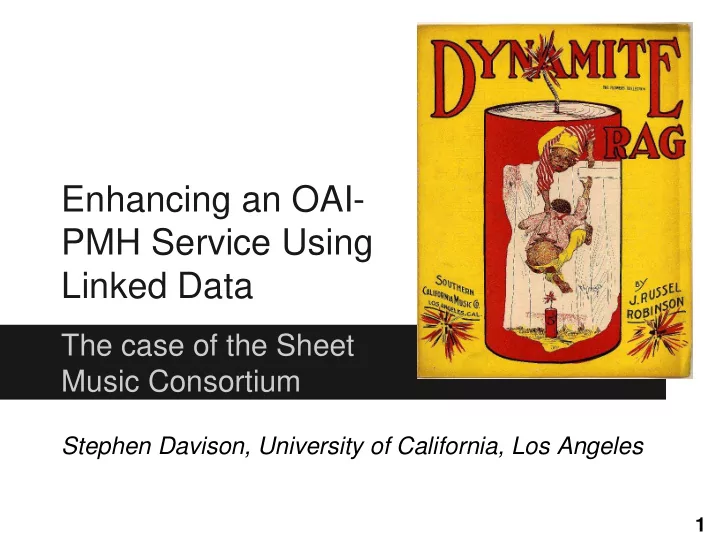
Enhancing an OAI- PMH Service Using Linked Data The case of the Sheet Music Consortium Stephen Davison, University of California, Los Angeles 1 Los Angeles: Southern California Music Co., 1910 2 New York: Howley, Haviland, Dresser, 1903
1
2
Los Angeles: Southern California Music Co., 1910
3
New York: Howley, Haviland, Dresser, 1903
Race relations Performance and performers Graphic art Musical composition “When it’s moonlight on the Levee, Caroline” “When I hear the banjos ringing” Has: composer, lyricist, graphic artist, publisher, performers
4
men women Society and Culture--Sentimental song Songs with piano Songs Landscapes Legacies of Racism and Discrimination--Afro-Americans Entertainment Legacies of Racism and Discrimination--Stereotypes--Afro-Americans Singers Couples Afro-Americans rivers Society and Culture--Couples Performers--Men--Kenny Kenny
5
6
publication of linked data
7
○ Harvested data maintained in XML format and
○ User contributed data is stored in a separate
8
9
10
11
SCHEMA institutions records Dublin Core 14 98,317 Qualified Dublin Core 9 26,236 MODS 4 103,504 WORKFLOW Direct harvesting using the OAI protocol 25 205,914 Harvesting the metadata via the Static Repository Gateway 1 2,222 Manual extract of MARC records from an integrated library system and mapping to MODS and ingest 1 19,921
Schemas and Workflows used to harvest records for the Sheet Music Consortium.
12
SMC metadata is harvested from diverse institutions, with varying practices
○
inventories & finding aids
○
spreadsheets
○
bibliographic “records”
○
focus on music vs. focus on illustrations
California: Granite Music, 1954
13
San Francisco: M Gray, 1879
14
○ Harry Puck (composer) ○ Puck, Harry, 1890-1964 ○ Puck, Harry [composer]
New York: Bert Kalmar & Harry Puck, 1914
15
○ First line of text ○ First line of the chorus ○ The same song may be published under multiple
■ California and you ■ California (and You) ■ Oh! you old Pacific Coast ○ A variety of distinct songs may have the same title
16
17
Los Angeles: Southern California Music Co., 1909
18
1. Extracted data (names, titles, publishers) from MODS records 2. Rank ordered word frequency using Voyeur/Voyant tools 3. Chose to work on group of dozen most important publishers 4. Used word frequency data to establish name and title groups 5. Used both internal and external information to establish when publishers really changed identity or ownership 6. Used Google Refine to normalize forms of name. Based choice of “preferred form of name” on frequency 7. Wrote these preferred forms back into the repository as “user supplied metadata” (i.e. separate from the harvested data) 8. Published publisher information on the web as HTML and LOD (RDF/XML) (plan also to publish RDFa) 9. Established unique ID’s, permanent URLs and link resolution for each publisher
19 Process for harvesting new data into the aggregated collection
20
PUBLISHER NAME PUBLISHER ADDRESS DATES OF PUBLICATIONS Kalmar & Puck 1905 Kalmar & Puck 152 West 45th Street, New York 1913-1915 Kalmar & Puck New York 1913-1916 Bert Kalmar & Harry Puck New York 1914-1915 Maurice Abrahams Music Co. New York 1913-1915 Maurice Abrahams Music Co. 1570 Broadway, New York 1913-1916 Kalmar Puck & Abrahams New York 1915-1918 Kalmar Puck & Abrahams 1570 Broadway 1917 Kalmar Puck & Abrahams Strand Theatre Building at 47th St 1917-1918 Maurice Abrahams, Inc. 1591 Broadway, New York 1923 Maurice Abrahams, Inc. 1923-1926 Kalmar & Ruby Music Corp. 6301 Sunset Boulevard, Hollywood 1937-1939
Summary of publisher information generated from SMC data
21
DATE PUBLISHER EVENT 1835 Oliver Ditson, Boston firm founded by Oliver Ditson 1867 Oliver Ditson, Boston acquired Firth, Son & Co., New York 1867 Charles H. Ditson, New York firm founded by Oliver’s son 1873 Oliver Ditson, Boston acquired Miller & Beacham, Baltimore 1875 Oliver Ditson, Boston acquired Wm. Hall & Son, New York acquired Lee & Walker, Philadelphia 1875 James E. Ditson, Philadelphia firm founded by Oliver’s son 1877 Oliver Ditson, Boston acquired G. D. Russell & Co., Boston acquired J.L. Peters, New York 1879 Oliver Ditson, Boston acquired G. André, Philadelphia 1883 Theodore Presser, Philadelphia firm founded by Theodore Presser 1890 Oliver Ditson, Boston acquired F.A. North & Co., Philadelphia 1931 Theodore Presser, Philadelphia acquired Oliver Ditson
Timeline for Oliver Ditson, Music Publisher
22
existing information through a mixture of machine and human analysis
○
Map relationships between names
○
Additional derived information
■
Addresses and dates
○
HTML
■
Visualization tools, mapping, timelines
○
RDF
○
RDFa
23
PUBLISHER IDENTIFIER Kalmar & Puck ark:/21198/r23x84k8 Maurice Abrahams Music Co. ark:/21198/r27p8w9m Kalmar Puck & Abrahams ark:/21198/r2cc0xm5 Kalmar & Ruby Music Corp ark:/21198/r2057cvv
Archival Resource Keys (ARK) for publishers The Name-to-Thing (N2T) Resolver:
e.g. http://n2t.net/ark:/21198/r2cc0xm5
24
<skos:prefLabel>Kalmar Puck & Abrahams</skos:prefLabel> <skos:altLabel>Kalmar, Puck & Abrahams</skos:altLabel> <skos:altLabel>Kalmar, Puck & Abrahams Consolidated Inc. </skos:altLabel> <skos:altLabel>Kalmar, Puck & Abrahams Consol't'd, Inc. </skos:altLabel> <rdfs:seeAlso rdf:resource="http://n2t.net/ark:/21198/r27p8w9m/"/> <!--Maurice Abrahams Music Co.--> <rdfs:seeAlso rdf:resource="http://n2t.net/ark:/21198/r23x84k8/"/> <!--Kalmar & Puck--> <rdfs:seeAlso rdf:resource="http://n2t.net/ark:/21198/r2057cvv/"/> <!--Kalmar & Ruby Music Corp-->
25
use with controlled values for names (personal, corporate, geographic, etc.), thesauri, taxonomies, subject heading systems, and other controlled value lists
needed in the library community
resources
26 <madsrdf:Address> <rdf:Description> <madsrdf:streetAddress>Strand Theatre Building at 47th Street</madsrdf:streetAddress> <madsrdf:city rdf:resource="http://sws.geonames.org/5128581/"/> <time:year>1917</time:year> <time:year>1918</time:year> </rdf:Description> </madsrdf:Address>
27
28
Have demonstrated a strategy for mitigating some of the problems in aggregated metadata and publishing normalized data on the web as linked data. Over time normalized linked data may take on the role that authority records do in OPACs, and may its way into formal authority vocabularies. Publishers are just a start… now we need to republish other normalized elements to the “web of data.” OAI is still a useful tool for harvesting data. With mapping tools and static repositories even the smallest of players can contribute. A possible model for other bibliographic projects.
29
sdavison@library.ucla.edu
New York: Howley, Haviland, Dresser, 1903
With special thanks to my collaborators and co-authors:
Yukari Sugiyama
East Asia Library, Yale University
Elizabeth McAulay
UCLA Digital Library Program
Claudia Horning
UCLA Cataloging & Metadata Center