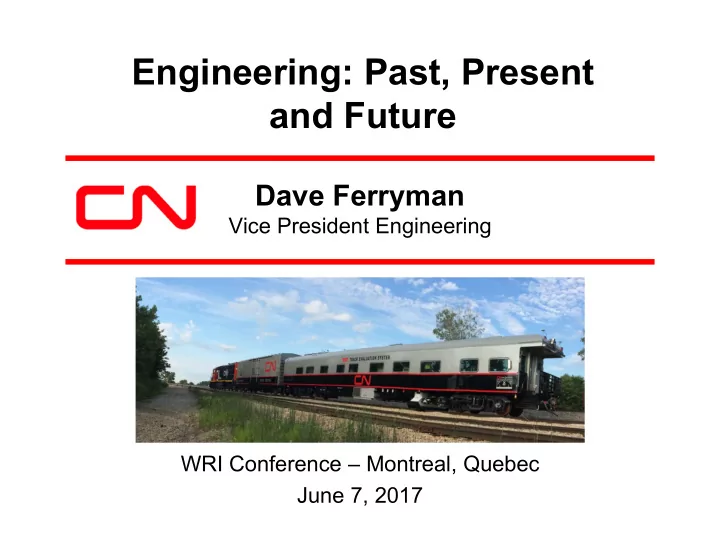
Engineering: Past, Present and Future Dave Ferryman Vice President - - PowerPoint PPT Presentation

engineering past present and future
SMART_READER_LITE
LIVE PREVIEW

Engineering: Past, Present and Future Dave Ferryman Vice President - - PowerPoint PPT Presentation

Engineering: Past, Present and Future Dave Ferryman Vice President Engineering WRI Conference Montreal, Quebec June 7, 2017 - 0 - CN Network Network Track Miles Infrastructure Capital Spending Mainline Core 8,617 2016 C$1.6B


slide-1
SLIDE 1
  • 0 -

Dave Ferryman

Vice President Engineering

Engineering: Past, Present and Future

WRI Conference – Montreal, Quebec June 7, 2017

slide-2
SLIDE 2
  • 1 -

CN Network

Network Track Miles

Mainline Core 8,617 Non‐core 12,602 Non‐Mainline 8,178 Total 29,397

Infrastructure Capital Spending

2016 C$1.6B 2017 Estimated C$1.6B

slide-3
SLIDE 3
  • 2 -

CN Engineering Safety Performance

  • Engineering accidents down 65% and tonnage up 25% since 2006

500 1,000 1,500 2,000 2,500 3,000 3,500 4,000 4,500 50 100 150 200 250 300 350 400 2006 2007 2008 2009 2010 2011 2012 2013 2014 2015 2016

Total MGT # of Accidents

Accidents Tonnage

slide-4
SLIDE 4
  • 3 -

My Family History

  • 4th Generation Railroader
  • John H. Ferryman
  • Depot Agent, GNR
  • Wenatchee, WA
  • William “Henri” Ferryman
  • Superintendent Engineering, GNR
  • Seattle, WA
  • William H. Ferryman Jr.
  • Chief Engineer, Denver Region, BN
  • Denver, CO
slide-5
SLIDE 5
  • 4 -

Railway Maintenance Planning Innovation

Current process

  • Use multiple technologies collecting

automated data sets

  • Generate capital programs from
  • bjective data collection and risk-based

scores

Past process

  • Requests received from field

employees based on their visual inspections

  • Management reviewed submissions

and relied heavily on subjective field input

Future process

  • Autonomous inspections
  • Cognitive data streams
slide-6
SLIDE 6
  • 5 -

Rail Maintenance & Replacement Improvements

Rail Replacement

  • Developed a tangent rail replacement

model

  • The model identifies areas to relay

based on a risk matrix

  • Curve relay locations are based on

review of historical wear rates

Rail Maintenance

  • Created a centralized team

accountable for rail grinding, rail lubrication and establishing proper curve superelevations

  • Objective – optimize rail maintenance

to extend rail life

Risk Score Minimum Score

slide-7
SLIDE 7
  • 6 -

100 200 300 400 500 600 1970 1974 1978 1982 1986 1990 1994 1998 2002 2006 2010 2014 2018 2022 2026 2030 2034 2038 2042 2046 2050 2054 2058 2062 2066 2070 2074 2078 2082 Tangent Rail Miles Year

Risk Modeling of Tangent Rail Programs

  • CN replaced a significant

amount of tangent rail in the late 1970’s/early 1980’s

  • Currently relaying portions of

that rail to match the theoretical life

  • As we install higher strength

steel, the theoretical life will increase

  • Created a tangent rail replacement model that identifies areas of higher

risk using objective metrics

  • The risk matrix focuses on several individual items to prioritize locations for

replacement

Tangent Relay/Year

Theoretical Rail Life Review

30 to 40 years 40 to 55 years

slide-8
SLIDE 8
  • 7 -

Interdepartmental Collaboration

Engineering, Mechanical and Transportation

  • Operations investigation team that

collaborates to find solutions to problems

  • Use data and modeling to provide an
  • bjective view for challenging situations
  • Objective – develop proactive strategies

to reduce the potential risk of specific

  • perations

Engineering and Mechanical

  • Analyzed high impact wheels (HIW)

and ISRF data to better understand the correlation

  • Data review led to a standard for track

inspections on dark territories for specific HIW

slide-9
SLIDE 9
  • 8 -

The Future of Engineering Technology

Better utilize the information to prioritize work

  • Review data trends to develop capital and maintenance programs
  • Use data to improve and optimize capital and workforce planning

models

  • Develop comparable and objective track health scores

More automated data collection

  • Autonomous geometry systems
  • Non-stop rail flaw testing
  • VTI units
  • Tie condition assessment
  • Ground Penetrating Radar (GPR)
  • Monitoring change run-over-run
slide-10
SLIDE 10
  • 9 -

Asset Management based on Life Cycles

Opportunities

  • Improve tools and reports to make it easier for field employees to

access and consume relevant data

  • Use multi-variable analysis to better understand track health
  • Move toward a predictive/prescriptive maintenance model
  • Enhance data governance and quality

Current Strengths

  • Understanding trends for visual,

RFD and Geometry exceptions

  • Adjusting test frequencies and

capital strategies based on trend lines

  • Mapping track inventory using GIS
slide-11
SLIDE 11
  • 10 -

Engineering Reliability Analytics (ERA)

GIS Enabled Asset Health Scores Inspection, Condition and Repair Oversight Capital Planning Tools

slide-12
SLIDE 12
  • 11 -

ERA – Operational Module

Territory Overview and Oversight

  • Quick access to territory overview
  • Review inspection status
  • Monitor track conditions
  • Audit repairs while in the field
  • Download reports and data to

plan activities

  • Visualize track health scores by

track segment

slide-13
SLIDE 13
  • 12 -

ERA – Planning Module

Capital Planning Tools

  • Reports that provide objective and

comparable data

  • Rail, tie and surfacing models that

assist with capital planning

  • Life-cycle asset management
  • Foundation for predictive analytics
slide-14
SLIDE 14
  • 13 -

Workforce Planning Model

Guideline for Comparing Territories

  • Point system for managing proper resource

allocation

  • Tonnage
  • Amount of track by class
  • Features
  • Headcount
  • Conditions
  • Projected Traffic
slide-15
SLIDE 15
  • 14 -

Moving Toward the Future

  • Developing actionable predictive models
  • Establishing a scalable enterprise solution for “big

data”

  • Making track data easy to access and easy to

understand

  • Getting the data to speak to users
  • Using information to lead our decision making
  • One day, have the data make proper decisions on

its own

slide-16
SLIDE 16
  • 15 -

Thank You