
SLIDE 1
Energy Storage in Vermont
VT Department of Public Service
1
Energy Storage in Vermont VT Department of Public Service 1 Act - - PowerPoint PPT Presentation
Energy Storage in Vermont VT Department of Public Service 1 Act 53 Storage Report On or before Nov. 15, 2017, Commissioner of Public Service shall submit a report on the issue of deploying energy storage on the Vermont electric
VT Department of Public Service
1
submit a report on the issue of deploying energy storage on the Vermont electric transmission and distribution system.”
affecting deployment of energy storage;
deployment of storage;
energy storage;
energy storage, including potential cost impacts to ratepayers; and
solutions for energy storage in Vermont and the potential benefits and cost impacts of each method for ratepayers.
http://publicservice.vermont.gov/content/energy-storage-study
2
study outline
transmission & distribution utilities, renewable energy and storage project developers, nonprofits, land use planners, neighboring states, and the regional transmission organization.
Written comments on the proposed outline and the draft report are available at http://publicservice.vermont.gov/content/energy-storage- study.
3
4
“….we view energy storage as a means to an end – rather than an end in and of itself – and thus many of our recommendations focus on pursuit of storage within the broader pursuit of a clean, efficient, reliable, and resilient grid in the most cost-effective manner for ratepayers.”
5
30 V.S.A. § 202a It is the general policy of the State of Vermont: (1) To assure, to the greatest extent practicable, that Vermont can meet its energy service needs in a manner that is adequate, reliable, secure, and sustainable; that assures affordability and encourages the State's economic vitality, the efficient use of energy resources, and cost-effective demand-side management; and that is environmentally sound. (2) To identify and evaluate, on an ongoing basis, resources that will meet Vermont's energy service needs in accordance with the principles
load management alternatives, wise use of renewable resources, and environmentally sound energy supply.
6
7
Courtesy Massachusetts Department of Energy Resources, from “State of Charge”
8
9
Source: VELCO
Source: VELCO
10
Source: VELCO
11
$12.1/w
12
Source: VELCO
13
Top left: Paul Bierman; Bottom left: By HopsonRoad - Own work, CC BY-SA 3.0, https://commons.wikimedia.org/w/index.php?curid=30591776
14
Peak management/regulation/other market opportunities Integration of renewables Grid resiliency/microgrid
15
16
17
Source: Bloomberg New Energy Finance
18
19
Battery control Benefits Challenges Utility
storage where it is most beneficial to the grid, and in the near term, to hit peaks
benefits on behalf of all ratepayers
behalf of multiple customers
distributed storage
participating in this market space
therefore tend to prioritize monetizable benefits
to minimize investment and risk may discourage exploration of newly emerging products Customer
sufficient benefit streams Third party
potentially resiliency/integration/reliability benefits for utilities and customers
allow shared access and benefits still under development
many
values by all parties challenging
20
21
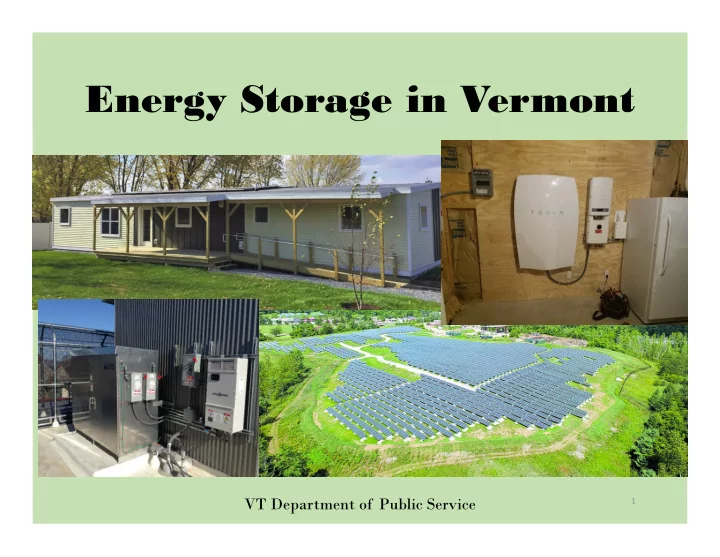
BED King St. Youth Center storage project Stafford Hill 2 MW solar + 3.4 MWh storage project in Rutland. Batteries are In the shipping containers in the upper right. Credit: GMP Vermod Sonnenbatteries (6 or 8 kWh) at McKnight
GMP Tesla Powerwall 5.5 kW install Sunverge 8 kWh in Plymouth Simpliphi 82 kWh system at Emerald Lake
Also…..
battery at BTV
1 MW/4 MWh battery on Panton PV site
MW/8 MWh battery microgrid projects in Milton & Ferrisburgh
utility-scale storage in time for summer 2018 peak
storage to alleviate N. VT export constraints
PowerGuru 32 kWh battery in Pownal
22
Dynapower test pad in S. Burlington Bill Laberge of Grassroots Solar with a Sonnenbatterie Tesla Powerwall unit installed by Peck Electric in S. Burlington. Northern Reliability VTA solar + storage in Rochester
23
24
http://publicservice.vermont.gov/content/energy-storage-study Anne Margolis anne.margolis@vermont.gov
25