
SLIDE 1
Numis Industrial Property Conference Paul Arenson, CEO
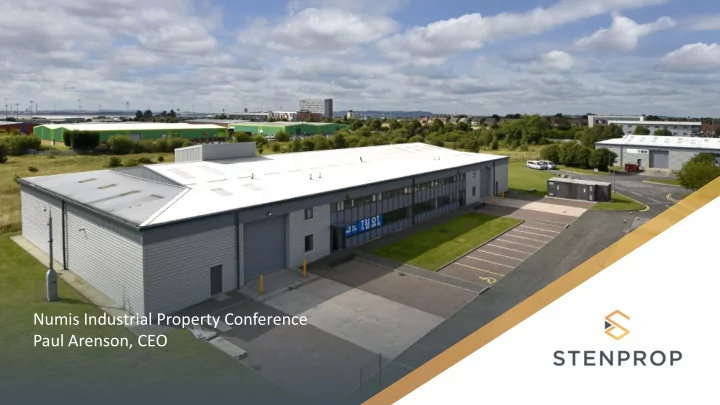
Numis Industrial Property Conference Paul Arenson, CEO Agenda THE - - PowerPoint PPT Presentation
Numis Industrial Property Conference Paul Arenson, CEO Agenda THE MLI OPPORTUNITY STENPROP OVERVIEW IMPACT OF CORONA ON MLI & STENPROP 2 THE MLI OPPORTUNITY 3 The MLI Opportunity MLI supply is static/diminishing due to high build costs
Numis Industrial Property Conference Paul Arenson, CEO
Agenda
THE MLI OPPORTUNITY STENPROP OVERVIEW IMPACT OF CORONA ON MLI & STENPROP
2
3
The MLI Opportunity
4
Supply Demand Rental Growth Asset Pricing Platform MLI supply is static/diminishing due to high build costs (relative to rents), limited land availability and higher value alternative use like residential. Structural change in demand for small business units driven by technology and the internet. Supply/demand imbalance resulting in strong annual rental growth Current market pricing for existing MLI investments is c. 50-60% of replacement cost value Opportunity to increase efficiency and revenue by using emerging technology, scale and the serviced model
Features of Multi-let Industrial
5
Versatile, flexible, urban, multi-tenanted, diversified income
Located in and adjacent to densely populated cities and towns across the UK Predominantly let to UK Small-to-Medium Enterprises (“SMEs”) Low obsolescence, low capex, high versatility of uses Small / medium lot sizes less than £20m per estate Highly diversified and granular tenant base in terms of company size and sector Purpose built units comprising 5 to 50 units on an estate controlled by owner Unit sizes on each estate typically range from 500 sq ft to 10,000 sq ft with the average being approximately 3,500 sq ft Typical tenant paying c. £18,000 rent p.a. (£5.14psf) representing between 1% -2% of their turnover 3-5 year lease durations
The industrial asset class has outperformed retail and office in terms of total return since 1986
Total Return Index (1986=100)
Industrial sector return evolution
100 500 900 1300 1700 2100 2500 1986 1990 1994 1998 2002 2006 2010 2014 Income Return Capital Growth
Retail, office and industrial sectors total return evolution
100 400 700 1000 1300 1600 1900 2200 1986 1990 1994 1998 2002 2006 2010 2014 Retail Office Industrial
Best Performing Sector in UK Property
6
Long term outperformance against wider commercial property driven by rental income and low ongoing capex
The best performing sector in property over a 30 year period
Source: IPD, 2017
Industrial sector: – Total return index 2275 over 30 years Office and retail sectors: – Total return indices of 1220 and 1290 respectively over 30 years Industrial property’s success is due to consistently higher income returns
The number of private sector businesses in the UK grew by 69% between 2000 and 2019, and 3.5% between 2018 and 2019 SMEs account for 99% of private sector businesses UK SMEs annual turnover is £1.9tn p.a, reflecting 52% of all private sector turnover, and employ 16.6m people (c. 60% of all private sector employees) Shift of retailers from shops to industrial/online Light industrial units provide flexible accommodation to sell, manufacture, dispatch and/or store goods, all under a single planning permission Click’n’Collect and Last Mile Distribution Networks are developing in urban areas Communication technology facilitating smaller more flexible independent businesses able to access suppliers, customers and other relationships more easily
Sector Fundamentals - Demand
7
Structural shift in the number and range of occupiers needing to operate from MLI units due to changes in communications technology
UK private sector businesses
The growth of small business The move away from traditional asset classes
Number of businesses (000s) Source: Office for National Statistics 1,000 2,000 3,000 4,000 5,000 6,000 7,000 1 2 3 4 5 6 7 8 9 10 11 12 13 14 15 16 17 18 19 2000
The internet continues to make multi-let industrial accommodation increasingly attractive to a wider range of businesses needing functional working space at affordable rent Industrial efficiency gains and new technologies like 3D printing are enabling companies to start ‘on-shoring’ activities, driving demand for UK manufacturing which would previously have gone abroad Cultural change driven by technology such as driverless cars, big data and virtual reality will drive demand for flexible space near conurbations which can adapt to changing occupational requirements
Sector Fundamentals - Demand
8
A structural shift in long term demand for industrial is occurring
The future
Sector Fundamentals - Supply
9
Supply constrained and diminishing. Rents need to rise to justify building MLI units.
Build Costs Land Availability
Real building costs up 74% in the 11 years to 2018. Only in the last 4 years or so have industrial rents started to move up having remained largely unchanged for a decade Industrial development accounts for approximately 15% of private commercial construction in 2018 vs 30% in 1997. Very little of which is MLI. In Stenprop’s view it is not economically viable to build small unit multi-let estates until rents increase by around 50% in most regional UK markets. We currently can purchase existing estates for 50 to 60% of replacement cost. Build costs are likely to remain high as there is little ability to financially engineer the design to reduce costs There is little land available in the UK in and around urban areas Most land supply is likely to be allocated to residential uses, or wider employment uses with higher development end-values (such as office or single-let industrial units). Approximately 40% of our existing estates (107 acres) are directly adjacent to existing residential properties. MLl supply is inelastic
74%
Real build cost increase between 2007 and 2018
£138 psf Replacement
cost of Industrials portfolio
Average UK consented vacant residential land value per acre (excluding Greater London)
Average purchase cost per acre of the Stenprop MLI portfolio
psf
Estimated rent required to justify new MLI development
£5.14 psf
Average passing rent on our MLI portfolio
vs
10
MLI Portfolio as at 30 September 2019
11
Notes:
1 Contractual rent includes contracted uplifts contained in existing leases over period of lease. 2 This excludes the vacant space at Coningsby Park, Peterborough which was purchased in December 2017 and is currentlyundergoing refurbishment and hence is not available to let. If included then total vacancy is 370,613 sq ft, reflecting 8.6%.
Current Passing Rent £20,350,259 £5.14 psf Contractual Rent 1 £21,255,526 £5.36 psf Estimated Rental Value (ERV) at 100% occupancy £24,036,785 £5.55 psf Current Vacancy 2 247,961 sq ft 6.1%
4,327,244
sq ft
1,187
Units
68
Assets
841
Tenants
Tenant Business Breakdown Geographic Breakdown by Area
Note: Excludes long-leasehold units and tenants Other 1% and less North West South East West Midlands East West Yorkshire Wales Scotland South Yorkshire East Midlands South West, 2% North Yorkshire, 1% North East, <1% 27% 12% 11% 10% 8% 8% 8% 7% 5% Manufacturing Wholesale and Retail Trade Private Individual / Unknown Administrative and Support Service Activities Construction Professional, Scientific and Technical Activities Arts, Entertainment and Recreation 4% 5% 6% 13% 19% 20% 26%
Rents
+2.9%
New Lettings
+22%
Renewals
+17%
Rent Reversion
+18.1%
Lease Events
156 MLI Portfolio Performance
12
6 months from 31st March 2019 to 30th September 2019
The MLI portfolio continues to deliver strong occupational performance
Average rental uplift over previous passing rent on 55 lettings completed and producing £1.2m p.a.
Average rental uplift over the 35 lease renewals completed and producing £0.6m p.a. of contractual rent Uplift between the current passing rent and Estimated Rental Value on the whole portfolio Breaks/expiries over the
at lease expiry. 19% of breaks
post expiry/break Increase in passing rents over the period
Lease Terms
4.36 years
Income Duration
3.97 years
Occupancy
93.9%
Income Diversity
13%
Lettings Pipeline
47
Average WAULT to lease expiry, 2.65 years to break Occupancy rate of units across the portfolio as at 30 September 2019 Of total rent roll secured against the top 10 tenants. Units under offer to let (£1.15m p.a. of rent) at an average contractual rent of £5.53 psf The average letting / renewal contractual term, with an average rent free period granted of 2.1 months
Continue to use a range of PropTech solutions to lease and manage the portfolio Enhanced analytics capability through the adoption of new BI tools Recruited a Tech Platform Manager and Data Analyst (started January 2020) Customer relationship management platform went live March 20. Has proved invaluable in collating discussions and bespoke arrangements with individual customers. Investing in a new finance and operations management platform for launch in early 2021 as part of the roll out of the serviced industrial concept Four Customer Engagement Managers (CEMs) now in place across regions who engage directly with customers to improve retention rates; Cut fees on lease renewals; drive customer satisfaction and reduce arrears/debtors through active ‘on-the-ground’ management. CEMs together with in-house asset managers have proved invaluable in liaising with customers during Corona crisis. Call centre handles c. 2,500 management calls per annum from existing customers. 45% of lettings on <4,000 sq ft units in England and Wales completed on Smart leases over the 3 months to 30 September 2019 Handling c. 1,500 leasing enquiries p.a. via our call centre Completed a number of lettings in less than 3 working days from enquiry to occupation Successfully implemented a number of paperless digital lease contracts. Now serving as a basis for contracts during Corona. Industrials.co.uk traffic up 55% y-o-y Upgrade to industrials.co.uk launched Enhanced lead tracking and marketing channel expenditure analysis Present on numerous on-line portals Generating over 200 direct marketing leads per month via the Industrials platform
Transition to Operating Business - Roll out of physical and digital capabilities
13
Marketing Leasing Customer Service Technology
Corporate and Financial Overview
14
Portfolio valuation
*based on September 19 valuations
Total bank debt
Weighted average debt maturity of 2.7years
Annual interest on bank debt
average interest rate of 2.63%
Unrestricted cash available
excluding undrawn revolving credit facility of £30m
Six months EPRA earnings to 30 September 19 £534m £217m £5.7m £60m £9.8m
3.41p per share
Current market cap (as at 23 April 2020) Last reported EPRA NAV at 30 September19 Discount to last reported NAV Fully covered dividend paid for 6 months to end September 19. Directors are largest single shareholder group £280m
98p per share
£413m
£1.44 per share
£133m 32% £9.7m
3.375p per share
8.33% *adjusted for acquisitions, disposals and changes in foreign exchange rates
15
Current Portfolio
£533m
£217m debt £60m free cash
Multi-let Industrial UK 58% Retail Germany 18% Office Guernsey 12% Care Homes Germany 7% Leisure Switzerland 3% Single-let Industrial UK 2%
Loan to value ratio Excluding free cash 40.7% Including free cash 29.5%
58% 18% 12% 7% 3% 2%
Transition Strategy to 100% UK MLI
Sell our three daily needs centres in Central Berlin (last valuation £71.7m). Sell our five German retail warehouses let to Bike max (last valuation £23.4m). Following these sales:
Post Corona utilise cash to acquire additional MLI up to £170m assuming 40% leverage. MLI component of the portfolio will rise to approximately 78% of portfolio MLI acquisition model to show an average cash on cash income return (before capital growth) of at least 7.5% pa on equity over a five-year period taking all running costs, lettings, voids and capex into account.
16
Portfolio Overview – post German retail centres sale
17
70% 15% 8% 4% 3%
£439m
£181m debt £115m free cash
Pre Post Multi-let Industrial UK 58% 70% Retail Germany 18%
Guernsey 12% 15% Care Homes Germany 7% 8% Leisure Switzerland 3% 4% Single-let Industrial UK 2% 3%
Loan to value ratio Excluding free cash 40.7% 41.2% Including free cash 29.5% 15.0%
18
Current Impact of Corona on MLI sector
Negative impact on the economy impacts all businesses and particularly the SMEs who are the main occupiers of MLI. Access to government support is helping.
19
Diversity of occupiers means impact is spread and different for each occupier. MLI units well suited to social distancing. Average size 3,000sq ft with few employees. Customers in e-commerce businesses benefitting or less impacted. Certain newer occupiers such as play centres, gyms, rock climbing and trampoline centres forced to close, and are facing difficulties. Occupiers who supply customers in the restaurant, coffee shop and other hospitality fields are suffering from a downturn in
Current Impact of Corona on Stenprop
Collected 73% of rent for March quarterly and April monthly rents. Letting enquiries reduced substantially. New enquiries more focused. Tenants not vacating as readily. A few who had given notice have asked to extend as moving is not feasible. The longer the lock down goes on the more impact it is likely to have on our customers and our rent collection rates. Stenprop set up to market space digitally through its own on-line portal and its call centre. Leases can be executed on-line. 16 new leases over 112,500 sqft concluded since staff working at home. Regional customer engagementmanager strategy proving itself in this period. Anticipate some impact on valuations but too early to be clear. Low interest rates for longer likely to be positive forvaluations once normal rent collections resume. Supply/demand fundamentals likely to continue post Corona. Corona will impact earnings (reduced earnings from holding cash, lowerrent collections, increased voids). Stenprop enjoys the support of its banks and is well capitalised to meet its ongoing obligations. Stenprop has no need to raise capital for the foreseeable future in order to implement its business plan.
20
Stenprop Response
21
Customers
Engaging pro-actively with all customers. No "one size fits all" solution. Creative solutions required Based on detailed information
Funders
Liaising actively. Funders all supportive.
Shareholders
Frequent update announcements. Taking calls from investors. Investors seem to take comfort from balance sheet strength
Staff
In regular contact with all staff to ensure they are coping. Ensured staff have everything they need to continue to operate as comfortably as possible. No redundancies or furloughs Strategic decision to retain cash until more clarity on the duration of the crisis and the impact on the economy. Intend to be quick out of the blocks at the right time to make opportune purchases. German sales programme continues with strong interest from purchasers. Strategic decision not to cut back on investment into ERP project and continue to use this time to build out operating platform. No need to seek Government funding.
Outlook for the MLI Sector Post Corona
More on-shoring and local manufacture/sourcing to diversify supply arrangements. Need to hold increased stock/supply levels and less reliance on ‘just in time’ efficiencies. Increased support for SMEs to manufacture and supply locally. Acceleration of adoption of e-commerce sales/distribution channels likely as more consumers and businesses participate. Adoption of communications technology will facilitate businesses being able to operate regionally and more remotely. More local travel and vacation likely to promote regional development. Government commitment to evolving adequate decentralised capacity to provide for population needs in times of crisis. Expansion of regional transport infrastructure to be an important component. Affordability of rent to become an increasingly important factor. MLI rents still only £5.14psf on average. Overall we believe the MLI asset class will survive the crisis and emerge as an asset class in more demand. The supply/demand imbalance for MLI space will remain. Supply constraints remain (limited land and existing MLI estates still valued at well below replacement cost) whilst the range and number of tenants continues to increase
22
Potential increase in demand for MLI space in the post Corona period as companies seek to build greater resilience to supply shocks.
Outlook for Stenprop
During the crisis: Stenprop has the team, balance sheet and management platform to meet the challenges
Stenprop can operate efficiently from home and is able to market space digitally and transact on-line. The occupier base is very diversified which should diversify the risk on rent collection. The portfolio is regionally diversified which should give some protection from Corona hotspots. The historic supply demand imbalance in the sector should serve to protect values and
23
Post crisis: Stenprop will be in a strong position to acquire additional MLI assets with cash and no need to raise capital. Stenprop will have evolved its platform further and be well positioned to scale its business with marginal incremental cost and greater efficiencies. Stenprop will be further down the track toward generating new revenue streams from ability to
existing customer base. The supply/demand imbalance is likely to have increased as more businesses need MLI with supply not economic to build. Interest rates likely to stay low for long favouring reliable high yielding assets.
Contact Details
24
STENPROP 180 GREAT PORTLAND STREET, LONDON, W1W 5QZ
T +44 (0) 20 3918 6631 Paul Arenson
Chief Executive Officer
Julian Carey
Executive Property Director
www.stenprop.com info@stenprop.com
James Beaumont
Chief Financial Officer