
SLIDE 1
Energy Facility Siting Council
Solar PV Facilities Rulemaking Advisory Committee Meeting #3 Boardman January 30, 2018
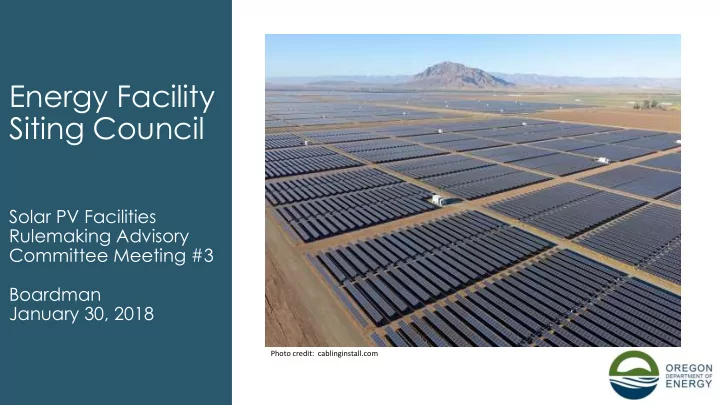
Photo credit: cablinginstall.com
Energy Facility Siting Council Solar PV Facilities Rulemaking - - PowerPoint PPT Presentation
Energy Facility Siting Council Solar PV Facilities Rulemaking Advisory Committee Meeting #3 Boardman January 30, 2018 Photo credit: cablinginstall.com Agenda Overview and Introductions Discussion of issues/potential standards
Solar PV Facilities Rulemaking Advisory Committee Meeting #3 Boardman January 30, 2018
Photo credit: cablinginstall.com
The department is seeking input on potential issues related to solar PV facilities to determine if specific standards may be required. Toxicity and disposal of solar panels Impacts to wildlife and wildlife habitat
island effect”)
What is glare? “Glare” includes a brief or extended flash of sunlight reflected from the surface of a solar panel or other system component. Glare has the potential to cause discomfort or temporary blindness in an observer.
Sunlight reflects off of solar panels being assembled near the Pendleton airport (E.J. Harris, The East Oregonian.)
Evidence suggests some potential for impacts. With anti-reflective coating, the average solar panel reflects as little as 2% of incoming sunlight, similar to smooth water. Intensity of glare is influenced by the arrangement of panels and angle of the sun.
Percentage of reflection light from the surface of a PV module as a function of angle. (Anurag et al., 2017)
While concerns about impacts related to glare are common, few jurisdictions regulate it specifically. ODOT and other jurisdictions have “solar highway” programs which have not impacted safety. Solar facilities have also been successfully sited on airports. FAA regulations require glare analysis for airport-based facilities.
The Oregon Solar Highway Demonstration Project located at the interchange of I-5 and I-205 near Portland (ODOT, 2016.)
Current standards may address some impacts:
These standards do not apply to potential impacts to private residences or landowners.
Some evidence suggests large-scale solar PV facilities have the potential to effect local air temperatures, humidity, pressure, and wind speed. Microclimate effects are driven by changes in surface reflectivity (albedo), shading, and roughness, as well as changes in vegetation. Some concerns have been raised about the impacts these microclimate effects may have on agriculture.
Theoretical differences between vegetated ecosystem (A) and solar facility (B). Heat is captured and stored in soils (orange arrows). Plants dissipate heat release (red) through evapotranspiration (blue). Solar panels convert some energy to electricity (purple) and reradiate some as heat (brown). (Barron- Gafford et al., 2016.)
Size and direction of impacts are highly site specific. Several empirical studies have found small but statistically significant increases in air temperatures near large solar facilities in rural areas. In urban areas, rooftop arrays and utility scale facilities may decrease ambient temperatures.
One study of a solar PV facility in Arizona found average temperatures near facility were 3-4 °C warmer at night than nearby desert lands (Barron-Gifford et al., 2016.)
Some practices may minimize adverse impacts. These include:
temperature sensitive areas
during construction and
A dual-use solar facility and sheep pasture near OSU has found improved forage production under solar panels (Adeh, Selker & Higgins, 2018.)
accepted farm or forest practices on surrounding lands.
Council to find that the following standards are met:
anticipated as a result of the proposed facility have been identified and adverse impacts will be mitigated in accordance with rules of the Council applicable to the siting of the proposed facility.
compatible through measures designed to reduce adverse impacts.