
SLIDE 1
H M F H A R C H I T E C T S
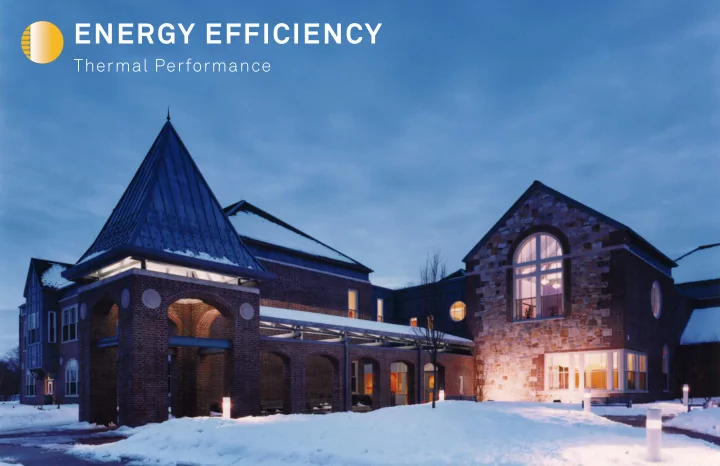
ENERGY EFFICIENCY Thermal Performance H M F H A R C H I T E C T S - - PowerPoint PPT Presentation
ENERGY EFFICIENCY Thermal Performance H M F H A R C H I T E C T S Weymouth Municipal Energy Use from 2015 data Chapman MS 13% All Non-Bldg Municipal 39% WHS 18% 47% Adams MS 5% Other WPS Bldgs All Other Town Bldgs 11% 14% H M F H
H M F H A R C H I T E C T S
H M F H A R C H I T E C T S
from 2015 data All Non-Bldg Municipal 39% All Other Town Bldgs 14% Chapman MS 13% WHS 18% Adams MS 5% Other WPS Bldgs 11% 47%
H M F H A R C H I T E C T S
Energy a building uses each year relative to its size
NATURAL GAS ELECTRICITY RENEWABLES
TOTAL ENERGY CONSUMPTION
H M F H A R C H I T E C T S
Net Zero Energy Code Minimum Optimized Payback ECMs - ENVIRONMENTAL CONSERVATION MEASURES
EUI - ENERGY USE $ - COST Zero Carbon Enhanced Budget Lowest First Cost Net Zero Energy Code Minimum Optimized Payback Zero Carbon
Enhanced Budget Lowest First Cost
H M F H A R C H I T E C T S
EUI (kBTU / sf / year) 20 40 60 80 80-120 65 38 30’s 35 38 40’s 26 Brookline E S
PROJECTED
Thompson E S Abbot Downing ES Claiborne Pell ES
COMPLETED 2013 COMPLETED 2012 COMPLETED 2013
66 22 Net Zero Ready 24.8 Architecture 2030 ll S
01
National Average HMFH Average Code Minimum Existing Chapman MA Average Net Zero + Renewables
Recent Partial Hisroty of Energy-Efficient / Net Zero School Design in Northeast
Project Architect Location Completed Projected Site EUI Concord Trio of Elementary Schools HMFH Architects Concord, NH 2012 38 Claiborne Pell E.S. HMFH Architects Newport, RI 2013 38 Thompson E.S. HMFH Architects Arlington, MA 2013 38 The Met School* RGB Architects Newport, RI 2014 35 Kathleen Grimm / P.S. 62* SOM NYC, NY 2015 33 MLK School & PAUS* Perkins Eastman Cambridge, MA 2015 33 MacArthur Elementary School* Ashley McGraw Architects Binghamton, NY 2015 22 Coolidge Corner School HMFH Architects Brookline, MA 2018 26 King Open* William Rawn & Arrowstreet Cambridge, MA 2019 (est) 27
* Project established Net Zero Design as primary goal in RFP
Kathleen Grimm School for Leadership and Sustainability at Sandy Ground / P.S. 62 SOM |68,000 SF | Opened Fall 2015 | Staten Island, NY
Source: SOM.com
source: SOM.com & ashraeny.org
Kathleen Grimm School for Leadership and Sustainability at Sandy Ground / P.S. 62 SOM
Authority (SCA) Green Schools Guide compliance in lieu of LEED
solar hot water system
MLK School / PAUS Perkins Eastman | 170,000 SF | Opened December 2015 | Cambridge, MA
Source: Perkinseastman.com & Cambridge.gov
MLK School & PAUS Perkins Eastman
source: Perkinseastman.com & Cambridge.gov
goal of Net Zero Emissions in the RFP
MLK School & PAUS Perkins Eastman
estimated 47% of the school’s required energy
water reclamation
used to block direct heat gain
Intensity 60% less than typical educational buildings in New England
source: Perkinseastman.com & Schoolconstructionnews.com
King Open / Cambridge Street Upper School & Community Complex William Rawn Associates & Arrowstreet | 250,000 SF | Cambridge, MA Under construction, opening Fall 2019
Source: Cambridgema.gov
Source: Arrowstreet.com & Cambridgema.gov
King Open / Cambridge Street Upper School & Community Complex William Rawn Associates & Arrowstreet
goal of Net Zero Emissions in the RFP
King Open / Cambridge Street Upper School & Community Complex William Rawn Associates & Arrowstreet
Emissions
energy than a typical Massachusetts school that meets the energy code
source: Arrowstreet.com & DDCJournal.com
Coolidge Corner School HMFH Architects | 227,000 SF | Opened Fall 2018 | Brookline, MA Grades PK-8 Projected EUI- 26
Photographer: Ed Wonsek
Renovation of Historic Building with New Addition
Photographer: Ed Wonsek
Source: HMFH
Wall Construction
insulation Roof Construction
insulation Glazing – 24% of vertical walls (average for the whole building)
Light Power Density (LPD) = 0.43 with daylight harvesting
Vent Fans 27% Pump and Aux 7% Space Cooling 7% Space Heating 2% Heat Rejection 1% Exterior Usage 1% Hot Water 1% Area Lights 18% Plug Load 36%
HVAC & Envelope 44%
Coolidge Corner School | Energy Consumption HMFH Architects
Project Geothermal Photovoltaic Size (SF) Stories Projected Site EUI * Kathleen Grimm / P.S. 62 Yes Yes 68,000 2 33 MLK School / PAUS Yes Yes 170,000 3 33 Coolidge Corner School No No 227,000 3 26 King Open /CSUS Yes Yes 250,000 5 27 *not accounting for renewable energy
Current Built Examples of Low-EUI Schools
H M F H A R C H I T E C T S
Sample project: Coolidge Corner School
HVAC & Envelope 53.9% HVAC & Envelope 54.6%
Baseline Building Results 7,586,862 kBtu/year As Designed 5,289,283 kBtu/year
Plug Load 16.8% Area Lights 20.9% Hot Water 8.4% Vent Fan 11.1% Pump & Aux 3.1% Space Cooling 4.8% Space Heating 33.6% Heat Rejection 0.6% Exterior Usage 0.7% Vent Fan 16.2% Pump & Aux 4.4% Space Cooling 4.1% Space Heating 28.3% Heat Rejection 0.8% Exterior Usage 0.8% Plug Load 24.1% Area Lights 11.12% Hot Water 10.2%
H M F H A R C H I T E C T S
ENERGY EFFICIENCY | Thermal Performance
Roof Insulation: R-30
reduce thermal bridging Wall Insulation: R-17
Slab on Grade Insulation:
around perimeter Roof Insulation: R-40
reduce thermal bridging Wall Insulation: R-20
Slab on Grade Insulation:
full slab
1.0 FIRST 98' - 0" ROOF 126' - 1 1/2" 2.0 SECOND 112' - 0" Bio MED Electrical Tech
D E T A I L S E E 1 5 B R I C K C O U R S E S 3 'ROOF INSULATION WALL INSULATION SLAB INSULATION
Daylight/Occupancy Sensor Low voltage controls
H M F H A R C H I T E C T S
Sloped, highly-reflective ceiling brings daylight into the building reducing energy use Ultra high-efficiency light fixture w/daylight dimming Light-reflecting walls High windows and 85% reflective light shelf to bounce light deep into the classroom Extensive daylight transmission through highly transparent glass Heat-mirror shading keeps heat out in the summer Triple glazing w/argon improves thermal performance
visible light
Windows located near corners reduce dark areas
SUPPORTS AN ACTIVE LIFESTYLE
Lighting Control System
Mechanical System Options Studied
GGD
70- 75°F 80°F + 65-68°F
VAV System Active Chilled Beams Displacement Ventilation VRF System
with Boiler and Chiller Plants
Radiant Heating Panels with DOAS (Dedicated Outdoor Air System) and High-Efficiency Boiler and Chiller Plants
Cooling/Heating Panels with DOAS (Dedicated Outdoor Air System) and High-Efficiency Boiler and Chiller Plants
with DOAS (Dedicated Outdoor Air System) and High- Efficiency Boiler and Chiller Plants
System with DOAS (Dedicated Outdoor Air System)
Heating/Cooling Plant
Ground Source Plant
Mechanical System Option Pro’s & Con’s
Building Energy Management System Common Benefits for All Systems
Unique Pro’s Option 1 Lowest Operational Expenses, Lowest Maintenance, Highest Air Quality, Lowest Noise Operation, Reduced Cooling Loads Option 2 Lowest Operational Expenses of Full AC Options, Lowest Maintenance of Full AC Options, Highest Air Quality, Lowest Noise Operation, Reduced Cooling Loads Option 3 Units Located in Ceiling, Moderate Maintenance Option 4 Lowest Energy Use, Does Not Use Fossil Fuels for Heating, Units Located in Ceiling Option 5 Lower Operational Expenses, Lower Maintenance, Highest Air Quality, Lowest Noise Operation, Reduced Cooling Loads Option 6 Lower Energy Use, Highest Air Quality, Lowest Noise Operation, Reduced Cooling Loads, Lower Fossil Fuel Consumption Unique Con’s Option 1 Dehumidification Only Limited to 78 deg F Cooling Setpoint, Utilizes Fossil Fuels for Heating, Requires Coordination for Chases and Floor Mounted Diffuser Locations Option 2 Utilizes Fossil Fuels for Heating, Requires Coordination for Chases and Floor Mounted Diffuser Locations Option 3 Utilizes Fossil Fuels for Heating, Highest Energy Use, Condensate Maintenance Option 4 Highest Operational Expenses, High Maintenance, Highest Noise Operation, Condensate Maintenance Option 5 Higher Operational Costs Compared to Water-Cooled Chiller Plant, Utilizes Fossil Fuels for Heating, Requires Coordination for Chases and Floor Mounted Diffuser Locations Option 6 Higher Operational Costs Compared to Water-Cooled Chiller Plant for Electric Heating, Highest Installation Costs and Coordination for Ground Source Well Field, Highest Maintenance, Utilizes Fossil Fuels for Heating, Requires Coordination for Chases and Floor Mounted Diffuser Locations
Energy Economics Methodology
Characteristics
GGD
Mechanical System Payback Summary
ASHRAE 90.1-2013 Energy Savings Summary
$22,000/well for a premium installation cost of $3,850,000
approximately $22,000/well for a premium installation cost of $4,950,000
system/Total building annual energy cost.
(Includes geothermal well, solar water heater and photovoltaic system. This project will achieve LEED certification and will be considered a net zero building.)
Progress)
H M F H A R C H I T E C T S
H M F H A R C H I T E C T S
H M F H A R C H I T E C T S
RESILIENCY
floodplain.
heat and extreme storms causing inland flooding.
emergency power in mind.
from site and storm water run-off.
H M F H A R C H I T E C T S
Maria Chapman Middle School Schematic Design H M F H A R C H I T E C T S
BIOSWALES
H M F H A R C H I T E C T S
RESILIENCY
structures.
Via Verde Dattner Architects and Grimshaw Architects Bronx, New York, United States
H M F H A R C H I T E C T S
RESILIENCY
H M F H A R C H I T E C T S
RESILIENCY
with new technologies and systems. Empty conduit under slabs for increased capacity in the future. Structure for increased bandwidth capacity in the future.
H M F H A R C H I T E C T S
RESILIENCY
H M F H A R C H I T E C T S
RESILIENCY
and performance.
H M F H A R C H I T E C T S
Maria Chapman Middle School Feasibility Study H M F H A R C H I T E C T S Maria Chapman Middle School Feasibility Study H M F H A R C H I T E C T S a Ma a Ma Ma Ma Ma a Ma Ma aria Ch Ch Ch Ch h Ch Ch Ch Ch Ch Ch Ch Ch h Ch Ch hap ap ap ap ap ap ap ap ap ap ap ap ap ap ap ap ap ap ap apma ma an Mi Mi Mi i Mi Mi i Mi i Mi idd d le Sch ch ch ch ch ch ch ch ch ch choo
Fe Fe Fe Fe Fe Fe Fe Fe Fe Fe e Fe e Fe Feas a ib ib ib ib ib ib ib ib ib ib ib ib ib ib ib ibil il il il il il il il il i it it it it it it it it it it it ity y y St St St St St St St St Stud dy