Energy Efficiency and Co-Benefits Assessment Public Reports - - PowerPoint PPT Presentation

energy efficiency and co benefits assessment public
SMART_READER_LITE
LIVE PREVIEW

Energy Efficiency and Co-Benefits Assessment Public Reports - - PowerPoint PPT Presentation

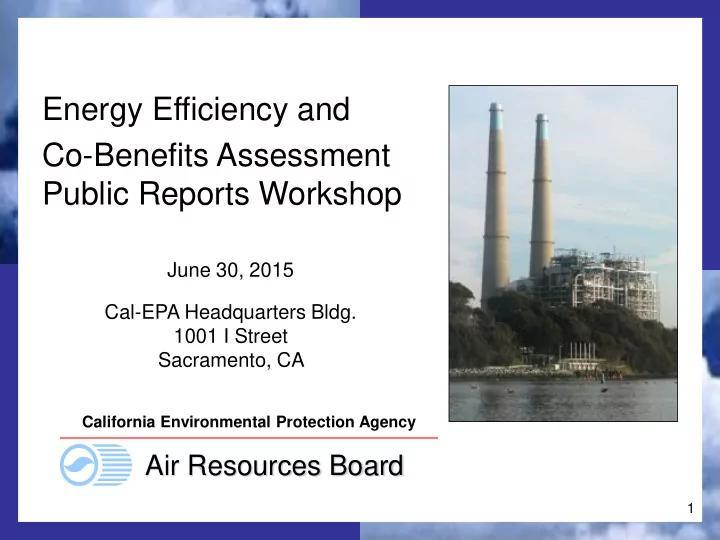
Energy Efficiency and Co-Benefits Assessment Public Reports Workshop June 30, 2015 Cal-EPA Headquarters Bldg. 1001 I Street Sacramento, CA California Environmental Protection Agency Air Resources Board 1 Overview Background Public

slide-1
SLIDE 1

1

Energy Efficiency and Co-Benefits Assessment Public Reports Workshop

June 30, 2015 Cal-EPA Headquarters Bldg. 1001 I Street Sacramento, CA

California Environmental Protection Agency

Air Resources Board

slide-2
SLIDE 2

2

Overview

  • Background
  • Public Report

Data

  • Third-Party

Review

  • Summary and

Next Steps

slide-3
SLIDE 3

3

Background

slide-4
SLIDE 4

4

Energy Efficiency and Co-Benefits Assessment (EEA) Regulation

Background

♦ Applicability:

♦ Large industrial sources with GHG emissions in 2009:

♦ ≥ 0.5 MMTCO2e ♦ Transportation fuel refineries and cement plants with ≥ 0.25 MMTCO2e ♦ Requirements:

♦ Identify energy efficiency improvement

  • pportunities/projects

♦ Estimate associated GHG, criteria pollutant, and toxic air contaminant reduction benefits, costs, and cost benefits

slide-5
SLIDE 5

5

EEA Assessment Reports Submitted for 43 Facilities

Based on 2009 GHG reporting data; GHG emissions for individual facilities may be accessed at: http://www.arb.ca.gov/cc/reporting/ghg-rep/reported-data/ghg-reports.htm

Background

Emissions ≥ 0.5 MMTCO2e

* Also includes transportation fuel refineries and cement plants ≥ 0.25 MMTCO2e

Sector Number of Facilities Total 2009 Carbon Dioxide Equivalent Emissions (MMTCO2e) Number of Projects Identified GHG Emission Reductions Identified (MMTCO2e) Petroleum Refineries* 12 31.4 401 2.78 Electricity Generation 14 12.3 118 1.91 Oil & Gas/Mineral Production 6 6.5 129 1.59 Cement Plants* 8 5.7 79 0.68 Hydrogen Plants 3 1.8 23 CBI Totals 43 57.7 750 6.96

slide-6
SLIDE 6

Public Report Prepared for Each Sector

♦ Summarize data provided in facility EEA Reports

– Emissions – Energy use – Identified projects

♦ Public report format:

– Introduction and Summary – Part I – Sector Summary – Part II – Facility Specific Data

♦ All data aggregated consistent with public

disclosure requirements under CCR section 95610

6

Background

slide-7
SLIDE 7

7

Public Report Data

slide-8
SLIDE 8

8

Sector 2009 GHG Emissions

Public Report Data

Total emissions: 57.7 MMT CO2e/yr

slide-9
SLIDE 9

9

Sector 2009 NOx and PM10 Emissions

Public Report Data

Total NOx emissions = 69 tons/day Total PM10 emissions = 16.3 tons/day

slide-10
SLIDE 10

Sector 2009 Energy Consumption

10

Public Report Data Total energy consumption = 770,930,000 MMBtu

slide-11
SLIDE 11

Refinery Process Gas and Natural Gas Account for Over 70% of 2009 Energy Use

11

Process Gas ~40% NG ~30% NG/Coal/Other ~14%

Public Report Data

slide-12
SLIDE 12

750 Energy Efficiency Projects Identified

12

Public Report Data

slide-13
SLIDE 13

Most GHG Emissions Reductions Identified as Completed/Ongoing or Scheduled

13

Public Report Data

Total GHG reductions = 6.969 MMT CO2e annually

/year

slide-14
SLIDE 14

Nearly All PM10 Emissions Reduction Co-Benefits Identified as Completed/On-going

14

Public Report Data

Total PM10 reductions = 1.08 tons/day

slide-15
SLIDE 15

NOx Emission Reduction Co-Benefits Primarily Identified as Completed/On-going

15

Public Report Data

Total NOx reductions = 11.3 tons/day

slide-16
SLIDE 16

16

Public Report Data

Equipment Category Description of Types of Projects Boilers Projects associated with boilers and auxiliary equipment used for cogeneration, steam, and combined cycle plants Electrical Only Equipment Projects dealing with electric motors powering air compressors, HVAC equipment, refrigeration equipment, pumps, fans, and

  • ther types of electric equipment

Other Equipment Projects that did not fall into another category including auxiliary equipment, plant control systems, and facility-wide projects and flare systems Combustion Gas Turbine/ Stationary Projects involving stationary gas turbines and other stationary engines Steam Only System Projects dealing with steam motors powering air compressors, fans, or pumps, steam turbines, and steam traps Thermal Equipment Projects dealing with furnaces and heat exchangers Power Generation Projects dealing with repowering generation units, and power generation unit related issues.

slide-17
SLIDE 17

17

Public Report Data

Boilers, Thermal, Other Equipment, and Power Generation Account for 90 Percent

  • f GHG Emissions Reductions

90% of reductions

slide-18
SLIDE 18

18

Public Report Data

Boilers, Thermal, Electrical, and Other Equipment Account for Over 90 Percent PM10 Emissions Reduction Co-Benefits

94% of reductions

slide-19
SLIDE 19

19

Public Report Data

Thermal Equipment Accounts for More than 50 Percent of NOx Reduction Co-Benefits

53% of reductions 43% of reductions

slide-20
SLIDE 20

Projects Categorized by Energy Efficiency Improvement Method

♦ Equipment modification ♦ Equipment upgrade ♦ New technologies ♦ Process change ♦ Improve controls ♦ Maintenance practices ♦ Management systems ♦ Research investment ♦ Same, but more efficient technologies ♦ Other

20

Public Report Data

slide-21
SLIDE 21

Optimizing Operations and New and Emerging Technologies Account for Majority of Annual GHG Emission Reductions

21

Public Report Data

65% of reductions

slide-22
SLIDE 22

Optimizing Operations and New and Emerging Technologies Account for Over 70 Percent of PM10 Emission Reduction Co-Benefits

22

Public Report Data

73% of reductions

slide-23
SLIDE 23

Optimizing Operations and New and Emerging Technologies Account for Over 85 Percent of NOx Emissions Reduction Co-Benefits

23

Public Report Data

86% of reductions

slide-24
SLIDE 24

24

Most Effective Methods

  • Improve controls/maintenance practice/

management systems:

  • ~30% of GHG emission reductions
  • ~50% of PM10 emission reductions
  • >50% of NOx emission reductions
  • New technologies/research investment/other
  • ~35% of GHG emission reductions
  • ~25% of PM10 emission reductions
  • ~30% of NOx emission reductions

Public Report Data

slide-25
SLIDE 25

25

Third-Party Review

slide-26
SLIDE 26

Third-party Reviewer: Industrial Assessment Center of SFSU

♦ Reviewed 9 of 43 facility reports ♦ Obtained additional background

data to facilitate review

♦ Conducted site visits ♦ Submitted third-party review

reports to ARB

– contain data not aggregated consistent with public disclosure requirements under CCR section 95610

26

Third-Party Review

slide-27
SLIDE 27

Third-Party Review

♦ Refinery Sector

– Three reports reviewed:

  • Valero Benicia
  • Tesoro Los Angeles
  • Chevron Richmond

– Reviewed 41 of 133 total projects

♦ Electricity generation sector

– Two reports reviewed:

  • Los Angeles Department of Water and Power (LADWP)

Scattergood

  • Midway Sunset Cogeneration Company (MSCC)

– 22 projects reviewed

27

Third-Party Review

slide-28
SLIDE 28

Third-Party Review

♦ Oil & gas production/minerals sector

– Two reports reviewed:

  • Aera Energy LLC Belridge
  • Aera Energy LLC Moco

– Reviewed 31 projects

♦ Cement plant sector

– One report reviewed:

  • CalPortland Mojave

– Reviewed 17 projects

28

Third-Party Review

slide-29
SLIDE 29

Third-Party Review

♦ Hydrogen plant sector

– One report reviewed:

  • Air Liquide El Segundo

– Reviewed 6 projects

29

Third-Party Review

slide-30
SLIDE 30

Third-Party Review Findings

♦ General conclusions:

– Projects are reasonable and understandable – Assumptions and calculation methods are appropriate

♦ If errors detected, corrections were requested and

made if agreed upon

♦ A few project analyses were noted as containing a

high degree of uncertainty

♦ Refinery reports lauded as indicating a thorough

effort

♦ More specific details to be included in ARB

Findings Report

30

Third-Party Review

slide-31
SLIDE 31

Summary and Next Steps

♦ Identified projects that produce the greatest

reductions require facilities to:

– Optimize process/equipment operations via:

  • Controls
  • Maintenance practices
  • Management systems

– Evaluate new and emerging technologies

♦ Next steps - develop ARB Findings Report

– Comprehensive review of reported data – Include specific third-party review conclusions

31

slide-32
SLIDE 32

32

Contacts

♦ Kirk Rosenkranz (Staff Lead) e-mail: kirk.rosenkranz@arb.ca.gov phone: (916) 327-7843 ♦ Maria Vacaru (Staff) e-mail: maria.vacaru@arb.ca.gov phone: (916) 322-7433 ♦ Cherie Rainforth, Manager

Control Strategies Section

e-mail: cherie.rainforth@arb.ca.gov phone: (916) 327-7213

Web Site: www.arb.ca.gov/energyaudits