end-of-life in ports BoatDIGEST Final Conference Brussels, 23 - - PowerPoint PPT Presentation

end of life
SMART_READER_LITE
LIVE PREVIEW

end-of-life in ports BoatDIGEST Final Conference Brussels, 23 - - PowerPoint PPT Presentation

Boats end-of-life in ports BoatDIGEST Final Conference Brussels, 23 September 2015 With the support of the Life Long Learning Programme of the European Union. This project has been funded with support from the European Commission. This


slide-1
SLIDE 1

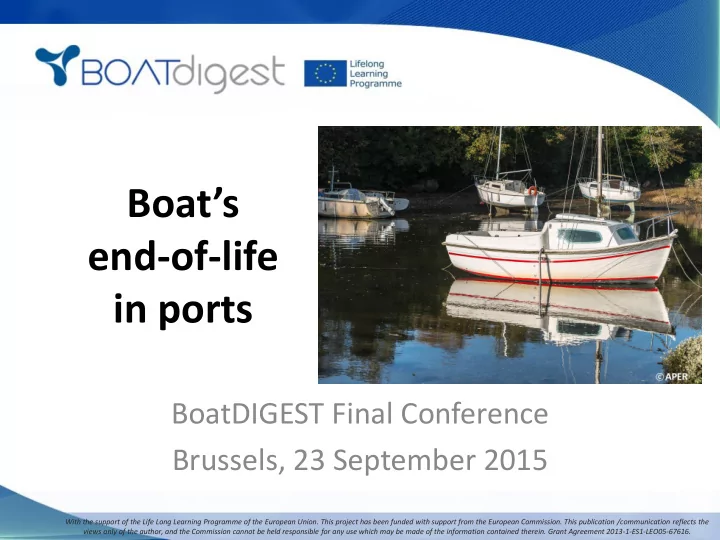
Boat’s end-of-life in ports

BoatDIGEST Final Conference Brussels, 23 September 2015

With the support of the Life Long Learning Programme of the European Union. This project has been funded with support from the European Commission. This publication /communication reflects the views only of the author, and the Commission cannot be held responsible for any use which may be made of the information contained therein. Grant Agreement 2013-1-ES1-LEO05-67616.

slide-2
SLIDE 2

Who we are

Mirna CIENIEWICZ Secretary General European Boating Industry Pierre BARBLEU President APER – Association pour la plaisance éco-responsable

slide-3
SLIDE 3

Some figures to start

  • Current fleet in Europe about 6-7 million units
  • Vast majority below 8m in length
  • 95% built in FRP – fibre reinforced polymer
  • Average lifetime: 35 years
  • Safe disposal needed for boats from 1970s

and onwards

slide-4
SLIDE 4

Problems posed by end-of-life

  • Visual pollution of abandoned boats whether

in nature, backyards or ports

  • Environmental risks linked to leakage (fuels,
  • ils, batteries)
  • Serious risk of fire / combustion with FRP
slide-5
SLIDE 5
slide-6
SLIDE 6

Boat’s end-of-life

  • Not a new issue…
  • But it needs to be properly addressed

throughout Europe

  • Most common reasons are:

– Lack of boat’s resale value – No more interest or capacity to go boating – Financial difficulties

slide-7
SLIDE 7

Who’s concerned

The whole boating community and more!

– Boat owners: individuals, clubs – Boat users: charter companies – Boat manufacturers & retailers – Marinas, ports and mooring areas – Waste management companies – Local communities and more…

slide-8
SLIDE 8

Why a boat has to be disposed

Most common reasons are:

– Age limit is reached – Damages can no longer be repaired safely – Boat has lost its resale value – No more interest or capacity to go boating – Financial difficulties

slide-9
SLIDE 9

Type of issues faced

  • When the owner is known:

– Lack of disposal solutions in many countries – Financing of disposal

  • When the owner is unknown:

– Legal aspects in addition to the above mentioned

slide-10
SLIDE 10

Current situation in Europe

  • Finland and France offer a complete solution

to boat owners (private and professional)

  • Sweden announced the creation of a scheme
  • In Italy, Spain and UK some dismantling

companies accept to dispose of boats, among

  • ther activities
  • Pilot projects in Norway
slide-11
SLIDE 11

Network of dismantling recreational craft in France

slide-12
SLIDE 12

Introduction

APER is a non profit organization, created in 2009 by the French Nautical Industries Federation. The objectives are to:

  • Build a responsible image of the boating industry,
  • Meet current and future environmental conditions
  • Control of financial balances and dismantling costs,
  • Initiate a process free of any legislative external constraint,
  • Propose an ecological and economical solution for the RC dismantling
slide-13
SLIDE 13

Inventory

3% 9% 46% 20% 10% 4% 8% avant 1950 1951 - 1970 1971 - 1990 1991 - 2000 2000 - 2005 après 2005 NSP

80 % boats built before 2000 58 % boats built before 1990

  • 991 573 registered boats (95 % below 24m in length) – 31 August 2011

with 16 319 new registrations

  • 546 000 registered recreational boats are active
  • 386 000 (- 6m) et 160 000 (+ 6m)
  • Average age of boats in 2008: 23 years
  • 13 000 boats arrive at the end of life every year (AFIT-2003)
  • 10 000 (- 6m) et 3 000 (+ 6m)
slide-14
SLIDE 14

Network operating

The network operates with:

  • 1. Agreement of companies with strong specifications
  • 2. Feedback of the activities
  • 3. Dismantling commitments (recycle waste, respond to quotation

requests within specified deadlines, achieve the dismantling operations within specified deadlines, sign a contract with APER, provide a copy of the certificate of dismantling, accept the competition between companies) The general principles are:

  • 1. Optimize dismantling costs
  • 2. Reduce the carbon footprint of operations
  • 3. Create competition between companies
slide-15
SLIDE 15

Network operating

1 Boat

  • wner

2 Website Boat Show Press 3 APER Identification

  • f

dismantling needs 4 Dismantling quotes requested by APER on behalf of

  • wner

5 Quotes are given to the

  • wner

6 Selection of dismantler by

  • wner
slide-16
SLIDE 16

Dismantling network

Blaringhem Chateaubriand Maco n Grois y Mérignac Fréjus Dieppe Gibervill e Le Havre Trignac Montpelli er Villenave d’Ornon Arzal La Rochelle La Crau Toulon Rennes Gigna c Bres t Condette Ploufragan Plouignea u

Véolia (8 sites) Independent operators (6 sites) Derichebourg (3 sites) Praxy (8 sites) Guyot Environnement (12 sites) Recycleurs Bretons (6 sites) Romi Recyclage (8 sites)

19 compagnies & 52 sites of dismantling provide economical and environmental sustainable solutions around the French coastline (25 departments of metropolitan coast).

slide-17
SLIDE 17

Dismantling regulation

The network of dismantlers consists exclusively of waste management professionals. All the sites must be: Installations Classified for the Protection of the Environment (ICPE), 2712-2, with an official authorization for the activities:

  • Storage,
  • Remediation,
  • Removal or
  • Clipping.

Dismantlers approved by APER provide to the customers guarantees on the quality and reliability of dismantling:

  • Working with a professional dismantler,
  • Benefit from his knowledge and expertise,
  • Respect of administrative rules: Installations Classified for the Protection of the Environment

(ICPE)

  • Ensure recycling of waste,
  • Propose a proximity action of dismantling
slide-18
SLIDE 18

Maritime regulation

Definition in the Code of Transport of the following concepts:

  • Wreck
  • Abandoned boat

These texts provide the procedure for loss of property. Problems:

  • Long and costly procedure
  • Financing of dismantling at the expense of the community

References: Part 5 - Transport and maritime navigation Titre IV – Abandoned boat & Wreck

  • Chapter 1 – Abandoned boat

 Section 1 à 3: Art. L. 5141-1 à 5141-7

  • Chapter 2 - Wreck

 Art. L. 5142-1

slide-19
SLIDE 19

Financing

Dismantling is fully paid by the last owner of the boat. APER recommends funding dismantling throughout boat life by all the owners.

Dismantling quote settled on the following basis:

  • 1. Transportation

30 %

  • 2. Dismantling & Remediation

50 %

  • 3. Handling of waste

20 %

This distribution is valid for boats from 5 to 12m.

slide-20
SLIDE 20

Figure of dismantling

About 4,000 boats were treated by APER & the companies since 2009. In 2013, + 300 boats have been dismantled by the network.

58% 21% 5% 5% 11% voilier bateau à moteur bateau de pêche dériveur autre 74% 21% 5% polyester bois acier

Kind of materials Kind of boat

Average size of boats: 7,66m Size between 4,75m and 10,53m Average price: 1207 € TTC Price between 500 € and 2920 € Average age: 30 years Age between 6 and 41 years.

slide-21
SLIDE 21

Fiberglass valorisation

There are two valorisation methods:

  • Energy valorisation: development of alternative fuel
  • Material valorisation: use of the material

The advantages of energy valorisation in cement:

  • A solution of short-term valorisation
  • 100% of waste used (0% landfill, 0% incineration)
  • No residual waste, no ash
  • Calorific power interesting
  • Economy of fuel and contribution to environmental protection
  • Flexibility (no minimum volume)
slide-22
SLIDE 22

Fiberglass valorisation

The advantages of material valorisation:

  • Production of a new raw material
  • Virtually unlimited range of products grows with outlet for construction and infrastructure
  • Offers far superior alternative to a variety of materials currently used, such as iron, steel,

concrete, plastic (recycled), wood The development of this material needs to develop relationship with other industries producing composite to ensure the viability of this valorisation process through volumes of material (manufacturing waste and end-of-life) sufficiently consistent.

slide-23
SLIDE 23

Network dynamic

France is the first European country to adopt a genuine organized recycling and dismantling network for boats. The success of this network is: concertation, organisation & federation. To ensure recognition and credibility of the network, APER coordinate closely with all stakeholders (dismantlers, institutional partners and authorities) in action in France. Dismantling of boats is now a reality in France:

  • www.recyclermonbateau.fr website: support and advise to owners in order

to find an environmental and economical solution.

  • A network with 2O compagnie & 52 dismantling sites all over France
slide-24
SLIDE 24

For more info

European Boating Industry

  • ffice@europeanboatingindustry.eu

www.europeanboatingindustry.eu

APER – Association pour la plaisance éco-

responsable (France) contact@aper.asso.fr www.recyclermonbateau.fr