SLIDE 1
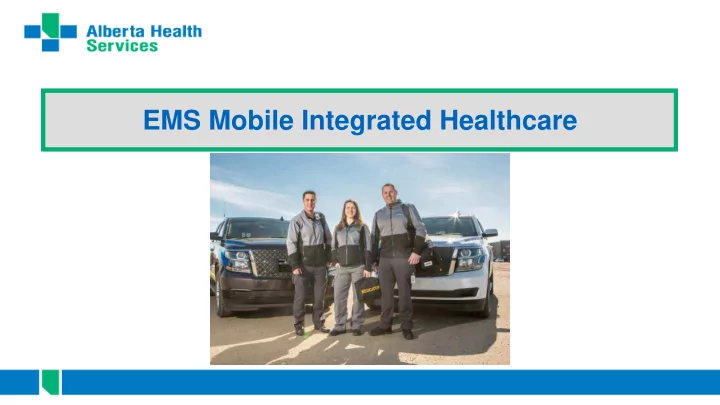
EMS Mobile Integrated Healthcare
SLIDE 2
2
Mobile Integrated Healthcare
Purpose To serve as a single point of contact for care providers needing to refer vulnerable patients for short-term medical support. Goal Improve healthcare system capacity by reducing reliance on EMS, the emergency department and hospitals for urgent low-acuity illnesses. Model Provide medical assessments, diagnostics and treatments using mobile Community Paramedic resources, in coordination with existing healthcare services through the MIH Assess Treat and Refer program.
SLIDE 3
3
EMS and Paramedic Opportunity
Moving patient care outside of the hospital Using the success and proven ability of EMS to provide mobile medical treatment Re-frame the Paramedic scope of practice Community Paramedics are provided with additional training and clinical rotations
Anywhere, Anytime, Access to non-emergent hospital level medical care
SLIDE 4 4
Accessing MIH Services
Access Point 1 – Community healthcare staff directly request Community Paramedic services via phone Access Point 2 – Physician or clinics request services via referral form Access Point 3 – EMS or Community referral via phone
1 2 3
Assess Treat and Refer Coordination Centre
300 Partners Across the Province
SLIDE 5 5
Medical Direction
- 1. Most Responsible Healthcare Provider – Family
Physician, Specialist, On-Call Facility Physician
- 2. MIH On-Line Medical Control (OLMC) Physician
First Pathway Most Responsible Healthcare Provider MIH OLMC Second Pathway
SLIDE 6 6
Clinical Services / Interventions
- CVC & IV rehydration
- IV, SQ, IM, PO, PORT & PICC
medication administration including IV antibiotics
- Specimen collection (blood,
urine, wound, NP)
- Blood transfusions
- Medication dispensing
- Point of Care Testing (iStat)
- Extensive medication formulary
available (60 + stocked)
- Urinary catheterization
- Wound closure & care (tissue
adhesive, sutures, dressings, staples)
- Prescription facilitation
- Facilitated DI transports
- Healthcare System Navigation and
Assessment
SLIDE 7
7
MIH Coordination Center
First point of contact for care providers Provide EMS and Community Health staff with real- time solutions for non-emergent patients Opportunity to connect patients with community health services when they choose not to be transported Coordination centers – Edmonton (North Sector) and Calgary (South Sector) Provincial Coverage Staffed by Community Paramedics called Patient Coordinators Interface with existing dispatch services
SLIDE 8 8
Crisis Response and EMS (CREMS)
- Partnership with AHS AMH and AHS EMS
- Provides Medical and Mental Health
Assessment to Patients Experiencing Crisis in Community
- Referrals from Access 24/7, EMS, EPS,
PACT, RPACT
- Provides Heavy User intervention via EMS
CHAPS Referrals
- Responds outside City of Edmonton
- Available 1200-000 Seven Days a Week
SLIDE 9 9
City Center Team (CCT)
- Supports at Risk and Vulnerable Persons
- Two Paramedics in Mobile Treatment Van
- Provides Outreach, System Navigation and
Urgent Medical Care
- Facilitate Community DI
- Works with Outreach Agencies and Teams
- Works Monday – Friday 0730-1600
SLIDE 10 10
Community Health and Prehospital Support (CHAPS)
- Managed by MIH Coordination Center
- Receive Report from EMS Paramedics for Patients Who Require
Additional Support or Heavy System Users
- Telephone Assessment by Community Paramedic to Patient then
Referral to Community Health Agency
- Works to Manage Heavy System Users and Ensure Patients Remain
Safely in Community
SLIDE 11 11
Health Outcomes for Edmonton Zone MIH
Zone 7 Day Admission Rate Edmonton 5% Provincial 7.6% Patient Events 4581 Hospital Avoidance 3435
Avoidance rates are based on the following measures:
- Administration of specific medications and blood analysis
- Urinary catheterization
- EMS to CRT referrals
- CTAS score 1, 2 and 3
- Acute wound treatment
SLIDE 12
12
Thank You
Contact Information: steven.amrhein@ahs.ca
www.ahs.ca/communityEMS