SLIDE 1
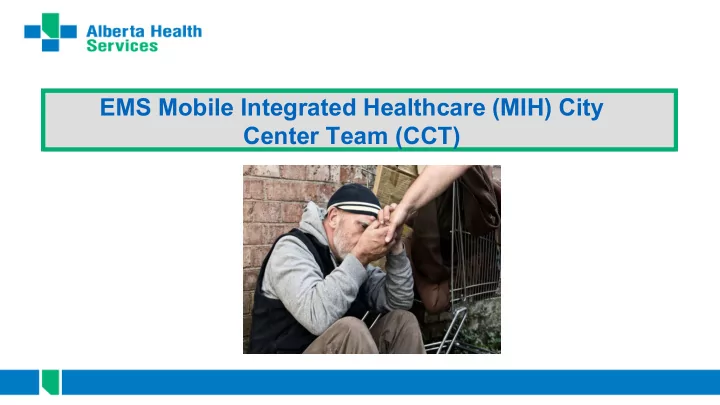
EMS Mobile Integrated Healthcare (MIH) City Center Team (CCT)
SLIDE 2
2
Mobile Integrated Healthcare (MIH) Model
Navigate vulnerable (complex, fragile, high needs) patients away from an overreliance on acute care resources by reducing their barriers to primary and specialty care Leverage the proven ability of EMS to provide mobile medical treatment Increase health equity, improve health outcomes
Access – Anywhere! Anytime! – to urgent hospital level medical care
SLIDE 3 3
Mobile Integrated Healthcare Teams
Single or Paired Community Paramedic and/or Nurse Practitioner Units
- Community Response Teams (urgent low acuity illness)
- Crisis Response Unit (mental health)
- City Centre Teams (mental health and addiction)
Supported with direct physician or NP consultation Paramedics are provided with community health education and clinical rotations – 8 weeks
- New Community Paramedic program with Mount Royal
University Urgent Health Center on Wheels
SLIDE 4 4
Homelessness and Healthcare
Homelessness is a complex, chronic medical condition -
- Higher incidence of illness.
- Addiction
- Mental health disorders
- Premature Deaths
- Lower likelihood of accessing primary care
– Traps individuals in homelessness
SLIDE 5 5
Homelessness and Healthcare
Deliver Health Equity
- Institutional and organizational barriers
Traditional resources may lack flexibility, availability, and responsiveness.
- Social determinants of health
Traditional resources may lack understanding and compassion.
- Inappropriate reliance on acute and
urgent care.
Episodic, often ineffective, further stigmatizes, traumatizes and disconnects from resources
Calgary Recovery Services Task Force
To improve health equity for people living with homelessness they require:
- Mobile outreach
- Multidisciplinary collaboration
- Increased continuity of care
- 1. Right care
- 2. Right time
- 3. Right place
- 4. Right provider
- 5. Right patient
SLIDE 6 6
Homelessness in Calgary
- Screen Shot 2019-10-28 at 12.00.22 PM
SLIDE 7 7
Trapped in Homelessness, Disconnected from Care
“Jay”
Encountered with severe frostbite in shelter.
- 28 year old man
- Untreated
schizophrenia
- Substance use disorder
- Malnutrition
- Poor dentition
- Chronic homelessness
SLIDE 8 8
The Mobile Urgent Care
CCT provides interventions typically only available in hospital or clinic setting:
- Comprehensive medical assessment
- Physician or Nurse Practitioner directed care
- IV medication and fluid administration
- Prescription facilitation and oral medication administration
- Withdrawal management
- Initiation of Opiate Agonist Treatment (OAT) and connection to
Addiction Medicine
- Urgent mental health crisis management and connection to Mental
Health resources
- Specimen collection, including Point of Care Testing
- Wound closure and care
- Palliative care support
- Facilitation of urgent diagnostic imagining
- Follow-up care and connection to family and specialty medicine.
SLIDE 9
9
The Collaboration – Physicians and Nurses
Health equity can only be achieved collaboratively NO! to hot potato medicine Interdisciplinary/Diversity Must “take care” of each other Communication & availability Ongoing learning together CPs optimize health resources CPs = avatars (or a Swiss Army knife)
SLIDE 10
10
Healthcare and Housing
While addressing health needs CCT is able to connect clients with housing advocates and other social and financial supports. Healthier can mean more easily housed. Removing distress helps improve likeliness to:
Meet application deadlines File taxes Attend appointments Get housed!
SLIDE 11
11
Community of Practice
SLIDE 12
12
A Home or a House of Cards?
Keep healthy to help keep housed and be there as a team to stabilize and support a return to housing.
SLIDE 13 13
The City Center Team – Evaluation
Patient and care provider surveys
- Non-stigmatizing, compassionate care that
increased ability & willingness to be connected with further support
- Reduced barriers to appropriate care.
- “CCT went above and beyond caring for me.” -
person living with homelessness Data
- 2700 patient events/year.
- Average 225 patient events/month.
- 145 patient events involving suboxone for 47
discreet patients.
SLIDE 14
14
Opioid Replacement Therapy
Immediate access to Opiate Substitution Treatment In Oct 2017 CCT in Calgary started connecting OUD patients with suboxone in community. Partnership with AHS Virtual Opioid Dependency Program Connection to other programs i.e. Methadone
SLIDE 15 15
CCT’s Collaboration with Calgary SCS
Sheldon M. Chumir – SCS
- May 28, 2018 – August 29, 2019
- 204 patient care events
- 57 discrete patients
Infection 71 Substance Use Disorder 44 MSK 24 RESP 20 WOUND 12 Not documented 10 GI/GU 9 Palliative, Neuro, Other 7
Primary Clinical Impression
SLIDE 16 16
Medical Direction
- 1. Most Responsible Provider – Family Physician, Specialist,
On-Call Facility Physician, Nurse Practitioner
- 2. Dedicated MIH On-Line Medical Control (OLMC) Physician
First Pathway Most Responsible Physician MIH OLMC Second Pathway
SLIDE 17 17
Accessing MIH Services
Access Point 1 – Community healthcare staff directly request Community Paramedic services via phone Access Point 2 – Physician or clinics request services via referral form Access Point 3 – EMS crew referral via phone
1 2 3
Assess Treat and Refer Coordination Centre
SLIDE 18
18
Assess Treat and Refer (ATR) Program
Provide EMS and Community Health staff with real-time solutions for non-emergent patients Opportunity to connect patients with community health services when they choose not to be transported Coordination centers – Edmonton (North Sector) and Calgary (South Sector) Provincial Coverage Interface with existing dispatch services
SLIDE 19 19
Provincial Mobile Integrated Healthcare Coverage
Calgary Zone 8 units
Edmonton Zone 7 units
- City Center Team (CCT)
- Crisis Response EMS (CREMS)
Central Zone (Red Deer & Camrose) 5 units North Zone (Grande Prairie Peace River) - 4 units South Zone (Medicine Hat and Lethbridge) 6 units
Includes smaller communities within a 50km geographical distance
SLIDE 20 20
Crisis Response EMS (CREMS) Team
In collaboration with AHS Addictions and Mental Health, the CREMS team includes a Paramedic and a Mental Health Therapist. This team provides timely mental health and crisis intervention, providing referrals and access to extended health services, thereby keeping patients in the community.
- Edmonton – Connected to 911 EMS calls and the Distress Line
– Targets high frequency EMS users
- Can provide additional case management and immediate connection
with existing Mental Health and Addiction
- Higher utilization from individuals with a fixed address than CCT
SLIDE 21 21
Community Response Team (CRT) Hybrid
Community Response Teams provide medical assessments, diagnostics and treatments for health concerns that are not currently being managed because of the difficulties association with homelessness, mental health issues and
- addiction. Expansion of services beyond
continuing care, family physicians and acute care referrals.
- Central Zone (Red Deer)
- South Zone (Lethbridge & Medicine Hat)
- Non-dedicated resource limits volume, follow up,
settings
SLIDE 22 22
The Future? Combined CCT & CREMS Unit
Provides mobile urgent clinical care in any community setting with enhanced ability to address mental health crises and provide better connection to mental health resources and urgent case management.
- Staffed by one Community Paramedic and one Mental Health
Therapist/Clinician
- Opportunity in MIH locations without dedicated CCT units currently
- Coverage would be 12 hours/day, 7 days/week.
SLIDE 23
23
Thank You