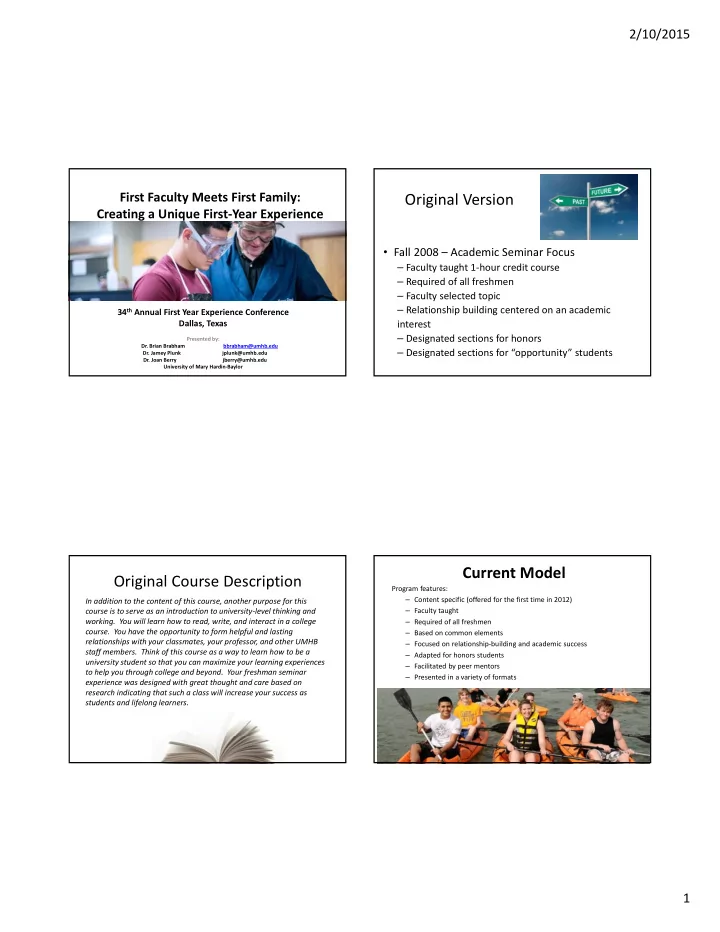
Original Version Creating a Unique First Year Experience Fall 2008 - - PDF document

original version
SMART_READER_LITE
LIVE PREVIEW

Original Version Creating a Unique First Year Experience Fall 2008 - - PDF document

2/10/2015 First Faculty Meets First Family: Original Version Creating a Unique First Year Experience Fall 2008 Academic Seminar Focus Faculty taught 1 hour credit course Required of all freshmen Faculty selected topic 34


slide-1
SLIDE 1

2/10/2015 1 First Faculty Meets First Family: Creating a Unique First‐Year Experience

34th Annual First Year Experience Conference Dallas, Texas

Presented by:

  • Dr. Brian Brabham

bbrabham@umhb.edu

  • Dr. Jamey Plunk

jplunk@umhb.edu

  • Dr. Joan Berry

jberry@umhb.edu University of Mary Hardin‐Baylor

Original Version

  • Fall 2008 – Academic Seminar Focus

– Faculty taught 1‐hour credit course – Required of all freshmen – Faculty selected topic – Relationship building centered on an academic interest – Designated sections for honors – Designated sections for “opportunity” students

Original Course Description

In addition to the content of this course, another purpose for this course is to serve as an introduction to university‐level thinking and

  • working. You will learn how to read, write, and interact in a college
  • course. You have the opportunity to form helpful and lasting

relationships with your classmates, your professor, and other UMHB staff members. Think of this course as a way to learn how to be a university student so that you can maximize your learning experiences to help you through college and beyond. Your freshman seminar experience was designed with great thought and care based on research indicating that such a class will increase your success as students and lifelong learners.

Current Model

Program features: – Content specific (offered for the first time in 2012) – Faculty taught – Required of all freshmen – Based on common elements – Focused on relationship‐building and academic success – Adapted for honors students – Facilitated by peer mentors – Presented in a variety of formats

slide-2
SLIDE 2

2/10/2015 2

Current Course Description

How do you balance academics and life as a college student? Why is it important to be in class every day? How do you find the resources you need to be successful? Freshman seminar is intended to answer students’ questions about the UMHB mission, the campus, characteristics of successful students, the advising process,

  • pportunities for involvement, and more. The class is intended to

assist students in transitioning to UMHB and building effective relationships with other students, faculty, and staff. Discussions center on recognizing the responsibilities involved in being a member of the UMHB learning community.

Course Content

  • Designed to support and retain

freshman students.

  • Enhances academic skills.
  • Integrates skills with other disciplines.
  • Introduces students to campus life (and how to survive

the experience).

  • Builds relationships with faculty and peers.
  • Explores the university mission.
  • Encourages organization and study skills.

Freshman Ryan Brenneman was having a tough time acclimating to life away from home.

We have 34 full‐time faculty members who teach freshman seminar. Of the 34 sections, two are honors, six are “exploratory”, and 26 are content‐specific.

“Non‐Negotiables”

  • Understanding the university mission
  • Using campus resources
  • Maintaining academic integrity
  • Using the online platform
  • Utilizing time management systems
  • Taking notes and studying effectively
  • Getting involved in student activities
  • Unpacking a syllabus
  • Demonstrating academic decorum
  • Surviving advising
  • Wise use of social media

Some professors use a topic of special interest as the springboard for activities, reading assignments, discussions, and papers. Others are more

  • generic. However, some topics are considered “non-negotiable” and

therefore must be included in the course. “My computer crashed, so I text‐ messaged you my term paper.”

First Faculty Resources

  • Access through a shared web link
  • Text resources
  • Life During College (Arndt & Coleman)
  • Keys to Success (Carter, Bishop and

Kravitz)

  • Student text provided by the

university

  • The A Game ‐ Sufka
  • Collaboration luncheons
slide-3
SLIDE 3

2/10/2015 3

Advising

  • Standard schedule is two one‐hour sessions per week for eight
  • weeks. However, alternatives to this may be selected by the

faculty member.

  • The program is Fall term only, with the exception of a section for

freshmen entering at mid‐term.

Scheduling

  • Each advisor commits to advising on four of six

advising dates between April and July.

  • Content specific advisors
  • Freshmen (and parents) meet with First Faculty

members to set up the first semester schedule.

  • Subsequently, the First Faculty member becomes

the “advisor” for his own students until a major is declared.

New Twists for 2014

  • Delivery

– Traditional delivery – Hybrid delivery – “Divide and Conquer” delivery

  • Collaboration regarding a shared reading

experience

Traditional Delivery

  • Meets twice per week for 50 minutes

– 8 week duration

  • Topics designated by “non‐

negotiables”

  • Delivery varies
  • Peer mentors utilized in class for

assistance

  • Not intended to be academically

“demanding”

Sample Face‐to‐Face Activities

  • Sunday lunch before the fall semester
  • Typical first year student needs

– Study skills – Time management – Navigating the campus. – Getting involved – Financial responsibility – Mission and vision of the university – Advising and knowing the degree plan

slide-4
SLIDE 4

2/10/2015 4

Hybrid Delivery

  • Relatively new concept for UMHB
  • UMHB has a relatively large athlete population
  • Fall semester

– Volleyball – Football

  • Teams often travel/compete on Friday

– Students were missing almost half of class meetings

Hybrid Delivery (cont.)

  • Meet face‐to‐face on Monday

– Topics seen in traditional model – “Letter to me”

  • Second “class” was online

– Discussion posts – Group discussions – Online assignments or readings

  • Peer mentors had access to online

environment

Hybrid Delivery (cont.)

  • Sample online discussions

– Week 1‐ “Give a brief biographical sketch of yourself along with an interesting fact about you.” – Week 2‐“What is the one thing you wish you had known about coming to college that you were not aware of?” – Week 3‐ “What is your why—Why are you where you are at this point in your life?” – Week 4‐ “What do you see as pros and cons of social media?’

“Divide and Conquer”

  • Based on the premise that retention is

positively impacted when students “connect” with at least one adult on campus.

  • Students are divided into three or four groups
  • f six students.
  • Each peer mentor and the faculty advisor

meet with one group at a time.

slide-5
SLIDE 5

2/10/2015 5

“Divide and Conquer”

  • Pros and cons:

– Professor definitely makes a more personal connection with each

  • student. Areas positively impacted are academic decorum, notetaking

skills, sense of security/safety. Students have opportunities to see

  • ther students who are driven to succeed.

– Peer mentors are critical. If one is absent or if they are not “top of the line” students, the program suffers. Less time for covering content.

  • Example:

– Group one accompanies one peer mentor to library for scavenger hunt. – Group two accompanies the second peer mentor on the Passport activity. – Faculty advisor meets with one group to discuss academic decorum

Assessing the Program (Student Evaluations)

(Percent of student responses at the “agree” or “strongly agree” mark) The seminar provided me with strategies for being a successful student. 2011 86% 2012 85% 2013 85% 2014 90% The peer mentors encouraged me and helped me in transition to college life. 2011 81% 2012 84% 2013 86% 2014 87% During this course, I built effective relationships with students and faculty. 2011 80% 2012 72% 2013 84% 2014 87% The work I was required to do was appropriate for a one‐hour class. 2011 74% 2012 82% 2013 80% 2014 83% My instructor is interested in my success at UMHB. 2011 93% 2012 93% 2013 92% 2014 91%

Assessing the Program

Faculty Feedback: We have a waiting list of professors who want to be “First Faculty”

  • members. Feedback is consistently high on

resources provided, perception of impact on student success, and realistic expectations of time given a one‐hour course.

Assessing the Program

Retention of the freshman class: 2010 63.82% 2011 67.62% 2012 65.61% 2013 68.44%

slide-6
SLIDE 6

2/10/2015 6

Some of our favorite student comments …

  • I made wonderful friends in this class.
  • This was a “take a breath” class. We could relax or

vent.

  • Our instructor let us be “kids” a little, but still made

sure we learned what we needed to know.

  • My instructor was RAD.
  • It helped me not be so nervous about my first week
  • f classes.
  • I learned that professors can be nice people.
  • We actually got to have FUN for an hour.
  • Suggestion for improvement? Turn on the heat. I

got frostbite and hypothermia. I miss my pinky toe. (But I learned a lot about faith and politics.)

Questions?

Thank you for attending Ha ve a safe trip home