EMS course hands-on course on electrical muscle stimulation pedro - - PowerPoint PPT Presentation

ems course
SMART_READER_LITE
LIVE PREVIEW

EMS course hands-on course on electrical muscle stimulation pedro - - PowerPoint PPT Presentation

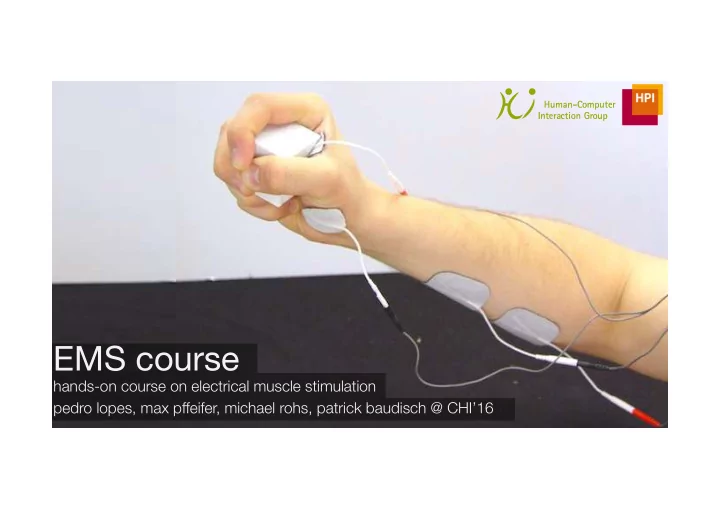
EMS course hands-on course on electrical muscle stimulation pedro lopes, max pffeifer, michael rohs, patrick baudisch @ CHI16 in this course you will be able to create interfaces that talk directly to the human body interfaces that talk


slide-1
SLIDE 1

hands-on course on electrical muscle stimulation pedro lopes, max pffeifer, michael rohs, patrick baudisch @ CHI’16

EMS course
slide-2
SLIDE 2

in this course you will be able to create interfaces that talk directly to the human body

slide-3
SLIDE 3
slide-4
SLIDE 4

interfaces that talk directly to the user’s body and are based on the proprioceptive sense

slide-5
SLIDE 5

interfaces that talk directly to the user’s body and are based on the proprioceptive sense we’ll be guiding you through the basics of how to actuate muscles using EMS (electrical muscle stimulation)

slide-6
SLIDE 6

interfaces that talk directly to the user’s body and are based on the proprioceptive sense we’ll be guiding you through the basics of how to electrically actuate muscles using EMS

slide-7
SLIDE 7

pedro lopes max pfeiffer tim dünte michael rohs patrick baudisch

slide-8
SLIDE 8

so what hardware are we using for EMS?

slide-9
SLIDE 9

you’ll get a EMS control kit similar to this … designed by Max and Tim for you!

slide-10
SLIDE 10

the board is now released as open source, as just like we did, you can fab your own

slide-11
SLIDE 11

what the board does: controls the amplitude of your haptic output, i.e., how much the user’s muscles contract

slide-12
SLIDE 12

wait… interactive systems based on electrical muscle stimulation?

PhD Thesis “Proprioceptive Interaction: interactive systems based on electrical muscle stimulation” by Pedro Lopes

slide-13
SLIDE 13

when you think of haptic interfaces capable

  • f force output… you think of this
slide-14
SLIDE 14
  • r this…
slide-15
SLIDE 15
  • r this… grounded force feedback devices
slide-16
SLIDE 16

these are great, precise and powerful

slide-17
SLIDE 17

however, they don’t miniaturize

slide-18
SLIDE 18

and today’s trend is mobility

slide-19
SLIDE 19

for large actuation and mobility researchers focused on exoskeletons but these are heavy and get in the way

slide-20
SLIDE 20

instead… we design interactive systems with strong haptic forces such as force feedback … with a substantially smaller footprint

slide-21
SLIDE 21

1 1 2 2 3 3 4 4

proprioceptive interfaces that r/w to the body

slide-22
SLIDE 22

1 1 2 2 3 3 4 4

proprioceptive interfaces that r/w to the body

slide-23
SLIDE 23

muscle propelled force feedback, CHI’13

slide-24
SLIDE 24

... device has no motors or actuators

slide-25
SLIDE 25

exoskeleton motors muscles skeleton battery carbs

slide-26
SLIDE 26

proprioceptive interfaces that r/w to the body

1 1 2 2 3 3 4 4

slide-27
SLIDE 27

proprioceptive interaction, CHI’15

slide-28
SLIDE 28

is interacting through the pose of their own body (proprius). i.e., rather than seeing, hearing, or feeling an outside stimulus, users feel the pose of their body.

proprioceptive interaction

slide-29
SLIDE 29

interactive device

slide-30
SLIDE 30
slide-31
SLIDE 31
slide-32
SLIDE 32
slide-33
SLIDE 33
slide-34
SLIDE 34
slide-35
SLIDE 35

very small I/O device…

slide-36
SLIDE 36

shared channel [human & machine]

slide-37
SLIDE 37
slide-38
SLIDE 38

different channels < human machine>

slide-39
SLIDE 39
slide-40
SLIDE 40
slide-41
SLIDE 41
slide-42
SLIDE 42

proprioceptive interfaces that r/w to the body

1 1 2 2 3 3 4 4

slide-43
SLIDE 43

we asked participants to: paint this affordance++, CHI 15

slide-44
SLIDE 44
slide-45
SLIDE 45

allowing objects to communicate dynamic use (motion, multi-step processes, behaviors that change over time) by controlling user behavior.

affordance++

slide-46
SLIDE 46

the key is that the instruction (motion) happens and is perceived, at the same time

(1) searching (2) reading (3) understanding (4) mimicking

slide-47
SLIDE 47

now the spray-can affords

  • 1. what to do: shaking motion
  • 2. the order of steps: grab, shake, spray
  • 3. hidden state: e.g., throw away when empty
slide-48
SLIDE 48
  • 1. motion
  • 2. order of steps

(multi-step processes)

  • 3. hidden state
slide-49
SLIDE 49
  • 1. motion
  • 2. order of steps

(multi-step processes)

  • 3. hidden state
slide-50
SLIDE 50

we asked participants to: prepare the avocado in thin slices

slide-51
SLIDE 51
slide-52
SLIDE 52
  • 1. motion
  • 2. order of steps

(multi-step processes)

  • 3. hidden state
slide-53
SLIDE 53

we asked participants to: drink some water

slide-54
SLIDE 54
slide-55
SLIDE 55

we asked participants to: collect all the screws

slide-56
SLIDE 56
slide-57
SLIDE 57

most users expect that pushing the handle is what grabs the nails, but that is the last step (releases)

slide-58
SLIDE 58

we asked participants to: drink some water

slide-59
SLIDE 59
slide-60
SLIDE 60

proprioceptive interfaces that r/w to the body

1 1 2 2 3 3 4 4

slide-61
SLIDE 61

but the output is not realistic, no motion

  • utput?
slide-62
SLIDE 62

impacto, UIST’15

slide-63
SLIDE 63

take away message from pedro

slide-64
SLIDE 64

is interacting through the pose of their own body (proprius). i.e., rather than seeing, hearing, or feeling an outside stimulus, users feel the pose of their body.

proprioceptive interaction

take away message

  • 1. immersive: feel the virtual world on your body
  • 2. interact eyes free & mobile
  • 3. post wearable, i.e., body = I/O interface
slide-65
SLIDE 65

we think this could be one approach to post-wearable: interfaces that fuse with the body

slide-66
SLIDE 66
  • ff to max now…
slide-67
SLIDE 67

Max Pfeiffer

Enabling Electrical Muscle Stimulation as Haptic Feedback

slide-68
SLIDE 68

Soap Babble Game:

Supporting Interaction in Public Space with Electrical Muscle Stimulation

UbiComp2013

  • M. Pfeiffer, S. Schneegass, F. Alt:
Supporting interaction in public space with electrical muscle stimulation. In proceedings Pervasive and ubiquitous computing adjunct publication, 2013.
slide-69
SLIDE 69

EMS Vibration Free

  • M. Pfeiffer, S. Schneegass, F. Alt, M. Rohs:
Let me grab this: A comparison of EMS and vibration for haptic feedback in free-hand interaction. In Proceedings of Augmented Human International Conference, 2014.

Let Me Grab This:

A Comparison of EMS and Vibration for Haptic Feedback in Free-Hand Interaction

slide-70
SLIDE 70

A Design Space for EMS Feedback for Free-Hand Interaction

  • M. Pfeiffer, S. Schneegass, F. Alt, M. Rohs:
A Design Space for Electrical Muscle Stimulation Feedback for Free-Hand Interaction. In Workshop on Assistive Augmentation – CHI, 2014.
slide-71
SLIDE 71

3D Virtual Hand Pointing with EMS and Vibration Feedback

  • M. Pfeiffer, W. Stuerzlinger:
3D Virtual Hand Pointing with EMS and Vibration Feedback. In proceedings of the 3DUI, 2015.
slide-72
SLIDE 72

Use Attached Haptic Feedback

  • n Touch Displays
  • M. Pfeiffer, L.D.L. Phan, M. Rohs:
User - Attached Haptic Feedback on Touch Displays via EMS. IEEE World Haptics - WIP, 2015.
slide-73
SLIDE 73

Cruise Control for Pedestrians:

Controlling Walking Direction using Electrical Muscle Stimulation

Honorable Mention Award

CHI 2015

ACM Conference on Human Factors in Computing Systems April 18 – 23, 2015 Seoul, Korea Presented to Max Pfeiffer University of Hannover, Germany For Cruise Control for Pedestrians: Controlling Walking Direction using Electrical Muscle Stimulation Max Pfeiffer, Tim Dünte, Stefan Schneegass, Florian Alt, Michael Rohs SIGCHI President Gerrit van der Veer Best of CHI Awards Chair Mark Billinghurst
  • M. Pfeiffer, T. Dünte, S. Schneegass, F. Alt, M. Rohs:
Cruise Control for Pedestrians: Controlling Walking Direction using Electrical Muscle Stimulation. In Proceedings of CHI, 2015.
slide-74
SLIDE 74

In Out Signal generator

Devices Control Actuation

Protocol

Let Your Body Move - Toolkit

  • P. Lopes, M. Pfeiffer, M. Rohs, P.Baudisch:
Let your body move – a tutorial on electrical muscle stimuli as haptics. IEEE World Haptics. 2015
  • M. Pfeiffer, T. Duente, M. Rohs:
A Wearable Force Feedback Toolkit with Electrical Muscle Stimulation Submitted to: CHI, 2016 Interactivity.
slide-75
SLIDE 75

let’s get started

  • with EMS
slide-76
SLIDE 76

now, you will: now, you will:

  • 1. get EMS + phone + board
  • 1. get EMS + phone + board
  • 2. open the WorldHaptics2015-v01 app
  • 2. open the WorldHaptics2015-v01 app

(desktop) (desktop)

  • 3. power the control board with 9v battery
  • 3. power the control board with 9v battery

(note don’t power the EMS yet, no electrodes) (note don’t power the EMS yet, no electrodes)

  • 4. connect the app to the board (board is
  • 4. connect the app to the board (board is

running already) running already)

  • 5. tap left/right to open channels
  • 5. tap left/right to open channels
  • 6. great, control board works!
  • 6. great, control board works!
  • 7. now let’s learn about EMS
  • 7. now let’s learn about EMS
slide-77
SLIDE 77

now, you will: now, you will:

  • 1. get EMS + phone + board
  • 1. get EMS + phone + board
  • 3. power the control board with 9v battery
  • 3. power the control board with 9v battery

(note don’t power the EMS yet, no electrodes) (note don’t power the EMS yet, no electrodes)

  • 4. connect the app to the board (board is
  • 4. connect the app to the board (board is

running already) running already)

  • 5. tap left/right to open channels
  • 5. tap left/right to open channels
  • 6. great, control board works!
  • 6. great, control board works!
  • 7. now let’s learn about EMS
  • 7. now let’s learn about EMS
  • 2. open the W
  • 2. open the WorldHaptics2015-v01 app
  • rldHaptics2015-v01 app

(desktop) (desktop)

slide-78
SLIDE 78

now, you will: now, you will:

  • 1. get EMS + phone + board
  • 1. get EMS + phone + board
  • 2. open the WorldHaptics2015-v01 app
  • 2. open the WorldHaptics2015-v01 app

(desktop) (desktop)

  • 3. power the control board with 9v battery + wait
  • 3. power the control board with 9v battery + wait

10s (don’t power the EMS yet, no electrodes) 10s (don’t power the EMS yet, no electrodes)

  • 4. connect the app to the board (board is
  • 4. connect the app to the board (board is

running already) running already)

  • 5. tap left/right to open channels
  • 5. tap left/right to open channels
  • 6. great, control board works!
  • 6. great, control board works!
  • 7. now let’s learn about EMS
  • 7. now let’s learn about EMS
slide-79
SLIDE 79

now, you will:

  • 1. get EMS + phone + board + electrodes
  • 2. open the WorldHaptics2015-v01 app

(desktop)

  • 3. power the control board with 9v battery

(note don’t power the EMS yet, no electrodes)

  • 5. tap left/right to open channels
  • 6. great, control board works!
  • 7. now let’s learn about EMS
  • 4. connect the app to the board

(board is running already)

slide-80
SLIDE 80

now, you will:

  • 1. get EMS + phone + board
  • 2. open the WorldHaptics2015-v01 app

(desktop)

  • 3. power the control board with 9v battery

(note don’t power the EMS yet, no electrodes)

  • 5. tap left/right to open channels
  • 6. great, control board works!
  • 7. now let’s learn about EMS
  • 4. connect the app to the board

(board is running already)

slide-81
SLIDE 81

now, you will: now, you will:

  • 1. get EMS + phone + board
  • 1. get EMS + phone + board
  • 2. open the WorldHaptics2015-v01 app
  • 2. open the WorldHaptics2015-v01 app

(desktop) (desktop)

  • 3. power the control board with 9v battery
  • 3. power the control board with 9v battery

(note don’t power the EMS yet, no electrodes) (note don’t power the EMS yet, no electrodes)

  • 4. connect the app to the board (board is
  • 4. connect the app to the board (board is

running already) running already)

  • 5. tap left/right to open channels
  • 5. tap left/right to open channels
  • 6. great, control board works!
  • 6. great, control board works!
  • 7. now let’s learn about EMS
  • 7. now let’s learn about EMS
slide-82
SLIDE 82

now, you will: now, you will:

  • 1. get EMS + phone + board
  • 1. get EMS + phone + board
  • 2. open the WorldHaptics2015-v01 app
  • 2. open the WorldHaptics2015-v01 app

(desktop) (desktop)

  • 3. power the control board with 9v battery
  • 3. power the control board with 9v battery

(note don’t power the EMS yet, no electrodes) (note don’t power the EMS yet, no electrodes)

  • 4. connect the app to the board (board is
  • 4. connect the app to the board (board is

running already) running already)

  • 5. tap left/right to open channels
  • 5. tap left/right to open channels
  • 6. if you see LEDS, great, control board works!
  • 6. if you see LEDS, great, control board works!
  • 7. now let’s learn about EMS
  • 7. now let’s learn about EMS
slide-83
SLIDE 83

now, you will: now, you will:

  • 1. get EMS + phone + board
  • 1. get EMS + phone + board
  • 2. open the WorldHaptics2015-v01 app
  • 2. open the WorldHaptics2015-v01 app

(desktop) (desktop)

  • 3. power the control board with 9v battery
  • 3. power the control board with 9v battery

(note don’t power the EMS yet, no electrodes) (note don’t power the EMS yet, no electrodes)

  • 4. connect the app to the board (board is
  • 4. connect the app to the board (board is

running already) running already)

  • 5. tap left/right to open channels
  • 5. tap left/right to open channels
  • 6. if you see LEDS, great, control board works!
  • 6. if you see LEDS, great, control board works!
  • 7. now let’s learn about EMS
  • 7. now let’s learn about EMS
slide-84
SLIDE 84

a word on safety

slide-85
SLIDE 85

basics of EMS are:

  • medically compliant device (TENS/EMS)
  • two electrodes attached to user’s skin
slide-86
SLIDE 86

EMS uses electrical impulses to stimulate nerves and muscle fibers. Here are the golden rules:

  • 0. Never put electrodes across the heart.
  • 1. Electrodes on the same side of the body.
  • 2. Electrodes must be close, no electrodes

more than a few centimeters away.

  • 3. always place electrodes first, then start EMS.

Do not readjust electrodes with EMS on.

slide-87
SLIDE 87

Actually EMS machines are designed to prevent situations such as an EMS pad that falls of, still..

  • 0. prevention is the best safety measure
  • How do machines protect you if a pad falls off?
  • 1. analog solution: parallel small resistor
  • 2. digital solution: test pulse prior to EMS pulse
slide-88
SLIDE 88

muscular anatomy

slide-89
SLIDE 89

to make your life easier, here are a few muscles that are easy to actuate:

  • 1. palm/wrist flexor
  • 2. palm/wrist extensor
  • 3. biceps
  • 4. calves
  • 5. leg turning
slide-90
SLIDE 90
slide-91
SLIDE 91
  • 1. flexor
  • 2. extensor

[palm side] [back of the hand] +

  • +
slide-92
SLIDE 92
  • 2. extensor
slide-93
SLIDE 93
  • 3. biceps
  • 4. calf [triceps surea]

[suggestion: larger pads ] back of the leg, side of the heel, large pads] +

  • +
slide-94
SLIDE 94

let’s start trying the EMS out!

  • 0. get the EMS hardware
  • 1. get the smartphone
  • 2. pair them together
  • 3. locate the palm/wrist flexor
  • 4. place electrodes with EMS off
  • 5. call us to check position
  • 6. calibrate first, on the max level (& pain-free)
  • 7. let’s try it as a wizard of oz device!
slide-95
SLIDE 95

exploring EMS

slide-96
SLIDE 96

break into groups and let’s brainstorm what novel interaction does your EMS system allow:

  • feeling/transmitting force
  • assistive systems
  • transmitting information
  • haptics for games
  • haptics for virtual reality
  • your own idea!
slide-97
SLIDE 97

interfacing with our

  • EMS control board
slide-98
SLIDE 98

the EMS board accepts commands via bluetooth 4.0 (low energy) or serial (USB).

  • there is an on-board arduino, running the code

to modulate the EMS amplitude according to the command received.

ems boar ems board bt

usb

in

  • ut
slide-99
SLIDE 99

ems boar ems board a medical a medical EMS EMS stimulator stimulator channel 1 electrodes channel 2 electrodes your your phone phone bt

usb

in

  • ut
  • r virtually

any bluetooth device

  • ut

the EMS board responds to commands via bluetooth 4.0 (low energy)

slide-100
SLIDE 100

ems boar ems board a medical a medical EMS EMS stimulator stimulator channel 1 electrodes channel 2 electrodes your your phone phone your laptop your laptop bt

usb

in

  • ut
  • r virtually

any bluetooth device

  • ut

the EMS board responds to commands via bluetooth 4.0 (low energy) or serial (USB). 


slide-101
SLIDE 101

credits

course Materials and Slides by Pedro EMS board designed by Max & Tim software by Max & Tim, edits by Pedro casings by Pedro & Doga software and Hardware under MIT License (no military use) see LICENSE.

slide-102
SLIDE 102

further

  • related work
slide-103
SLIDE 103

eyes-free wearable output (vibrotactile)

slide-104
SLIDE 104

increase expressiveness (vibrotactile arrays)

[Huang et. al, CHI’10]

slide-105
SLIDE 105

input and output, unified (gesture output)

[roudaut & al., CHI’13]

slide-106
SLIDE 106

rehabilitation based on EMS, since the 60’s

[Liberson et. al, Patent ’67] [Vodovni et al, Prosthetics ’77]

slide-107
SLIDE 107

EMS as training system

[tamaki & rekimoto, CHI’11]

slide-108
SLIDE 108

EMG interfaces for muscle input [saponas et al., CHI’10]

slide-109
SLIDE 109

exit(0);