
SLIDE 1
Emotional well-being of students learning from home
Theme: Life In Lockdown "What if w e are in a lockdow n situation for more than a year?" Date and Place: May 2020, Bengaluru Team: Legacy Leavers
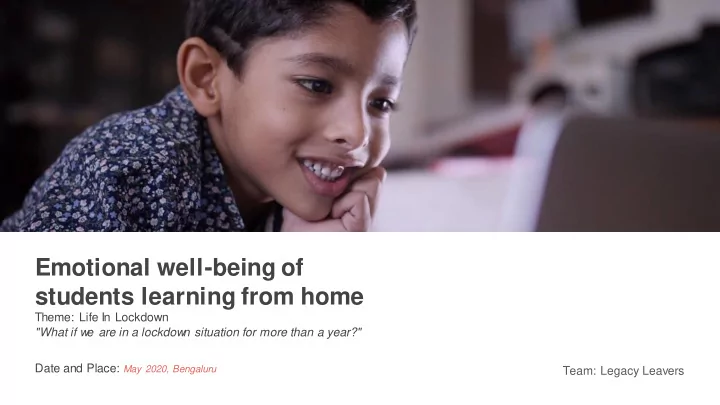
Emotional well-being of students learning from home Theme: Life In - - PowerPoint PPT Presentation
Emotional well-being of students learning from home Theme: Life In Lockdown "What if w e are in a lockdow n situation for more than a year?" Date and Place: May 2020, Bengaluru Team: Legacy Leavers Team Name : Utkarsh Chaturvedi
Theme: Life In Lockdown "What if w e are in a lockdow n situation for more than a year?" Date and Place: May 2020, Bengaluru Team: Legacy Leavers
Name : Rahul Dudeja Technologist Project Lead Name : Priyanka Gangwal Design Researcher Design Strategy
Profile Photo
MENTOR’s Name Sunit Sharma
Profile Photo
Name : Saurabh Kumar Digital Designer User Research
Profile Photo
Name : Utkarsh Chaturvedi Experience Designer User Experience Design
Profile Photo Profile Photo
What is the long term impact of teaching and learning from home on school going children going to be like?
The need for social distancing has created new challenges for school going children as young as 3 years old - reduced socialising with their classmates, decrease in
working hours and many more. Teachers too are missing
while teaching which would help them enhance their approach and teaching methods. Prolonged isolation and increased screen time is expected to impact children's emotional well being in the coming
is based on the fundamental principles of schooling — care, concern, and compassion. How might students communicate their feelings effectively to their teachers who they are not able to meet physically anymore for the next academic year? REPRESENTATIVE IMAGE FOR THE LOCKDOWN SCENARIO YOU WOULD LIKE TO WORK ON
Problem description
How should students taking online classes their schools have arranged for the academic year 2020-21 get an opportunity to realise and communicate their emotions? How can their teachers, friends and parents know what they are going through and help them feel good and motivated whenever needed? How can they socialise with their classmates that imitates the fun they earlier had in class?
Why is it urgent?
Nearly 321 million Indian children were asked to stay home. Ten weeks later, they remain away from classrooms and have been advised online or distance learning. Of the said population, 12.5% of the households of students in India (27% in urban areas and 5% in rural areas) have internet access at home and are able to learn online. Digital education tools being used by 11% of households include - desktop computers, laptops, notebooks, netbooks, palmtops or tablets. 24% of households use smartphones.
Profile
Umang Sharma, Male. 6 years old. Class 1 student
L&T apartment in JP Nagar with his nuclear family including his mother and father.
Demographics
Income: Both his parents work in the IT sector and are currently working from home full time. Education : Umang completed his KG education so far from the same school he's at now.
Feelings
Values & Goals: He wishes to continue schooling through online classes Worries: He feels bad being uncertain about when he can start school again and wishes to connect with his teachers and friends as usual. He misses his friends and feels lonely as his parents are mostly busy through the day. Influences: His school mates
Pain points
Lack of non-academic activities in online classes makes the learning process mundane. Monotony and boredom at home. Reduced interaction with people from school which was like his second home.
What happens to the problem identified in the long run?
Increasing pressure and expectations from children in terms of above average academic performances, taking additional study classes, doing well in non-academic fields, hectic lifestyles, etc have increased anxiety and stress common among Indian children. The topic of empowering teachers with the knowledge and means to take care of school children’s emotional well-being has been gaining immense attention in recent times. New Delhi government's ‘Happiness Curriculum’ scheme launched across 1,030 government schools in 2018, has been hailed as a major school education reform in the country. Increasing stress levels in children have made a handful of schools incorporate emotional well-being including activities, workshops or other means in one form or another in their curriculums. We hence believe the solution that we design for the UMO challenge has scope beyond the pandemic crisis and can be modified/adapted into both a digital/physical experience once schools reopen.
Relevance of children's emotional well-being
Following their education, when they venture into adulthood, they will be required to work alongside people on different emotional spectrums. Being equipped with handling emotions, empathy, and learning to navigate themselves through different situations become critical then.
11590137598404.html
increases/story-ejsLGZz5EiZCLxjThu2H3M.html
stressed/articleshow/66087800.cms
IQ-in-a-childs-development
Now that you have completed all the previous slides, please submit & share your deck to team@umo.design Make sure you have completed: Slides 3 - Lockdown scenario captured Slide 4 - Identified the problem and explained why it is an urgent one Slide 5 - Target user persona(s) IMPORTANT INSTRUCTIONS:
Powerpoint which ever you are working with, to team@umo.design
(yellow button in the top right corner), Make sure “Anyone with the link” option is enabled. Then copy the link and email.
We first started by listing multiple lockdown problem areas and potential solutions addressing them collaboratively using Miro. The finalised problem area of well-being of students studying from home was selected after weighing out all concepts on parameters
degree of innovation. Concept brainstorming board Potential concepts
The design process followed is represented on the right. We inititated the design process by looking into existing efforts made across the country to maintain well-being of students during the lockdown and otherwise. The desk research was followed by building a hypothesis and conducting primary research. After completing the research, we ideated on possible solutions, conceptualised and prototyped one of the ideas. Buiildng research hypothesis Primary research Insights and observations gathering Brainstorming followed by conceptualising a solution Final prototyping Secondary desk research
Some of the existing works done towards emotional well-being of students are listed below. Government efforts New Delhi governments’ ‘Happiness Curriculum’ scheme launched across 1,030 government schools in 2018, has been hailed as a major school education reform in the country.
Source : The Hindu
Space design A boarding school in Chennai called 'Riverbend' is all set to prioritise personal happiness and emotional intelligenceover grades by ditching the age-old concept of a 'traditional classroom' and giving way to concepts like ideation laboratory or a meditation room.
Source : Indiatvnews Image Source Image Source
NGO efforts Founded in 2017, LightUp engages with students and conducts teacher training programmes and parent sensitisation sessionsto contribute to a “better” child-parent-teacher microcosm and facilitate higher academic achievements.
Source : Yourstory
Other mediums A number of apps, board games and journals are available to choose from. They enable kids in getting introduced to different kinds of emotions, track them and learn to bring shifts in them too.
Source : cbc Image Source Image Source
To finalise a target age group for the solution, we looked at which age do children begin to start differentiating between emotions. We selected the age group 5-12 years.
Early & middle childhood (1.5-5yrs) The age group is assertive and kids try to establish relationships with other children and do things together. Late childhood (5-12yrs) Begins comparing themselves with
Adolescence (12-18yrs) Teens try to find their place in the society as well as their personal identity. They seek independence and develop their own outlook towards life.
Source : Parent Circle
Students between the age 5-12 years studying in schools (or as now – studying from home), need to be provided with a facility to express their feelings about both academic and personal experiences
positive shifts in emotions when necessary.
We had interactive virtual interview sessions to validate the
from different parts of the country - 5 Students Includes children between the ages of 5-12 years. 5 Parents Parents of 5 years old children and above. And with at least one child. 5 Teachers Including school teachers and tutors. Interview setup Interview stimuli used in sessions with students
The participants
The profiles of participants from various parts of the country are as follows - Teachers Bluebells International (Delhi) : English teacher (4th & 5th grade) Vidya Valley School (Pune) : Ex Arts teacher Counselling & remediation teacher S.B. Patil Public School (Pune) : KG department coordinator Delhi Public School (Bengaluru South) : UKG & 1st grade teacher Teachers Parents Students
The profiles of participants from various parts of the country are as follows - Parents Mumbai : Working (daughter 6Y, son 7Y) Bengaluru : Housewife (daughter 20Y) Housewife (son 11Y, daughter 13Y) Working (son 7.5Y) Shillong : Housewife (son 10Y, daughters 13Y & 16Y) Students Chennai : Male, 13Y Bengaluru : Famale, 11Y Female, 7Y Kolkata : Female, 11Y Female, 11Y Teachers Parents Students
The areas of inquiry were as follows -
being
being (in case of student's we asked who they go to)
and personal challenges
– parents, teachers and students amidst the lockdown
Areas of inquiry
Quoting students
“I like talking to teachers who talk about non- academic topics and gives good advises” “I would like to openly talk about issues I face academically and personally with teachers so they can understand me better” “There is no one to listen sometimes, parents get busy”
Quoting parents
“We play games at home and give points for rewards which they accumulate to choose things of their choice” “Communication is
them to speak up and even be themselves” “Ways to handle different emotions should be taught in schools, because sometimes they don’t share everything about what's going on in their heads when they reach this age”
Quoting teachers
“Many times I call parents talking about their child and they just break down saying they are not able to control their kids. They expect teachers to become co- parents or co-mothers to an
great” “Kids do express all kinds of emotions we cannot even think of only when asked” “Many of my kids share their personal secrets with me, and in return I advise them or just listen sometimes” “I know one of my students would always ask me so many doubts in person, but with the lockdown the frequency of interaction has reduced drastically"
Lack of insights and detailed reasoning about feelings that children express. These are mainly relating to experiences in schools. It is a common concern expressed by parents.
Teachers expressed that children share experiences from their personal lives with them. They like teachers to be their sounding boards and even seek opinions and advises from.
Both parents and teachers curate activities and conversations catering to unique personality needs to break the ice between them.It helps children to open up on non academic topics.
There exists no formal training to teach or guide children about how to
teachers believe it to be a potential topic to be taught in schools.
After the research, we mapped what a typical weekday of a school going child looks like, and considered experiences that are common during the lockdown to design a solution that can be used both during the lockdown and post the pandemic crisis.
Reimagining approach towards maintaining well-being of students in school by tracking not just physical presence
During lockdown Provide students with a platform to mark their virtual attendance sharing their emotive states. The concept can be extended to students providing emotive feedbacks by sharing opinions on
communication in times of distance learning. Post the pandemic crisis Provide students with a playful and engaging activity on daily basis to mark their emotive state, where the marking activity indirectly marks their attendance too.
'Journio' is an application to track well-being of students learning from home.
The name Journio is inspired by the word 'Journal'. The platform primarily acts as a platform to interact with students through multiple short activities. The intent is to use the platform once everyday to indirectly mark their attendance while getting insights into their emotions or opinions on academic or non academic topics. It is a mobile/desktop application that can be installed by teachers and parents/students. While the primary goal of the platform is to allow students to express feelings playfully while they mark their attendance, it can also help teachers plan their connects with students and/or parents to discuss relevant experiences and collaboratively work on enhancing a child's learning from home experience.
A glimpse into teacher's application screens
A glimpse into teacher's application screens
A glimpse into student's application screens
A glimpse into how students view the app
Journio provides a bunch of digtial activities which are in form of questions to get insights into student's feelings. As seen on the screen (right), the intent is to provide multiple activity options teachers can select from and initiate on everyday basis. For example, if activity 1 "An emotion a day" is chosen, student's get the question "how are you feeling today" on their screens and they get to select their responses from pre-set options. The nature of activities suggested in the concept are at a prototype
consulting child therapists or child counsellors. The idea is to get common well-being data inferences from the various activties designed. Meaning, all activities lead to informing teachers and parents if a student is excited, happy, unhappy or unsure about his/her feelings and take relevant actions.
Activities below can help understand direct emotive states.
Examples of activities
Activity 1 – An emotion a day Question : How are you feeling today? Options for students to choose from : Yay! Happy Sad Grrr Oh no Activity 2 – Reflection on the day Question : How was your day today? Options for students to choose from : Yay! Happy Sad Grrr Oh no Activity 3 – Subjects and emotions Question : How did you like the English class today? Options for students to choose from : Yay! Happy Sad Grrr Oh no
Activities below are designed to motivate students by providing them with pre-set responses that nudge them to think positively. Actvity 4 – Motivation for the day Question : How are you feeling today? Options for students to choose from : Active Social Curious Creative Actvity 5 – Many reasons to smile Question : What are you the most happy about today? Options for students to choose from : Friends School Family My hobbies Actvity 3 – Positive self talk Question : How are you motivating yourself today? Options for students to choose from : I am good at... I will practice more of... I will get better at... I learnt from...
The sequence of steps involved in using Journio
01 Every morning/ preferred time of the day Teacher selects
enable access to students. 02 Activity initiates
Student at home
application on his/her laptop. 03 Inputting information Students add their answers based on their feelings. 04 Class data received Teacher has access to the
mood and individual student data. 05 Observes app recommendations The app also suggests students with relatively concerning well-being data so teachers can approach them.
06 Planning connects Teacher can connect with students themselves
remediation departments of schools in touch with them (depending on school norms). 07 Noting down
Advises given Teachers can note down points from their discussions with students on the app whch can be viewed by parents too. 08 Students & their well-being By being able to express challenges faced personally
teachers taking relevant empathetic actions towards expressed concerns will contribute in enhancing student's well-being over time. 09 Continuous feedback Teachers get access to constant feedbacks and insights from student's lives whilst teaching them from homes.
A one stop platform for all information about a class's well-being.
An attendance register Journio provides a new way of marking emotional presence. A platform for planning communications between teachers & parents. A way for teachers to get to know a student in an academic year where they may be starting schools with no idea who the kids are/or with limited knowledge of their personalities. A feedback mechanism between students and teachers to better know how they feel about classes and personal challenges Multiple short activtities That can be used to analyse a child's state
access to common well-being data points.
Teachers
Functionally, Journio works as an attendance register and provides a new spin on how attendance can go beyond just marking students physically present. Teachers get to know student's feelings, preferences and opinions through activities in a new academic year where they may be starting with no idea who the kids are/or with limited knowledge of their personalities.
Students
Provides an opportunity to share feelings and feedbacks with teachers by expressing how they feel about classes or
personal challenges. Encouraged to have a dialogue about their inner most thoughts and feelings with trusted guardians and educators for their emotional well- being.
Parents
As parents have an added responsibility of being teachers at home to their kids - Journio helps teachers guide parents through these times and provides a platform for quicker back-and-forth communication b/w parents & teachers which can function even better than the once/twice a term PTMs in the normal schooling system
The impact of Journio goes beyond individual levels, and has impacts on
Individual Journio helps students to express their feelings, share feedbacks and realise ways to get over demotivating feelings should they
appropriate teaching actions and build interpersonal relationships. Organisational Having evolved values that encourage students to have a dialogue about their inner most thoughts and feelings with trusted guardians and educators for their emotional well-being and holistic growth. Societal Encouraging shared responsibility and embibing the new culture
enhance communication between all stakeholders.
This concept can be made immediately available to students already learning from home. However the concept can be refined further by considering the below mentioned aspects before execution - Prototype testing in a true learning and teaching from home scenario followed by feedback from teachers, students and parents. Building various online activities/questions that help get comon well-being data points and testing efficiency with the help of relevant experts. Not many teachers may have the expertise to share advises on non-academic concerns. To make the most of insights from the app, schools can be encouraged to onboard expert remediation professionals if they don't already have
An offline Journio experience can be curated that can be adapted by schools as they reopen. While the application performs similar functions as in the lockdown, the physcial experience of children marking their responses can be amended. Students can select and mark attendance using physical pegs representative of unique emotions and teachers can record information by scanning pegs using the Journio app. Varying daily activities using pegs can build a sense of anticipation and excitement among students, while providing teachers with numerous conversation triggers and opportunities to contribute in enhacing student's well-being.
Like working from home, "learning from home" is expected to be a new addition to the popular lingo in the education industry. It is believed for AI to play a bigger role than human teachers in teaching. Building Journio is our attempt in enabling human teachers to continue to enrich the lives and lessons of young children, by integrating culture, morals, human values and life skills in their digital interactions.
Now that you have completed the all sections in the deck. Please send an email out to ensure that your submission is on time. IMPORTANT FINAL SUBMISSION INSTRUCTIONS: Please ensure that you submit the following:
and submit
instructions followed from the video section in the instructions deck
embed a video link and the presentation link here