
SLIDE 1
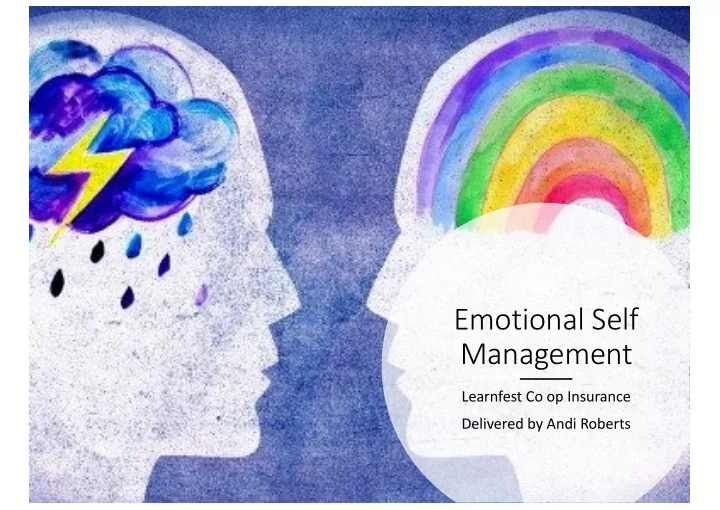
Emotional Self Management
Learnfest Co op Insurance Delivered by Andi Roberts
Emotional Self Management Learnfest Co op Insurance Delivered by - - PowerPoint PPT Presentation
Emotional Self Management Learnfest Co op Insurance Delivered by Andi Roberts Quickly review Goleman model of emotional intelligence Understand why emotional self management is so important Goals of Learn two ways of better
Learnfest Co op Insurance Delivered by Andi Roberts
model of emotional intelligence
emotional self management is so important
understanding our emotions
manage your emotions
http://bit.ly/coopfest
Artist: Shin Kwang Ho understand your own motivations and behaviors, it's nearly impossible to develop an understanding of
ability to think rationally and apply technical capabilities.” Daniel Goleman
employee skill, knowledge, or expertise” EI Consortium
related to emotional competencies, including inability to handle interpersonal problems; unsatisfactory team leadership during times of difficulty or conflict; or inability to adapt to change
Based on work by D Goleman
Positive energy / emotions Negative energy / emotions Choose a time period: Meeting. Day, Project, Week, Month, year etc Reflect on inflection points Causes, emotions, impact AND how you could handle them differently
Based on work by R Greenaway
Positive energy / emotions Negative energy / emotions Choose a time period: Meeting. Day, Project, Week, Month, year etc Reflect on inflection points Causes, emotions, impact AND how you could handle them differently “There is nothing either good or bad, but thinking makes it so” Hamlet – W Shakespeare
Based on work by R Greenaway
(Russell 1980) (Cope 2004)
What impact the emotion has Unpleasant Pleasant
(Russell 1980) (Cope 2004)
What level of intensity or energy the emotion has Low energy High energy
(Russell 1980) (Cope 2004)
Low energy High energy Unpleasant Pleasant
“Stressed” “Stimulated” “Sad” “Serene”
(Russell 1980) (Cope 2004)
Low energy High energy Unpleasant Pleasant
Anger Anxiety Fear Disgust Hate Desperation
“Stimulated” “Sad” “Serene” “Stressed”
Excitement Astonishment Joy Love Surprise Arousal Blissfulness Contentment Gladness Happiness Hope Relaxation Pride Boredom Irritation Unhappiness Loneliness Resignation Guilt
(Russell 1980) (Cope 2004)
Low energy High energy Unpleasant Pleasant
“Stimulated” “Sad” “Serene” “Stressed” 1 2 3 4 5 6 7 8 9 X) Event & Feeling & Cause Y) Event & Feeling & Cause Z) Event & Feeling & Cause
(Russell 1980) (Cope 2004)
Activity - Apply one of the two tools on yourself (pick an appropriate time frame) – Draw and reflect
Artist: Cameron Grey thought pattern influencing these beliefs?
Throw into chat (A) Your key insight (B) One thing you will do after today’s sessions
Learnfest Co op Insurance
Many thanks! Andi Roberts @andi_Roberts linkedin.com/in/andiroberts/