EMIS/DS 1300: A Practical Introduction to Data Science Slides by - - PowerPoint PPT Presentation

emis ds 1300 a practical introduction to data science
SMART_READER_LITE
LIVE PREVIEW

EMIS/DS 1300: A Practical Introduction to Data Science Slides by - - PowerPoint PPT Presentation

EMIS/DS 1300: A Practical Introduction to Data Science Slides by Michael Hahsler Data + Science = Results? Data Science ? Data Sources Results What is Data Science? Data science is a concept to unify statistics, data analysis, machine


slide-1
SLIDE 1

EMIS/DS 1300: A Practical Introduction to Data Science

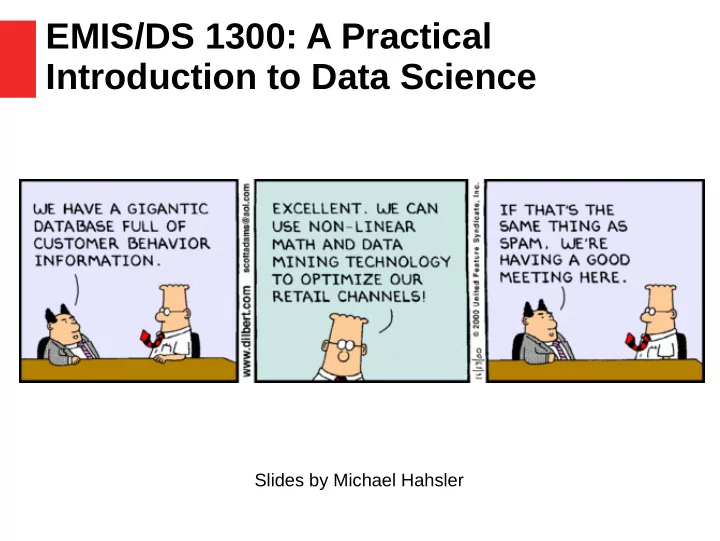
Slides by Michael Hahsler
slide-2
SLIDE 2

Data + Science = Results?

Data Sources Data Science Results

?

slide-3
SLIDE 3

What is Data Science?

“Data science is a concept to unify statistics, data analysis, machine learning and their related methods in

  • rder to understand and analyze actual phenomena

with data.”

[Hayashi, Chikio "What is Data Science?"]

slide-4
SLIDE 4

What is Statistics?

  • “Statistics is a branch of mathematics dealing with data

collection, organization, analysis, interpretation and presentation.” [Wikipedia]

  • Techniques:

– Design of experiments (sampling) – Descriptive statistics – Statistical inference (estimation, testing)

slide-5
SLIDE 5

What is Analytics and Data Mining?

  • Analytics and Data Mining is the

discovery and communication of meaningful patterns in data.

  • Analytics relies on the

simultaneous application of statistics, computer programming and operations research to quantify performance.

  • Analytics often favors data

visualization to communicate insight.

  • Data Mining focuses on

predictive models.

[Wikipedia]

slide-6
SLIDE 6

What is Machine Learning and Artifjcial Intelligence?

  • Machine learning (ML) is the

study of algorithms and statistical models that computer systems use to progressively improve their performance on a specific task. The goal is to make accurate predictions or decisions without being explicitly programmed to perform the task.

  • AI is the study of intelligent

agents, devices that perceives its environment and takes actions that maximize its chance of successfully achieving its goals.

[Wikipedia]

slide-7
SLIDE 7

7 / 30

Businesses collect and warehouse lots of data.

  • Bank/credit card transactions
  • Web data, e-commerce
  • Social media
  • Internet of things (IOT)

Computers are cheaper and more powerful.

  • SaaS/IaaS/PaaS

Competition to provide better services.

  • Mass customization and recommendation systems
  • Targeted advertising
  • Improved logistics

Why do companies care about Data Science?

slide-8
SLIDE 8

Data Science from a Scientifjc Viewpoint

 Data collected and stored at

enormous speeds (GB/hour)

  • remote sensors on a satellite
  • telescopes scanning the skies
  • microarrays generating gene

expression data

  • scientifjc simulations

generating terabytes of data

 Data may help scientists

  • identify patterns and relationships
  • to classify and segment data
  • formulate hypotheses
slide-9
SLIDE 9

10 / 30

  • Uber
  • Airbnb
  • Netflix
  • Amazon
  • Logistics
  • Banking, loans, insurance
  • Pharmaceutical industry
  • Healthcare
  • Sports

Some Applications of Data Science

slide-10
SLIDE 10

Who does all this?

And who gets the big paycheck?

slide-11
SLIDE 11

The Data Scientist

Good luck finding this person! Probably a team effort!

Source: T. Stadelmann, et al., Applied Data Science in Europe

slide-12
SLIDE 12

15 / 30

What Does a Data Scientist Do?

  • Identifying data analytics opportunities.
  • Find/collect the correct data sets and variables.
  • Clean the data and ensure accuracy and

completeness.

  • Decide on appropriate models and algorithms to mine

the data. Identify patterns and trends.

  • Interpret the results to data to discover solutions and
  • pportunities.
  • Communicate findings to stakeholders using

visualization and prototypes.

slide-13
SLIDE 13

How to do a Data Science project? CRISP-DM Reference Model

  • Cross Industry Standard

Process for Data Mining

  • De facto standard for

conducting data mining and knowledge discovery projects.

  • Defines tasks and outputs.
  • Now developed by IBM as the

Analytics Solutions Unified Method for Data Mining/Predictive Analytics (ASUM-DM).

  • SAS has SEMMA and most

consulting companies use their own process.

slide-14
SLIDE 14

Tasks in the CRISP-DM Model

slide-15
SLIDE 15

The Data Science Process

Source: The Data Science Process, Springboard https://www.kdnuggets.com/2016/03/data-science-process.html

slide-16
SLIDE 16

Tools

2018 Magic Quadrant for Data Science and Machine Learning Platforms

slide-17
SLIDE 17

Tools - Popularity

n = 1,220 analytic professionals

https://www.kdnuggets.com/2018/05/poll-tools-analytics-data-science-machine-learning-results.html http://www.rexeranalytics.com/Data-Miner-Survey-2015-Intro.html

Rexer Analytics 2015

slide-18
SLIDE 18

Tools - Types

 Data: Relational databases (SQLite), NoSQL

databases

 Spreadsheet: Excel, Google Sheets  Visualization: Tableau, Microsoft Power BI, SAS

jmp

 Data Science Platforms

  • Simple graphical user interface
  • Process oriented
  • Programming oriented
slide-19
SLIDE 19

Tools Simple GUI

 Weka: Waikato

Environment for Knowledge Analysis (Java API)

 Rattle: GUI for Data

Mining using R

slide-20
SLIDE 20

Tools -Process oriented

 SAS Enterprise

Miner

 IBM SPSS

Modeler

 RapidMiner  Knime  Orange

slide-21
SLIDE 21

Tools -Programming oriented

 Python

  • Scikit-learn, pandas
  • IPython, notebooks

 R

  • Rattle for beginners
  • RStudio IDE, markdown, shiny
  • Microsoft Open R

→ Both have similar capabilities. Slightly different focus:

  • R: Statistical computing and visualization
  • Python: Machine learning and big data
slide-22
SLIDE 22

Eat Eat fruits fruits when when they are in they are in season!!! season!!!

Data Visualization

Infoviz is a field

  • f its own.
slide-23
SLIDE 23

Do you notice the slight flaw? Do you notice the slight flaw?

slide-24
SLIDE 24

Legal, Privacy and Security Issues

slide-25
SLIDE 25

Legal, Privacy and Security Issues

  • Are we allowed to collect the data?
  • Are we allowed to use the data?
  • Is it ethical to use and act on the data?
  • Is privacy preserved in the process?
  • Problem: Internet is global but legislation

is local!

slide-26
SLIDE 26

GDPR

EU law on data protection and privacy for all individuals within the European Union (EU) and the European Economic Area (EEA) Implementation: 25 May 2018 California passed a similar bill called The California Consumer Privacy Act of 2018 Personal data may not be processed unless there is at least one legal basis to do so. Lawful purposes are:

  • Consent by the individual (Opt-in)
  • Legal obligations of the data controller
  • Protect the vital interests of a data subject or another individual
  • To perform a task in the public interest or in official authority
  • For the legitimate interests of a data controller
slide-27
SLIDE 27

=

https://www.informs.org/About-INFORMS/Privacy-Policy

slide-28
SLIDE 28

Legal, Privacy and Security Issues

Data-Gathering via Apps Presents a Gray Legal Area

By KEVIN J. O’BRIEN Published: October 28, 2012

BERLIN — Angry Birds, the top-selling paid mobile app for the iPhone in the United States and Europe, has been downloaded more than a billion times by devoted game players around the world, who often spend hours slinging squawking fowl at groups of egg-stealing pigs. When Jason Hong, an associate professor at the Human-Computer Interaction Institute at Carnegie Mellon University, surveyed 40 users, all but two were unaware that the game was storing their locations so that they could later be the targets of ads....

slide-29
SLIDE 29
slide-30
SLIDE 30

Here is what the small print says...

Pokémon Go’s constant location tracking and camera access required

for gameplay, paired with its skyrocketing popularity, could provide data like no app before it. “Their privacy policy is vague,” Hong said. “I’d say deliberately vague, because of the lack of clarity on the business model.” ... The agreement says Pokémon Go collects data about its users as a “business asset.” This includes data used to personally identify players such as email addresses and other information pulled from Google and Facebook accounts players use to sign up for the game. If Niantic is ever sold, the agreement states, all that data can go to another company.

USA Today Network Josh Hafner, USA TODAY 2:38 p.m. EDT July 13, 2016