Emerging Concrete Pavement Solutions Roller Compacted Concrete (RCC) - - PowerPoint PPT Presentation

emerging concrete pavement solutions
SMART_READER_LITE
LIVE PREVIEW

Emerging Concrete Pavement Solutions Roller Compacted Concrete (RCC) - - PowerPoint PPT Presentation

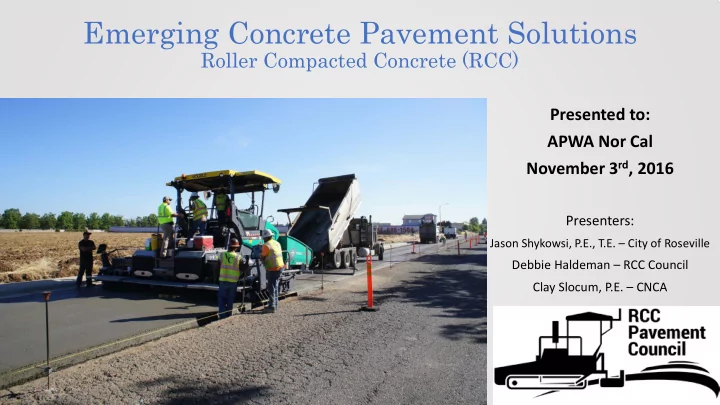
Emerging Concrete Pavement Solutions Roller Compacted Concrete (RCC) Presented to: APWA Nor Cal November 3 rd , 2016 Presenters: Jason Shykowsi, P.E., T.E. City of Roseville Debbie Haldeman RCC Council Clay Slocum, P.E. CNCA 1


slide-1
SLIDE 1

Emerging Concrete Pavement Solutions

Roller Compacted Concrete (RCC)

Presented to: APWA Nor Cal November 3rd, 2016

Presenters:

Jason Shykowsi, P.E., T.E. – City of Roseville

Debbie Haldeman – RCC Council Clay Slocum, P.E. – CNCA

1
slide-2
SLIDE 2

Outline:

  • Definition / History
  • RCC introduction
  • Material
  • Construction
  • QA/QC
  • Jointing, Preserving & Utilities!
  • Roseville’s story
  • Takeaways

2

Bellefontaine, Ohio – 125 Year Old Concrete Pavement

Photo: roadsideamerica.com

slide-3
SLIDE 3

Definition

“Roller-Compacted Concrete (RCC) is a no-slump concrete that is compacted by vibratory rollers”

■ Zero slump (consistency of damp dense gravel) ■ No forms or finishing ■ No reinforcing steel ■ High production ■ Asphalt paving equipment

Concrete placed in a different way!

Photos: CP Tech Center, PCA, Iowa State University – Guide for Roller-Compacted Concrete Pavements

slide-4
SLIDE 4

Roller Compacted Concrete (RCC) History:

  • Extensive pavement use for 12 years
  • Placed with a high density asphalt paver
  • Compacted with vibratory rollers
  • No forms, reinforcing steel, or finishing
  • Normal concrete strength – designed like JPCP
  • Low W/C ratio = limited shrinkage cracks

RCC Pavements

Photos: CP Tech Center, PCA, Iowa State University – Guide for Roller-Compacted Concrete Pavements

slide-5
SLIDE 5

RCC’s Multiple Personalities

Concrete

  • rigid pavement
  • strength tests

Soils

  • mix design
  • density test

Asphalt

  • paver
  • rollers

Roller-Compacted Concrete

slide-6
SLIDE 6

6 Photos: CP Tech Center, PCA, Iowa State University – Guide for Roller-Compacted Concrete Pavements

slide-7
SLIDE 7

RCC Placing Equipment

  • High initial density, 90-100%
  • Compact to 98% avg. relative density with rollers
  • Less roll-down
  • 4” to 10” lift thickness range
  • High-volume placement (5-7 ft/min)

High Density Pavers

slide-8
SLIDE 8

Recommended Batching System - A Continuous Pugmill Mixer

  • 200 ft by 200 ft staging area required
  • High production rates: 50 to 200+ CY/hr
  • Excellent mixing efficiency

Pugmill Production

slide-9
SLIDE 9

QA / QC Process

  • Tested with a nuke gage at depth
  • Test density behind paver & after roller
  • Establish rolling patterns
  • Cylinders prepared with vibratory hammer

according to ASTM C1435

  • Cores can be obtained to verify density

Compressive Strength Moisture & Density

Photos: CP Tech Center, PCA, Iowa State University – Guide for Roller-Compacted Concrete Pavements

slide-10
SLIDE 10

Curing & Saw Cutting Improves Performance

  • Ensure uniformity
  • Apply as soon as possible
  • Improves surface durability

Curing Saw Cut & Fill Joints (Where Necessary)

  • More aesthetically pleasing
  • Recommend sawing within 2 - 6 hours
  • Spacing: Max 36 times thickness
slide-11
SLIDE 11

HMA RCC PCC

Diamond Ground RCC Diamond Ground Conventional Concrete

What Does RCC Look Like? It Looks Like Light Asphalt!

slide-12
SLIDE 12

Diamond Grinding

  • Removal of thin surface layer of hardened PCC
  • Preserves pavement – smoothens the road
  • Typical cost = $3 to $5 per square yard

Diamond Grinding

  • Typical 10-15 year rehab schedule
  • Improves friction and surface aesthetics
  • Reduces noise

Benefits

slide-13
SLIDE 13

Joint Layout Is Crucial To Performance

BAD J Jointing P g Practices es

slide-14
SLIDE 14

Joint Layout Is Crucial To Performance

Good

  • d Joi
  • inting P

Prac actic ices

slide-15
SLIDE 15

Roseville’s Challenge

  • Street maintenance funding is a

challenge

  • Roseville’s Funding sources:
  • State Gas Tax  Largest
  • Utility Impact Reimbursements
  • Transportation Development Act
  • Federal Gas Tax
  • State Gas Tax distributed by lane

miles and population

  • Gas Tax unchanged since 1993

while costs have tripled

slide-16
SLIDE 16

Roseville’s Challenge

  • Roseville – 1,000 lane miles of asphalt roadway
  • Need to maintain 100 lane miles/year – $8.5 million
  • City averages $4.4 million/year available for

roadway maintenance - about half of what is needed Maintenance Funding

slide-17
SLIDE 17

The Research

slide-18
SLIDE 18

The Research

slide-19
SLIDE 19

The Research

RCC/AC Engineering Cost Estimates for Pleasant Grove Option Construct 50-yr. Maint. Lifecycle Cost RCC over cement-treated subgrade $914,186 $490,000 $1,404,186 Asphalt over cement-treated subgrade $1,254,962 $785,840 $2,040,802

slide-20
SLIDE 20
  • Open to light traffic

tomorrow!

  • 48 hours for heavy-

duty traffic!

  • Build strong, durable

roadways with environmental benefits

  • 20 to 25 years without

Maintenance

The Research

slide-21
SLIDE 21
  • Project size/volume
  • Pavement thickness and width
  • Site geometry
  • Traffic control – opening to

traffic

The Research

slide-22
SLIDE 22
slide-23
SLIDE 23

The Research

slide-24
SLIDE 24

The Research

slide-25
SLIDE 25

The Research

Diamond Ground Arterial Troweled Residential

slide-26
SLIDE 26

Outreach

Past

  • BIA
  • Utilities
  • Transportation Commission
  • City Council – three times
  • Hickory Public Meeting
  • Social media

Future

  • City Council – award
  • Project Tour
  • City Council - NOC
  • City Standard workshops
  • City Council – Standard

adoption

slide-27
SLIDE 27

How To Perform A Utility Repair

Un - Doweled

Saw cut T/4

Outreach

slide-28
SLIDE 28

Outreach

slide-29
SLIDE 29

Pilot Project

  • Complete reconstruction
  • f three sections of failed

road – Washington, Atkinson/Denio, Hickory

  • Three differing road

types – arterial, collector, residential

  • Three different finishes –

natural, diamond grind, troweled

slide-30
SLIDE 30

Pilot Project

slide-31
SLIDE 31

Pilot Project

slide-32
SLIDE 32

Pilot Project

slide-33
SLIDE 33

Pilot Project

slide-34
SLIDE 34

Pilot Project

slide-35
SLIDE 35

Pilot Project

slide-36
SLIDE 36

Pilot Project

slide-37
SLIDE 37

Pilot Project

slide-38
SLIDE 38

Pilot Project

5-1.06 SUPERINTENDENCE In addition to Section 5-1.06 of the State Standard Specifications, the following apply: As part of the bid package and prior to Project award, the prime contractor must have

  • n their payroll, or be under contract with, either a consultant or subcontractor that

will provide a RCC Superintendent for the project and provide documentation of such

  • agreement. The RCC Superintendent shall be present at the job site during all items

relating to Roller Compacted Concrete. Additionally, the contractor shall submit, as part of the bid package, the RCC Superintendent’s resume. At a minimum, the RCC Superintendent’s resume shall include the following:

  • RCC Superintendent must have experience with the equipment required of the work

including pugmills and high density pavers.

  • RCC Superintendent must have a minimum of 3 years RCC Pavement experience.
  • RCC Superintendent must have completed at least 3 RCC pavement projects with

a minimum of 2,000 CY each using the required equipment.

  • Three (3) RCC project references, including photographs that are representative of

the projects, must be included.

  • Prime Contractor or RCC Superintendent must have completed at least 5 public

roadway projects that included asphalt, PCC and/or RSC paving. Project references are required including photographs that are representative of the projects.

slide-39
SLIDE 39

Pilot Project

As part of their duties, the RCC Superintendent will be required to perform the following items:

  • RCC Superintendent must submit and conduct a City approved pre-construction

RCC training program agenda and trainer for both contractor and City staff involved with the RCC portion of the project.

  • RCC Superintendent must oversee the prime contractor or subcontractor perform

at least one (1) 1,500 SY RCC paving test section specific to this project prior to

  • paving. This can be inclusive of the test sections required elsewhere in these

specifications. The Engineer has sole discretion to approve or reject the RCC Superintendent. If the proposed RCC superintendent is rejected, the contractor has three (3) business days to submit another RCC Superintendent for consideration by the Engineer.

slide-40
SLIDE 40

Pilot Project

Washington RCC/AC Using 2016 Bid Results Location Total Cost Cost/SF 8” HMA, 15” CTB, Cut and Export $3,558,202 $7.02 RCC, PCC, CTB, Diamond Grind, Cut and Export $2,873,348 $5.67

slide-41
SLIDE 41

Pilot Project

  • Rebid this winter
  • Advertise nationwide
  • Begin construction in

April

  • Start at Atkinson/Denio, then Hickory, and

finally Washington when school is out for the summer

  • Completion Fall of 2017
slide-42
SLIDE 42

Resources:

  • RCC Pavement Council
  • Cemex
  • National Concrete Pavement Technology Center
  • Portland Cement Association
  • American Concrete Pavement Association
  • Lawrence Berkeley National Laboratories
  • MIT Concrete Sustainability Hub
  • Caltrans

Pilot Project

slide-43
SLIDE 43

Jason Shykowski, P.E., T.E. Principal Engineer City of Roseville Jshykowski@Roseville.ca.us

Debbie Haldeman Business Development Manager RCC Pavement Council & Cemex Deborahg.Haldeman@cemex.com Clay Slocum, P.E. Pavements Engineer California Nevada Cement Association Clay.Slocum@CNCement.org