embedded security October 2015 The Old Model (simplified view) - - PDF document

embedded security october 2015
SMART_READER_LITE
LIVE PREVIEW

embedded security October 2015 The Old Model (simplified view) - - PDF document

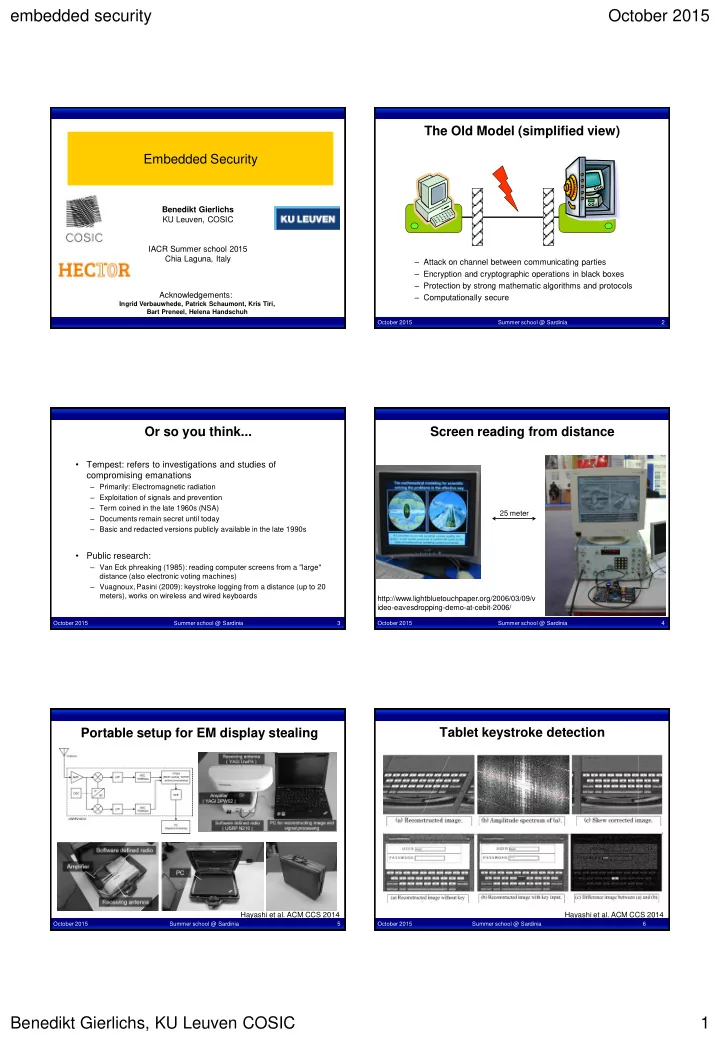
embedded security October 2015 The Old Model (simplified view) Embedded Security Benedikt Gierlichs KU Leuven, COSIC IACR Summer school 2015 Chia Laguna, Italy Attack on channel between communicating parties Encryption and


slide-1
SLIDE 1

embedded security October 2015 Benedikt Gierlichs, KU Leuven COSIC 1

Embedded Security

Benedikt Gierlichs KU Leuven, COSIC IACR Summer school 2015 Chia Laguna, Italy Acknowledgements:

Ingrid Verbauwhede, Patrick Schaumont, Kris Tiri, Bart Preneel, Helena Handschuh

– Attack on channel between communicating parties – Encryption and cryptographic operations in black boxes – Protection by strong mathematic algorithms and protocols – Computationally secure

October 2015 Summer school @ Sardinia 2

The Old Model (simplified view)

  • Tempest: refers to investigations and studies of

compromising emanations

– Primarily: Electromagnetic radiation – Exploitation of signals and prevention – Term coined in the late 1960s (NSA) – Documents remain secret until today – Basic and redacted versions publicly available in the late 1990s

  • Public research:

– Van Eck phreaking (1985): reading computer screens from a "large" distance (also electronic voting machines) – Vuagnoux, Pasini (2009): keystroke logging from a distance (up to 20 meters), works on wireless and wired keyboards

October 2015 Summer school @ Sardinia 3

Or so you think... Screen reading from distance

October 2015 Summer school @ Sardinia 4

25 meter http://www.lightbluetouchpaper.org/2006/03/09/v ideo-eavesdropping-demo-at-cebit-2006/

Portable setup for EM display stealing

October 2015 Summer school @ Sardinia 5

Hayashi et al. ACM CCS 2014

October 2015 Summer school @ Sardinia 6

Tablet keystroke detection

Hayashi et al. ACM CCS 2014

slide-2
SLIDE 2

embedded security October 2015 Benedikt Gierlichs, KU Leuven COSIC 2

  • A cryptographic device is an electronic device that

implements a cryptographic algorithm and stores a cryptographic key. It is capable of performing cryptographic

  • perations using that key.
  • Embedded: it is exposed to adversaries in a hostile

environment; full physical access, no time constraints

– Note: the adversary might be a legitimate user!

October 2015 Summer school @ Sardinia 7

Embedded Cryptographic Devices

Firewall

  • New Model (also simplified view):

– Attack on channel and endpoints – Encryption and cryptographic operations in gray boxes – Protection by strong mathematic algorithms and protocols – Protection by secure implementation

  • Need secure implementations not only algorithms

October 2015 Summer school @ Sardinia 8

How is Embedded Security affected? Internet of Things

[Source photograph: J. Rabaey: A Brand New Wireless Day]

October 2015 9 Summer school @ Sardinia

“A system of collaborating computational elements controlling physical entities” [1] “Networked embedded systems interacting with the environment” [2]

Cyber physical systems

October 2015 Summer school @ Sardinia 10 [1] wikipedia [2] Ed Lee, after H. Gill NSF

Network: controller area network (CAN)

Medical devices, typical scenario

October 2015 Summer school @ Sardinia 11

IMEC: Human++ project

  • Small embedded devices communicate over wireless

link for sensing and actuation

  • Goal: low energy (battery powered, temperature)
  • Security goal: attack resistant

Interacting with the environment

October 2015 Summer school @ Sardinia 12

IMEC: NERF - brain stimulant Deep Brain stimulation

[Sources: J. Rabaey, National Institutes of Health, Neurology journal]

Embedded cryptography?

slide-3
SLIDE 3

embedded security October 2015 Benedikt Gierlichs, KU Leuven COSIC 3

Your system is as secure as its weakest link

October 2015 Summer school @ Sardinia 13

Always keep in mind

October 2015 Summer school @ Sardinia 14

Your system is as secure as its weakest link

Unknown source: seen on schneier.com October 2015 Summer school @ Sardinia 15

Your system is as secure as its weakest link

Source: P. Kocher

  • The adversary will go for the weakest entry point

– Disable or go around security mechanisms – Guess / spy on passwords – Bribe the security guard

  • If you use good crypto, he will try to go around it

– System designer: thinks of the "right" way to use the system – Adversary: does not play by the rules – Designer has to think like the adversary, anticipate attacks, protect against them – There is no way to protect against all attacks

  • Do you know all attacks?

October 2015 Summer school @ Sardinia 16

Your system is as secure as its weakest link

“Researcher has a new attack for embedded devices Vulnerability lies in ARM and XScale microprocessors” Computerworld – security April 4, 2007 How: Use JTAG interface “Secustick gives false sense of security” April 12, 2007 http://tweakers.net/reviews/683 Security completely broken

October 2015 Summer school @ Sardinia 17

Security for Embedded Systems

  • SecuStick:

– On plug-in: Windows program pops up and asks for password – Self-destructs if wrong password entered n-many times – Attempt counter stored in flash memory chip – Write-enable pin connected to GND: infinite number of attempts to guess the password  – Password is checked in software routine on PC: changing return value from "0" to "1" gives full access 

October 2015 Summer school @ Sardinia 18

Security for Embedded Systems

April 12, 2007: http://tweakers.net/reviews/683

slide-4
SLIDE 4

embedded security October 2015 Benedikt Gierlichs, KU Leuven COSIC 4

  • Let us assume that the system is well designed

– Adversary cannot go around / disable security features – Good cryptography is used

  • Embedded context, physical access

– Adversary can "look" at the device under attack

  • Measure physical quantities

– Adversary can manipulate the device under attack

  • Expose it to physical stress and "see" how it behaves

October 2015 Summer school @ Sardinia 19

Physical security of embedded cryptographic devices

  • Active versus passive

– Active: Perturbate and conclude – Passive: Observe and infer

  • Invasive versus non-invasive

– Invasive: open package and contact chip – Semi-invasive: open package, no contact – Non-invasive: no modification

  • Side channel: passive and non-invasive

– Very difficult to detect – Often cheap to set-up – Often: need lots of measurements  automating

  • Circuit modification: active and invasive

– Expensive to detect invasion (chip might be without power) – Very expensive equipment and expertise required

October 2015 Summer school @ Sardinia 20

Classification of Physical Attacks

active passive Non-Invasive Invasive

  • Physical attacks ≠ Cryptanalysis

(gray box, physics) (black box, maths)

  • Does not tackle the algorithm's math. security
  • Observe physical quantities in the device's vincinity and use

additional information during cryptanalysis

October 2015 Summer school @ Sardinia 21

Side-Channel Leakage

Input Output Leakage

  • Timing

– Overall or "local" execution time

  • Power, Electromagnetic radiation

– Predominant: CMOS technology – Consumes power when it does something, transistors switch – Electric current induces and EM field

  • More exotic but shown to be practical

– Light, Sound, Temperature

October 2015 Summer school @ Sardinia 22

Some Side-Channels (not exhaustive)

execution time time

  • Smart cards
  • FPGA, ASIC
  • Phone, tablet
  • Set-top boxes
  • Etc.

October 2015 Summer school @ Sardinia 23

Examples: measurement setups

source: langer-emv.de

  • Side-channel leakage

– Is not intended – Information leakage was not considered at design time – Leaked information is not supposed to be known – Can enable new kind of attack

  • Often, optimizations enable leakage
  • Device under attack is operated in normal conditions

– Adversary is passive an solely observes

October 2015 Summer school @ Sardinia 24

Side-Channel leakage

slide-5
SLIDE 5

embedded security October 2015 Benedikt Gierlichs, KU Leuven COSIC 5

October 2015 Summer school @ Sardinia 25

Principle is nothing new...

“Breaking into a Safe is hard, because one has to solve a single, very hard problem...” “Things are different if it is possible to solve many small problems instead...” “Divide et impera!”

A timing attack

October 2015 Summer school @ Sardinia 26

  • 4-digit PIN verification

FUNCTION check (USER_PIN, CORRECT_PIN) FOR i=1 TO PIN_LENGTH IF USER_PIN[i] != CORRECT_PIN[i] RETURN -1 ENDFOR RETURN 0 MAIN FUNCTION … IF check(…) == -1 COUNTER++ ELSE COUNTER = 0 …

  • 10000 possible combinations
  • On average 5000 attempts necessary
  • Typically only 3 attempts allowed (counter)
  • Probability of correct guess: 3/10000

A timing attack

October 2015 Summer school @ Sardinia 27

  • Execution time of check(…) leaks information
  • Average 5 (worst case 10) attempts per digit
  • Average 20 (worst case 40) attempts per PIN
  • … but recall that only 3 attempts are allowed
  • Test random PIN, measure time N
  • Change first PIN digit, measure time N’
  • If N == N’ both digit guesses are wrong
  • If N > N’ the first digit guess was correct
  • If N < N’ the new digit guess is correct
  • Some cryptographic algorithms gain their cryptographic

strength by repeating a "weak" function many times

– Classical model: adversary sees only final and secure result

  • Other algorithms use few complex functions but their

implementations follow a similar idea

  • Side Channels leak information about these "weak"

intermediate results

  • Side Channel attacks exploit information about "weak"

intermediate results

October 2015 Summer school @ Sardinia 28

Concept of Side Channel attacks

  • Passive: micro-probing

– Probe the bus with a very thin needle – Read out data from bus or individual cells directly – Several needles concurrently

  • Active: modify circuits

– Connect or disconnect security mechanism

  • Disconnect security sensors
  • RNG stuck at a fixed value
  • Reconstruct blown fuses

– Cut or paste tracks with laser or focused ion beam – Add probe pads on buried layers

October 2015 Summer school @ Sardinia 29

Invasive attacks

[www.fa-mal.com] [Helena Handschuh]

RNG OUT "0"

  • Vcc
  • Glitch
  • Clock
  • Temperature
  • UV
  • Light
  • X-Rays
  • ...

October 2015 Summer school @ Sardinia 30

Active attacks: fault injection

Apply combinations of strange environmental conditions and bypass or infer secrets

input error

Slide: Helena Handschuh

slide-6
SLIDE 6

embedded security October 2015 Benedikt Gierlichs, KU Leuven COSIC 6

  • Exploit faulty behavior provoked by physical stress

applied to the device

  • Semi-invasive: open package but no contact

– Laser fault injection allows to target a relatively small surface area of the target device – Laser pulse frequency ~ 50Hz – Fully automated scan of chip surface – Once you have a weak spot: perturbate and exploit – Recent: 2 laser spots, 20 ns interval, diode lasers

October 2015 Summer school @ Sardinia 31

Active attacks (semi invasive) fault injection

[www.new-wave.com] October 2015 Summer school @ Sardinia 32

Microscope view

  • Ask for a cryptographic computation twice

– With any input and no fault (reference) – With the same input and fault injection

  • Infer information about the key from the output differential
  • Sometimes a single fault injection is enough!

October 2015 Summer school @ Sardinia 33

Differential Fault Analysis Embedded security requirements

Time Power Area

[wonderfulengineering.com]

Security

October 2015 34 Summer school @ Sardinia

  • Security consumes resources!

– extra area, extra power, extra time, development overhead – E.g. communication – computation trade-off

  • Similar to power or area optimization

– Perfect security does not exist (zero-power design doesn't exist either) – Low-risk security does exist (low-power design does exist)

  • Different: attacker will go for the easiest entry point:

– If strong crypto algorithm: try other weaknesses – Monitor power consumption, electromagnetic radiation, timing – Introduce glitches (= fault attacks) – Guess the password – Bribe the security guard (= social engineering)

October 2015 Summer school @ Sardinia 35

Security as a design dimension Thank you for your attention!

October 2015 36 Summer school @ Sardinia