Embedded Bayesian Perception & Risk Assessment for ADAS & - - PowerPoint PPT Presentation

embedded bayesian perception risk assessment for adas
SMART_READER_LITE
LIVE PREVIEW

Embedded Bayesian Perception & Risk Assessment for ADAS & - - PowerPoint PPT Presentation

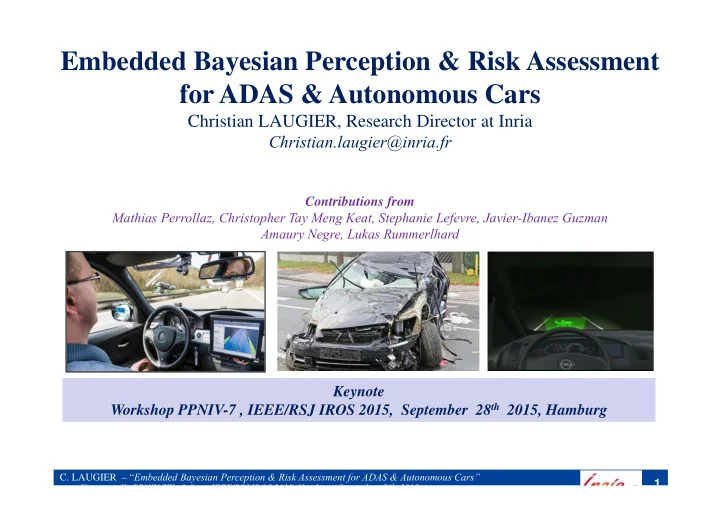
Embedded Bayesian Perception & Risk Assessment for ADAS & Autonomous Cars Christian LAUGIER, Research Director at Inria Christian.laugier@inria.fr Contributions from Mathias Perrollaz, Christopher Tay Meng Keat, Stephanie Lefevre,


slide-1
SLIDE 1

1

  • C. LAUGIER – “Embedded Bayesian Perception & Risk Assessment for ADAS & Autonomous Cars”

K lk PPNIV 7W k h IEEE/RSJ IROS 2015 H b S b 28h 2015

1

Embedded Bayesian Perception & Risk Assessment for ADAS & Autonomous Cars

Christian LAUGIER, Research Director at Inria

Christian.laugier@inria.fr

Contributions from Mathias Perrollaz, Christopher Tay Meng Keat, Stephanie Lefevre, Javier-Ibanez Guzman Amaury Negre, Lukas Rummerlhard

Keynote Workshop PPNIV-7 , IEEE/RSJ IROS 2015, September 28th 2015, Hamburg

slide-2
SLIDE 2
  • C. LAUGIER – “Embedded Bayesian Perception & Risk Assessment for ADAS & Autonomous Cars”

Keynote talk, PPNIV 7Workshop , IEEE/RSJ IROS 2015, Hamburg, September 28h 2015

2

Content of the talk

 Socio-economic context & Addressed problem  Bayesian Perception (Key Technology 1)  Bayesian Risk Assessment & Decision-making (Key Technology 2)  Conclusion & Perspectives

slide-3
SLIDE 3
  • C. LAUGIER – “Embedded Bayesian Perception & Risk Assessment for ADAS & Autonomous Cars”

Keynote talk, PPNIV 7Workshop , IEEE/RSJ IROS 2015, Hamburg, September 28h 2015

3

The car ?

Automobile plays a big role in our human society

A Social & Industrial revolution in the 20th century

For most of cars owners it’s more than that !  Synonymous to motion freedom  Often considered as a Precious Personal Goods & showing a particular Social position  Often synonymous to Driving Pleasure (including speed feeling)… but this is progressively changing because of rules enforcements  Look / Performances & Comfort / Safety are more and more considered as important criteria …. A technological machine designed for enhancing individual Mobility ?

slide-4
SLIDE 4
  • C. LAUGIER – “Embedded Bayesian Perception & Risk Assessment for ADAS & Autonomous Cars”

Keynote talk, PPNIV 7Workshop , IEEE/RSJ IROS 2015, Hamburg, September 28h 2015

4

Traffic congestion Pollution Parking problems Accidents

But the reality is somewhat different !

in particular in cities

slide-5
SLIDE 5
  • C. LAUGIER – “Embedded Bayesian Perception & Risk Assessment for ADAS & Autonomous Cars”

Keynote talk, PPNIV 7Workshop , IEEE/RSJ IROS 2015, Hamburg, September 28h 2015

5

Intelligent Mobility & Next Cars Generation

A drastic change of the Societal & Economic context

 Huge expected growth of the number of Vehicles (~3 billions in 2050) & of People in

cities (~75% of population in 2050)

 Human Society is no more accepting all the nuisances & the incredible socio-economic

cost of traffic accidents => 50 millions injuries & 1.3 million fatalities/Year in the world [1]

… 93% of road accidents are caused by human errors !

 Driving Safety & Efficiency are now becoming major issues for both governments

(regulations & supporting plans) and the automotive industry (technology & commercial issues)

 Growth of ADAS market: $16 billions at the end of 2012 … $261 billions by 2020 [2]  New Technologies can strongly help for (e.g. for ADAS & Autonomous Driving)

 Constructing Cleaner & more Intelligent cars => Next cars generation  Developing Sustainable Mobility solutions for smart cities => Cybercars

[1] G.Yeomans. Autonomous Vehicles, Handling Over Control: Opportunities and Risks for Insurance. Lloyd’s 2014 [2] ABI Research on Intelligent Transportation Systems and Automotive Technologies Research Services
slide-6
SLIDE 6
  • C. LAUGIER – “Embedded Bayesian Perception & Risk Assessment for ADAS & Autonomous Cars”

Keynote talk, PPNIV 7Workshop , IEEE/RSJ IROS 2015, Hamburg, September 28h 2015

6

 Thanks to the last decades advances in the fields of ICT & Robotics, Smart Cars &

ITS are gradually becoming a reality

=> Driving assistance & Autonomous driving, Passive & Active Safety systems, V2X communications, Green technologies for reducing fuel consumption & pollution … and also significant advances in Embedded Perception & Decision-making systems  Legal issue is also progressively addressed by governmental authorities => June 22, 2011: Law Authorizing Driverless Cars on Nevada roads … and this law has also been adopted later on by California and some other states in USA => Several other countries (including Europe, France, Japan …) are also currently analyzing the way to adapt the legislation to this new generation of cars

The good news

slide-7
SLIDE 7
  • C. LAUGIER – “Embedded Bayesian Perception & Risk Assessment for ADAS & Autonomous Cars”

Keynote talk, PPNIV 7Workshop , IEEE/RSJ IROS 2015, Hamburg, September 28h 2015

7

Still some open questions: Why driverless cars ? Intelligent co-Pilot v/s Full Autonomy ? Acceptability ? Legal issue ? Driver / Co-Pilot Control transitions ?

Google Car 2011 => 140 000 miles covered Toyota

Automated Highway Driving Assist => Demo Tokyo 2013, Product 2016 ?

But also most of the major Automotive Constructors ! e.g. Tesla (90% Autonomous in 2016) Volvo, Mercedes Class S, BMW ….

Horizon 2020-30 ?

Nissan promises a driverless car for 2020

Carlos Ghosn Renault /Nissan

Autonomous car: An industrial challenge for tomorrow ! French Minister of Industry & Carlos Ghosn (CEO Renault-Nissan)

Automotive industry

Expected evolution from ADAS to Driverless Cars?

slide-8
SLIDE 8
  • C. LAUGIER – “Embedded Bayesian Perception & Risk Assessment for ADAS & Autonomous Cars”

Keynote talk, PPNIV 7Workshop , IEEE/RSJ IROS 2015, Hamburg, September 28h 2015

8

Today talk: Addressed Problem & Challenges

ADAS & Autonomous Driving

Safe & Socially Compliant Vehicle Navigation in Open & Dynamic Human Environments Focus on Perception & Risk Assessment & Decision-making

Situation Awareness & Decision-making in complex situations Anticipation & Prediction

Place Charles de Gaulle (Paris), every day Road Safety campaign, France 2014

Main features

 Dynamic & Open Environments  Incompleteness & Uncertainty (Model & Perception)  Human in the loop (Social & Interaction Constraints)

slide-9
SLIDE 9
  • C. LAUGIER – “Embedded Bayesian Perception & Risk Assessment for ADAS & Autonomous Cars”

Keynote talk, PPNIV 7Workshop , IEEE/RSJ IROS 2015, Hamburg, September 28h 2015

9

Key Technology 1: Bayesian Perception

 Main difficulties Noisy data, Incompleteness, Dynamicity, Discrete measurements + Real time !  Approach: Bayesian Perception

  • Reasoning about Uncertainty & Time window (Past & Future events)
  • Improving robustness using Bayesian Sensors Fusion
  • Interpreting the dynamic scene using Semantic & Contextual information

Characterization of the

Safe navigable space (local)

Scene interpretation => Using Context & Semantics Sensors Fusion => Mapping & Detection Embedded Perception => Continuous monitoring the dynamic environment

slide-10
SLIDE 10
  • C. LAUGIER – “Embedded Bayesian Perception & Risk Assessment for ADAS & Autonomous Cars”

Keynote talk, PPNIV 7Workshop , IEEE/RSJ IROS 2015, Hamburg, September 28h 2015

10

Bayesian Perception : Basic idea

Sensors Observations

Lidar, Stereo camera, IMU …

Environment Model

  • Sensor Fusion
  • Occupancy grid integrating uncertainty
  • Velocities representations
  • Prediction models

Bayesian Perception

pedestrian car Occupancy probability + Velocity probability + Motion prediction model

slide-11
SLIDE 11
  • C. LAUGIER – “Embedded Bayesian Perception & Risk Assessment for ADAS & Autonomous Cars”

Keynote talk, PPNIV 7Workshop , IEEE/RSJ IROS 2015, Hamburg, September 28h 2015

11

A new framework: Dynamic Probabilistic Grid

A clear distinction between Static & Dynamic parts

 Processing Dynamic Environments using DP-Grids (Occupation & Velocity Probabilities)  Bayesian Inference + Probabilistic Sensor & Dynamic Models (Robust to sensing errors & occultation)  Highly parallel processing (Hardware implementation : GPU, Many-core architecture, SoC) Occupancy & Velocity Probabilities Bayesian Filtering (each time step) 25 Hz Sensing

A Key Technology: Bayesian Occupancy Filter (BOF)

Velocity flow (particles)

 Patented by Inria & Probayes,

Commercialized by Probayes

 Used by: Toyota, Denso, Probayes,

IRT Nanoelec / CEA

slide-12
SLIDE 12
  • C. LAUGIER – “Embedded Bayesian Perception & Risk Assessment for ADAS & Autonomous Cars”

Keynote talk, PPNIV 7Workshop , IEEE/RSJ IROS 2015, Hamburg, September 28h 2015

12

Bayesian Occupancy Filter (BOF): Outline

  • Estimate Spatial occupancy
  • Analyze Motion Field (using Bayesian filtering)
  • Reason at the Grid level (i.e. no object segmentation

at this level)

Camera view

Resulting Occupancy Grid Extracted Motion field Sensors data fusion + Bayesian Filtering

Main features:

Occupancy Probability (POcc) + Velocity Probability (Pvelocity)

Grid update => Bayesian Filter Sensing

slide-13
SLIDE 13
  • C. LAUGIER – “Embedded Bayesian Perception & Risk Assessment for ADAS & Autonomous Cars”

Keynote talk, PPNIV 7Workshop , IEEE/RSJ IROS 2015, Hamburg, September 28h 2015

13

Laser scanners (left + right) Joint Occupancy Grids

Data fusion: The joint Occupancy Grid

  • Observations Zi are given by each sensor i (Lidars, cameras, etc)
  • For each set of observation Zi , Occupancy Grids are computed: P(O | Zi )
  • Individual grids are merged into a single one: P(O | Z)
slide-14
SLIDE 14
  • C. LAUGIER – “Embedded Bayesian Perception & Risk Assessment for ADAS & Autonomous Cars”

Keynote talk, PPNIV 7Workshop , IEEE/RSJ IROS 2015, Hamburg, September 28h 2015

14

Bayesian Filter (25 Hz)

Observations

Instantaneous OG Filtered OG (includes motion field)

Taking into account dynamicity: Filtered Occupancy Grid (Bayesian filtering)

  • Filtering is achieved through the prediction/correction loop (Bayesian Filter).

It allows to take into account grid changes over time

  • Observations are used to update the environment model
  • Update is performed in each cell in parallel (using BOF equations)
  • Motion field is constructed from the resulting filtered data

Motion field is represented in orange color

slide-15
SLIDE 15
  • C. LAUGIER – “Embedded Bayesian Perception & Risk Assessment for ADAS & Autonomous Cars”

Keynote talk, PPNIV 7Workshop , IEEE/RSJ IROS 2015, Hamburg, September 28h 2015

15

Variables:

  • C : current cell
  • A : antecedent cell, i.e. the cell from which

the occupancy of the current cell comes from

  • O : occupancy of the current cell C
  • O-1 : previous occupancy in the antecedent

cell

  • V : current velocity
  • V-1 : previous velocity in the antecedent
  • Z : observations (sensor data)

Objective:

Evaluate P(O V | Z C) : Probability of Occupancy & Velocity for each cell C, Knowing the observations Z and the cell location C in the grid

Bayesian Occupancy Filter – Formalism

slide-16
SLIDE 16
  • C. LAUGIER – “Embedded Bayesian Perception & Risk Assessment for ADAS & Autonomous Cars”

Keynote talk, PPNIV 7Workshop , IEEE/RSJ IROS 2015, Hamburg, September 28h 2015

16

Bayesian Occupancy Filter

How to theoretically compute P(O V | Z C) ?

Sum over the possible antecedents A and their states (O-1 V-1)

The joint probability term can be re-written as follows: P(C A O O-1 V V-1 Z) = P(A) P(O-1 V-1 | A) P(O V | O-1 V-1) P(C | A V) P(Z | O C)

Joint probability => used for the update of P(O V | Z C)

P(A) : Selected as uniform (every cell can a priori be an antecedent) P(O-1 V-1 | A) : Result from the previous iteration P(O V | O-1 V-1) : Dynamic model P(C | A V) : Indicator function of the cell C corresponding to the “projection” in the grid

  • f the antecedent A at a given velocity V

P(Z | O C) : Sensor model

slide-17
SLIDE 17
  • C. LAUGIER – “Embedded Bayesian Perception & Risk Assessment for ADAS & Autonomous Cars”

Keynote talk, PPNIV 7Workshop , IEEE/RSJ IROS 2015, Hamburg, September 28h 2015

17

  • Dynamic part (particles) is “projected” in the

grid using motion model (motion prediction)

  • Both Dynamic & Static parts are expressed in the

new reference frame (moving vehicle frame)

  • The two resulting representations are confronted

to the observations (estimation step)

  • New representations (static & dynamic) are

jointly evaluated and particles re-sampled

Main steps in the updating process

t-1 t

Static part Dynamic part

Bayesian Occupancy Filter

How to compute P(O V | Z C) in practice (HSBOF process)

slide-18
SLIDE 18
  • C. LAUGIER – “Embedded Bayesian Perception & Risk Assessment for ADAS & Autonomous Cars”

Keynote talk, PPNIV 7Workshop , IEEE/RSJ IROS 2015, Hamburg, September 28h 2015

18

Underlying Conservative Prediction Capability

=> Application to Conservative Collision Anticipation

Autonomous Vehicle (Cycab) Parked Vehicle (occultation)

Thanks to the prediction capability of the BOF technology, the Autonomous Vehicle “anticipates” the behavior of the pedestrian and brakes (even if the pedestrian is temporarily hidden by the parked vehicle)

slide-19
SLIDE 19
  • C. LAUGIER – “Embedded Bayesian Perception & Risk Assessment for ADAS & Autonomous Cars”

Keynote talk, PPNIV 7Workshop , IEEE/RSJ IROS 2015, Hamburg, September 28h 2015

19

Implementation & Experimentation

Toyota Lexus Renault Zoé

Manycore SThorm GPU Nvidia Jetson

HSBOF & 2 Lidars

Miniaturization

slide-20
SLIDE 20
  • C. LAUGIER – “Embedded Bayesian Perception & Risk Assessment for ADAS & Autonomous Cars”

Keynote talk, PPNIV 7Workshop , IEEE/RSJ IROS 2015, Hamburg, September 28h 2015

20

Bayesian Sensor Fusion (Inria / Toyota Lexus)

CPU+GPU+ROS / Stereo + 2 Lidars + GPS + IMU

[Perrollaz et al 10] [Laugier et al ITSM 11] IROS Harashima Award 2012

2 Lidars IBEO Lux Stereo camera TYZX

Stereo Vision Bayesian Sensor Fusion

slide-21
SLIDE 21
  • C. LAUGIER – “Embedded Bayesian Perception & Risk Assessment for ADAS & Autonomous Cars”

Keynote talk, PPNIV 7Workshop , IEEE/RSJ IROS 2015, Hamburg, September 28h 2015

21

  • Data association is performed as lately as possible
  • More robust to Perception errors & Temporary occultation

Bayesian Sensor Fusion + Detection & Tracking

Fast Clustering and Tracking Algorithm (FCTA)

[Mekhnacha 09, Laugier et al ITSM’11]

Detected &Tracked Objects

Stereo-vision (U-disparity OG+ Road/obstacle classif.)

Cartesian Occupancy Grid Road (Navigable Space) Possible

  • bstacles

Road Obstacles

Objects classification Laser Fusion (8 layers, 2 lasers)

Grid & Object level processing architecture

Multi-Lane tracker Motion Detection

=> Dynamic grid filtering using Motion data (IMU + Odometry)

Reducing false detections HSBOF

[Perrollaz et al 10-12] [Makris et al 12] [Qadeer et al 12, Negre et al 14]

slide-22
SLIDE 22
  • C. LAUGIER – “Embedded Bayesian Perception & Risk Assessment for ADAS & Autonomous Cars”

Keynote talk, PPNIV 7Workshop , IEEE/RSJ IROS 2015, Hamburg, September 28h 2015

22

 Main difficulties Uncertainty, Partial Knowledge, World changes, Human in the loop + Real time  Approach: Prediction + Risk Assessment + Bayesian Decision

  • Reasoning about Uncertainty & Contextual Knowledge (History & Prediction)
  • Avoiding Pending & Future collisions (Probabilistic Collision Risk at t+ )
  • Decision-making by taking into account the Predicted behavior of the observed

mobile agents (cars, cycles, pedestrians …) & the Social / Traffic rules

Key Technology 2: Risk Assessment & Decision

=> Decision-making for avoiding Pending & Future Collisions

Complex dynamic situation Decision-making for Safe Navigation => Safest maneuver to execute ?

Alarm / Control

Human Aware Situation Assessment

slide-23
SLIDE 23
  • C. LAUGIER – “Embedded Bayesian Perception & Risk Assessment for ADAS & Autonomous Cars”

Keynote talk, PPNIV 7Workshop , IEEE/RSJ IROS 2015, Hamburg, September 28h 2015

23

Short-term collision risk (Grid level, Conservative)

  • Detect “Risky Situations” a few seconds ahead (0.5 – 3 s)
  • Risky situations are localized in Space & Time
  • Conservative motion prediction in the grid (Particles & Occupancy)
  • Collision checking with Car model (shape & velocity) for every future

time steps (horizon t+)

 s => Precrash = 1 s => Collision mitigation  = 1.5 s => Warning / Braking 1s before the crash Static Dynamic Risk /Alarm

Objective: System outputs:

slide-24
SLIDE 24
  • C. LAUGIER – “Embedded Bayesian Perception & Risk Assessment for ADAS & Autonomous Cars”

Keynote talk, PPNIV 7Workshop , IEEE/RSJ IROS 2015, Hamburg, September 28h 2015

24

Short-term collision risk (Grid level, Conservative)

Static obstacle Dynamic cell Car model

Projecting over time the estimated scene & car model

Approach (using conservative prediction)

Projecting over time the Estimated scene (Particles & Occupancy) & Car model (Shape &

Velocity) => Apply a conservative motion model (using current car motion data)

Collision assessment for every next time step Integration of Risk over a time range [t t+]

slide-25
SLIDE 25
  • C. LAUGIER – “Embedded Bayesian Perception & Risk Assessment for ADAS & Autonomous Cars”

Keynote talk, PPNIV 7Workshop , IEEE/RSJ IROS 2015, Hamburg, September 28h 2015

25

Short-term collision risk – Experimental results

Crash scenario on test tracks

=> Almost all collisions predicted before the crash (0.5 – 2 s before)

Ego Vehicle Other Vehicle Mobile Dummy

Alarm ! Urban street experiments

=> Almost no false alarm (car, pedestrians…)

Alarm !

video

slide-26
SLIDE 26
  • C. LAUGIER – “Embedded Bayesian Perception & Risk Assessment for ADAS & Autonomous Cars”

Keynote talk, PPNIV 7Workshop , IEEE/RSJ IROS 2015, Hamburg, September 28h 2015

26

Short-term collision risk – Crash scenario

1s before crash Ego Vehicle Other Vehicle Mobile Puppet Video Static Dynamic Risk

slide-27
SLIDE 27
  • C. LAUGIER – “Embedded Bayesian Perception & Risk Assessment for ADAS & Autonomous Cars”

Keynote talk, PPNIV 7Workshop , IEEE/RSJ IROS 2015, Hamburg, September 28h 2015

27

Generalized Risk Assessment (Object level)

=> Increasing time horizon & complexity using semantics

 Understand the Current Situation & its likely Evolution  Evaluate the Risk of future Collision for Safe Navigation Decision  Highly structured environment & Traffic rules make prediction more easy

Context & Semantics

(History & Space geometry & Traffic rules)

+ Behavior Prediction

(For all surrounding traffic participants)

+ Probabilistic Risk Assessment

Previous

  • bservations

Highly structured environment + Strict traffic rules => Prediction more easy

Decision making at road intersections

False alarm ! Conservative TTC-based crash warning is not sufficient !

slide-28
SLIDE 28
  • C. LAUGIER – “Embedded Bayesian Perception & Risk Assessment for ADAS & Autonomous Cars”

Keynote talk, PPNIV 7Workshop , IEEE/RSJ IROS 2015, Hamburg, September 28h 2015

28 [Tay thesis 09] [Laugier et al 11] Patent Inria & Toyota & Probayes 2010

Behavior prediction & Risk

Probayes & Inria & Toyota

Gaussian Process + LSCM

28

Behavior-based Collision risk (Object level)

Trajectory prediction & Collision Risk Assessment

Video

Behavior modeling & learning + Behavior Prediction From behaviors to trajectories Probabilistic collision risk

slide-29
SLIDE 29
  • C. LAUGIER – “Embedded Bayesian Perception & Risk Assessment for ADAS & Autonomous Cars”

Keynote talk, PPNIV 7Workshop , IEEE/RSJ IROS 2015, Hamburg, September 28h 2015

29

Behavior-based Collision risk (Object level)

Intention & Expectation approach

Human in the loop & Interdependent behaviors

 Detect drivers errors & Colliding behaviors  Risk = Comparing maneuvers Intention & Expectations (using DBN)

Intersection:  Complex Geometry & Traffic context  Large number of Vehicles & Possible Maneuvers  Vehicle behaviors are Interdependent  Human Drivers are in the loop !

slide-30
SLIDE 30
  • C. LAUGIER – “Embedded Bayesian Perception & Risk Assessment for ADAS & Autonomous Cars”

Keynote talk, PPNIV 7Workshop , IEEE/RSJ IROS 2015, Hamburg, September 28h 2015

30

Dynamic Bayesian Network

A Human-like reasoning paradigm => detect Drivers Errors & Colliding behaviors

 Estimating “Drivers Intentions” from Vehicles States Observations (X Y θ S TS) => Perception or V2V communication  Inferring “Behaviors Expectations” from Drivers Intentions & Traffic rules Risk = Comparing Maneuvers Intention & Expectation using a “Dynamic Bayesian Network”

=> Taking traffic context into account (Topology, Geometry, Priority rules, Vehicles states) => Digital map obtained using “Open Street Map”

Blind rural intersection (near Paris)

30

Behavior-based Collision risk (Object level)

Intention & Expectation approach

Risk

model

Traffic Rules Intention model Expectation model

[Lefevre thesis 13] [Lefevre & Laugier IV’12, Best student paper] Patent Inria & Renault 2012 (intersections) + Patent Inria & Berkeley 2013 (generalization)

slide-31
SLIDE 31
  • C. LAUGIER – “Embedded Bayesian Perception & Risk Assessment for ADAS & Autonomous Cars”

Keynote talk, PPNIV 7Workshop , IEEE/RSJ IROS 2015, Hamburg, September 28h 2015

31

Current & Future work

Manycore STHORM GPU Nvidia Jetson

Miniaturization & Improvements

Current implementation

 Approaches for Software & Hardware integration (Embedded Perception)

=> Reduce drastically Size, Weight, Energy consumption, Cost ... while improving Efficiency

CPU (2006) GPU (2010) Manycore & GPU low power (2014) SoC (2018-20) Dedicated Hardware & Software integration (2017)

 Technologies for Autonomous Driving (Perception + Decision + Control + Learning)

 PhD on “Driving Decisional Process” => Coop. Berkeley & Renault  PhD on “Models & Algorithms for Autonomous Driving” => Toyota

=> Coop. CEA LETI (common projects & PhD student)

Equipped Toyota Lexus hybrid Equipped Renault Zoé electric

slide-32
SLIDE 32
  • C. LAUGIER – “Embedded Bayesian Perception & Risk Assessment for ADAS & Autonomous Cars”

Keynote talk, PPNIV 7Workshop , IEEE/RSJ IROS 2015, Hamburg, September 28h 2015

32

Conclusion & Perspectives

 Intelligent Cars (ADAS & Future Driverless Cars) are gradually

becoming a reality

 Bayesian Perception & Situation Awareness & Bayesian Decision are key

Technologies for dealing with uncertainty & addressing the Challenge of Autonomous Vehicles

 Several implementations on commercial cars & Tests in realistic traffic

situations have successfully been performed

…. However system Robustness & Efficiency have still to be improved, in particular when human is in the loop (Share control & Interaction)

Parking Assistant (2004)

Fully Autonomous Driving (2025-30 ?)

Volvo Pedestrian avoidance system (2011)

  • Camera & Radar detection
  • Automatic braking (below 25km/h)
slide-33
SLIDE 33
  • C. LAUGIER – “Embedded Bayesian Perception & Risk Assessment for ADAS & Autonomous Cars”

Keynote talk, PPNIV 7Workshop , IEEE/RSJ IROS 2015, Hamburg, September 28h 2015

33

IEEE RAS Technical Committee on “AGV & ITS”

Numerous Workshops & Special issues since 2002

March 2012

  • C. Laugier: Guest Editor Part

“Fully Autonomous Driving”

March 2012

Winter 2011 Vol 3, Nb 4 Guest Editors:

  • C. Laugier & J. Machan

July 2013

2nd edition planned for Dec 2014 Significant contribution from Inria

  • C. Laugier Guest co-author for IV Chapter

Springer, 2008 Chapman & , Hall / CRC, Dec. 2013

Thank You - Any questions ?

christian.laugier@inria.fr - http://emotion.inrialpes.fr/laugier