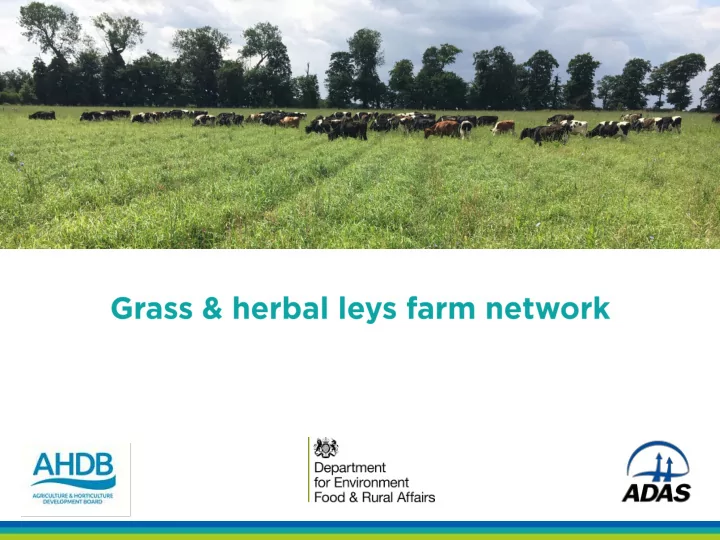
Value of grass/herbal leys in improving soil quality Anne Bhogal, - - PowerPoint PPT Presentation

value of grass herbal leys in improving soil quality
SMART_READER_LITE
LIVE PREVIEW

Value of grass/herbal leys in improving soil quality Anne Bhogal, - - PowerPoint PPT Presentation

Value of grass/herbal leys in improving soil quality Anne Bhogal, ADAS Using leys to manage weeds in arable rotations Lynn Tatnell, ADAS Integrating herbal leys into arable rotations Tom Chapman, Easthall Farm & St


slide-1
SLIDE 1
slide-2
SLIDE 2
  • Value of grass/herbal leys in improving soil quality
  • Anne Bhogal, ADAS
  • Using leys to manage weeds in arable rotations
  • Lynn Tatnell, ADAS
  • Integrating herbal leys into arable rotations
  • Tom Chapman, Easthall Farm & St Paul’s Walden Bury

Estate

#LeysNetwork

slide-3
SLIDE 3
  • Introduction to the network and long term aim &

vision

  • Lizzie Sagoo, ADAS
  • Break out session: Network priorities
  • Panel discussion: Practical issues of managing leys

within the rotation

  • Summary & next steps

#LeysNetwork

slide-4
SLIDE 4

Insert image here

slide-5
SLIDE 5
slide-6
SLIDE 6

www.soilsecurity.org; How do we measure and define soil health (March 2016)

slide-7
SLIDE 7

Physics Biology Chemistry

slide-8
SLIDE 8
slide-9
SLIDE 9

Soil organic matter (SOM)

  • The majority of soil functions are driven by biological processes,

underpinned by SOM decomposition

  • The ‘major currency’ in soil systems

SOM measurements – an overall indicator of soil health

slide-10
SLIDE 10
  • Improved soil structure and workability
  • Increased water holding capacity and

infiltration

  • Increased biological activity
  • Improved retention and turnover of

nutrients

  • Greater resilience to dry weather

conditions

slide-11
SLIDE 11

Source: Verheijen et al., 2005

Grasslands (E&W) Arable (dry) Arable (wet)

slide-12
SLIDE 12

SOM Content Time

Increase inputs (or slow down decomposition) Initial Equilibrium Transition Final Equilibrium

  • Annual rate of increase

declines as a new equilibrium is reached

  • SOM will not accumulate

indefinitely

slide-13
SLIDE 13

Apply organic materials: 0.5 - 2.5 t/ha/yr Change cultivation practices: - 1.7 - +0.7 t/ha/yr Grow higher yielding crops: 0.17 - 0.34 t/ha/yr Landuse change:

  • 1.7 - + 1.4 t/ha/yr
  • A needle in a haystack?

Data from Dawson & Smith, 2006

slide-14
SLIDE 14

SOIL ORGANIC MATTER VEGETATION CO2 CO2 OM (roots/residues/ manures) CH4 Rainfall SURFACE & GROUND WATERS Dissolved OM; Sediment LIVESTOCK

INCREASE INPUTS REDUCE LOSSES

slide-15
SLIDE 15

We will seek out ways to work with farmers to achieve good soil management practices, including appropriate tillage choices, reintroducing grass leys into arable rotations and the use of cover crops.

slide-16
SLIDE 16
slide-17
SLIDE 17

1 2 3 4 5

2001 2007

Sample date Soil organic C (%) Initial sample (autumn 2001) Arable (autumn 2007) Arable reversion grassland (autumn 2007)

24% increase in SOC after 6 years of arable reversion to grassland (heavy clay soil)

slide-18
SLIDE 18

Change in SOC under grass/arable and ley arable rotations

(Courtesy of D. Powlson, RR)

slide-19
SLIDE 19

Changes in soil organic matter over 70 years in continuous arable and ley–arable rotations at Woburn

Johnston et al., 2017 EJSS Volume: 68, Issue: 3, Pages: 305-316, DOI: (10.1111/ejss.12415)

Grass/clover ley Lucerne ley up to 1973; Grass/clover Arable Arable (with root crops & fallows)

slide-20
SLIDE 20
slide-21
SLIDE 21

SOC Bulk density Earthworms

Jarvis et al. (2017 https://doi.org/10.1016/j.agee.2017.06.042

6 yr rotation in Sweden Length of ley: 5 yrs 3 yrs 2 yrs 1 yr

slide-22
SLIDE 22

Network Survey:

  • Q. Is soil quality an important

factor?

“Water holding capacity is

greatly increased & erosion reduced” “I haven’t needed slitters or subsoilers since growing leys” “I’ve seen a huge improvement in our soils over 3 years”

Online survey March 2018

slide-23
SLIDE 23
slide-24
SLIDE 24

Organic material Dry Matter Application rate (t/ha) NVZ 250kg N/ha Organic carbon applied (t/ha) Cattle FYM 25% 42 5.5 Broiler litter 60% 8 2.5 Green Compost 60% 33 4.5 Green/Food Compost 60% 22 5.0 Organic material Dry Matter Application rate (t/ha) NVZ 250kg N/ha Organic matter applied (t/ha) Cattle FYM 25% 42 5.5 Broiler litter 60% 8 2.5 Green Compost 60% 33 4.5 Green/Food Compost 60% 22 5.0

slide-25
SLIDE 25
  • Managed as a hay meadow –

can’t extrapolate to more intensively managed grasslands

Soil carbon changes between 2002 and 2011 as affected by (log) plant species richness and the presence (orange triangles) and absence of legumes (blue circles); Source: Lange et al. 2014; Nature Comm.

slide-26
SLIDE 26
slide-27
SLIDE 27
slide-28
SLIDE 28

Soil Biology and Soil Health Partnership

Research and Knowledge Exchange

  • Five years research &

knowledge exchange on soil biology and soil health

  • Improve on-farm

understanding of soil health

  • Developing and validate

indicators of soil biology and soil health

slide-29
SLIDE 29
slide-30
SLIDE 30
slide-31
SLIDE 31

#LeysNetwork

slide-32
SLIDE 32

Usin ing le leys to manage weeds in in an arable rotation

Lynn Tatnell ll, ADAS Bo Boxw xworth

slide-33
SLIDE 33

Outline

  • Why do we need to manage weeds?
  • Herbicide resistance
  • Loss of actives
  • Yield loss
  • Breaking the weed seed cycle
  • Seed return
  • Seed bank
  • Species as future weeds!
  • Monitor and manage
  • Long term thinking
slide-34
SLIDE 34

UK resistant species: year 1st detected

1982 1990 1993 2000 2001 2002

slide-35
SLIDE 35

Counties with herbicide-resistant Black-grass (by 2016)

First found 1982

20,000 farms in 37 counties

(Angus and Shropshire added)

First found 1982

slide-36
SLIDE 36

Counties with herbicide-resistant Italian rye-grass (by 2016)

First found 1990

Now >475 farms in 34 counties

(Cheshire added)

slide-37
SLIDE 37

Counties with herbicide-resistant Wild-oats (by 2016)

First found 1993

Now >250 farms in 28 counties

slide-38
SLIDE 38

Reality of resistant black-grass: Familiar sight?

slide-39
SLIDE 39

Essex

Photo source: Syngenta UK Ltd

slide-40
SLIDE 40

Cambridgeshire

Photo source: Syngenta UK Ltd

slide-41
SLIDE 41

135 Black-grass resistance test results in 2013

Enhanced metabolism ALS resistance ACCase target site

46%

19% 4% 10% 7% 3% 9% 66% 84% 75% 2% samples were all S or R?

slide-42
SLIDE 42

Cultivation Herbicides Drilling date Crop choice

Rotation essential for sustainable weed

management

?

slide-43
SLIDE 43

Weed seed cycle

Flowering plants Young plants Seed bank & germination Seeds

slide-44
SLIDE 44

Black-grass and yield loss

500 BG heads/m²

= 63%

Yield loss

100 BG heads/m²

= 13%

yield loss

slide-45
SLIDE 45

And then there’s seed return! 1 plant 10 ears Seeds/ear 80-150 Seeds/ Plant 200-2000

slide-46
SLIDE 46

Black-grass seed return per head

slide-47
SLIDE 47

Seed return for black-grass

500 heads/m² =

54,000 seeds/m²

100 heads/m² =

7,000 seeds/m²

slide-48
SLIDE 48

1 plant 10 heads 1000 seeds

slide-49
SLIDE 49

Seed return from 10 plants/m2

Heads per m2 before harvest 100 Seed return per ha 100 million Seed return in 10 ha field 1 billion 1 shot of seed 0.8 of ton bag 8 ton bags

0.8 x8

slide-50
SLIDE 50

Heads per m2 before harvest 500 Seed return per ha 500 million Seed return in 10 ha field 5 billion

1.2 pints/m2 4 ton bags/ha x4 x40 40 ton bags/10ha

Seed return from 50 plants/m2

slide-51
SLIDE 51

Managing the seedbank

  • the heart of all good weed control!
  • Soil contains many weed seeds

– the ‘seedbank’

  • Weeds generally emerge only from the top 5cm of soil
  • Cultivations stir the seedbank, bury fresh seed and bring old

seed up

  • Some buried seed becomes dormant, some dies
  • Prevent weeds from setting and shedding seed
slide-52
SLIDE 52

Seed longevity

Longevity Grasses Broad-leaved weeds Under 1 year Soft brome, rye brome, barren brome, volunteer cereals, oats Volunteer sunflower, linseed 1-5 years Perennial rye-grass, black- grass and winter wild-oat Chickweed, crane’s bill, creeping thistle, mayweed Over 5 years Wild-oat, Italian rye-grass and many others Black-bindweed, charlock, common poppy, speedwells, volunteer rape

slide-53
SLIDE 53

Weed germination periods differ

5-20%

  • ver 20%

Aug Sep Oct Nov Dec Jan Feb Mar Apr May Jun Jul Black-grass Spring wild-oat Cleavers Barren brome Annual meadow grass Crane’s bill Chickweed Volunteer cereals

slide-54
SLIDE 54

Network survey results for weeds

Q: Does your use of grass/herbal ley help you control black-grass? No black-grass Yes Yes, but low black-grass 47.5% 20% 32.5% 40 responses

slide-55
SLIDE 55

Network survey results for weeds

Q: Do you see an increase in any other weed species in crops following a ley? 40 responses 70% 15% 15% No problems Yes Too early

slide-56
SLIDE 56

Species reported in survey to have increased as a weed problem

  • Broad-leaved weeds generally
  • Polygonums
  • Fat hen
  • Dandelions
  • Thistle (sow thistle? Creeping?)
  • Not the ley species but need careful consideration
  • Grazing compaction can lead to weed germination
  • r colonisation
slide-57
SLIDE 57

Preventing future weeds!

  • Carefully consider ley species mix
  • Ensure seed rate high enough to compete with weeds
  • Consider your own soil type
  • Consider your rotational crop choices
  • Think about weed seedbank – prevent seed return
  • Manage individual species if problematic
  • Monitor success/failure of control
  • Longer term thinking for weed control- essential
slide-58
SLIDE 58

Long term benefits of a rotational ley

  • Integrated Weed Management – IWM
  • Widens the choices – herbicides, cultural control
  • Reduces weed seed bank
  • Resistance management improved
  • Retain current herbicides
  • Improves crop yields
  • Improves soil health
slide-59
SLIDE 59

Questions?

slide-60
SLIDE 60

Integrating Herbal Leys into Arable Rotations

Tom Chapman Farmer, Estate Manager & Consultant

slide-61
SLIDE 61

St Paul’s Walden Estate

  • 2,000 acres
  • 150 sucklers plus followers
  • 900 acres arable contract-farmed
  • 500 acres woodland
  • Let houses
  • Commercial & office lets
  • Boreholes for drinking water
  • Photovoltaic
  • Shoot
  • Sawmill & wood drying kiln
slide-62
SLIDE 62

Nuffield Scholarship – Part 1

Groundswell 2017

slide-63
SLIDE 63

N American mob graziers

slide-64
SLIDE 64

Nuffield Scholarship – Part 2

Groundswell 2017

slide-65
SLIDE 65

S American mixed farmers

Groundswell 2017

slide-66
SLIDE 66

Difference between a Grass & a Herbal Ley

  • Grass Ley: Usually Ryegrass

& Clover

  • Herbal Ley: Many different

broadleaf and grass varieties

slide-67
SLIDE 67

Why We Farm

6CO2 + 6H2O C6H12O6 + 6O2

slide-68
SLIDE 68

Photosynthesis Equation

Carbon Dioxide + Water Glucose + Oxygen (Sunlight Energy)

Sun’s energy is captured and locked into the glucose molecule

slide-69
SLIDE 69

Releasing the Sun’s Energy

slide-70
SLIDE 70

Capturing the sun

2 4 6 8 10 12 14 Jan Feb Mar Apr May Jun Jul Aug Sep Oct Nov Dec

slide-71
SLIDE 71

Capturing the sun

2 4 6 8 10 12 14 Jan Feb Mar Apr May Jun Jul Aug Sep Oct Nov Dec

slide-72
SLIDE 72

Soil OM is captured sunlight

slide-73
SLIDE 73

Why herbal leys rather than grass leys?

Above Ground:

  • Improved capture of sunlight
  • More diverse & balanced diet for livestock

– Anthelmintic & other properties

  • Wider growing window & more balanced growth curve

– At either end of the season – During the heat of summer

  • Species self-select for different soil types
  • Naturally controls many arable weeds eg blackgrass
slide-74
SLIDE 74

Why herbal leys rather than grass leys?

Below Ground:

  • Different rooting depths

– Reduces competition for water – larger volume of soil – Pulls nutrients to the surface from a greater depth of soil

  • More organic matter at varying depths means soil improves

more quickly = FERTILITY!

slide-75
SLIDE 75

Plants for Soil Fertility

slide-76
SLIDE 76

Incorporating leys into an arable rotation

  • Where to locate the ley?

– Infrastructure: Fencing, water, access, handling pens etc – Weed control: eg blackgrass infestation etc – Term of ley: what is length of arable rotation? How will it fit in? What crop should follow the ley?

slide-77
SLIDE 77

Choice of plant species

  • Cool season & warm season grasses & broadleaves
  • What is suited to your local climate & soil types?
  • How are you planning to use the ley?
  • Use seedsman for advice
slide-78
SLIDE 78

Cool Season Grasses Barley Rye Wheat Triticale Cocksfoot Cool Season Broadleaves Lentil Pea Forage Radish Sweet clover Chicory Warm Season Grasses Maize Sorgum Sudangrass Warm Season Broadleaves Buckwheat Hairy Vetch Sunflower Cowpea

Plant Groups

slide-79
SLIDE 79

Establishment

  • Straight after harvest (as per OSR) works best in my experience

– Soil still warm – Usually some moisture – Plants establish before winter and allows earlier grazing in spring

  • Plough, or Direct Drill, or Broadcast?

– Retention of soil structure is key – Aim for maximum soil coverage – Drill larger & broadcast smaller?

  • Rolling is essential, especially if ploughing, to reconsolidate
slide-80
SLIDE 80

Wet weather – new leys

Groundswell 2017

slide-81
SLIDE 81

Establishment (continued)

  • Canvassed the opinions of
  • ther farmers:

– d/d westerwolds or festoliums for 1 year ley – Biodrill mounted to rolls – d/d straight into stubbles – Broadcast into standing crop – Undersow spring oats using Einbock, then roll

Biodrill Einbock

slide-82
SLIDE 82

Utilising the ley

  • Grazing
  • Silage
  • Hay
slide-83
SLIDE 83

Utilising the ley

  • Grazing

– Requires suitable infrastructure: Fences, water, handling facilities

slide-84
SLIDE 84

Fencing ideas – arable land

slide-85
SLIDE 85

Water Options

Groundswell 2017

  • Permanent mains-fed supply
  • Water bowser
  • Temporary overground pipes
  • Water pump and temporary trough
slide-86
SLIDE 86

Water

Groundswell 2017

slide-87
SLIDE 87

Utilising the Ley

  • Silage

– Do you have a use for it? – Alternatively, do you have a ready market locally (costly to transport)

slide-88
SLIDE 88

Utilising the Ley

  • Hay / haylage

– Specialist area, especially if trying to enter the horse market – Difficulties in making hay if using multi-species herbal leys – Storage required (hay) and possible issues with rodents (haylage)

slide-89
SLIDE 89

How To Become A Mixed Farm

What you need:

Access to Land Capital investment Livestock Farmer

slide-90
SLIDE 90

How To Become A Mixed Farm

  • Neighbouring Farmer
  • Farmer’s Son
  • New Entrant / College Leaver
  • Grazing management company

Livestock Farmer

slide-91
SLIDE 91

How To Become A Mixed Farm

  • Change in Rotations

– More cover crops / More spring cropping – 4/5 year grass / forage leys

  • Land tenure

– Grazing licence / share farming / FBT / Other Access to Land

slide-92
SLIDE 92

How To Become A Mixed Farm

  • Landowner
  • Existing Livestock Farmers
  • Private Individual
  • ‘Green’ Investment Funds

Capital investment

slide-93
SLIDE 93

Destroying the crop

  • Chemical

– eg spray off with dessicant

  • Mechanical

– eg plough & power harrow

  • Alternatives?

– Heavy grazing / stubble turnips followed by shallow cultivation in spring

slide-94
SLIDE 94

Establish the following crop

  • Concern over frit fly and leatherjacket damage esp after grass

ley

slide-95
SLIDE 95

Establish the following crop

  • Should a grass ley be followed by a legume crop to ‘clean’ the

ground?

  • Conversely, a herbal ley may have more broadleaf volunteers

in the following crop so would a cereal be a better option?

  • Work required on savings: fertiliser; herbicides etc for crops

following herbal ley

slide-96
SLIDE 96

Soil Crop Health Timeline

slide-97
SLIDE 97

The Golden Rules

  • 1. Always keep soil covered
  • 2. Try to keep a growing crop

in the ground at all times

  • 3. Grow a mixture of plant

types through the year

  • 4. Do not cultivate or disturb

the soil

  • 5. Include grazing livestock in

your rotations

slide-98
SLIDE 98

Heifers Grazing Cocktail-Mix Ley

slide-99
SLIDE 99

Heifers Grazing Cocktail-Mix Ley

Lucerne Cocksfoot Chicory Timothy Red & white clovers Sweet clover Birdsfoot trefoil Sainfoin

Plus: Peas, forage rape, stubble turnips, maize, sunflowers, wheat and forage rye

slide-100
SLIDE 100
slide-101
SLIDE 101

The Future (by Tom Chapman!)

Capturing Sunlight Healthy Soils Grazing Livestock

slide-102
SLIDE 102
slide-103
SLIDE 103
  • Network of farmers, researchers & industry

partners

  • Platform to investigate long term (>5-10 yrs)

impacts of leys in rotations

  • Impact on soil quality
  • Benefits to following crops in rotation
  • Effectiveness at controlling blackgrass
  • Other…
  • Link to other organisations and on-going

projects

slide-104
SLIDE 104

128 registered with the network (14th April)

slide-105
SLIDE 105
  • To register people with the network
  • Collect information on use of/interest in leys
  • Farmers with leys -
  • Management of leys
  • Willing to take part in research?
  • www.smartsurvey.co.uk/s/grassandherballeysnetwork/
slide-106
SLIDE 106
  • Currently 94 responses
  • Including 52 from farmers
  • 42 farmers with leys in rotation
  • 10 farmers without leys
  • 90% of farms with leys willing to take part in

monitoring

  • Includes farms across the country on range of soil types &

with a range of management regimes

slide-107
SLIDE 107
slide-108
SLIDE 108
slide-109
SLIDE 109

Use of grass/herbal ley Length of ley

slide-110
SLIDE 110

Method of ley establishment Cultivations prior to following crop

slide-111
SLIDE 111
  • Identify and prioritise areas for research
  • What are the knowledge gaps and barriers to -
  • Increasing the adoption of grass/herbal leys within

rotations

  • Improving the utilisation & efficiency of leys
  • How do you want to engage with the network?
  • 45 minutes
slide-112
SLIDE 112
slide-113
SLIDE 113
  • Continue to expand the network
  • Collate feedback from today and from survey
  • Future network strategy report
  • Email update to network July 2018
slide-114
SLIDE 114