EMBC Tutorial on Interpretable and Transparent Deep Learning - - PowerPoint PPT Presentation

embc tutorial on interpretable and transparent deep
SMART_READER_LITE
LIVE PREVIEW

EMBC Tutorial on Interpretable and Transparent Deep Learning - - PowerPoint PPT Presentation

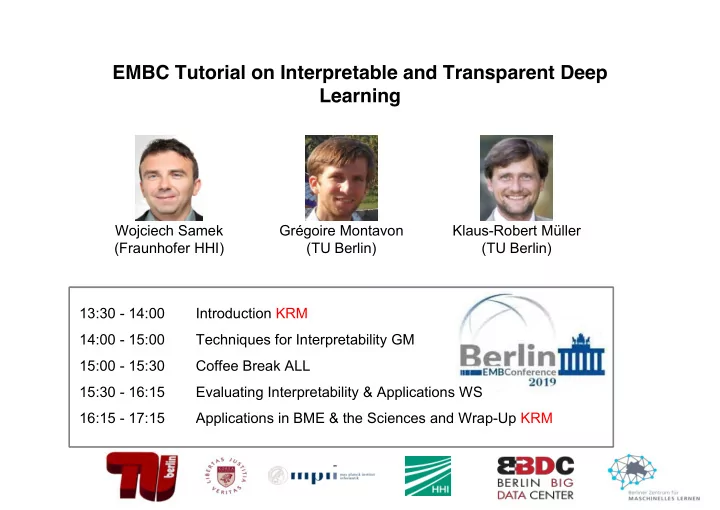
EMBC Tutorial on Interpretable and Transparent Deep Learning Wojciech Samek Grgoire Montavon Klaus-Robert Mller (Fraunhofer HHI) (TU Berlin) (TU Berlin) 13:30 - 14:00 Introduction KRM 14:00 - 15:00 Techniques for Interpretability GM


slide-1
SLIDE 1

EMBC Tutorial on Interpretable and Transparent Deep Learning

Wojciech Samek (Fraunhofer HHI) Grégoire Montavon (TU Berlin) Klaus-Robert Müller (TU Berlin) 13:30 - 14:00 Introduction KRM 14:00 - 15:00 Techniques for Interpretability GM 15:00 - 15:30 Coffee Break ALL 15:30 - 16:15 Evaluating Interpretability & Applications WS 16:15 - 17:15 Applications in BME & the Sciences and Wrap-Up KRM

slide-2
SLIDE 2

Why interpretability?

slide-3
SLIDE 3

Why interpretability?

slide-4
SLIDE 4

Why interpretability?

slide-5
SLIDE 5

Why interpretability?

slide-6
SLIDE 6

Why interpretability? Insights!

slide-7
SLIDE 7

Why interpretability?

slide-8
SLIDE 8

Overview and Intuition for different Techniques: sensitivity, deconvolution, LRP and friends.

slide-9
SLIDE 9

Understanding Deep Nets: Two Views

Understanding what mechanism the network uses to solve a problem or implement a function. Understanding how the network relates the input to the output variables.

slide-10
SLIDE 10
slide-11
SLIDE 11

Approach 1: Class Prototypes

Image from Symonian’13

“How does a goose typically look like according to the neural network?”

goose non-goose

Class prototypes

slide-12
SLIDE 12

Approach 2: Individual Explanations

Images from Lapuschkin’16

“Why is a given image classified as a sheep?”

sheep non-sheep

slide-13
SLIDE 13
  • 3. Sensitivity analysis

Sensitivity analysis: The relevance of input feature i is given by the squared partial derivative: evidence for “car”

DNN

input

slide-14
SLIDE 14

Understanding Sensitivity Analysis

Problem: sensitivity analysis does not highlight cars Sensitivity analysis explains a variation of the function, not the function value itself. Observation: Sensitivity analysis:

slide-15
SLIDE 15

Sensitivity Analysis Problem: Shattered Gradients

[Montufar’14, Balduzzi’17]

Input gradient (on which sensitivity analysis is based), becomes increasingly highly varying and unreliable with neural network depth.

slide-16
SLIDE 16

Shattered Gradients II

[Montufar’14, Balduzzi’17]

Example in [0,1]:

Input gradient (on which sensitivity analysis is based), becomes increasingly highly varying and unreliable with neural network depth.

slide-17
SLIDE 17

LPR is not sensitive to gradient shattering

slide-18
SLIDE 18

Explaining Neural Network Predictions

Layer-wise relevance Propagation (LRP, Bach et al 15) first method to explain nonlinear classifiers

  • based on generic theory (related to Taylor decomposition – deep taylor decomposition M et al 16)
  • applicable to any NN with monotonous activation, BoW models, Fisher Vectors, SVMs etc.

Explanation: “Which pixels contribute how much to the classification” (Bach et al 2015) (what makes this image to be classified as a car) Sensitivity / Saliency: “Which pixels lead to increase/decrease of prediction score when changed” (what makes this image to be classified more/less as a car) (Baehrens et al 10, Simonyan et al 14)

  • Cf. Deconvolution: “Matching input pattern for the classified object in the image” (Zeiler & Fergus 2014)

(relation to f(x) not specified)

Each method solves a different problem!!!

slide-19
SLIDE 19

Classification cat ladybug dog large activation

Explaining Neural Network Predictions

slide-20
SLIDE 20

Explanation cat ladybug dog

=

Initialization

Explaining Neural Network Predictions

slide-21
SLIDE 21

Explanation cat ladybug dog Theoretical interpretation Deep Taylor Decomposition ?

Explaining Neural Network Predictions

depends on the activations and the weights: LRP naive z-rule

slide-22
SLIDE 22

Explanation cat ladybug dog Relevance Conservation Property

Explaining Neural Network Predictions

large relevance

slide-23
SLIDE 23

Gradients

LRP (Bach et al., 2015) Deep Taylor Decomposition (Montavon et al., 2017 (arXiv 2015)) LRP for LSTM (Arras et al., 2017) Probabilistic Diff (Zintgraf et al., 2016) Sensitivity (Baehrens et al. 2010) Sensitivity (Simonyan et al. 2014) Deconvolution (Zeiler & Fergus 2014) Meaningful Perturbations (Fong & Vedaldi 2017) DeepLIFT (Shrikumar et al., 2016)

Decomposition

Sensitivity (Morch et al., 1995) Gradient vs. Decomposition (Montavon et al., 2018)

Optimization

Guided Backprop (Springenberg et al. 2015) Integrated Gradient (Sundararajan et al., 2017) Gradient times input (Shrikumar et al., 2016) PatternLRP (Kindermans et al., 2017) LIME (Ribeiro et al., 2016)

Deconvolution Understanding the Model

Network Dissection (Zhou et al. 2017) Inverting CNNs (Mahendran & Vedaldi, 2015) Deep Visualization (Yosinski et al., 2015) Feature visualization (Erhan et al. 2009) Synthesis of preferred inputs (Nguyen et al. 2016) Inverting CNNs (Dosovitskiy & Brox, 2015) Grad-CAM (Selvaraju et al., 2016) Excitation Backprop (Zhang et al., 2016) RNN cell state analysis (Karpathy et al., 2015)

Historical remarks on Explaining Predictors

TCAV (Kim et al. 2018)