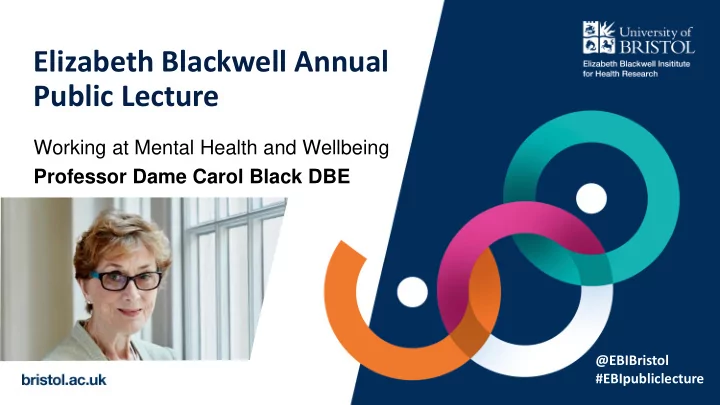
SLIDE 1 Elizabeth Blackwell Annual Public Lecture
Working at Mental Health and Wellbeing Professor Dame Carol Black DBE
@EBIBristol #EBIpubliclecture
SLIDE 2
Welcome and introduction by
Professor Rachael Gooberman-Hill Director of the Elizabeth Blackwell Institute for Health Research Professor Jane Norman Dean of Health Sciences
SLIDE 3 Practicalities
- Hearing loop: middle of the room best
- Quiet room: room 1.5 opposite the
Great Hall
- First Aid: do let a staff member know
- Elizabeth Blackwell Institute staff:
wearing purple lanyards
- Drinks Reception: in Reception Room
- Fire assembly point: exit left from main entrance
- Toilets: on the ground floor, including inclusive
and accessible toilet
SLIDE 4
Welcome and introduction by
Professor Rachael Gooberman-Hill Director of the Elizabeth Blackwell Institute for Health Research Professor Jane Norman Dean of Health Sciences
SLIDE 5 Elizabeth Blackwell Annual Public Lecture 2019
Working at Mental Health and Wellbeing Professor Dame Carol Black DBE
Chair of the British Library, and the Centre for Ageing Better Adviser on Health, Wellbeing and Work to various Government bodies
@EBIBristol #EBIpubliclecture
SLIDE 6 Elizabeth Blackwell
- Born Bristol 1821, moved to USA 1832
- Started as teacher, but entered US medical school 1847
- First woman to graduate from a US medical school.
- First woman listed on the British Medical Register.
Her medical interests included Public Health, women’s and children’s health, and education – she founded a medical school in 1860.
A tireless pioneer
SLIDE 7
My own journey – starting in Bristol
}
SLIDE 8 The ‘light bulb’ moment …
- The social gradient
- Stress
- Early life
- Social exclusion
- Work/Unemployment
- Social support
- Addiction
- Food
- Transport
.. while President of the RCP, working with the Faculty of Occupational Medicine. The determinants of health are largely social :
Marmot, and others
SLIDE 9 Work
Sickness absence
Work Capability Assessment
ESA JSA Work Inactivity
The scope of my work
Claim to Employment Support Allowance (ESA) Work Capability Assessment (WCA)
Wait for WCA often long – many appeals Too few drivers in the journey keeping people in work
SSP/OSP
Support BUT too late LEAVE WORK
School
Apprenticeship etc Higher Education
FALL ILL and
Out of work
BENEFITS
SLIDE 10 My passion
- Enabling individuals to have good health and wellbeing …
- … so that they find quality in life and purposeful activity.
- Such activity is often work – paid or unpaid.
- Major barriers to this :
- poor Mental Health and wellbeing
SLIDE 11 The Continuum
- I shall talk mainly about the workplace ….
- …. which has been my interest since 2006.
BUT
- The factors that affect workers – stress, poor sleep, financial
concerns, harassment and bullying – are also to be found in Higher Education, and some of them in schools.
- This topic needs a joined-up approach.
SLIDE 12 What Works Centre for Wellbeing
- Founded 2015, “an independent collaborative centre that
puts high-quality evidence on wellbeing into the hands of decision-makers in government, communities, businesses and other organisations.”
- “We bring pioneering thinkers together from across these
sectors to share ideas and solutions.”
- “Our goal: to improve, and save, lives through better
policy and practice for wellbeing.” Wellbeing at Work : five main drivers: Health, Relationships, Security, Environment, Purpose
SLIDE 13 Why invest in employee wellbeing ?
A number of studies point to the potential benefits for employers who choose to invest in employee wellbeing. Better performance : Organisations with high levels of employee wellbeing have
- utperformed the stock market by around 2% per year over 25 years.
London Business School, 2015
Reduced costs : Average cost of absence and presenteeism due to ill-health is around 8% of a company’s wage bill. Telegraph, Britain’s Healthiest Company survey 2015 Total cost of sickness absence to UK business c. £15 bn per year. Black/Frost 2011 Higher creativity : Organisations promoting health and wellbeing are seen as 3.5 times more likely to be creative and innovative. World Economic Form 2010
SLIDE 14
Wellbeing and economic performance
SLIDE 15 Preventing people from working
Common Mental Common MSK Chronic medical Major functional Health problems problems conditions (multiple?) incapacity Stress, anxiety Back pain, Diabetes, lung, Major trauma, depression neck pain, heart (obesity- addictions, soft-tissue related), cancer, neurological rheumatism inflammatory disabilities. arthritis
Social determinants of health Poor workplaces, poor work, poor managers
SLIDE 16
What are the everyday challenges on the ground? What are the solutions?
SLIDE 17 Using Britain’s Healthiest Workplace survey to understand workers’ health
now in its seventh year
430
150k
employees
>20m
data points
Independence Independent Advisory Board Rigour Scale
SLIDE 18 40-minute online completed by management 20-minute
completed voluntarily by employees Comprehensive, on
with benchmarking information, site visit if possible, and
suggestions for improvement
Organisational Health Assessment Employee Health Assessment
Organisational Health Report Inputs Outputs Employee Health Report Immediate personal report, identifying lifestyle and health risks, with suggestions for improvement
How are data collected and fed back?
SLIDE 19
Risk factors that impact upon productivity loss (average days per yr)
Mental Wellbeing risks: Bullying 6 days to Depression 19 Lifestyle risks : Obesity 1.2 days to Sleep Lack 6.4 days
SLIDE 20 Change in risk factors and change in productivity loss
Reduction in work impairment days (per year) associated with reduction in risk factors
Reduced MSK pain 0.8 per condition Reducing added fats 2.5 Physical activity times 5 2.6 (from 30 to 150 mins/wk) Reduced time pressure 2.9 No longer bullied 5.0 Sleep up from 4 to 7 hours 5.2 Now few financial concerns 5.8 Reduced salt intake 6.2
No longer depressed 31.0
SLIDE 21
BHW: Messages from 2018 UK cohort
Analysis of 26,432 employees in 129 organisations Average days lost due to absence and presenteeism, per employee per year, 35.6 days Best-performing company in survey, Nomura 18 days 55 mins of every lost productive hour is due to presenteeism Over one third of productivity loss is related to work stress and lifestyle choices Average productivity loss per employee translates to £81bn annual cost to UK economy
SLIDE 22 Risk factors for MH are the most significant drivers
- f work impairment for UK employees
33% 15% 13% 14% 25%
Attribution of UK productivity loss due to ill-health-related absence and presenteeism Mental Health
Physical and Lifestyle Chronic conditions Financial concerns
One-third
- f total productivity loss of
UK employees is attributable to mental health and wellbeing issues. 2018
Other
SLIDE 23 Essential Enablers of Mental Health and Wellbeing
Leadership Board engagement Manager capability
- These are essential to mental
Health and Wellbeing of employees.
- They support organisational
culture …..
- …. but are often forgotten.
After them, think of:
SLIDE 24 Culture is key - very strong relationship between line manager support and mental wellbeing
My line manager cares about my health and wellbeing….
Symptoms of depression 2 or more stress factors Sleep <7 hours per night
23% 13% 6% 4% 4% 91% 79% 42% 22% 13% 45% 36% 33% 28% 27%
Note: adjusted for age, income and gender
SLIDE 25 Line Managers’ Health and Wellbeing
Have you ever had health problems yourself that affected your work capacity?
Survey 2017 Switzerland
44.6 34.1 12.4 9.0
I have never had health problems I have had physical problems I have had psychological problemsI have had both physical and psychological problems
% Never Physical
Psychological
Psychological and Physical
- Selected slides from a presentation by Niklas Baer at the OECD Wellbeing Week, October 2018
- Data from 2017 survey of 1,540 managers of Small or Medium Enterprises in the German part of Switzerland.
SLIDE 26 Healthy managers’ employees
Conclusion: healthy managers do not have ill employees
9% 17% 20% 32% 5% 6% 16% 27%
I have never had any health problems (45%) I have had physical problems (34%) I have had psychological problems (12%) I have had physical and psychological problems (9%)
Perceived % of employees with physical problems Perceived % of employees with psychological problems
- Selected slides from presentation by Niklas Baer at OECD Wellbeing Week, October 2018
- Data from a 2017 survey of 1,540 managers of Small or Medium Enterprises in the German part of Switzerland.
SLIDE 27 Mental Ill-Health – its relationships
and MSK problems
SLIDE 28
- What is the extent/incidence of problems?
- What is the dimension of MH issues?
- Which sections of staff are most at risk?
- Are there any particularly exposed groups?
Do you know your data?
SLIDE 29 High incidence of MH issues in the UK workforce, across a broad range of dimensions
“A lot” of financial concerns
9.6%
Symptoms of depression
7.9%
Subject to frequent bullying
1.1%
Depression Factors contributing to MH concerns
At least 1 type of work stress
58.1%
SLIDE 30 Mental Health concerns are negatively correlated with income and seniority
Subject to frequent bullying
Incidence of concerns by income (adjusted for age and gender):
0.0 0.2 0.4 0.6 0.8 1.0 1.2 1.4 1.6 £10-20k >£150k
Symptoms of depression
2 4 6 8 10 12 14 16 £10-20k >£150k % at risk % at risk
At least 1 type of work stress
10 20 30 40 50 60 70 £10-20k >£150k % at risk
“A lot” of financial concerns
3 6 9 12 15 18 21 £10-20k % at risk >£150k
SLIDE 31 Younger employees are most exposed to MH concerns, across the board
Incidence of concerns by age (adjusted for income and gender):
Subject to frequent bullying
0.0 0.5 1.0 1.5 2.0 2.5 3.0 18-20 >66 % at risk
Symptoms of depression
3 6 9 12 15 18 21 >66 18-20 % at risk
At least 1 type of work-related stress
10 20 30 40 50 60 70 18-20 >66 % at risk
“A lot” of financial concerns
2 4 6 8 10 12 14 16 18-20 >66 % at risk
SLIDE 32 Employees, particularly the young, are reluctant to use MH interventions offered by their employer
36% 8% 7% 22% 11% 13% 19% 55% 65% 61% 21% 6% 14%
My line manager Another senior manager A mentor or coach from within my
Another colleague Someone in Human Resources Someone in Occupational Health or an
counsellor A confidential helpline Friends Family members A GP Websites A charity Another health professional
Who or where, would you go to for support if you were experiencing a mental health problem?
Sources of support at work
Line manager support is key
Other sources of support
Friends, family and GP are the most commonly-used sources of support
SLIDE 33 The common basket of Mental Health interventions
Information leaflets etc Mindfulness MH First Aid Cognitive Behaviour Therapy EAP Volunteering Resilience /anti-stress Massage/relaxation classes Financial Wellbeing On line/app resources Coaching Physical activity
Which ones make a difference? Who uses them?
SLIDE 34 Employees are largely unaware of the MH interventions available to them at work
Total employee population Access to mental health interventions
Awareness of interventions
Participation
After taking into account access, awareness and participation rates,
- nly 3%
- f employees use mental health and
wellbeing interventions in the workplace Of those that do,
71%
feel that the interventions improve their mental health
SLIDE 35 Massage, mindfulness and volunteering optimise participation and health-improvement rates
0% 10% 20% 30% 40% 50% 60% 70% 80% 90% 0% 5% 10% 15% 20% 25% 30% 35% 40% 45% 50%
Mental health improvement rate Participation rate
Effectiveness of mental health interventions (participation x health improvement rate) Volunteering / charity work Mental health training Resilience and stress management training Mindfulness Massage and relaxation classes
Survey 2018
SLIDE 36
- Know your own Staff, data and demographics – organisations vary.
- Create the right organisational enablers.
- Know the dimension/extent of your challenges, and the most
exposed groups.
- Ask Staff what they think will work best.
- Use evidence-based or best practice interventions
- Work hard on participation
- Collect data and evaluate.
What can and should employers do?
SLIDE 37
The Continuum
Period Influences
Early years Parents, home, social determinants of health School Parents, teachers, environment University Transition, part student part worker, environment crucial The World of Work Need for ‘good work’ and ‘good workplaces’
We need healthy, engaged, sustainable workers.
SLIDE 38
“Mentally Healthy Universities” project
Collaboration between : National Mind, Goldman Sachs, and 10 local partners (including Bristol and Cambridge) Design :
SLIDE 39 Student Mental Health and Wellbeing, Cambridge
Extract from the Implementation Plan : “ To be successful, it is widely acknowledged by Universities UK that work
- n student mental health and wellbeing must take a whole-institution approach.
This means that it will extend to identify how to support staff, on their own wellbeing and on ways to support students. The plan will also need to cover a wide range of existing work, on academic workloads, equality & diversity, international strategy, and postgraduate experience Any successful action plan will need to be widely endorsed across the collegiate University, and carefully co-ordinated.”
SLIDE 40 Cambridge Medical Students
Addenbrooke’s Hospital Concerns raised by :
- Faculty/Peers
- Students for others
- The failing student
Information courtesy of Dean Diana Wood, and Sub-Dean Richard Davies
SLIDE 41 Physical Health Mental Health Behaviour Performance Social
Health on the radar
(about 44%, which is about 10% of total clinical school population) Students ‘on the radar’
Reasons for coming to the team’s attention.
SLIDE 42
Presenting Issues - CSMHS
CSMHS = Clinical School Mental Health Service NHS Staff and students
SLIDE 43 Can wellbeing be embedded in schools?
Changing landscape :
- Good schools have already explored ways to teach wellbeing.
- The importance of learning about wellbeing and mental health has been
reinforced by the pending statutory requirement to teach Health Education, along with Ofsted’s new Framework.
- The Framework focuses on personal development, including resilience,
within a curriculum that meets the needs of students. The Dept of Education has a significant programme of school and college teacher and leader wellbeing recommendations, hopefully late 2019.
SLIDE 44 Bounce Forward : Healthy Minds curriculum
Bounce Forward have developed an evidence-informed wellbeing curriculum for schools, with content gathered from a project that searched internationally for the best well-tested materials. The four-year curriculum consists of 113 lessons for year 7 to 10 students. Resilience skills are taught explicitly through 26 individual lessons, or implicitly through the teaching of other topics. Research outcomes : baseline data year 7, collected again Year 9 and Year 10. Control group taught Personal, Social, Health and Economics ‘as usual’. Health and behaviour results (out 2020) show gains across all outcomes. At mid-way point, internalising and externalising behaviour shows mixed
SLIDE 45
Final word
We must work with the continuum …. … and it helps to be able to ‘bounce’.
SLIDE 46
Questions
Please raise your hand and a person with a roving microphone will come to you
SLIDE 47
Final remarks by
Professor Rachael Gooberman-Hill Director of the Elizabeth Blackwell Institute for Health Research
SLIDE 48
Thank you for coming
Keep in touch Twitter: @EBIBristol Sign up to our newsletter: www.bristol.ac.uk/blackwell
SLIDE 49 Elizabeth Blackwell Annual Public Lecture
Working at Mental Health and Wellbeing Professor Dame Carol Black DBE
@EBIBristol #EBIpubliclecture