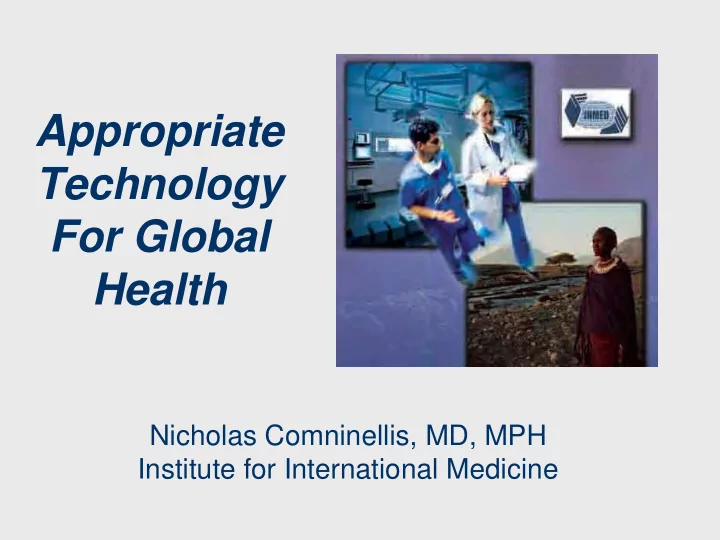
SLIDE 1
Appropriate Technology For Global Health
Nicholas Comninellis, MD, MPH Institute for International Medicine
SLIDE 2 Presentation Objectives
At the completion of this presentation, participants will be able in the context of a low-resource community to:
- Identify the controversies connected
with use of technology
- Select technology most appropriate for
given settings
SLIDE 3 Healthcare In Crisis
- Health is chronically in crisis, especially
in low resource communities.
- Wise leadership is essential by those
who understand the causes of ill health, recognize effective interventions, and possess the necessary diplomatic skills to implement them.
SLIDE 4 Learn To Think Like A Leader
- Few are taught to think like
leaders in health. Traditional medical training addresses
- nly individual patient care.
- Health leadership requires
- skill. But more importantly, it
requires motivation and
these virtues, many health professionals can become effective leaders.
SLIDE 5
Learn To Think About Health Systems
SLIDE 6
What Is A Health System?
SLIDE 7 A Health System:
- The way we go about organizing for better
health
- “The combination of resources,
- rganization, financing and management that
culminate in health services for people”
SLIDE 8
Why Consider Health Systems?
SLIDE 9
Why Consider Health Systems?
A wide variety of interventions may promote health, but may also not be appropriate or efficient for a given community.
SLIDE 10
What Basic Ethical Principles Should Apply To Health Systems?
SLIDE 11 Ethical Principles For Health Systems
- Sanctity of human life
- Alleviation of suffering
- Common good and
social justice (benefits everyone)
limited resources (cost effectiveness)
SLIDE 12
Calculating Cost-Effectiveness
Average cost of the intervention Average number of Years of Life Saved = Cost-effectiveness
SLIDE 13
Calculating Cost-Effectiveness
Cost-effectiveness of measles vaccine in West Africa: $2 (vaccination cost per person) 5 Years of Life Saved = $0.40 per Year of Life Saved
SLIDE 14
Calculating Cost-Effectiveness
Cost-effectiveness of hypertension control in West Africa: $450 (HTN control cost per person) 5 Years of Life Saved = $9 per Year of Life Saved
SLIDE 15
Effective use of limited resources includes appropriate application of technology – especially in low- resource settings
SLIDE 16 2008 Health Indicators
Nation Life Expect @ Birth Under 5 Mortality Per Capita Health Expenditure
All Low Income 59 years (M 58/F 60) 11% $16 All Africa 51 (M 50/F 52) 16% $33 Angola 41 26% $16 Liberia 44 23% $6 Niger 42 25% $6 Sierra Leone 40 27% $6 Zambia 43 18% $18 Afghanistan 42 25% $3 Iraq 56 (M 48/F 67) 5%? $14 All High Income 80 (M 77/F 82) 0.7% $2,672
SLIDE 17
What tests can be used to determine whether a technology is appropriate or not?
SLIDE 18
Reliability
SLIDE 19
Sustainability
SLIDE 20
Acceptability
SLIDE 21
What are some inappropriate uses of technology in low- resource health systems?
SLIDE 22
Inappropriate Uses Of Technology
Diagnostic imaging that is financially unsustainable
SLIDE 23
Inappropriate Uses Of Technology
Diagnostics & therapeutics that require personnel with skills that are unavailable
SLIDE 24
Inappropriate Uses Of Technology
Prescription of medications that are unavailable or unfamiliar
SLIDE 25 Inappropriate Medications
“Our healthcare team saw a Honduran lady who was treated by an American physician for her chronic neuropathic pain with a newly marketed and expensive medication. After the physician left, the lady developed severe adverse effects, with no one to care for her, let alone anyone who was familiar with the drug…”
Nancy Crigger
SLIDE 26
Inappropriate Medications
“While well intended, the physician's care was neither sustainable nor safe. Even if the drug had been effective, she would never be able to obtain it in Honduras. Using prudence in prescribing (limiting medications to those on the WHO Essential Drug List) and making sure that a local follow-up was in place may have helped the physician avoid this precarious situation."
SLIDE 27
What are some appropriate uses of technology in low- resource health systems?
SLIDE 28
Appropriate Uses Of Technology
Rapid diagnostic tests
SLIDE 29
Appropriate Uses Of Technology
Mobile health information and medical record keeping
SLIDE 30
Appropriate Uses Of Technology
Ultrasound imaging
SLIDE 31
Appropriate Uses Of Technology
Adherence to use of WHO & National Essential Drugs
SLIDE 32
How Can We Keep Technology Appropriate?
SLIDE 33
Keeping Technology Appropriate: Partnerships With Local Hosts
SLIDE 34
The guidance of local partners greatly increases the likelihood that technology will be used appropriately.
SLIDE 35 Partnership With Whom?
professionals
institutions
institutions
agencies
SLIDE 36
Appropriate Technology For Global Health
SLIDE 37
Reliability
SLIDE 38
Sustainability
SLIDE 39
Acceptability
SLIDE 40
Commit Yourself To Thinking Like A Leader
SLIDE 41
“I don't know what your destiny will be, but one thing I do know: the only ones among you who will be really happy are those who have sought and found how to serve.” Albert Schweitzer (1875 – 1965)
SLIDE 42 Institute for International Medicine
- Equipping healthcare professionals to serve the forgotten -
6400 Prospect Ave Suite 338A Kansas City MO 64132 816-444-6400
www.inmed.us
Nicholas Comninellis, MD, MPH