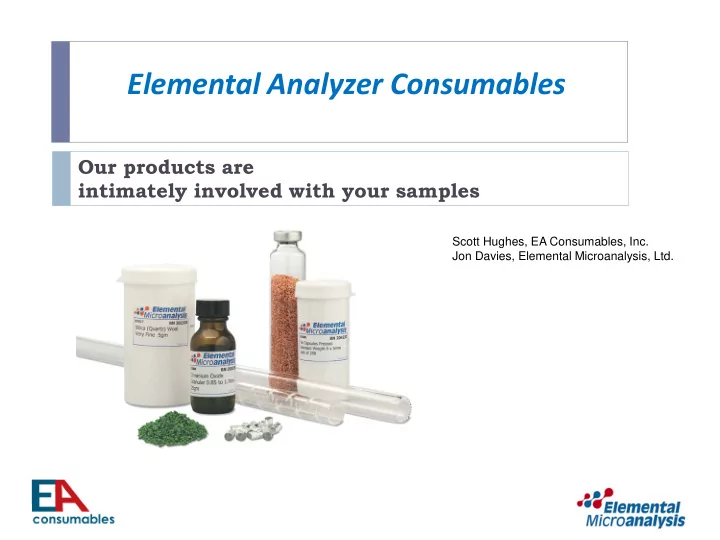
SLIDE 1 Elemental Analyzer Consumables
Our products are intimately involved with your samples
Scott Hughes, EA Consumables, Inc. Jon Davies, Elemental Microanalysis, Ltd.
SLIDE 2 Intimately Involved
A lot of focus is on the laboratory instruments
Things that cost a lot get a lot of attention Impressive and shiny for lab tours
The Big The Tenacious The Colorful
SLIDE 3 Intimately Involved
Simple truth
If you do not get complete conversion of your analyte to N2,
CO2, SO2, CO or H2, then the big expensive shiny “detectors” will not help you.
The instrumentation IS important. Has to provide:
Ability to transfer sample Hot environment with a steady carrier flow Ability to add oxygen at correct time and place and …the “detector” does matter
SLIDE 4
Intimately Involved
Analyzers and Consumables
Like the Chicken & Pig in making Breakfast
The Analyzer participates The Consumables are intimately involved
SLIDE 5
Your sample and our products have an intimate relationship
Sample Encapsulation Combustion Aides-Reaction Blocking Oxidation Reagents Interference removal Reduction Absorption materials
Focus on the nature and applications of consumables for NC and NCS determinations
SLIDE 6 Sample Encapsulation
Many Choices – Over 400 from Elemental Microanalysis
Material – Tin, Silver, Nickel, Copper, Aluminum, Cellulose Form
Capsules: Pressed, Flat bottom smooth, round bottom smooth Boats, Pans, Disks/Squares, Cones
Size – 1.06mm to 32mm diameter Weight – Standard, light weight, ultra light weight Preparation – Standard, Pre-cleaned
SLIDE 7 Encapsulation
Tin
The “go to” encapsulation material Exothermically reacts with oxygen to help in the thermal
decomposition of the sample.
Very pliable and easy to fold/work Issues
In situ carbon blank Tin oxide is corrosive to quartz at operating temperatures
SLIDE 8 Encapsulation
Silver
Typically used for oxygen determination, as there is no formation of an
- xide (at combustion temperatures) as is the case with tin
Can tarnish in storage. Will be removed at 375oC. Also used for removal of inorganic carbon from sample by acid
fumigation or addition.
No exothermic reaction. No ash, forms a silver melt in the reaction tube It is stiffer and not as easy to fold/work compared to tin Higher cost Big savings in the lightweight silver capsule options
HINT: Collect the waste. Can fund a wild lab party!
SLIDE 9 Encapsulation
Aluminum
Can be pre-combusted at 550oC to remove contaminants There is an art to get it to combust. Can inhibit full sample reaction.
Forms
Pressed – Solids Pre-cleaned in sample well Smooth wall (flat or round bottoms) – liquids Disks/Squares/Cones – sticky, fibrous, big samples Evaporating cups – liquid reduction
SLIDE 10 Life Cycle of a Pressed Capsule
Purchase of special purity foil of the
appropriate thickness and width
SLIDE 11 Life Cycle of a Pressed Capsule
Purchase of special purity foil of the
appropriate thickness and width
Feeds into custom made cutting/pressing
machine.
Cuts round disk
Pin forms capsule in die
Ejects capsule to collection bin
SLIDE 12 Life Cycle of a Pressed Capsule
Purchase of special purity foil of the
appropriate thickness and width
Feeds into custom made cutting/pressing
machine.
Cuts round disk
Pin forms capsule in die
Ejects capsule to collection bin
Waste is melted down and cast into ingots.
SLIDE 13 Life Cycle of a Pressed Capsule
Purchase of special purity foil of the
appropriate thickness and width
Feeds into custom made cutting/pressing
machine.
Cuts round disk
Pin forms capsule in die
Ejects capsule to collection bin
Waste is melted down and cast into ingots. Ingots are rolled into sheets suitable for the
extruded smooth wall capsules
SLIDE 14 Life Cycle of a Pressed Capsule
Purchase of special purity foil of the
appropriate thickness and width
Feeds into custom made cutting/pressing
machine.
Cuts round disk
Pin forms capsule in die
Ejects capsule to collection bin
Waste is melted down and cast into ingots. Ingots are rolled into sheets suitable for the
extruded smooth wall capsules
Ultra-Pure capsules get an additional solvent
wash.
Weighed into final package.
SLIDE 15
Your sample and our products have an intimate relationship
Sample Encapsulation Combustion Aides-Reaction Blocking Oxidation Reagents Interference removal Reduction Absorption materials
SLIDE 16
The path to N2, CO2, SO2
The combustion soup
Organicish Sample + O2 + heat (~1,000oC) = Volatile combustion products CO, CO2, CH4,CO3,H2O,N2,NxOx,SO2,SO3,X-,HF
Block the formation of… Chemical Oxidation to CO2 Reduce Absorb
SLIDE 17 Combustion aides
Added to sample
Additional oxygen source at point of combustion Block undesired side reaction
Stable sulfides and carbonates Will fuse with alkali and alkaline earth oxides
Vanadium Pentoxide Toxic Tungstic Oxide Powdered
SLIDE 18
Combustion aides
Fine Powders
Niobium Pentoxide Added oxygen Silver Oxide Added oxygen Cobalt Oxide Added oxygen Magnesium Oxide Added oxygen – bind F- Sucrose For inorganic fertilizers Carbon powder (high purity) as above Tin powder Added heat
SLIDE 19
Your sample and our products have an intimate relationship
Sample Encapsulation Combustion Aides-Reaction Blocking Oxidation Reagents Interference removal Reduction Absorption materials
SLIDE 20 Active Reagents, NC analysis
CE/Costech/ Eurovector Elementar Sercon/ Europa Perkin Elmer
Chromium Oxide Copper Oxide Chromium Oxide Chromium Oxide Cobaltous/ic Oxide, silvered Lead Chromate Copper Oxide Silver Tungstate on Magnesium Oxide (Silver Wool) (Silvered Copper Oxide) Silver Vanadate Silver wool Silver Gauze Copper Copper Copper Copper Silver wool Quartz chips Copper Oxide Silver wool
Combustion Reduction
SLIDE 21 Active Reagents, S or NCS analysis
CE/Costech/ Eurovector Elementar Sercon/ Eurpoa Perkin Elmer
Tungstic Oxide Tungstic Oxide Tungstic Oxide on Zirconium Oxide Tungstic Oxide on Zirconium Oxide Copper Copper Copper None Copper None None Silver wool (cooler zone)
Combustion Reduction
SLIDE 22 Not all the same
Chromium Oxide
Key impurities in the Chromium Oxide can cause devitrification of quartz
Devitrification is accelerated in the presence of Na & P ions.
Most Cr2O3 is formed from sodium dichromate, so Na is always present
Elemental Microanalysis uses a different process to form Cr2O3 to results in lower sodium impurities.
After granulation, it is further heat treated to drive off other impurities
The results is much longer tube life
The tube on the left showed no signs of devitrification after 1,000 determinations.
SLIDE 23 Not all the same
Tungsten (VI) Oxide, Tungsten Trioxide, Tungstic Oxide
These actually are all the same.
B1025 Tungstic Oxide, granular for
Costech/Thermo/Europa
Produced by reacting Scheelite (CaWO4) with HCl to form tungstic acid,
followed by decomposition to WO3
The material is tableted under very high pressure, and then ground to
the appropriate size. Results is very dense material. B1217 Tungstic Oxide, granular for Elementar
Requires a less dense granular material Produced by reacting tungsten metal with oxygen at elevated
- temperature. Results in a much less dense granule.
SLIDE 24
Your sample and our products have an intimate relationship
Sample Encapsulation Combustion Aides-Reaction Blocking Oxidation Reagents Interference removal Reduction Absorption materials
SLIDE 25 Interference Removal Reagents
Things to remove
Sulfur Cl, Br, I F H2O Oxidative help Silver Wool/Gauze Coboltous/ic Oxide Silvered Copper granules silvered Copper Oxide silvered Silver Vanadate Silver Tungstate/Magnesium Oxide Magnesium Oxide Lead Chromate Iron Wool
SLIDE 26
Your sample and our products have an intimate relationship
Sample Encapsulation Combustion Aides-Reaction Blocking Oxidation Reagents Interference removal Reduction Absorption materials
SLIDE 27
Reduction - Copper
Available in many forms
Copper Wires fine 0.5 x 4mm Copper Wires course 0.65 x 6mm Copper Granules fine 0.05 – 0.2mm Copper Granules standard 0.1 – 0.5mm Copper Granules course 0.3 – 0.85mm Copper wires highest purity for IRMS Electrolytic Copper Copper turning extra fine long strands Copper turnings fine long strands
SLIDE 28 Reduction – Copper
Cu + O2 + NxOx + SO3 CuO + Cu2O + N2 + SO2 Cu + SO2 (lower temperature) CuS + CuO + Cu2O
Surface reaction
More available surface area, more capacity
In general wrt capacity
Granular > Wires Fine > Standard > Coarse An old penny > Electrolytic copper
“Normal Copper” has very low capacity Copper is first oxidized and then subsequently reduced
IRMS grade – longer reaction time
SLIDE 29
Your sample and our products have an intimate relationship
Sample Encapsulation Combustion Aides-Reaction Blocking Oxidation Reagents Interference removal Reduction Absorption materials
SLIDE 30 Absorption Materials
Water
Magnesium Perchlorate
Regular and Indicating 25g can ship as a HazMat excepted quantity Gets hard when wet, can cause blockages
Sicapent (phosphorous pentoxide on inert support indicating)
Very low water vapor pressure Most effective desiccant Good flow properties when wet – easy to remove Nobody likes to handle (forms phosphorous acid when wet)
SLIDE 31
Absorption Materials
Carbon Dioxide
Carbosorb (NaOH on support) EMAsorb (our version of Carbosorb – black to grey) Soda Lime (mostly calcium hydroxide, some NaOH, and KOH)
All above are HazMats
25g bottles can be shipped under excepted quantity rules
Chromosorbs
Polymers based on diatomaceous earth (mostly SiO2) P types have twice the density and capacity of W types Low blank for CNS so OK for liquid absorbant
SLIDE 32 Intimately Involved
Conclusions
For successful EA-IRMS determinations:
Complete conversion of sample into analyte gases Removal of interfering substances Reagents can be tailored for specific types of samples Preparation of the reagents has a significant effect on
effectiveness and life of the reagents.
Chickens and Pigs can get along together Let just skip breakfast!