Electronics Summary CS/ECE 5710/6710 Digital VLSI Design Voltage - - PDF document

electronics summary
SMART_READER_LITE
LIVE PREVIEW

Electronics Summary CS/ECE 5710/6710 Digital VLSI Design Voltage - - PDF document

Electronics Summary CS/ECE 5710/6710 Digital VLSI Design Voltage is a measure of electrical potential energy Current is moving charge caused by voltage Resistance reduces current flow Ohms Law: V = I R Energy (joules): work


slide-1
SLIDE 1
  • 1

CS/ECE 5710/6710 Digital VLSI Design

Electronics Summary

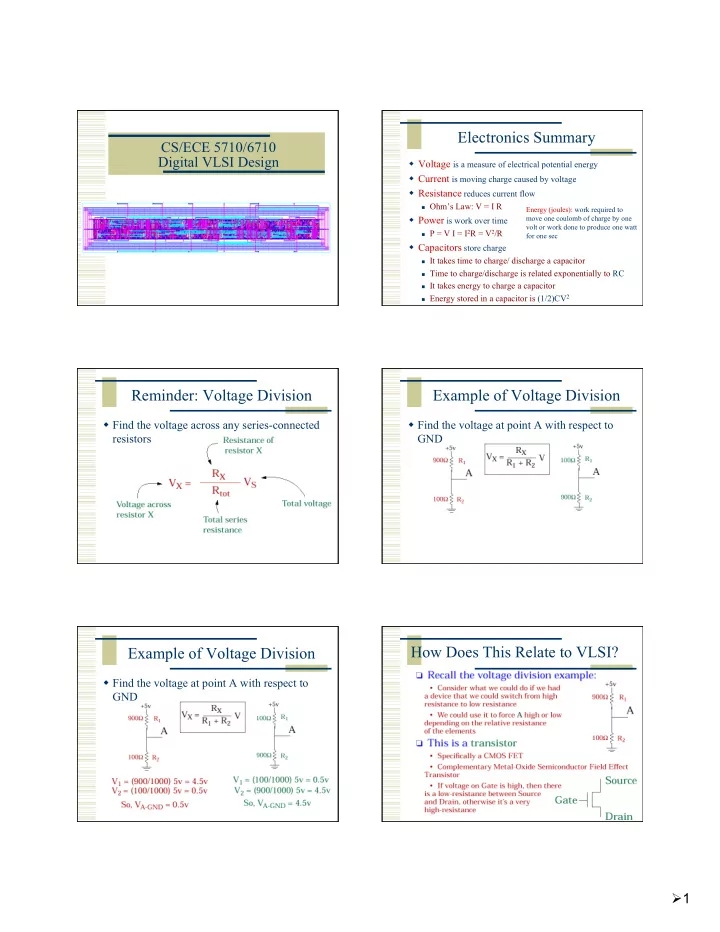
 Voltage is a measure of electrical potential energy  Current is moving charge caused by voltage  Resistance reduces current flow

 Ohm’s Law: V = I R

 Power is work over time

 P = V I = I2R = V2/R

 Capacitors store charge

 It takes time to charge/ discharge a capacitor  Time to charge/discharge is related exponentially to RC  It takes energy to charge a capacitor  Energy stored in a capacitor is (1/2)CV2

Energy (joules): work required to move one coulomb of charge by one volt or work done to produce one watt for one sec

Reminder: Voltage Division

 Find the voltage across any series-connected resistors

Example of Voltage Division

 Find the voltage at point A with respect to GND

Example of Voltage Division

 Find the voltage at point A with respect to GND

How Does This Relate to VLSI?

slide-2
SLIDE 2
  • 2

Model of a CMOS Transistor Two Types of CMOS Transistors CMOS Transistors

 Complementary Metal Oxide Semiconductor  Two types of transistors

 Built on silicon substrate  “majority carrier” devices  Field-effect transistors  An electric field attracts carriers to form a conducting

channel in the silicon…

 We’ll get much more of this later…  For now, just some basic abstractions

Silicon Lattice

 Transistors are built on a silicon substrate  Silicon is a Group IV material  Forms crystal lattice with bonds to four neighbors

Figures from Reid Harrison

“Semi” conductor?

 Thermal energy (atomic-scale vibrations) can shake an electron loose

 Leaves a “hole” behind Figures from Reid Harrison

“Semi” conductor?

 Room temperature: 1.5x10¹⁰ free electrons per cubic

centimeter

 But, 5x10²² silicon atoms / cc  So, one out of every 3 trillion atoms has a missing e Figures from Reid Harrison

slide-3
SLIDE 3
  • 3

Dopants

 Group V: extra electron (n-type)

 Phosphorous, Arsenic,

 Group III: missing electron, (p-type)

 Usually Boron Figures from Reid Harrison

Dopants

 Note that each type of doped silicon is electrostatically neutral in the large

 Consists of mobile electrons and holes  And fixed charges (dopant atoms) Figures from Reid Harrison

p-n Junctions

 A junction between p-type and n-type semiconductor forms a diode.

 Current flows only in one direction

p-n Junctions

 Two mechanisms for carrier (hole or electron)

motion

 Drift - requires an electric field  Diffusion – requires a concentration gradient Figures from Reid Harrison

p-n Junctions

 With no external voltage diffusion causes a

depletion region

 Causes an

electric field because of charge recombination

 Causes drift

current…

Figures from Reid Harrison

p-n Junctions

 Eventually reaches equilibrium where diffusion

current offsets drift current

Figures from Reid Harrison

slide-4
SLIDE 4
  • 4

p-n Junctions

 By applying an external voltage you can modulate

the width of the depletion region and cause diffusion

  • r drift to dominate…

Figures from Reid Harrison

+

  • i

electrons Vds +Vgs S G D

N-type Transistor nMOS Operation

 Body is commonly tied to ground (0 V)  When the gate is at a low voltage:

 P-type body is at low voltage  Source-body and drain-body diodes are OFF  No current flows, transistor is OFF

nMOS Operation Cont.

 When the gate is at a high voltage:

 Positive charge on gate of MOS capacitor  Negative charge attracted to body  Inverts a channel under gate to n-type  Now current can flow through n-type silicon

from source through channel to drain, transistor is ON

+

  • i

holes Vsd

  • Vgs

S G D

P-type Transistor pMOS Transistor

 Similar, but doping and voltages reversed

 Body tied to high voltage (VDD)  Gate low: transistor ON  Gate high: transistor OFF  Bubble indicates inverted behavior

slide-5
SLIDE 5
  • 5

A Cutaway View

 CMOS structure with both transistor types

Transistors as Switches

 For now, we’ll abstract away most analog details…

S G D S G D G=0 G=1 G=0 G=1 Good 0 Poor 0 Good 1 Poor 1 Good 1 Good 0 Good 1 Good 0 Not Perfect Switches!

“Switching Circuit”

 For example, a switch can control when a light comes on or off

No electricity can flow +5v 0v

“AND” Circuit

 Both switch X AND switch Y need to be closed for the light to light up

+5v 0v

X Y

“OR” Circuit

 The light comes on if either X OR Y are closed

+5v

X Y

0v

CMOS Inverter

slide-6
SLIDE 6
  • 6

CMOS Inverter

A Y 1

CMOS Inverter

A Y 1 ?

CMOS Inverter

A Y 1

CMOS Inverter

A Y 1 1

Timing Issues in CMOS Power Consumption

slide-7
SLIDE 7
  • 7

CMOS NAND Gate CMOS NAND Gate

A B Y 1 1 1 1

CMOS NAND Gate

A B Y 1 1 1 1 1

CMOS NAND Gate

A B Y 1 1 1 1 1 1

CMOS NAND Gate

A B Y 1 1 1 1 1 1 1

CMOS NAND Gate

A B Y 1 1 1 1 1 1 1

slide-8
SLIDE 8
  • 8

CMOS NOR Gate 3-input NAND Gate

 Y pulls low if ALL inputs are 1  Y pulls high if ANY input is 0

3-input NAND Gate

 Y pulls low if ALL inputs are 1  Y pulls high if ANY input is 0

N-type and P-type Uses

 Because of the imperfect nature of the the transistor switches

 ALWAYS use N-type to pull low  ALWAYS use P-type to pull high  If you need to pull both ways, use them both

S In Out S S=0, In = Out S=1, In = Out

Switch to Chalkboard

 Complex Gate  Tri-State  Latch  D-register  XOR