Electromagnetic Spectrum CMPSCI 370HH: Introduction to Computer - - PowerPoint PPT Presentation

electromagnetic spectrum
SMART_READER_LITE
LIVE PREVIEW

Electromagnetic Spectrum CMPSCI 370HH: Introduction to Computer - - PowerPoint PPT Presentation

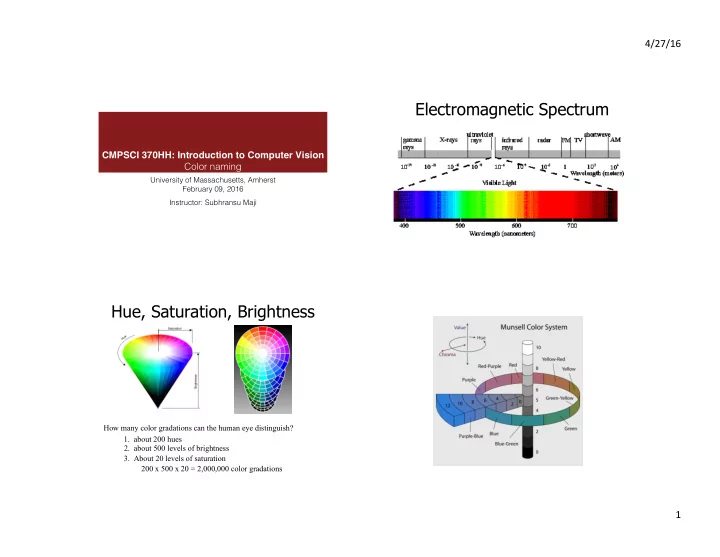
4/27/16 Electromagnetic Spectrum CMPSCI 370HH: Introduction to Computer Vision Color naming University of Massachusetts, Amherst February 09, 2016 Instructor: Subhransu Maji Hue, Saturation, Brightness How many color gradations


slide-1
SLIDE 1

4/27/16 1

CMPSCI 370HH: Introduction to Computer Vision Color naming

University of Massachusetts, Amherst February 09, 2016 Instructor: Subhransu Maji

Electromagnetic Spectrum

How many color gradations can the human eye distinguish?

  • 1. about 200 hues
  • 2. about 500 levels of brightness
  • 3. About 20 levels of saturation

200 х 500 х 20 = 2,000,000 color gradations

Hue, Saturation, Brightness

slide-2
SLIDE 2

4/27/16 2

http://web.mit.edu/bcs/schillerlab/research.html

Retina

Light entering To brain via optic nerve Rod Cone Ganglion cell Bipolar cell Photoreceptor layer

Amacrine cell Horizontal cell

  • Trichromatic Theory

red-, green-, blue-sensitive cones

  • Opponent-process Theory

red-green, blue-yellow, black-white opponent pairs

Cones

  • Short (Blue)
  • Medium

(Green)

  • Long (Red)

Trichromatic – Cones

slide-3
SLIDE 3

4/27/16 3

Opponent-Process

Qs to ask about role of language on color perception

Two Positions

  • Universalists
  • perceptual categories are “hardwired” into the

visual system, and language categories reflect these discontinuities in perceptual color space

  • Relativists
  • perceptual categories are constructed through

language

Berlin & Kay (1969)

  • Is color naming across languages largely a matter
  • f arbitrary linguistic convention?
  • If YES: support relativist position
  • If NO: support universalist position
slide-4
SLIDE 4

4/27/16 4 Dogs Shmogs

Can languages pick out any category?

Dividing the spectrum

BLELLOW?

Name that color. Languages

slide-5
SLIDE 5

4/27/16 5

Eleven possible basic color terms

  • White, black, red, green, yellow, blue, brown, purple, pink,
  • range, gray.
  • All languages contain term for white and black.
  • Has 3 terms, contains a term for red.
  • Has 4 terms, contains green or yellow.
  • Has 5 terms, contains both green and yellow.
  • Has 6 terms, contains blue.
  • Has 7 terms, contains brown.
  • Has 8 or more terms, chosen from {purple, pink, orange, gray}

Color hierarchy

  • White, black
  • Red
  • Green, yellow
  • Blue
  • Brown
  • Purple, pink, orange, gray
  • Even assuming these 11 basic color terms, there should be 2048 possible

sets—but only 22 (1%) are attested.

Color terms

  • BW

Jalé (New Guinea) ‘brilliant’ vs. ‘dull’

  • BWR

Tiv (Nigeria), Australian aboriginals in Seven Rivers District, Queensland.

  • BWRG

Ibibo (Nigeria), Hanunóo (Philippines)

  • BWRY

Ibo (Nigeria), Fitzroy River people (Queensland)

  • BWRYG Tzeltal (Mexico), Daza (eastern Nigeria)
  • BWRYGU

Plains Tamil (South India), Nupe (Nigeria), Mandarin?

  • BWRYGUO Nez Perce (Washington), Malayalam (southern India)

Color terms

  • Interesting questions abound, including why this order,

why these eleven—and there are potential reasons for it that can be drawn from the perception of color spaces which we will not attempt here.

  • The point is: This is a fact about Language: If you have

a basic color term for blue, you also have basic color terms for black, white, red, green, and yellow.