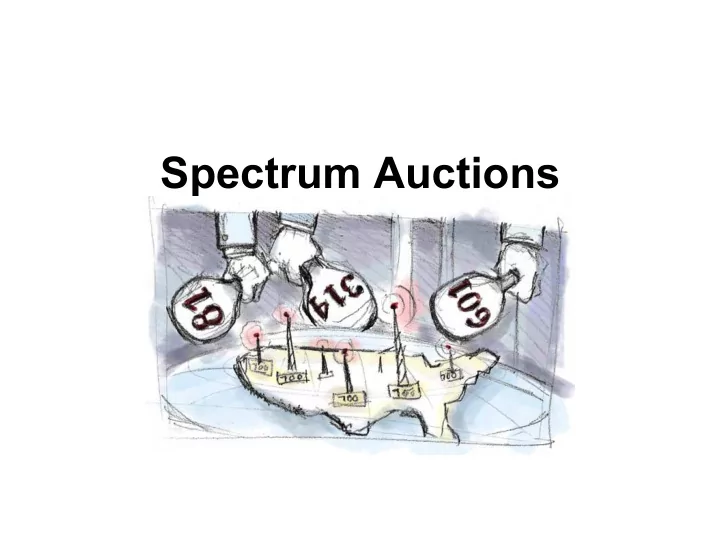
Spectrum Auctions What is a Spectrum Auction? Definition: A formal - - PowerPoint PPT Presentation

spectrum auctions what is a spectrum auction
SMART_READER_LITE
LIVE PREVIEW

Spectrum Auctions What is a Spectrum Auction? Definition: A formal - - PowerPoint PPT Presentation

Spectrum Auctions What is a Spectrum Auction? Definition: A formal auction run by the Federal Communications Commission (FCC) for licenses of the electromagnetic spectrum that are open to any eligible company or individual that has submitted


slide-1
SLIDE 1

Spectrum Auctions

slide-2
SLIDE 2

What is a Spectrum Auction?

  • Definition: A formal auction run by the Federal Communications

Commission (FCC) for licenses of the electromagnetic spectrum that are

  • pen to any eligible company or individual that has submitted and been

approved by the Commission.

  • Spectrum Auctions are conducted over the Internet. Bidders can access

the auction from anywhere with an internet connection (even the comfort

  • f their own homes!)
  • A Spectrum Auction could run for a single day to several days depending
  • n the number of bidders, number of licenses, and the auction design.

They are run from Monday through Friday under a standard eastern time zone.

slide-3
SLIDE 3
slide-4
SLIDE 4

Two types of Auction Design

  • 1. Simultaneous Multiple-Round Auctions: Multiple rounds are announced with their

duration given before the round is released. Each bidder cannot see the other bid until the round is over and all bids are made public. This increases the likelihood that the bidder who values it the most receives the license. The rounds will be given simultaneously until all bidding activity ceases.

  • 2. Package Bidding: Bidders are eligible to bid on multiple licenses at the same time

giving bidders a chance to acquire multiple strategically important licenses. Package Bidding also reduces the chances of a bidder only acquiring part of a desired set. Package bidding procedures are also designed to allow the auction to proceed at an appropriate pace, to encourage straightforward bidding, and to permit bidders to employ flexible backup strategies.

slide-5
SLIDE 5

Auction Process: Pre-Auction

  • FCC posts public notice up to 6 months

before auction is held

  • 75 days before the auction: seminar is held,

software demonstrated, and Q&A occurs

  • DEADLINES! Deadline to apply, deadline to

pay...

  • Mock Auction, 2 days before the real event
slide-6
SLIDE 6

Auction Process: During the Auction

  • Bidders must

actively bid

  • Bid portion of

maximum eligibility,

  • r risk losing

eligibility

  • Or use a waiver

(Not actually representative of real-life auction proceedings)

slide-7
SLIDE 7

Auction Process: Post-Auction

  • Results of each

round made publicly available 15 minutes after closing

  • Winners announced

at end of auction

  • Companies get 10

business days to provide down payment

slide-8
SLIDE 8

History

  • Before 1993 - Spectrum licenses were sold lotto-style to

qualified bidders

  • This process could take years and resulted in little government

revenue

  • 1993 - Congress passed the Omnibus Budget

Reconciliation Act

  • Gave the FCC the authority to auction off spectrum licenses resulting

in higher government revenue

  • Ideally, shortens selling process to less than a year
  • 1994 - First ever spectrum auction conducted
slide-9
SLIDE 9

History

  • 1997 - Congress passed the Balanced Budget Act
  • Requires the FCC to conduct auctions when multiple applications for

the same spectrum license were received

  • Before the 2008 auction
  • Google lobbied the FCC to require open standards for the 700MHz

license holders

  • FCC complied, requiring license holders to open their networks to all

devices and applications

  • 87 auctions conducted to this day
  • Another auction coming next year
slide-10
SLIDE 10

History

  • 2008 - the 700 MHz Spectrum Auction
  • Previously used for analog TV broadcasting
  • Verizon won valuable “C” block

§

Low frequency = better coverage + extra bandwidth

slide-11
SLIDE 11

History

Verizon AT&T

slide-12
SLIDE 12

History

  • 2008 - 700 MHz Auction
  • Advanced number of objectives

§

Revenue

§

Open access

§

Opportunities for small business

  • Transformative effect
slide-13
SLIDE 13

Issues

  • Google's involvement in the US 2008

spectrum auction

  • Google supports network neutrality*
  • At the time, many network providers

(Verizon and AT&T) blocked external applications and devices on their networks*

  • Google bid on the 700MHz spectrum*

in attempts to make it open to the public

  • Google requested open policies to the

FCC in return for a minimum of $4.6 billion

slide-14
SLIDE 14

Issues

  • Google's involvement in the US 2008

spectrum auction (cont.)

  • FCC adopted Google’s policies:

§ Open applications § Open Devices

  • Verizon won the 700MHz auction, but

the policies were still put in place § As a result Verizon was required to allow any device or application to connect to it

  • Google was successful, and received

free access.

  • Verizon filed a lawsuit against FCC but

dropped the case later

slide-15
SLIDE 15

Issues

  • 2015 Spectrum Auction and what it can mean for TV broadcasters
  • TV stations will take bids to give up part of their spectrum so that wireless

carriers can meet demands for mobile broadband

  • How the auction will work:

§ Reverse auction: some TV stations will voluntarily relinquish some/all of their spectrum in exchange for payment § Repacking of the broadcast TV band: moving the broadcast signal to a new frequency to free up a portion of the UHF band for alternative uses § Forward auction: the bidding on the newly available spectrum

  • The FCC is creating rules for the conduction of voluntary incentive auctions of

the spectrum, including broadcast TV spectrum, as authorized by Congress in 2012

  • The National Association of Broadcasters (NAB), concerned that broadcasters

who do not volunteer/participate will be harmed by the process, filed a lawsuit

  • n August 18, 2014

VS.

slide-16
SLIDE 16

Issues

  • 2015 Spectrum Auction and what it can

mean for TV broadcasters (cont.)

  • NAB’s main concern: “TVStudy”

methodology § FCC: new TVStudy software

  • perates on modern computer

systems, faster, more accuracy in modeling and analysis, & easier to use/more versatile than existing software § NAB: FCC not providing adequate protection for broadcasters who decline to participate in the auction and remain on the air § “Under this new methodology, many broadcast licensees, including NAB’s members, will lose coverage area and population served during the auction’s repacking and reassignment process, or be forced to participate in the auction (and relinquish broadcast spectrum rights)” § Could delay the 2015 auction

slide-17
SLIDE 17

What’s happening now?

U.S. AWS-3 Spectrum Auction

  • AWS = Advanced Wireless Services
  • Originally reserved for government agencies (Defense Department)
  • Auction to be held on November 13
  • About 80 participants
  • Reserve price around $10 billion to $10.5 billion
  • No limitations on bidding activity
slide-18
SLIDE 18

What’s happening now?

  • Three bands of spectrum available for auction:
  • 1,695MHz to 1,710MHz band
  • 1,755MHz to 1,780MHz band
  • 2,155MHz to 2,180MHz band
  • These bands:
  • Have difficulty going through walls
  • Can carry a large amount of data and traffic
  • Can improve networks and speed
  • Attempt for global harmony
slide-19
SLIDE 19

Some Important Benefits

  • Other industries will benefit
  • Handle cellular support for devices like health monitoring

equipment, security cameras, and smart cars

  • 4K video (ultra high-definition video) will be more readily supported
  • Carriers will be able to run their networks on cheaper equipment

and devices

slide-20
SLIDE 20

When will these benefits show up?

  • May take two to three years
  • Reason:
  • Defense Department is currently using the spectrum
  • Will be moved to different bands of spectrum
slide-21
SLIDE 21

When’s the next auction?

  • Next auction (Incentive Auction) will be held next year
  • Type of spectrum up for sale
  • 600 MHz frequency
  • covers farther distances and supports more people with less

equipment

slide-22
SLIDE 22

Sources

Issues:

  • Google’s Involvement in the 2008 Spectrum Auction
  • http://www.cnet.com/news/spectrum-auction-google-wins-by-losing/
  • http://news.cnet.com/Google-lobbies-for-open-wireless-networks/2100-1039_3-6190863.html?tag=mncol;txt
  • http://en.wikipedia.org/wiki/United_States_2008_wireless_spectrum_auction#Lawsuits
  • NAB’s lawsuit for the 2015 Spectrum Auction
  • http://www.nab.org/advocacy/issue.asp?id=2025
  • http://www.pcmag.com/article2/0,2817,2463368,00.asp
  • http://online.wsj.com/articles/tv-broadcasters-sue-over-fcc-auction-of-airwaves-1408402394

What’s happening now:

  • http://www.cnet.com/news/the-us-government-is-auctioning-off-wireless-spectrum-why-you- should-care-

faq/

  • http://www.rcrwireless.com/20141002/carriers/verizon-wireless-att-t-mobile-us-dish-among-80- set-for-

aws-3-spectrum-auction-tag2

slide-23
SLIDE 23

Sources (continued)

Introduction to a Spectrum Auction:

  • FCC’s definition of an auction and what one entails
  • http://wireless.fcc.gov/auctions/default.htm?job=about_auctions&page=1

§ Pages 1-5

  • Picture on the first slide
  • http://www.popularmechanics.com/technology/gadgets/news/4246037